Practical Palmistry
 77
77

Practical Palmistry
Henry Frith’s "Practical Palmistry" offers a grounded perspective on chirosophy, distinguishing itself by emphasizing "actual experiences" over mere speculation. Frith’s methodical breakdown of hand features—from the subtle curves of the mounts to the clear declarations of the major lines—demonstrates a committed practitioner’s eye. His insistence on unbiassed study, as noted in the original blurb, is commendable, pushing the reader towards analytical engagement rather than passive acceptance. The chapter detailing the 'mounts,' for instance, provides specific correspondences that feel less like fanciful pronouncements and more like a developed symbolic language. A limitation, however, lies in the text’s somewhat dated prose, which, while authentic to its publication era, can occasionally obscure the directness of its instruction. Despite this, the work’s focus on practical application and observational rigor makes it a solid reference for anyone seeking to understand the traditional framework of palmistry. It serves as a valuable, if sometimes dense, manual for the serious student.
📝 Description
77
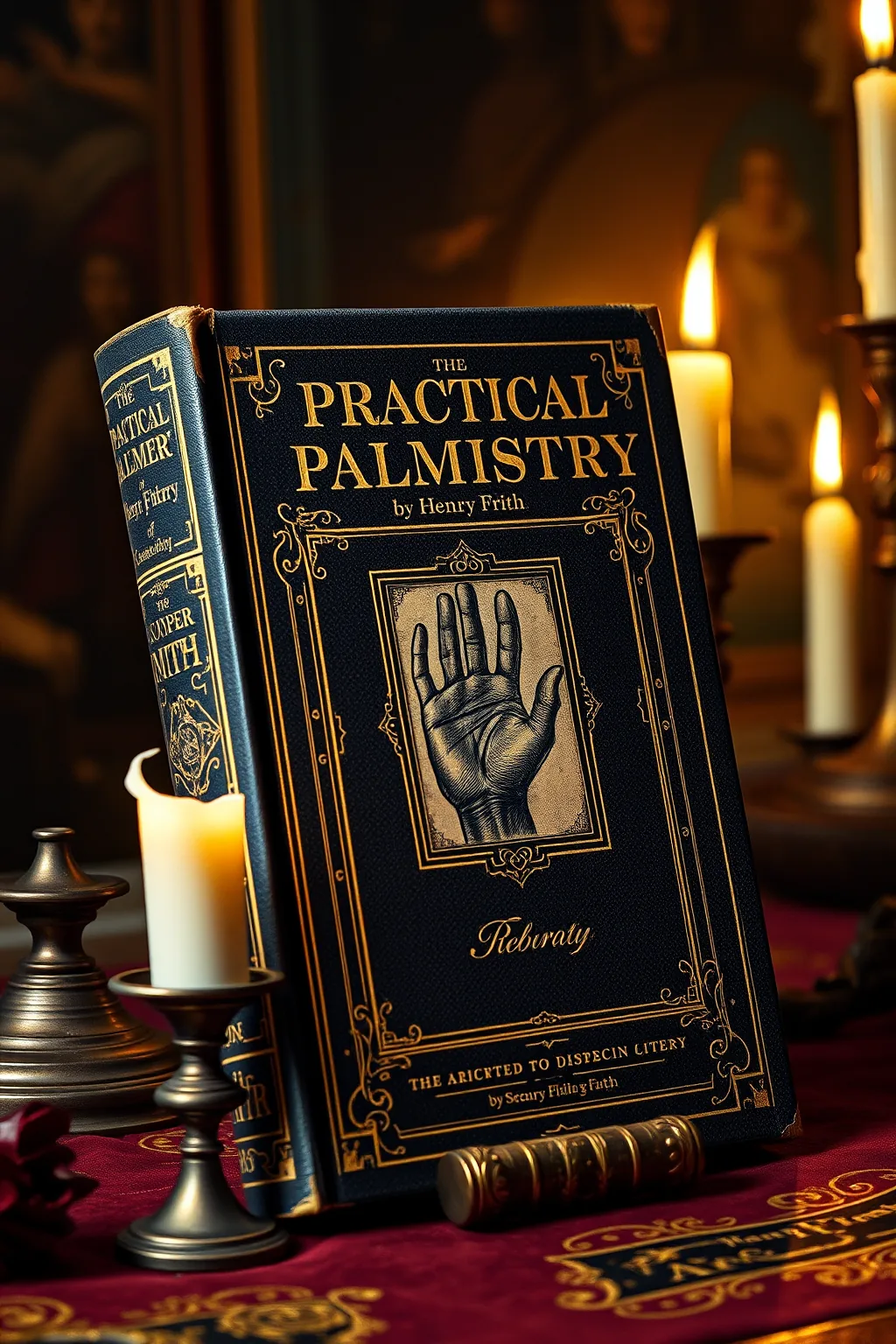
Henry Frith's Practical Palmistry, published in 1902, grounds chirosophy in personal observation.
Henry Frith's 1902 book, Practical Palmistry, examines chirosophy, the practice of reading palms. Frith builds his explanations on his own experience and observations, not just abstract theory. He presents a structured method for interpreting hand features, including lines, mounts, and overall shape, as indicators of personality, future events, and life paths. The book aims to make the principles of palmistry clear and understandable for students committed to its study.
This text is for serious practitioners of chirosophy and esoteric studies who are prepared for "unbiassed study" and practical application. It appeals to those who approach occult subjects with a discerning yet receptive mindset, wanting to grasp the specific interpretations and methods used in palmistry. Those interested in divination's history, comparative occult traditions, or the psychological elements of these practices will find relevant material. It is not suited for a casual glance but for diligent investigation.
Emerging from the late 19th and early 20th centuries, a period of renewed interest in disciplines like phrenology and astrology, Frith's work reflects a broader effort to organize and validate occult knowledge. This era saw a tension between rationalist thought and a fascination with the unseen. Frith's emphasis on empirical observation sought to align esoteric practices with a more scientific, though unconventional, approach, engaging with the intellectual currents of his time.
💡 Why Read This Book?
• Learn to interpret the major and minor lines of the palm, such as the Heart line and the Fate line, as presented in Frith's detailed system, offering a structured method beyond generic interpretations. • Understand the significance of the palm's mounts, like the Mount of Venus and the Mount of Jupiter, and how their development is linked to character traits as explored in Frith's observational framework. • Gain insight into the physical characteristics of the hand, including skin texture and nail shape, as indicators of temperament, a specific analytical layer detailed within the book’s practical approach.
⭐ Reader Reviews
Honest opinions from readers who have explored this book.
❓ Frequently Asked Questions
When was Henry Frith's Practical Palmistry first published?
Henry Frith's "Practical Palmistry" was first published in the late 19th or early 20th century, with a modern edition appearing in 2017, indicating enduring interest in its methods.
What is chirosophy according to Frith's book?
According to Frith, chirosophy is the art and science of reading palms, based on actual experience and observation of hand formations and lines to understand character and life events.
Does Practical Palmistry offer a scientific approach to palm reading?
Frith aims for a systematic and observational approach, encouraging "unbiassed study" and practice, which he presents as a more rigorous method than purely theoretical palmistry.
What are the main components of the hand discussed in Practical Palmistry?
The book systematically discusses major lines (Life, Head, Heart, Fate), mounts (Venus, Jupiter, Saturn, etc.), hand shapes, finger characteristics, and various markings on the palm.
Is Henry Frith's book suitable for beginners in palmistry?
Yes, the book is designed for serious students and offers a detailed, practical guide, but it requires diligent study and practice rather than providing superficial 'how-to' advice.
Where can I find more information on Frith's palmistry methods?
You can explore "Practical Palmistry" by Henry Frith, focusing on its detailed sections on line interpretation and mount analysis for a comprehensive understanding of his approach.
🔮 Key Themes & Symbolism
Systematic Line Interpretation
Frith meticulously dissects the significance of each major palm line: the Life Line, Head Line, Heart Line, and Fate Line. He goes beyond simple definitions, detailing how the length, depth, clarity, and breaks in these lines offer nuanced insights into a person's vitality, intellect, emotional nature, and life path. The work emphasizes observing the subtle variations and interplays between lines, suggesting that a holistic view is crucial for accurate interpretation, moving beyond rote memorization to a more analytical understanding of chirosophic symbolism.
The Language of the Mounts
A central theme is the detailed exploration of the palm's mounts—the fleshy pads beneath the fingers and at the base of the palm. Frith assigns specific characteristics and influences to each mount, such as the Mount of Venus (love, passion), Mount of Jupiter (ambition, leadership), and Mount of Saturn (seriousness, wisdom). The development and prominence of these mounts are presented as indicators of an individual's innate qualities and potential, forming a crucial layer of analysis alongside the lines.
Observation and Experience
Frith repeatedly stresses that his teachings are grounded in "actual experiences" and "unbiassed study." This theme underscores a commitment to empirical observation within the esoteric field of palmistry. He encourages readers to verify interpretations through practice and comparison, positioning the book not as absolute doctrine but as a framework for diligent personal investigation into the art of chirosophy.
Holistic Hand Analysis
Beyond lines and mounts, Frith integrates the analysis of hand shape, finger proportions, nail characteristics, and skin texture. This holistic approach suggests that the entire hand, in its physical manifestation, provides a complete map of the individual. By considering these diverse elements in conjunction, the reader is guided towards a more comprehensive and accurate understanding of a person's character, tendencies, and life circumstances.
💬 Memorable Quotes
Direct passages from the work, attributed to the author.
“If they, after study - unbiassed study - and some practice in Palmistry, discovered that there was nothing in it, then, by all means, let them say how far their conclusions have reached and by what means.”
— This statement from the original blurb highlights Frith's call for rigorous, objective examination of palmistry. It emphasizes intellectual honesty and encourages skepticism tempered by practical experience, rather than blind faith in esoteric practices.
“A Treatise on Chirosophy Based Upon Actual Experiences”
— This subtitle is a key tenet of Frith's approach, signaling that the book prioritizes practical observation and empirical evidence over purely theoretical or speculative pronouncements in the field of palm reading.
“The interpretation of the lines, mounts, and general formation of the hand.”
— This phrase expresses the core subject matter of the book, indicating a systematic breakdown of palmistry's fundamental elements for analytical purposes.
“The significance of each line, mount, and marking.”
— This phrase points to the detailed, component-by-component analysis offered in the book, promising a thorough exploration of the symbolic language of the hand.
💡 Key Ideas
Editorial paraphrase of the work's core concepts — not direct quotes.
This announcement made by one responsible physician or physiologist would have weight - more weight than the statement of a writer who is in some sense an interested party.
This quote reflects a desire for external validation and a scientific-like credibility for palmistry. Frith seems to acknowledge the need for objective, detached analysis to lend authority to the practice.
🌙 Esoteric Significance
Tradition
Frith's work aligns with the Western Esoteric tradition, specifically within the lineage of practical divination and chirosophy that gained prominence in the late 19th century. While not strictly Hermetic or Kabbalistic, it draws upon a long history of hand interpretation that predates modern occultism. His approach emphasizes systematization and empirical observation, a characteristic often found in esoteric manuals seeking to codify complex symbolic systems for practical application, distinguishing it from purely mystical or philosophical explorations.
Symbolism
Key symbols in Frith's work include the major palm lines (Life, Head, Heart, Fate) which represent core aspects of existence, vitality, intellect, emotion, and destiny. The mounts, such as Venus (representing love and vitality) and Jupiter (representing ambition and leadership), act as symbolic indicators of personality traits and potentials. The interplay and development of these lines and mounts form a symbolic language through which character and life events are read.
Modern Relevance
Contemporary practitioners of Western Esotericism, particularly those focused on divination and psychological astrology, often reference older texts like Frith's for foundational understanding. His systematic approach to hand analysis continues to inform modern chirosophers and those interested in the psychological interpretation of symbols, bridging the gap between historical esoteric practices and modern self-exploration techniques.
👥 Who Should Read This Book
• Aspiring palmists seeking a structured, observational framework for learning chirosophy, moving beyond superficial interpretations. • Students of esoteric history interested in the development of divination practices during the late 19th and early 20th centuries. • Individuals exploring comparative occultism who wish to understand the specific methodologies and terminologies of traditional palmistry.
📜 Historical Context
Henry Frith's "Practical Palmistry" emerged during a period of intense fascination with esoteric and occult sciences in the Western world, particularly the late 19th and early 20th centuries. This era witnessed a surge in interest in spiritualism, theosophy, and various forms of divination, often driven by a desire to find meaning beyond the perceived materialism of the age. Frith's work positioned itself within this milieu, aiming to provide a structured, observational method for palmistry, distinguishing it from more purely fortune-telling or mystical approaches. Contemporaries like William Franklin were also active in the field, publishing their own treatises on chirosophy. Frith's emphasis on "actual experiences" and "unbiassed study" can be seen as an attempt to lend a degree of empirical credibility to a practice often relegated to superstition, aligning with a broader intellectual current that sought to systematize and legitimize occult knowledge, even if it existed outside mainstream academic acceptance.
📔 Journal Prompts
The significance of the Mount of Venus and its development.
Frith's approach to "unbiassed study" in palmistry.
Analysis of the Head Line's various formations.
Interpreting minor markings on the palm.
The relationship between hand shape and character traits.
🗂️ Glossary
Chirosophy
The art and science of palmistry, focusing on the interpretation of the lines, mounts, and other features of the hand to understand character and predict future events.
Mounts
The fleshy, raised areas on the palm located beneath the fingers and at the base of the palm, each believed to correspond to specific planetary influences and human characteristics.
Life Line
The semi-circular line originating near the thumb and curving around the Mount of Venus, typically interpreted as relating to vitality, physical health, and major life events.
Head Line
The line extending horizontally across the palm, generally read for indications of intellectual capacity, mental processes, and communication style.
Heart Line
The line running horizontally across the upper palm, beneath the fingers, which is traditionally interpreted as representing emotional nature, romantic life, and heart health.
Fate Line
A vertical line, often found in the center of the palm, interpreted as relating to career, life path, destiny, and external influences.
Markings
Specific signs or symbols (e.g., crosses, stars, islands, squares) that appear on the lines or mounts of the palm, believed to modify or indicate specific circumstances related to the feature they appear on.


















![Collected Short Stories [51 stories]](/img/thumb/collected-short-stories-51-stories-roald-dahl-593005.webp)
