Philosopher's Stone
 79
79

Philosopher's Stone
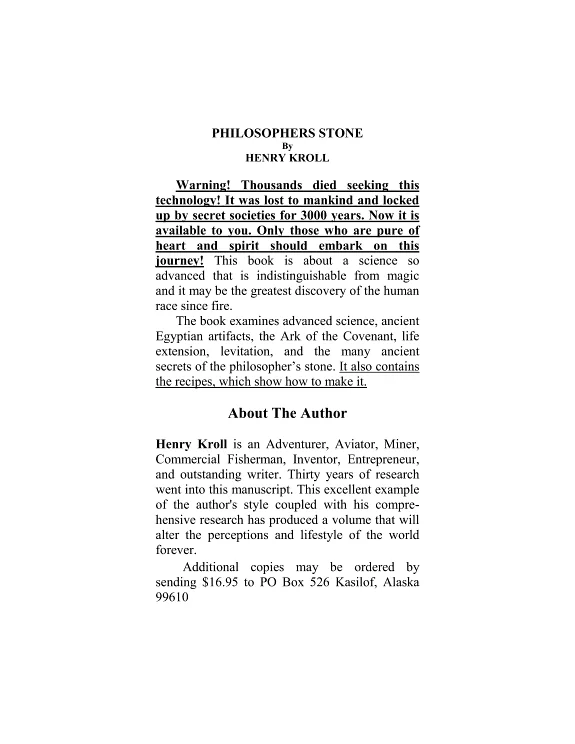
Henry Kroll's "Philosopher's Stone" offers a meticulous dissection of alchemical literature, moving beyond simplistic interpretations of gold-making. Kroll’s strength lies in his detailed engagement with primary texts, often illuminating obscure passages that reveal the philosophical depth of the Great Work. For instance, his analysis of the symbolic relationship between the Sun and the Moon in alchemical diagrams provides a tangible example of the work's interpretive rigor. However, the book occasionally suffers from an almost overwhelming density of theoretical material, which can make it challenging for readers without a pre-existing academic background in esotericism. The narrative sometimes gets bogged down in intricate philosophical debates, potentially obscuring the practical or psychological dimensions for some. Despite this, the work provides an invaluable resource for understanding the intellectual architecture of historical alchemy. Kroll’s "Philosopher's Stone" is a vital, albeit demanding, contribution to esoteric scholarship.
📝 Description
79
Henry Kroll's 2004 book analyzes the alchemical Great Work as spiritual evolution.
Published in 2004, Henry Kroll's "Philosopher's Stone" examines the theory and practice of alchemy, focusing on the historical and philosophical roots of the Great Work. The book moves beyond the material transformation of metals into gold, presenting it as a metaphor for spiritual and psychological development. Kroll dissects the symbolic language and conceptual frameworks that have shaped alchemical traditions for centuries. The work is intended for serious students of Western esotericism, particularly those interested in alchemy and Hermeticism. Readers should have a background in philosophical concepts and be ready for dense theoretical material, as this is not an introductory text but an academic study of the alchemical worldview.
Kroll situates alchemical traditions within larger historical and philosophical movements, referencing figures and ideas from antiquity through the Renaissance. The book contrasts alchemy with competing intellectual currents like early scientific rationalism, tracing its enduring presence in Western thought. This contextualization is particularly relevant given the renewed academic and popular interest in occult studies around the book's publication date. The analysis centers on concepts like the *prima materia*, the symbolic chaos or unmanifest potential of the Great Work, and the alchemical process stages—Nigredo, Albedo, and Rubedo—interpreted as spiritual purification. The Philosopher's Stone itself is shown as a symbol of perfected being and gnosis.
This book belongs to the tradition of Western esotericism, specifically within the study of alchemy and Hermeticism. It engages with the historical development of these practices and their philosophical underpinnings, tracing their influence from ancient times through later intellectual periods. Kroll's work connects the alchemical pursuit of the Great Work to broader themes of spiritual evolution and psychological development, positioning it within a lineage of thought that seeks transformative knowledge.
💡 Why Read This Book?
• Gain a nuanced understanding of alchemical stages like Nigredo and Albedo, as presented in Kroll's detailed analysis, to grasp the symbolic progression of spiritual transformation beyond mere material transmutation. • Explore the concept of the *prima materia* and its representation as unmanifest potential, offering a unique perspective on creation myths and the nature of existence as discussed in the book. • Understand the symbolic interplay between celestial bodies, such as the Sun and Moon, within alchemical diagrams, providing concrete visual metaphors for the integration of opposites central to the Great Work.
⭐ Reader Reviews
Honest opinions from readers who have explored this book.
❓ Frequently Asked Questions
What is the primary focus of Henry Kroll's "Philosopher's Stone"?
The book primarily focuses on the philosophical and symbolic aspects of alchemy, interpreting the Great Work not just as material transmutation but as a metaphor for spiritual and psychological development.
When was "Philosopher's Stone" first published?
Henry Kroll's "Philosopher's Stone" was first published in October 2004, placing it within a period of renewed academic interest in esoteric subjects.
Is "Philosopher's Stone" suitable for beginners in alchemy?
While informative, the book is quite dense and theoretical. It is best suited for readers with some prior knowledge of Western esotericism or philosophy, rather than complete beginners.
What historical periods or movements does the book reference?
The work references various historical periods and intellectual currents, including ancient Hermeticism, Renaissance alchemy, and philosophical debates contemporary to the early scientific revolution.
Does the book explain the practical methods of alchemy?
The book's emphasis is on the theory, philosophy, and symbolism of alchemy. While it discusses the stages of the Great Work, it is not a practical manual for laboratory procedures.
What is the 'Great Work' as described by Kroll?
The 'Great Work' in Kroll's context refers to the alchemical process, understood metaphorically as a journey of spiritual purification, self-knowledge, and the attainment of perfected being.
🔮 Key Themes & Symbolism
The Great Work as Spiritual Metaphor
Kroll interprets the alchemical "Great Work" not merely as the creation of gold but as a profound spiritual and psychological process. The transformation of base metals mirrors the purification and elevation of the human soul. This concept draws directly from Hermetic traditions that view material processes as symbolic reflections of inner states. The book meticulously unpacks how alchemists viewed the stages of their work, such as Nigredo (blackening) and Albedo (whitening), as essential steps in overcoming corruption and achieving spiritual perfection.
Prima Materia and Unmanifest Potential
Central to the alchemical pursuit is the concept of the *prima materia*, the primordial substance from which all things are formed. Kroll explores this not just as a physical substrate but as a representation of pure, undifferentiated potential—the raw material of both the cosmos and the individual consciousness. This theme connects to Gnostic ideas of a pre-creation state and Kabbalistic concepts of the initial divine emanations, highlighting the alchemical quest for the source of all being.
Symbolic Language of Alchemy
The book extensively decodes the rich symbolic language employed by alchemists. Kroll examines recurring motifs like the Ouroboros, the hermaphrodite (Rebis), and the interplay of solar and lunar principles. These symbols, far from being mere decorative elements, are presented as essential keys to understanding the complex philosophical and spiritual doctrines. The interpretation of these symbols is crucial for grasping the alchemical worldview, which sought hidden correspondences between the macrocosm and the microcosm.
Alchemy and Western Esotericism
Kroll situates alchemy within the broader range of Western esoteric traditions. He demonstrates how alchemical thought has interacted with Hermeticism, Neoplatonism, Kabbalah, and even early Christian mysticism. The book highlights alchemy's enduring influence on subsequent esoteric movements and its unique position as a discipline that sought to synthesize material experimentation with profound spiritual insight, particularly during the Renaissance.
💬 Memorable Quotes
Direct passages from the work, attributed to the author.
“Gold is not merely a metal, but the symbol of perfected being and ultimate consciousness.”
— This interpretation emphasizes the spiritual goal of alchemy. The alchemists' pursuit of gold was primarily a metaphor for achieving spiritual enlightenment, inner perfection, and a state of elevated consciousness, rather than simply material wealth.
“The *prima materia* represents the unformed potential present at the dawn of creation.”
— This statement underscores the foundational role of the *prima materia*. It's presented as the chaotic, undifferentiated substance from which all manifest reality arises, a concept echoing creation myths and the quest for the ultimate source.
“The laboratory of the alchemist is also the inner space of the soul.”
— This interpretation suggests the dual nature of alchemical practice. The external, physical experiments in the laboratory are seen as externalizations or reflections of an internal, spiritual transformation occurring within the practitioner's psyche.
💡 Key Ideas
Editorial paraphrase of the work's core concepts — not direct quotes.
The alchemical process begins with the dissolution of the existing form, a necessary step before re-creation.
This paraphrased concept highlights the alchemical principle of *solve et coagula* (dissolve and coagulate). It signifies that in the Great Work, breaking down existing structures—whether material, mental, or spiritual—is a prerequisite for achieving a higher, perfected state.
Understanding the interplay of Sol and Luna is key to balancing the opposing forces within the Work.
This paraphrased concept points to the crucial alchemical symbolism of the Sun (Sol) and Moon (Luna). Their union represents the integration of masculine and feminine, active and passive, conscious and unconscious principles necessary for achieving wholeness.
🌙 Esoteric Significance
Tradition
This work is firmly rooted in the Western Hermetic tradition, drawing heavily on alchemical literature that spans from ancient Egypt and Greece through the medieval and Renaissance periods. It aligns with the Hermetic principle of "As Above, So Below," interpreting the transformation of matter as a reflection of cosmic and spiritual processes. Kroll's approach emphasizes the philosophical and mystical aspects, positioning alchemy as a path to gnosis and spiritual perfection, a core tenet within Hermeticism and related esoteric schools.
Symbolism
Key symbols explored include the *prima materia*, representing the unformed potential or chaos from which creation emerges, and the Philosopher's Stone itself, symbolizing perfected being and spiritual enlightenment. The text also explores the significance of colors in the alchemical process (Nigredo, Albedo, Citrinitas, Rubedo) as stages of purification and transformation. The union of opposites, often symbolized by the Rebis (hermaphrodite) or the integration of Solar and Lunar principles, is another central motif, representing the achievement of wholeness and balance.
Modern Relevance
Kroll's rigorous analysis of alchemical symbolism and philosophy finds resonance in contemporary depth psychology, particularly Jungian analysis, which interprets alchemical processes as metaphors for individuation and psychological integration. Modern practitioners of Hermeticism and ceremonial magic also draw upon these texts to understand the symbolic underpinnings of their practices. The book's emphasis on the transformative potential inherent in symbolic work remains relevant for those seeking spiritual growth and self-understanding in a secularized world.
👥 Who Should Read This Book
• Students of Western Esotericism seeking a deep dive into the philosophical and symbolic dimensions of alchemy, moving beyond purely historical or chemical interpretations. • Practitioners of Hermeticism or comparative mysticism interested in understanding the core concepts and historical context of the Great Work as a spiritual path. • Scholars of religion, philosophy, and the history of science looking for a detailed analysis of how alchemical thought intersected with other intellectual currents from antiquity through the Renaissance.
📜 Historical Context
Published in 2004, Henry Kroll's "Philosopher's Stone" emerged during a period of significant academic and popular resurgence in esoteric studies. The book engages with a tradition stretching back to antiquity, particularly the Hermetic texts attributed to Hermes Trismegistus, and flourishing during the Renaissance. Kroll's work situates alchemy within this lineage, contrasting its symbolic, spiritual aims with the increasingly mechanistic worldview developing through figures like Isaac Newton, who himself engaged with alchemical theories. The book implicitly responds to scholarship that often reduced alchemy to proto-chemistry, instead reasserting its philosophical and mystical dimensions. While Kroll does not engage directly with a specific contemporary scholar in this excerpt, his rigorous textual analysis implicitly dialogues with established interpretations of alchemical history, aiming to provide a more integrated understanding of the practice and its practitioners. The early 2000s saw numerous publications exploring occult philosophy, making Kroll's contribution part of a broader intellectual current.
📔 Journal Prompts
The *prima materia* as unmanifest potential: How does this concept relate to your own creative or spiritual beginnings?
Reflect on the symbolic meaning of the Nigredo stage in relation to personal challenges or transformations.
Analyze the integration of Sol and Luna symbolism: Where do opposing forces manifest in your life, and how might they be balanced?
Consider the alchemist's laboratory as an inner space: What "work" needs to be done within your own consciousness?
The Philosopher's Stone as perfected being: What does spiritual perfection signify in your personal understanding?
🗂️ Glossary
Great Work
The central process in alchemy, often referred to as the Major work. It encompasses the entire series of operations aimed at producing the Philosopher's Stone, understood both materially and spiritually.
Prima Materia
The fundamental, primordial substance from which all other substances are derived. In esoteric alchemy, it represents the unformed potential or chaotic essence that must be worked upon.
Philosopher's Stone
The legendary alchemical substance said to be capable of transmuting base metals into gold and silver, and often believed to possess the elixir of life. Esoterically, it symbolizes perfected consciousness or spiritual enlightenment.
Nigredo
The first stage of the alchemical process, often symbolized by blackness or putrefaction. It represents dissolution, breakdown, and the confrontation with the shadow self or the *prima materia*.
Albedo
The second stage, or "whitening," following Nigredo. It symbolizes purification, illumination, and the washing away of impurities, leading to a state of clarity.
Solve et Coagula
Latin for "dissolve and coagulate." This fundamental alchemical principle describes the process of breaking down matter (solve) and then reforming it into a higher state (coagula).
Rebis
An alchemical symbol representing the union of opposites, often depicted as a hermaphrodite. It signifies the integration of masculine and feminine principles, the conscious and unconscious, leading to wholeness.
This book appears in 2 collections
🔮 Readers Also Liked
Browse all →









From the “Elixir of Life” Collection
View all →







More Free Occult Philosophy Books
View all →