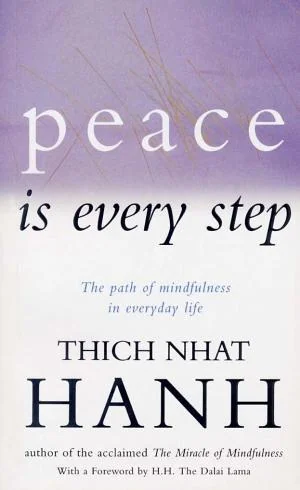
Peace is Every Step
 80
80

Peace is Every Step
Thich Nhat Hanh’s Peace is Every Step doesn't just offer advice; it demonstrates a way of being. The book's strength lies in its gentle, insistent redirection of attention to the present. He masterfully uses simple anecdotes, like the story of his own mindful breathing during moments of crisis, to illustrate complex ideas. A notable passage describes finding peace even while sitting in a noisy cafe, transforming a potentially disruptive environment into a space for mindful observation. However, for readers accustomed to more structured, problem-solution self-help formats, the book's organic flow might initially feel unanchored. Its power is in its subtlety, requiring a willingness to internalize rather than merely analyze. Ultimately, Peace is Every Step serves as a profound manual for cultivating equanimity through everyday actions.
📝 Description
80
First published in 1995, Thich Nhat Hanh's Peace is Every Step grounds spiritual inquiry in daily life.
This book presents mindfulness not as an abstract concept, but as a practical way to find calm in everyday actions. Thich Nhat Hanh illustrates how simple activities, from breathing to drinking tea, can become moments of deep awareness. He offers gentle guidance, using personal stories and meditations to show readers how to cultivate presence, even amidst life's difficulties.
The work is for anyone seeking accessible methods for managing stress and finding peace. It reaches those who might find traditional meditation challenging to fit into busy schedules. Readers interested in Buddhist ideas but wanting a straightforward introduction will also find it valuable. The book provides tools for personal resilience, useful for activists and community leaders.
Emerging in the mid-1990s, Peace is Every Step draws directly from Thich Nhat Hanh's Zen Buddhist practice and his experiences with the anti-Vietnam War movement. Unlike more secular or therapeutic approaches to mindfulness gaining popularity at the time, his work emphasizes embodied awareness and a non-dualistic understanding of peace. The core idea is that peace is not an external achievement but an internal state cultivated moment by moment through direct experience.
💡 Why Read This Book?
• Learn the practice of "stopping" to interrupt cycles of anxious thought, as described in the context of his experiences as a peace activist. • Cultivate "mindful living" by transforming mundane activities like washing dishes into opportunities for deep presence, a core teaching from the book's initial chapters. • Understand the concept of "interbeing," the interconnectedness of all things, which Thich Nhat Hanh explains through personal stories to foster compassion and reduce internal conflict.
⭐ Reader Reviews
Honest opinions from readers who have explored this book.
❓ Frequently Asked Questions
What is the core philosophy behind Thich Nhat Hanh's "Peace is Every Step"?
The core philosophy is that peace is an internal state achievable in the present moment, not a future goal. It emphasizes "mindful living," integrating awareness into everyday activities like breathing and walking, as detailed throughout the book's meditations.
How does "Peace is Every Step" differ from other mindfulness books?
It distinguishes itself by grounding mindfulness in concrete, simple actions and personal narratives from Thich Nhat Hanh's life as a peace activist and teacher, making it highly accessible and relatable compared to more academic or therapeutic texts.
Can "Peace is Every Step" help with anxiety or stress?
Yes, the book provides practical techniques such as "stopping" distressing thoughts and cultivating "presence" during daily routines. These methods are designed to reduce mental turmoil and foster a sense of calm, directly addressing common sources of anxiety.
What does Thich Nhat Hanh mean by "interbeing"?
Interbeing, a key concept, refers to the understanding that all phenomena are interconnected and interdependent. Thich Nhat Hanh uses this to illustrate how our actions affect others and the world, promoting compassion and a sense of unity.
Is "Peace is Every Step" suitable for beginners in meditation?
Absolutely. The book breaks down mindfulness into simple, actionable steps like conscious breathing and mindful walking. It's designed for those new to these practices, offering guidance that can be immediately applied to daily life.
What is the significance of the title "Peace is Every Step"?
The title encapsulates the book's central message: that peace is not a destination but a continuous practice found in every action and moment. It highlights the potential for cultivating inner peace through mindful engagement with life's simplest movements, like walking.
🔮 Key Themes & Symbolism
Mindfulness in Mundane Acts
The book posits that profound spiritual realization is accessible not through grand gestures but through attentive engagement with ordinary tasks. Thich Nhat Hanh illustrates this by detailing how actions like drinking tea, washing dishes, or even driving can become profound moments of "mindful living." This approach democratizes spiritual practice, suggesting that enlightenment is not reserved for monastics but available to anyone willing to bring awareness to their immediate experience, transforming the mundane into the sacred.
The Practice of "Stopping"
A core technique presented is "stopping," a method designed to interrupt the incessant stream of stressful or negative thoughts. Thich Nhat Hanh explains "stopping" not as suppression, but as a conscious pause, often initiated by focusing on the breath. This brief interlude allows one to regain clarity and prevent being swept away by mental agitation. It's a practical tool for emotional regulation, directly applicable during moments of conflict or internal distress, as drawn from his experiences.
Interbeing and Compassion
Central to Thich Nhat Hanh's philosophy is the concept of "interbeing," the understanding that no individual exists in isolation. Everything is connected; our existence is contingent upon countless other factors. This realization naturally fosters compassion, as one recognizes the shared suffering and interconnectedness of all beings. The book uses personal anecdotes, including his work as a peace activist, to demonstrate how embracing interbeing can dissolve hostility and cultivate empathy.
Peace as an Internal State
Contrary to popular belief, peace is presented not as the absence of external conflict but as an internal condition cultivated through mindful awareness. The book argues that true peace originates within the individual and can be found "in every step" of life, regardless of external circumstances. This perspective shifts the focus from changing the world to transforming one's inner landscape, suggesting that individual peace is the foundation for collective tranquility.
💬 Memorable Quotes
Direct passages from the work, attributed to the author.
“The present moment is filled with joy and happiness. If you are not present, you will miss it.”
— This highlights the core teaching that peace and fulfillment are not future aspirations but immediate realities accessible through conscious presence. Missing the present moment means foregoing opportunities for joy and contentment that are already available.
“We have to be careful not to run away from ourselves.”
— This encourages self-acceptance and direct confrontation with one's inner experiences, rather than avoidance. True peace, the book suggests, comes from acknowledging and integrating all aspects of the self, even the difficult ones.
“Breathing in, I calm my body. Breathing out, I smile.”
— This is a simple, direct meditation practice. It demonstrates how the fundamental act of breathing can be harnessed to cultivate both physical relaxation and emotional well-being, serving as an anchor to the present.
“Looking deeply into the nature of things, we see that "I" and "the other" are not separate.”
— This succinctly explains the concept of "interbeing." It suggests that a deeper understanding reveals the interconnectedness of all phenomena, dissolving the illusion of a separate self and fostering a sense of unity with the world.
“If you carry joy in your heart, you can fly.”
— This emphasizes the transformative power of inner contentment. When one cultivates positive states like joy, it can uplift the spirit and provide a sense of freedom and resilience, irrespective of external conditions.
🌙 Esoteric Significance
Tradition
While deeply rooted in Zen Buddhism, a Mahayana tradition, Thich Nhat Hanh's work presents these teachings in a universally accessible manner, aligning with the broader esoteric goal of inner transformation. It shares with traditions like Hermeticism the emphasis on understanding the self and the interconnectedness of reality as a path to wisdom. However, it departs from many Western esoteric lineages by eschewing complex ritual or symbolic systems for direct, experiential engagement with the present moment.
Symbolism
The act of "breathing" serves as a primary symbol, representing the constant, life-sustaining rhythm that connects us to the present and to existence itself. "Walking" symbolizes the journey of life, where each step, when taken mindfully, becomes a point of arrival and peace. The "smile," often mentioned in conjunction with breathing, symbolizes the internal state of equanimity and joy that arises from present-moment awareness, independent of external conditions.
Modern Relevance
Thich Nhat Hanh's teachings, particularly the emphasis on "mindful living" and "interbeing," have profoundly influenced contemporary mindfulness-based interventions (MBIs) like MBSR (Mindfulness-Based Stress Reduction) and MBCT (Mindfulness-Based Cognitive Therapy). His accessible approach continues to inform secular mindfulness practitioners, therapists, and educators globally, bridging the gap between ancient Buddhist wisdom and the needs of modern society seeking practical tools for well-being and conflict resolution.
👥 Who Should Read This Book
• Individuals seeking practical, non-dogmatic methods for managing daily stress and anxiety, who will learn techniques like "stopping" thoughts and "mindful breathing" directly from the author's personal experiences. • Those interested in Buddhist philosophy but intimidated by complex texts, who will appreciate Thich Nhat Hanh's accessible prose and focus on embodied practice derived from Zen. • Peace activists and community organizers, who can benefit from cultivating inner resilience and compassionate communication skills through the concept of "interbeing."
📜 Historical Context
Published in 1995, Peace is Every Step emerged during a period of burgeoning interest in Eastern philosophies and mindfulness in the West, partly fueled by the New Age movement and a growing dissatisfaction with purely materialistic worldviews. Thich Nhat Hanh, a Vietnamese Zen monk and prominent peace activist since the 1960s Vietnam War era, brought a unique perspective shaped by both deep spiritual practice and direct engagement with global conflict. His work offered an alternative to the more academic or therapeutically-oriented approaches to stress reduction and self-help prevalent at the time. Unlike the analytical methods favored by figures like the Dalai Lama, whose works were also gaining popularity, Thich Nhat Hanh's teachings emphasized practical, embodied techniques derived from Zen Buddhism. The book's reception was notably positive, resonating with a broad audience seeking practical spiritual guidance without overt religious dogma, and contributing to the mainstreaming of mindfulness practices.
📔 Journal Prompts
Your "walking meditation" today: describe the sensations and thoughts that arose with each step.
The practice of "stopping": identify one recurring anxious thought and apply the "stopping" technique.
Reflecting on "interbeing": how does recognizing your connection to a specific object (e.g., a cup of tea) change your perception of it?
Cultivating a "smile": what physical sensations accompany your mindful breathing during moments of calm?
Finding peace in a chore: detail your experience of performing a mundane task mindfully, as described in the book's opening sections.
🗂️ Glossary
Mindful Living
The practice of bringing full attention and awareness to everyday activities, transforming ordinary moments into opportunities for presence and insight, as detailed in the early chapters.
Stopping
A technique to interrupt the flow of distressing thoughts by consciously pausing and returning attention to the breath or physical sensations, offering immediate mental relief.
Interbeing
The understanding that all phenomena are interconnected and interdependent; nothing exists in isolation. This concept fosters compassion and reduces feelings of separation.
Presence
The state of being fully attentive to and aware of the present moment, free from distractions of the past or future.
Zen Buddhism
A school of Mahayana Buddhism emphasizing meditation, intuition, and direct experience of enlightenment, from which Thich Nhat Hanh draws his teachings.
Mindful Breathing
Consciously observing the natural rhythm of inhalation and exhalation as an anchor to the present moment and a tool for calming the mind.
Four Foundations of Mindfulness
A core Buddhist teaching concerning sustained attention to the body, feelings, mind, and mental objects, which Thich Nhat Hanh adapts for practical application.
This book appears in 1 collection
🔮 Readers Also Liked
Browse all →









From the “Meditation” Collection
View all →







More Free Occult Philosophy Books
View all →