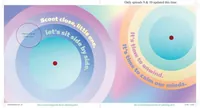
Otherwhere

 72
72

Otherwhere
Kurt Leland's "Otherwhere" attempts to map the terrain of nonphysical reality through a synthesis of personal experience and mythological analysis. The book's strength lies in its direct engagement with the subjective nature of perception, particularly how cultural narratives shape our understanding of what Leland terms "Otherwhere." His descriptions of otherworldly travels, while often impressionistic, offer a compelling counterpoint to purely materialistic views of existence. However, the work occasionally struggles with coherence, with personal anecdotes sometimes overshadowing the broader theoretical framework. A passage discussing the archetypal imagery of the serpent across various creation myths, for instance, highlights Leland's ability to connect disparate cultural symbols but leaves the reader wanting a more rigorous comparative analysis. "Otherwhere" is a sincere, if occasionally uneven, exploration of consciousness beyond the physical.
📝 Description
72
Kurt Leland's 2002 book, "Otherwhere," examines nonphysical reality through personal experience and myth.
First published in 2002, Kurt Leland's "Otherwhere" investigates the nature of nonphysical reality. The book addresses the human impulse to comprehend existence, referencing creation narratives, the soul, and the afterlife. Leland proposes that the universe is primarily energy, with our perception shaped by individual and cultural viewpoints. He shares his own experiences and thoughts on these less tangible dimensions.
This work is aimed at those interested in comparative mythology, consciousness studies, and personal spiritual seeking. It is for readers who want to connect abstract philosophical ideas with direct encounters in subtle realms. Anyone curious about reality beyond the material world, or the archetypal imagery that informs our cosmic understanding, will find considerable content here.
Published in the early 2000s, "Otherwhere" emerged during a resurgence of interest in consciousness research and alternative spiritual paths, following the New Age movements. Leland combines personal narrative with mythological analysis, distinguishing his work from purely academic or theoretical texts. He engages with themes found in thinkers like Carl Jung, who examined archetypes and the collective unconscious, as well as contemporary esoteric writers discussing altered states of perception.
💡 Why Read This Book?
• Gain a framework for understanding subjective spiritual experiences by examining Leland's concept of "Otherwhere" as a translation of universal energy through individual and cultural interpretation. • Explore the connection between personal otherworldly encounters and cross-cultural creation myths, as detailed in the book's analysis of humanity's oldest questions. • Appreciate the role of archetypal imagery in shaping perceived reality, a theme explored through Leland's integration of mythology and his own reported experiences.
⭐ Reader Reviews
Honest opinions from readers who have explored this book.
❓ Frequently Asked Questions
What is Kurt Leland's definition of 'Otherwhere'?
Kurt Leland defines 'Otherwhere' as nonphysical reality, a dimension or state of being accessible through spiritual perception or altered consciousness, distinct from the material world.
When was 'Otherwhere' first published?
The book 'Otherwhere' by Kurt Leland was first published in 2002, reflecting early 21st-century interest in consciousness and metaphysics.
What is the central argument of 'Otherwhere'?
The central argument is that the universe is composed of energy, and our interpretation of this energy, both individually and culturally, shapes our perception of reality, including nonphysical realms.
Does 'Otherwhere' rely on personal experience or academic research?
The book integrates both personal accounts of otherworldly travels and reflections with an analysis of mythology and cultural interpretations of cosmic enigmas.
What kind of myths does Leland examine in 'Otherwhere'?
Leland examines myths related to creation, the nature of God, the soul, and concepts of the afterlife found across various cultures.
Is 'Otherwhere' considered a work of comparative mythology?
Yes, 'Otherwhere' can be considered a work of comparative mythology, as it draws parallels between different cultural narratives and Leland's personal metaphysical experiences.
🔮 Key Themes & Symbolism
The Nature of Otherwhere
Leland's concept of 'Otherwhere' posits a nonphysical reality fundamental to existence. This realm is not static but a fluid construct shaped by the translation of universal energy. The book suggests that access to Otherwhere is through altered states of consciousness, where individual and collective interpretations of energetic phenomena become paramount. It challenges a purely materialist worldview by offering a subjective, experienced-based perspective on dimensions beyond ordinary perception, linking these experiences to archetypal patterns found in global mythologies.
Mythology as Energetic Interpretation
The work views mythology not merely as ancient stories but as sophisticated frameworks for interpreting cosmic energies and enigmas. Leland integrates creation myths, soul concepts, and afterlife narratives from diverse cultures to illustrate how humanity has historically attempted to map the 'Otherwhere.' This perspective suggests that cultural mythologies are collective attempts to translate and understand the same fundamental energetic reality, providing a shared symbolic language for the ineffable aspects of existence.
Personal Experience and Universal Truth
A core theme is the synthesis of Kurt Leland's personal otherworldly travels with universal mythological motifs. He argues that individual encounters with nonphysical reality, when examined, often echo themes found in ancient myths. This approach validates subjective spiritual experiences by connecting them to broader cultural and historical patterns. The book emphasizes that understanding the universe requires acknowledging both the objective energetic substratum and the subjective, interpretive lens through which we perceive it.
Consciousness and Reality Construction
Leland explores how consciousness actively constructs our reality. The 'translation' of universal energy into perceivable images is not passive but an active process influenced by psychological states and cultural conditioning. 'Otherwhere' suggests that by understanding these interpretive mechanisms, individuals can gain deeper insights into the nature of their own consciousness and its role in shaping their experienced reality, potentially opening pathways to different modes of perception.
💬 Memorable Quotes
Direct passages from the work, attributed to the author.
“The universe is made of energy, and that the translation of this energy into images is subject to both individual and cultural interpretation.”
— This foundational statement from the book highlights Leland's core thesis: reality is not fixed but a dynamic interplay between fundamental energy and the perceiver's subjective and collective filters.
“Every culture has its own mythology to explain such cosmic enigmas as creation, God, the soul, and the afterlife.”
— This observation underscores the universality of humanity's quest for meaning and the role of myth across diverse societies in addressing profound existential questions.
“In Otherwhere - Leland's term for nonphysical reality - he recognizes that the universe is made of energy.”
— This defines Leland's central concept and links it to a fundamental energetic understanding of existence, moving beyond purely materialist frameworks.
“Reflecting upon his otherworldly travels, Leland integrates mythology and personal experience.”
— This points to the book's unique methodology, blending subjective experiential accounts with the analysis of established mythological traditions.
“Leland provides insight into humankind's greatest mysteries.”
— This expresses the ambitious scope of the book, aiming to illuminate fundamental questions about existence, consciousness, and the nature of reality.
🌙 Esoteric Significance
Tradition
While not strictly adhering to a single esoteric lineage, "Otherwhere" draws heavily from traditions that emphasize the primacy of consciousness and the existence of subtle realms. Its exploration of archetypal imagery and the interpretation of energy aligns with concepts found in Jungian psychology, Theosophy, and certain streams of Hermeticism. Leland's work departs from rigid doctrines by centering personal experience as a valid pathway to understanding, offering a more fluid and individualistic approach to metaphysical inquiry.
Symbolism
The book implicitly engages with archetypal symbols prevalent across mythologies, such as the serpent (often representing creation, transformation, or primordial energy) and cosmic journeys (symbolizing the soul's passage through different states of consciousness or realms). These symbols, interpreted through Leland's lens, function as conduits for understanding the energetic nature of "Otherwhere" and humanity's relationship to it.
Modern Relevance
Leland's emphasis on the subjective interpretation of universal energy finds echoes in contemporary consciousness studies, quantum mysticism discussions, and certain strains of modern shamanism and psychedelic-assisted therapy. Thinkers and practitioners exploring the intersection of mind, matter, and altered states of consciousness may find his framework for understanding nonphysical reality a useful reference point.
👥 Who Should Read This Book
• Individuals interested in comparative mythology seeking to understand the underlying energetic or experiential basis of cross-cultural narratives. • Explorers of consciousness and subjective reality who wish to bridge personal otherworldly experiences with theoretical frameworks. • Readers of metaphysics and esoteric philosophy looking for works that integrate personal testimony with broader concepts of nonphysical existence.
📜 Historical Context
Published in 2002, Kurt Leland's "Otherwhere" emerged during a period where discussions of consciousness, spirituality, and the limits of scientific materialism were gaining traction outside of mainstream academic circles. It followed the wave of New Age thought from the preceding decades but sought a more integrated approach, blending personal accounts with comparative mythology. Leland's work can be seen in dialogue with thinkers like Stanislav Grof, who explored transpersonal psychology and altered states, and contemporary authors exploring shamanism and consciousness, such as Michael Harner. While not directly engaging with specific academic debates of the time, "Otherwhere" contributed to a broader cultural milieu that questioned reductionist explanations of reality and explored subjective experience as a valid source of knowledge about the cosmos.
📔 Journal Prompts
The translation of energy into perceived images: how does your cultural background influence your interpretation?
Reflect on a personal experience that felt like it occurred in 'Otherwhere'.
Compare a creation myth from one culture to another; what shared energetic principles might they represent?
How do concepts of the soul or afterlife appear in myths you are familiar with?
Consider a symbol from mythology; what nonphysical reality might it be attempting to represent?
🗂️ Glossary
Otherwhere
Kurt Leland's term for nonphysical reality, a dimension or state of being beyond the material world, accessible through consciousness.
Energy Translation
The process by which fundamental universal energy is interpreted and transformed into perceivable images or experiences, influenced by individual and cultural factors.
Cosmic Enigmas
Fundamental questions about existence, such as creation, the nature of God, the soul, and the afterlife, which cultures attempt to explain through mythology.
Nonphysical Reality
The realm or state of existence that is not composed of matter and is not directly perceivable through ordinary physical senses.
Mythology
A collection of myths, especially one belonging to a particular religious or cultural tradition; in this context, viewed as a framework for interpreting existence.
Archetypal Imagery
Universal symbols or motifs that recur across different cultures and time periods, often representing fundamental aspects of the human psyche or cosmic principles.
Personal Experience
Subjective encounters or events, particularly those related to consciousness and altered states, used by Leland as evidence for metaphysical concepts.
This book appears in 1 collection
🔮 Readers Also Liked
Browse all →

![Serrano Miguel Adolf Hitler The Ultimate Avatar [ 2000]](/img/thumb/serrano-miguel-adolf-hitler-the-ultimate-avatar-2000.webp)







From the “Astral Projection” Collection
View all →







More Free Occult Philosophy Books
View all →