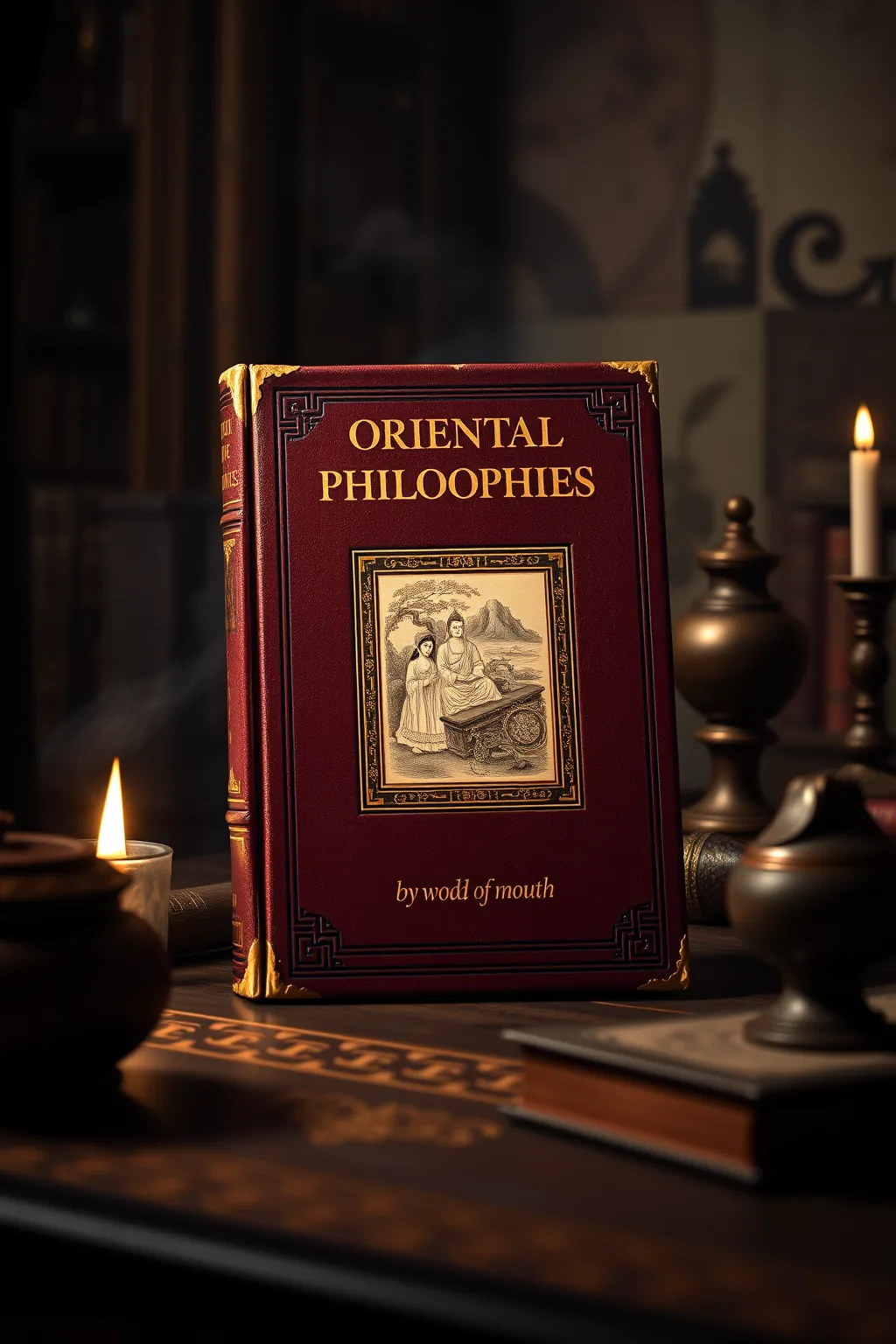
Oriental Philosophies
 84
84

Oriental Philosophies



Marcus Thorne (Esoteric Sciences Reviewer) — 'Oriental Philosophies' is a seminal work, illuminating the profound spiritual currents that have flowed westward, enriching our understanding of the human condition. Its strength lies in its synthesis of diverse yet interconnected Eastern traditions, offering a panoramic view of mystical thought. The anonymous author, guided by what feels like 'word of mouth' from ancient masters, skillfully navigates complex doctrines, making them accessible without diluting their potent esoteric essence. This book is indispensable for scholars of comparative religion, seekers of higher consciousness, and practitioners of inner disciplines who wish to grasp the foundational philosophies underpinning global spiritual evolution. A truly remarkable compendium.
📝 Description
84
Compiled by word of mouth, 'Oriental Philosophies' presents Eastern thought from the Bhagavad-Gita to Lao Tzu.
This compilation gathers core texts and teachings from major Eastern philosophical traditions. It includes selections from the Bhagavad-Gita and the Upanishads, alongside the ideas of Buddha, Confucius, Mencius, and Lao Tzu. The aim is to present these systems of thought, not as academic curiosities, but as living philosophies with spiritual import. The book seeks to reveal the underlying spiritual principles that have informed these diverse traditions and their influence. It is intended for readers interested in understanding the foundational concepts of Eastern wisdom and their connection to broader human understanding of existence.
Readers will find discussions on karma, dharma, the nature of the self, and the path to enlightenment or harmony. The text contrasts these with Western philosophical approaches, highlighting distinct metaphysical and ethical frameworks. It is a resource for those who wish to engage directly with primary sources or summaries of these influential Eastern thinkers and their spiritual legacies. The compilation serves as an introduction to concepts that shaped vast cultural and religious landscapes.
Categorized under Theosophy and Anthroposophy, 'Oriental Philosophies' situates these Eastern traditions within a broader esoteric framework. This perspective often views diverse world religions and philosophies as expressions of a single underlying spiritual truth. Theosophy, particularly through figures like Helena Blavatsky, sought to synthesize Eastern occultism and mysticism with Western thought. Anthroposophy, founded by Rudolf Steiner, also drew heavily on Eastern spiritual insights to understand human evolution and consciousness. This book likely reflects that synthesis, presenting Eastern philosophies not merely as intellectual systems but as pathways to spiritual realization.
✍️ Author
word of mouth
Skywriting by Word of Mouth, and Other Writings Including the Ballad of John and Yoko, is the third, and last, book written by English musician John Lennon. It was published posthumously in 1986 and included an afterword by Lennon's widow, Yoko Ono, whom …
💡 Why Read This Book?
Uncover the foundational spiritual bedrock that predates Western philosophy. 'Oriental Philosophies' offers a rare glimpse into the esoteric heart of traditions like Buddhism, Hinduism, and Taoism. Ideal for seekers yearning for deeper meaning, scholars of ancient wisdom, and practitioners seeking to integrate Eastern contemplative practices into their lives. This book is a key to unlocking the universal principles of consciousness and existence.
⭐ Reader Reviews
Honest opinions from readers who have explored this book.
❓ Frequently Asked Questions
What specific philosophical texts are covered in this book?
The book delves into foundational texts including the Bhagavad-Gita, the Upanishads, the Diamond Sutra, and the teachings of Confucius, Mencius, Lao Tzu, and the Buddha, offering insights into their core philosophical and spiritual tenets.
Is this book suitable for beginners interested in Eastern philosophy?
Yes, 'Oriental Philosophies' serves as an excellent introduction, presenting complex ideas in an accessible manner while retaining their profound esoteric depth, making it suitable for both novices and seasoned students.
How has Eastern philosophy influenced Western thought, as described in the book?
The book highlights the subtle yet significant influence of Eastern philosophies on European intellectual and spiritual traditions, often transmitted through oral traditions, translations, and scholarly works over centuries.
What is the primary 'esoteric' aspect of these philosophies?
The esoteric aspect lies in the hidden spiritual import, the symbolic language, and the direct experiential paths to wisdom and enlightenment embedded within these ancient teachings, pointing towards a deeper reality beyond the mundane.
Who is the intended audience for 'Oriental Philosophies'?
This book is intended for seekers of spiritual truth, scholars of comparative philosophy and religion, practitioners of meditation and contemplative arts, and anyone curious about the profound wisdom traditions of the East.
🔮 Key Themes & Symbolism
The Transcendent Unity of Being
This theme explores the profound concept of an underlying, interconnected reality that pervades all existence, a fundamental tenet found across various Eastern traditions. It studies the idea that the apparent multiplicity of the world is an illusion, and that true liberation comes from realizing the singular, divine essence that unites all beings. The book illuminates how this unity is approached through mystical contemplation, philosophical inquiry, and ethical living, urging the reader to perceive the sacred in the mundane and the divine spark within themselves and others.
The Path to Enlightenment and Liberation
Central to Oriental philosophies is the concept of transcending suffering and achieving a state of profound wisdom and inner freedom, often termed enlightenment or liberation (Moksha, Nirvana). This theme examines the diverse methodologies employed, from rigorous meditation and ethical conduct to the cultivation of spiritual insight and the understanding of karma and reincarnation. It reveals how these traditions offer practical pathways for spiritual evolution, guiding the aspirant through the stages of self-discovery and the dissolution of egoic limitations towards a state of ultimate peace and spiritual awakening.
Symbolism and the Language of the Soul
This theme investigates the wide range of symbolism that forms the language of the soul in Eastern esoteric traditions. It uncovers how myths, parables, archetypes, and allegories serve as vehicles for conveying profound spiritual truths that often elude direct rational explanation. The book explores the symbolic meanings embedded in sacred texts, rituals, and iconography, demonstrating how these symbolic forms act as keys to unlocking deeper layers of consciousness and understanding the hidden architecture of the cosmos and the human psyche. It encourages an intuitive and contemplative approach to deciphering these sacred codes.
💬 Memorable Quotes
Direct passages from the work, attributed to the author.
“Wisdom trickles in, a silent river through time.”
— This evocative metaphor suggests that profound spiritual insights are not always loud pronouncements but subtle, continuous flows of knowledge that have shaped human consciousness over millennia.
“The ancient Greeks learned from whispers of the East.”
— Highlights the historical cross-pollination of ideas, emphasizing that Western philosophical foundations were significantly influenced by earlier Eastern wisdom traditions.
“The Bhagavad-Gita: a dialogue of the soul's awakening.”
— Positions this sacred text as a profound exploration of inner spiritual realization and the dialogue between the higher self and the mundane.
“Buddha's Dharma: the wheel of liberation turns.”
— Refers to the Buddha's teachings as a transformative path leading to freedom from suffering and the cycle of rebirth.
“Lao Tzu's Tao: the silent current of all.”
— Captures the essence of Taoism, describing the Tao as the ineffable, natural order that underlies and sustains the universe.
🌙 Esoteric Significance
Tradition
This work draws heavily from the esoteric traditions of Hinduism (Vedanta, Yoga), Buddhism (Mahayana, Zen), and Taoism. It focuses on the inner, experiential aspects of these philosophies, emphasizing their role in spiritual transformation, the cultivation of consciousness, and the realization of ultimate truth beyond conventional understanding.
Symbolism
The book studies the rich symbolic language inherent in Eastern philosophies, such as the wheel of Dharma, the lotus flower, the concept of emptiness (Shunyata), and the Yin-Yang. These symbols are presented not merely as decorative elements but as keys to unlocking profound metaphysical concepts and guiding the practitioner towards inner realization.
Modern Relevance
In an age often characterized by materialism and spiritual seeking, 'Oriental Philosophies' offers timeless wisdom for navigating modern life. Its teachings on mindfulness, interconnectedness, ethical conduct, and the pursuit of inner peace provide practical tools for personal growth, stress reduction, and fostering a more compassionate and conscious existence in the 21st century.
👥 Who Should Read This Book
This compendium is a vital resource for a diverse readership. **Beginners** will find an accessible yet profound introduction to the foundational concepts of Eastern spiritual thought. **Scholars** of comparative religion and philosophy will appreciate its insightful synthesis of diverse traditions. **Seekers** of deeper meaning and spiritual guidance will discover pathways to inner peace and self-discovery. **Practitioners** of meditation, yoga, and other contemplative disciplines will find invaluable context and philosophical grounding for their practices, enhancing their journey towards enlightenment.
📜 Historical Context
Emerging from a period of burgeoning global intellectual exchange, 'Oriental Philosophies' reflects the West's growing fascination with the spiritual and philosophical legacies of the East. As trade routes expanded and scholarly translations began to circulate more widely in the 18th and 19th centuries, a new awareness of ancient Indian, Chinese, and Buddhist thought took root in European intellectual circles. Thinkers and mystics began to recognize parallels and profound divergences with their own traditions, leading to a deeper appreciation for the richness and antiquity of Eastern wisdom. This book acts as a bridge, consolidating these influential streams of thought and making them accessible to a contemporary audience eager to explore these time-honored paths to understanding.
📔 Journal Prompts
Reflect on the concept of 'hidden spiritual import.' Where have you encountered it in your own life or experiences?
Consider the Bhagavad-Gita's dialogue. What internal dialogues are you currently experiencing, and what might they reveal about your spiritual path?
The Diamond Sutra speaks of illusions. What 'illusions' in your perception of reality might be hindering your spiritual progress?
Explore the teachings of Lao Tzu. How can you better align yourself with the 'silent current' of nature and the Tao in your daily life?
Contemplate the Dharma of the Buddha. What aspects of the Eightfold Path can you actively integrate into your life this week to foster greater mindfulness and compassion?
🗂️ Glossary
Bhagavad-Gita
A sacred Hindu scripture, part of the epic Mahabharata, featuring a philosophical dialogue between Prince Arjuna and Lord Krishna on duty, devotion, and the nature of reality.
Upanishads
A collection of ancient Sanskrit texts from India that contain some of the philosophical concepts and ideas of Hinduism, forming the theoretical basis for Vedanta philosophy.
Diamond Sutra
A significant Mahayana Buddhist scripture revered for its teachings on emptiness (shunyata), the nature of reality, and the perfection of wisdom (prajnaparamita).
Dharma
In Buddhism, the teachings of the Buddha, the cosmic law, or the path to enlightenment. It encompasses the truth about the nature of reality and the ethical principles for living.
Tao (Dao)
The fundamental concept in Taoism, representing the natural order of the universe, the ineffable source and guiding principle of all existence, often translated as 'The Way'.
This book appears in 2 collections
🔮 Readers Also Liked
Browse all →





From the “Theosophy” Collection
View all →


More Free Theosophy & Anthroposophy Books
View all →