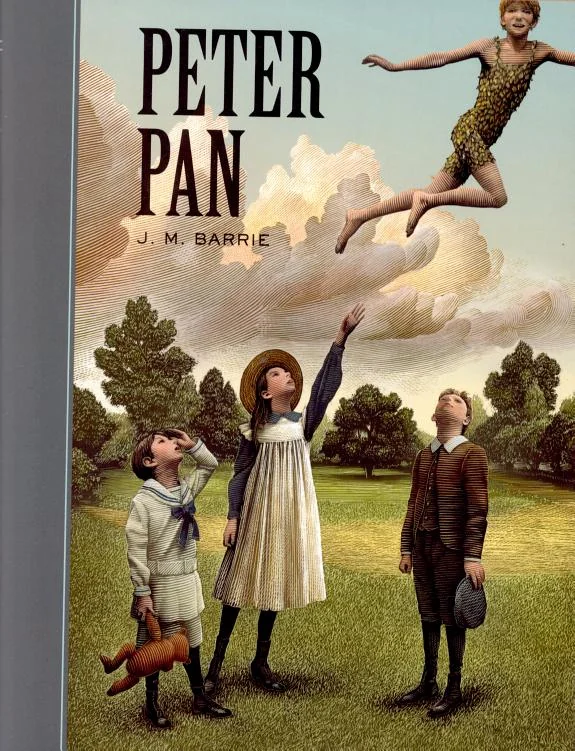
Peter Pan
 71
71

Peter Pan
Barrie’s Peter Pan, particularly in its 1911 novel form, is more than a simple children's fantasy; it’s a complex exploration of arrested development and the bittersweet nature of memory. The unwavering depiction of Peter’s eternal boyhood, while initially charming, reveals a melancholic core. His inability to mature or retain memories, as seen in his forgetfulness regarding the Darling children's names, highlights the fundamental trade-off for his perpetual youth. A notable passage is Wendy's realization that Peter has forgotten his own mother, a stark illustration of the emotional cost of his chosen state. The narrative’s exploration of this duality—the freedom from adult burdens versus the loss of deep emotional connection—remains its most compelling aspect. While the story’s charm is undeniable, its occasional sentimentality and the inherent passivity of the Darling children as they are swept along by Peter’s adventures can feel dated. Nevertheless, the enduring power of Neverland as a psychological landscape makes it a significant work.
📝 Description
71
J.M. Barrie's Peter Pan first appeared as a play in 1904, later novelized in 1911, presenting an escape to Neverland.
The story follows the Darling children, Wendy, John, and Michael, as they fly away with Peter Pan to Neverland. There, they meet the Lost Boys and the pirate Captain Hook. Peter Pan is the boy who never grows up, a figure who actively resists adulthood and its responsibilities. The island of Neverland is a place where children can live freely, away from the rules and expectations of the adult world.
Barrie's work reflects a tension between childhood innocence and the encroaching realities of growing older. It touches on themes of memory, imagination, and the psychological implications of repression. The narrative offers a contrast to the more rigid ideas about childhood prevalent in the preceding Victorian era, tapping into a broader cultural fascination with the idea of perpetual youth.
The novel's creation coincided with a period of societal shifts and emerging psychological theories. Barrie's characters and their world can be seen as an exploration of subconscious desires and a yearning for freedom. The enduring appeal of Peter Pan lies in its ability to speak to both children and adults about the complex relationship between imagination and the inevitable march of time.
While not explicitly occult, Peter Pan taps into a widespread esoteric fascination with eternal youth and the rejection of societal maturation. Neverland functions as a liminal space, a psychic landscape where the rules of the mundane world do not apply. Peter's refusal to grow up can be interpreted as a rejection of the ego's integration into conventional adult society, a theme found in various spiritual traditions that emphasize preserving a state of childlike wonder or innocence. The story explores the power of belief and imagination to shape reality, a concept echoed in magical thinking and certain philosophical schools.
💡 Why Read This Book?
• Understand the psychological allure of eternal youth, as depicted by Peter Pan's refusal to mature, offering insight into societal anxieties about aging and responsibility. • Analyze Neverland as a symbolic space where unconscious desires for freedom from adult constraints can be explored, providing a unique lens on escapist fantasies. • Examine the complex mother-child dynamic and the concept of maternal instinct through Wendy's journey, contrasting it with Peter's inability to form lasting familial bonds.
⭐ Reader Reviews
Honest opinions from readers who have explored this book.
❓ Frequently Asked Questions
What is the difference between the Peter Pan play and the 1911 novel?
The play Peter Pan; or, the Boy Who Wouldn't Grow Up premiered in London in 1904. The 1911 novelization, Peter and Wendy, expands upon the play's narrative, adding descriptive detail and character depth, solidifying the story for a broader audience.
When was Peter Pan first published?
J.M. Barrie's Peter Pan was first staged as a play in 1904. The novelization, titled Peter and Wendy, was published in 1911, becoming the most commonly referenced version of the story.
Who are the main characters in Peter Pan?
The primary characters include Peter Pan, the boy who never grows up; Wendy Darling, who becomes a surrogate mother figure; her brothers John and Michael; the pirate Captain Hook; and the Lost Boys who inhabit Neverland.
What is the significance of Neverland in Peter Pan?
Neverland serves as a fantastical, timeless realm where children can escape the realities of growing up. It is a symbolic landscape reflecting the boundless imagination of childhood and the desires for adventure and freedom.
What does Peter Pan symbolize?
Peter Pan symbolizes eternal childhood, innocence, and the refusal to conform to adult expectations. He represents the part of us that wishes to remain free from responsibility, time, and the inevitability of aging.
Did J.M. Barrie write other works?
Yes, J.M. Barrie wrote numerous other works, including novels like 'The Little Minister' and plays such as 'Dear Brutus' and 'What Every Woman Knows'. However, Peter Pan remains his most globally recognized creation.
🔮 Key Themes & Symbolism
The Refusal to Grow Up
Peter Pan embodies the potent desire to evade maturity, a central theme resonating with both children and adults. His existence in Neverland is a deliberate rejection of the adult world's responsibilities, perceived limitations, and eventual decay. This defiance is not merely playful but represents a profound psychological stance against the compromises life necessitates. The narrative interrogates the cost of this perpetual childhood: the inability to form lasting emotional bonds and the forgetting of significant life events, including one's own family.
Neverland as a Psychological Space
Neverland is more than a geographical location; it functions as a potent symbol of the subconscious mind and the field of imagination. It is a space where desires for adventure, freedom from consequence, and eternal youth are actualized. The island's fluid nature, accommodating pirates, mermaids, and fairies, mirrors the unconstrained range of dreams. For the Darling children, it represents an escape from domesticity and the impending realities of growing up, offering a temporary sanctuary where childhood can be lived without end.
Memory and Identity
The narrative critically examines the role of memory in shaping identity, particularly through Peter's character. His inability to recall past events or people, including his own mother, highlights how forgetting is integral to his unchanging state. Conversely, Wendy's desire to return home and her role in telling stories suggest that memory and narrative are crucial for maintaining connection and understanding one's place in the world. The act of remembering, or failing to remember, becomes a defining characteristic of both Peter and the children who visit Neverland.
Maternal Instinct and Abandonment
Wendy's inherent maternal instincts are central to her role in Neverland, where she becomes a surrogate mother to Peter and the Lost Boys. This theme explores the deep-seated human need for nurturing and belonging. However, it also touches upon the poignancy of abandonment, both Peter's (in a sense, by his mother) and the Darling children's eventual return to their own family, leaving Neverland behind. The story juxtaposes the idealized, imaginative 'mothering' in Neverland with the genuine, though perhaps less exciting, familial bonds of the real world.
💬 Memorable Quotes
Direct passages from the work, attributed to the author.
“All children, except one, grow up.”
— This simple statement from the novel's opening lines immediately establishes the central conceit: the extraordinary nature of Peter Pan and the universality of childhood's eventual end for everyone else.
“It is the most difficult thing in the world to be ill when you have to keep well.”
— This observation, often attributed to Peter, reflects the immense effort required to maintain his perpetually youthful and carefree state, highlighting the active 'work' involved in resisting adulthood.
“It is sad, all this sadness, but it is not a thing you need to worry about.”
— Spoken by Wendy, this reflects a child's attempt to process complex emotions like sadness by compartmentalizing them, a coping mechanism that Peter Pan's world often encourages by sidestepping deep feeling.
“When the first baby laughed for the first time, its laugh broke into a thousand pieces, and they all went skipping about. That was the beginning of fairies.”
— This whimsical origin story for fairies underscores the connection between pure, unadulterated joy and the existence of magic, suggesting that belief and innocent laughter are the very essence of enchantment.
“You don't know a thing about mothers.”
— A direct accusation from Wendy to Peter, this highlights Peter's fundamental lack of understanding regarding deep emotional connections and familial bonds, a direct consequence of his refusal to grow and forget.
🌙 Esoteric Significance
Tradition
While not explicitly aligned with a formal esoteric tradition, Peter Pan can be viewed through a lens of Jungian psychology and archetypal symbolism. The concept of the 'eternal child' or 'puer aeternus' is a recurring motif in Gnostic and Hermetic thought, representing an immature masculine principle that resists integration and wholeness. Peter's flight, his detachment from earthly concerns, and his dwelling in a timeless realm echo Gnostic ideas of a spiritual world separate from the material.
Symbolism
Peter Pan himself is a potent symbol of the Puer Aeternus, the archetypal eternal boy who refuses to mature or face the responsibilities of adulthood. Neverland symbolizes the field of the unconscious or the dream world, a place of pure imagination unbound by linear time or physical law. Captain Hook represents the shadow aspect, the embodiment of fear, mortality, and the repressed consequences of Peter's arrested development, particularly his fear of the crocodile clock.
Modern Relevance
The themes of arrested development and the allure of perpetual youth continue to resonate in contemporary culture, influencing discussions around the 'Peter Pan syndrome' in psychology and sociology. Thinkers and practitioners in modern depth psychology, particularly those following Jungian principles, often analyze Peter Pan as a key text for understanding archetypal patterns. The work's exploration of escapism and the tension between freedom and responsibility remains relevant in an era grappling with digital immersion and the desire to avoid adult burdens.
👥 Who Should Read This Book
• Students of comparative mythology and folklore seeking to understand archetypes of eternal youth and the Puer Aeternus figure. • Psychologists and readers interested in Jungian archetypes and the symbolic representation of the unconscious in literature. • Educators and parents exploring themes of childhood, imagination, and the transition into adulthood through a classic narrative.
📜 Historical Context
J.M. Barrie's Peter Pan, notably the 1911 novelization 'Peter and Wendy,' emerged from the fertile ground of the Edwardian era. This period, following the strict Victorian age, saw shifting attitudes towards childhood, with a growing recognition of its distinct psychological and emotional landscape. Barrie’s work tapped into this evolving perspective, offering a fantastical counterpoint to the more didactic children's literature prevalent at the time. The story’s success, building on the 1904 stage play, coincided with early explorations into psychoanalysis by figures like Sigmund Freud, whose theories on repression and the subconscious may have indirectly informed the narrative's appeal. While not directly engaging with specific philosophical movements, Peter Pan captured a cultural zeitgeist that questioned rigid societal norms and embraced the imaginative potential of youth. The work was received with immense popularity, becoming a staple of children's literature and theatre, though its darker undertones have been subject to critical re-evaluation over time.
📔 Journal Prompts
Peter Pan's refusal to grow up: what adult responsibilities do you find yourself resisting?
The symbolic range of Neverland: what elements of your own inner world does it mirror?
Wendy's maternal instincts: how do you balance nurturing others with self-care?
Captain Hook's fear of the crocodile: what 'time-bound' fears do you seek to outrun?
The Lost Boys' desire for a mother: what does this reveal about unmet needs for belonging?
🗂️ Glossary
Neverland
A fantastical island where children never grow up, serving as a symbolic field of imagination, adventure, and arrested development, free from the constraints of the real world.
Lost Boys
A group of young boys in Neverland who have fallen out of their prams and were never claimed by their parents. They are Peter Pan's companions and represent a state of perpetual, unparented childhood.
Puer Aeternus
Latin for 'eternal boy.' An archetypal figure representing immaturity, resistance to growing up, and a connection to the magical or unconscious realms, often seen as both charming and problematic.
Shadow
In Jungian psychology, the unconscious aspect of the personality that the conscious ego does not identify in itself. Captain Hook can be seen as Peter's shadow, embodying repressed fears and mortality.
Arrested Development
A psychological state characterized by the failure to progress through the normal stages of emotional or psychological maturation. Peter Pan is the literary embodiment of this concept.
Archetype
A recurrent symbol or motif in literature, art, or mythology that is universally understood, representing fundamental human experiences or patterns of behavior, such as the eternal child.
The Crocodile
A creature in Neverland that has swallowed a clock, symbolizing the relentless passage of time and mortality, which Captain Hook fears intensely, contrasting with Peter's timeless existence.
This book appears in 1 collection
🔮 Readers Also Liked
Browse all →








From the “Fairies” Collection
View all →







More Free Occult Philosophy Books
View all →