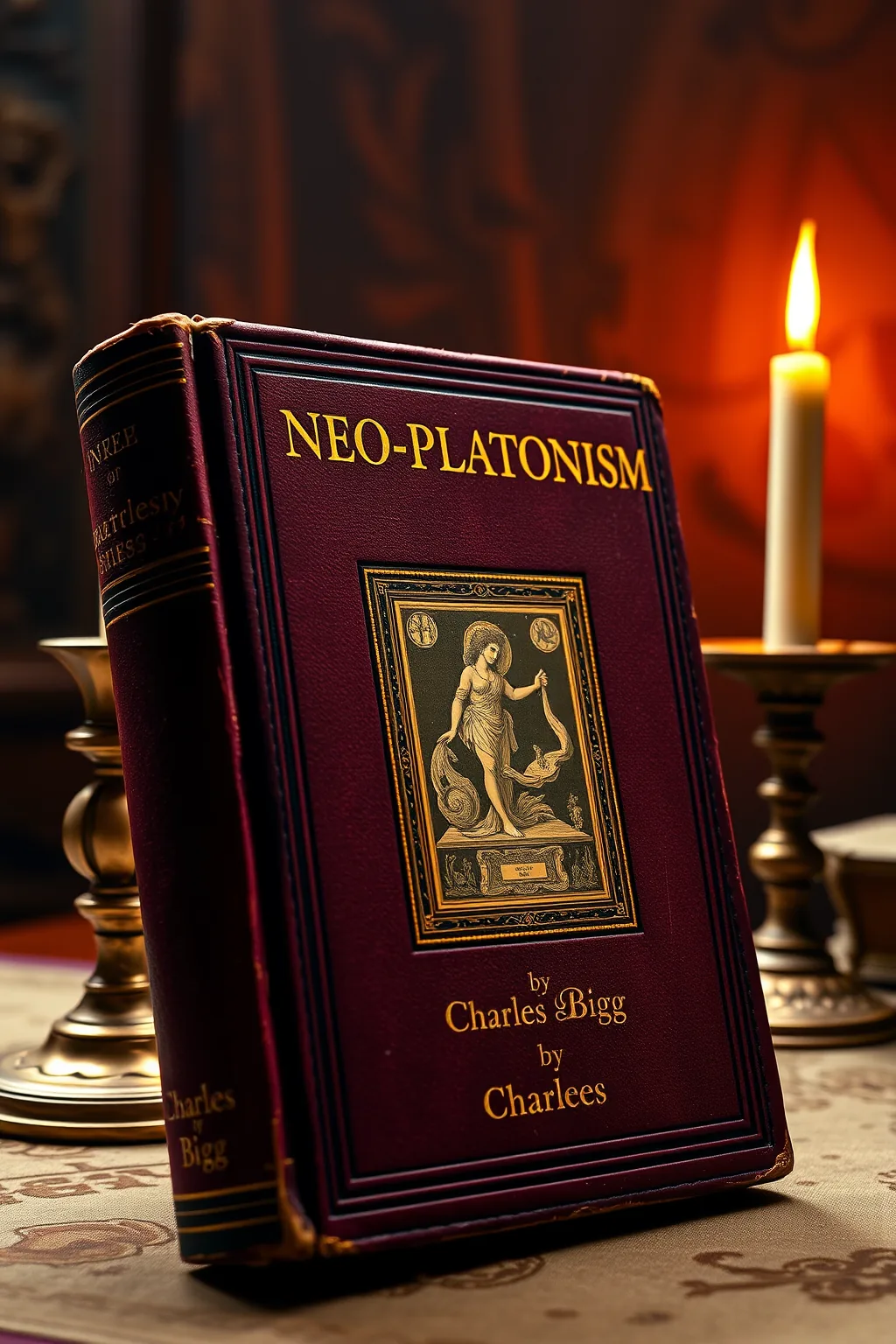
Neo-Platonism
 77
77

Neo-Platonism
Bigg's "Neo-Platonism" provides a rigorous, if somewhat dense, exposition of a philosophy that profoundly shaped Western thought. The strength lies in its systematic breakdown of complex metaphysical arguments, particularly the intricate emanationist cosmology. However, the prose can be academic, sometimes obscuring the experiential dimension that was central to Neo-Platonic practice. A passage discussing Plotinus's concept of the soul's descent and ascent, and the arduous nature of achieving henosis, exemplifies this: it's intellectually thorough but lacks the evocative power one might associate with mystical philosophy.
While the book is invaluable for understanding the intellectual architecture of Neo-Platonism, its accessibility is limited for those without prior philosophical training. It serves best as a scholarly resource for those already initiated into its subject matter. For the dedicated student, it offers a clear, if unadorned, path through a foundational esoteric tradition.
📝 Description
77
Charles Bigg's "Neo-Platonism" details the philosophical system that began in 3rd-century Alexandria.
Charles Bigg's "Neo-Platonism" examines the philosophical system that originated with Ammonius Saccas in 3rd-century Alexandria. The book traces the development of this thought through its principal figures, including Plotinus and Porphyry, and their successors. Bigg dissects the core ideas of Neo-Platonism, focusing on its metaphysical structure, the concept of The One, and the process by which the intelligible and sensible worlds arise from it.
This volume is for students of ancient philosophy and Western esotericism who have a basic grasp of classical Greek thought. It is especially useful for those interested in the intellectual origins of mystical traditions, the impact of Platonic ideas on later religious and philosophical thought, and the arguments about reality and the soul's path toward the divine.
Bigg places Neo-Platonism within the intellectual climate of the Roman Empire, a time of syncretism and growing interest in mystical and philosophical ideas. It became a significant influence on early Christian theology, Gnosticism, and later Hermetic traditions. Bigg's analysis often contrasts Neo-Platonism with contemporary schools of thought and emerging religious doctrines, showing its unique combination of Platonic concepts and mystical aims.
Neo-Platonism was a significant force in the intellectual and spiritual landscape of the late Roman Empire. It sought to synthesize Platonic philosophy with mystical experiences and religious aspirations, influencing early Christian theology, Gnosticism, and Hermeticism. Bigg's work details how this system presented a hierarchical view of reality emanating from an ultimate, ineffable source, and aimed at the soul's return to this divine principle through contemplation and spiritual practice.
💡 Why Read This Book?
• Understand the concept of "The One" and its role as the uncaused cause, a foundational principle in many esoteric cosmologies, as detailed in Bigg's analysis of Plotinus. • Grasp the theory of "emanation," which explains how the material world arises from a divine source, a key idea for interpreting symbolic systems in Hermeticism and Gnosticism. • Explore the Neo-Platonic goal of "henosis," the soul's mystical union with the divine, offering a philosophical framework for understanding esoteric spiritual practices.
⭐ Reader Reviews
Honest opinions from readers who have explored this book.
❓ Frequently Asked Questions
What is the primary philosophical system discussed in Charles Bigg's Neo-Platonism?
The book centers on Neo-Platonism, a philosophical and mystical system that originated in 3rd-century Alexandria with figures like Ammonius Saccas, building upon Plato's dialogues.
Who are the key philosophers associated with Neo-Platonism examined in this book?
Charles Bigg's work prominently features the teachings of Plotinus, often considered the most influential Neo-Platonist, as well as Porphyry, Iamblichus, and Proclus.
What is the central metaphysical concept explored in Neo-Platonism?
The core concept is "The One," an ineffable, transcendent, and singular source from which all reality emanates, forming a hierarchical structure of existence.
How did Neo-Platonism influence later intellectual and spiritual traditions?
The work touches upon Neo-Platonism's significant impact on early Christian theology, Islamic philosophy, Jewish Kabbalah, and later Renaissance Neoplatonists and esoteric movements.
What is the ultimate goal of the Neo-Platonic path as described by Bigg?
The ultimate aim is "henosis," a mystical union or ecstatic experience of the soul with "The One," achieved through philosophical contemplation and purification.
When was Charles Bigg's "Neo-Platonism" first published?
Charles Bigg's "Neo-Platonism" was first published in 2007, making it a modern scholarly treatment of the ancient philosophical school.
🔮 Key Themes & Symbolism
The Transcendent One
Bigg's "Neo-Platonism" meticulously details the philosophical concept of "The One," the ultimate, ineffable source of all existence. This principle is posited as beyond all categories of being and thought, yet it is the generative ground from which the entire cosmos emanates. The work explores how Neo-Platonists like Plotinus grappled with articulating this ultimate reality through negation and apophatic theology, influencing later mystical discourse across various traditions.
Emanationism and Hierarchy
A central theme is the Neo-Platonic doctrine of emanation, explained by Bigg as a necessary outflowing from The One. This process generates a hierarchy of being, starting with the Nous (Intellect), followed by the Psyche (Soul), and descending to the material world. Understanding this ordered cascade is crucial for grasping the Neo-Platonic worldview and its attempts to reconcile divine unity with the multiplicity of creation.
The Soul's Journey
Bigg examines the Neo-Platonic conception of the human soul as a divine spark fallen into materiality. The book outlines the path of ascent, or "henosis," which involves philosophical contemplation, ethical purification, and ultimately, ecstatic union with The One. This spiritual trajectory is a central to esoteric traditions, offering a framework for self-transformation and divine communion.
Influence on Esotericism
The work implicitly or explicitly traces the profound influence of Neo-Platonism on subsequent Western esoteric traditions. From early Christian mysticism and Gnosticism to Renaissance Hermeticism and later occult philosophies, the fundamental concepts of The One, emanation, and the soul's return remain enduringly relevant, forming a bedrock of metaphysical thought.
💬 Memorable Quotes
Direct passages from the work, attributed to the author.
“The soul’s aim is to return to the source from which it emanated.”
— This interpretation captures the core purpose of the Neo-Platonic spiritual path. It emphasizes the soul's divine origin and its inherent drive to re-ascend through the hierarchical levels of reality back to its ultimate source, The One.
“Nous, or the Intellect, is the first emanation from the absolute Unity.”
— This statement defines the Nous as the immediate product of The One's generative activity. It signifies the first level of multiplicity and conscious thought within the Neo-Platonic cosmology, serving as the intermediary between the transcendent source and the lower realms.
“To know the Good is to become the Good.”
— This concept, often associated with Plotinus, suggests that true knowledge of the ultimate Good (The One) is not merely intellectual but transformative. It implies that achieving union with the Good involves an assimilation of its very essence.
💡 Key Ideas
Editorial paraphrase of the work's core concepts — not direct quotes.
The One is not anything, it is not mind, it is not truth, it is not being.
This paraphrased concept highlights the Neo-Platonic emphasis on the absolute transcendence of the ultimate principle. It asserts that The One is beyond all conceptualization and categorization, a fundamental tenet for understanding its ineffable nature.
The sensible world is a reflection or image of the intelligible realm.
This paraphrase illustrates the Neo-Platonic view of reality's structure. It posits that the material world we perceive is an imperfect copy or shadow of a higher, more perfect, intelligible reality governed by the Nous and its Forms.
🌙 Esoteric Significance
Tradition
Neo-Platonism forms a central to Western esoteric traditions, particularly within the Hermetic and Gnostic lineages, and heavily influenced Christian mysticism. It provides a systematic metaphysical structure that underpins many esoteric worldviews, offering a detailed cosmology and an articulated path for spiritual ascent. Bigg's work clarifies this foundational system for modern esoteric practitioners and scholars seeking to understand its origins and core principles.
Symbolism
Key symbols include "The One," representing the ineffable, absolute source beyond all description. The concept of "emanation" itself functions symbolically, illustrating the divine outpouring that creates and sustains the cosmos. The "Nous" (Intellect) and "Psyche" (Soul) represent crucial intermediary principles, often symbolized by light or spirit, guiding the soul's journey back to its divine origin.
Modern Relevance
Contemporary thinkers and practitioners in fields such as depth psychology (e.g., Jungian analysis), perennial philosophy, and various forms of Western esotericism continue to draw from Neo-Platonic ideas. Concepts of the transcendent Self, the nature of consciousness, and the soul's journey towards integration find echoes in modern spiritual and psychological discourse, demonstrating the enduring relevance of this ancient philosophical system.
👥 Who Should Read This Book
• Students of ancient philosophy seeking a clear exposition of Plotinus and his successors, offering a rigorous understanding of the metaphysical underpinnings of Western thought. • Practitioners of Western esotericism interested in the roots of traditions like Hermeticism and Gnosticism, providing essential context for their symbolic languages and spiritual goals. • Comparative religion scholars investigating the philosophical dialogues and influences between pagan thought and early Christian theology in the Roman Empire.
📜 Historical Context
Charles Bigg's "Neo-Platonism," first published in 2007, engages with a philosophical current that flourished from the 3rd to the 6th centuries CE. This era, within the broader Roman Empire, was a fertile ground for syncretic thought, blending Greek philosophy with Eastern mystical traditions. Neo-Platonism emerged as a significant intellectual force, offering a sophisticated metaphysical framework that stood in contrast to both Stoicism and the burgeoning doctrines of Christianity. Key figures like Plotinus, Porphyry, and Iamblichus developed intricate systems that would profoundly influence later Christian theology, particularly through figures like Augustine of Hippo, and later reappear in Renaissance Neoplatonism. The work implicitly addresses the intellectual milieu where pagan philosophical schools contended with new religious movements for influence and adherents.
📔 Journal Prompts
The nature of The One as described by Plotinus.
Reflecting on the process of emanation from The One.
The soul's descent and ascent through the Neo-Platonic hierarchy.
The practical implications of seeking henosis.
The relationship between the intelligible and sensible worlds.
🗂️ Glossary
The One
The ultimate, ineffable, transcendent, and singular source of all existence in Neo-Platonism, beyond all being and comprehension.
Emanation
The Neo-Platonic doctrine that all reality flows necessarily from The One in a hierarchical series of hypostases or levels of being.
Nous
The Intellect or divine mind, the first emanation from The One, containing the Platonic Forms or Ideas.
Psyche
The Soul, a hypostasis below the Nous, which animates the cosmos and individual beings, and which has a divine origin.
Henosis
The Neo-Platonic term for mystical union or ecstatic communion of the individual soul with The One.
Apophatic Theology
A theological approach that describes God or the divine by negation, stating what it is not, rather than what it is, reflecting the ineffability of The One.
Hypostasis
A term used in Neo-Platonism to denote a fundamental level or principle of reality, such as The One, Nous, and Psyche.
🔮 Readers Also Liked
Browse all →









More by Charles Bigg
All books →




More Free Occult Philosophy Books
View all →