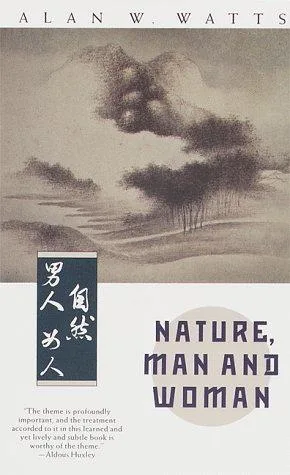
Nature, Man,& Woman
 78
78

Nature, Man,& Woman
Alan Watts’ "Nature, Man & Woman" offers a familiar yet potent distillation of his lifelong philosophical project: dismantling the illusion of separation. The strength of this collection lies in its directness; Watts’ voice, even in posthumously compiled essays, retains its characteristic clarity and disarming wit. He consistently probes the Western tendency to treat humanity as an alien intruder upon nature, rather than an intrinsic expression of it. A particularly striking passage discusses the 'skin-encapsulated ego,' a vivid metaphor for the self perceived as a discrete entity, and its resulting anxieties. However, the book’s primary limitation is its lack of new material for those already deeply immersed in Watts’ extensive catalog; much here revisits well-trodden ground. For newcomers, it serves as an excellent, albeit unvarnished, introduction to his core ideas. Watts’ enduring critique of our conceptual frameworks, particularly concerning the subject-object split, remains a valuable challenge. The work ultimately serves as a potent reminder of our fundamental connectedness, urging a re-seeing of the world. It is a necessary, if not entirely novel, contemplation on our place in the cosmos.
📝 Description
78
Alan Watts' 2022 compilation "Nature, Man & Woman" challenges dualistic thinking about existence.
Originally published in 2022, "Nature, Man & Woman" collects lectures and writings by Alan Watts that question how humans understand their place in the universe. Watts, known for translating Eastern philosophies for Western readers, uses his direct style to examine the connection between humanity, consciousness, and the natural world. This book is not a linear narrative but a series of linked essays and thoughts. It aims to make readers rethink basic assumptions about themselves, society, and the cosmos.
This volume suits readers familiar with Alan Watts or those curious about Zen Buddhism, Taoism, and Vedanta. It is for people interested in the philosophical basis of ecological awareness and humanity's relationship with nature, going beyond surface level environmental ideas. Those who feel dissatisfied with purely materialistic views will find Watts' ideas on the illusion of separation especially relevant. Students of comparative philosophy and those interested in how Eastern thought was adapted in the West will also find value here.
The ideas in "Nature, Man & Woman" originate from Alan Watts' work in the mid-to-late 20th century, a time of shifting cultural and intellectual thought. His lectures and writings from the 1950s through the 1970s coincided with a growing Western interest in Eastern philosophies, influenced by figures like Aldous Huxley and the counterculture. Watts engaged with existentialist ideas, proposing a non-dualistic perspective as an alternative to the anxieties of modern life.
💡 Why Read This Book?
• Understand the 'skin-encapsulated ego' concept, a core Wattsian idea that explains the psychological roots of alienation from nature. This offers a distinct framework for self-analysis not found in typical ecological texts. • Grasp the 'playful universe' perspective, derived from Taoist principles, which reframes life not as a struggle but as spontaneous unfolding. This offers a unique emotional and mental shift in facing challenges. • Explore the critique of the subject-object dichotomy, a philosophical distinction prevalent since Descartes, and discover how Watts argues for an integrated view of humanity and the cosmos.
⭐ Reader Reviews
Honest opinions from readers who have explored this book.
❓ Frequently Asked Questions
What is Alan Watts' core philosophical approach in "Nature, Man & Woman"?
Watts' approach in "Nature, Man & Woman" centers on challenging the perceived separation between humanity and the natural world, advocating for a non-dualistic understanding where the self is seen as integral to the universe, drawing heavily from Eastern philosophies.
When was "Nature, Man & Woman" first published, and what does this signify?
The book was first published in 2022, but its content is drawn from Alan Watts' earlier lectures and writings from the mid-to-late 20th century, reflecting his engagement with the philosophical currents of that era.
How does Watts define the 'ego-self' in this work?
Watts defines the 'ego-self' as a socially constructed illusion, a 'skin-encapsulated ego,' that creates a false sense of isolation and individuality, leading to anxiety and disconnection from the wider reality.
What Eastern philosophies most influenced the ideas presented in the book?
The primary Eastern philosophies influencing "Nature, Man & Woman" are Zen Buddhism and Taoism, particularly their concepts of interconnectedness, the spontaneous nature of reality, and the critique of rigid conceptual frameworks.
Is "Nature, Man & Woman" suitable for someone new to Alan Watts?
Yes, for newcomers, "Nature, Man & Woman" serves as an accessible introduction to Watts' core ideas on nature, consciousness, and Eastern philosophy, presented in his characteristic clear and engaging style.
What is the 'game of difference' as discussed by Watts?
The 'game of difference,' as discussed by Watts, refers to the societal tendency to create and emphasize distinctions and divisions between people, objects, and concepts, which he argues leads to conflict and misunderstanding.
🔮 Key Themes & Symbolism
The Illusion of Separation
Watts meticulously deconstructs the Western psychological and philosophical tendency to perceive oneself as an isolated entity, distinct from the external world and the rest of humanity. He posits that this 'skin-encapsulated ego' is the root cause of alienation, anxiety, and ecological imbalance. The book argues that recognizing our inherent unity with the universe, a concept central to Taoism and Buddhism, is the key to overcoming this fundamental misunderstanding of reality. This theme challenges readers to re-evaluate their sense of self and their relationship with the cosmos.
The Playful Universe
Drawing from Taoist philosophy, Watts presents the universe not as a serious, deterministic mechanism or a problem to be solved, but as a spontaneous, creative play. He suggests that life's struggles and complexities are often self-imposed by a rigid, goal-oriented mindset. Embracing the 'playful universe' means understanding that existence is an ongoing process of unfolding, similar to a dance or a musical improvisation. This perspective encourages a more relaxed, accepting, and joyful engagement with life, moving away from the constant striving and anxiety associated with the ego-driven pursuit of control.
Consciousness and Reality
The book studies the nature of consciousness, questioning the conventional view that it is merely a byproduct of the physical brain. Watts explores the idea that consciousness is fundamental and that the universe itself is a manifestation of a universal, underlying consciousness. He critiques the subject-object duality, arguing that the perceived separation between the observer and the observed is an artificial construct. By dissolving this division, he posits that one can experience a more direct and unified apprehension of reality, aligning with concepts found in Vedanta.
Humanity's Place in Nature
Watts forcefully argues against the anthropocentric view that positions humans as separate from and superior to the natural world. He contends that this mindset, prevalent in Western thought, leads to exploitation and environmental degradation. Instead, he advocates for seeing humanity as an integral part of the natural order, an expression of the same cosmic energy that animates all life. This theme calls for a profound shift in perspective, fostering a sense of belonging and responsibility towards the Earth and all its inhabitants.
💬 Memorable Quotes
Direct passages from the work, attributed to the author.
“The 'skin-encapsulated ego' is the fundamental illusion.”
— This concise statement expresses Watts' critique of the Western conception of the self as a distinct, isolated entity enclosed within the physical body. He argues this perceived boundary is the source of much human suffering and alienation.
“You are IT.”
— A powerful and direct assertion reflecting the non-dualistic philosophy Watts often expounded. It means the individual self is not separate from the universal consciousness or the totality of existence; rather, it is the very expression of it.
“The 'game of difference' creates all our divisions.”
— Watts uses this phrase to describe how societal and personal constructs of 'us' versus 'them,' or 'this' versus 'that,' lead to conflict. The book encourages seeing beyond these manufactured distinctions to recognize underlying unity.
“Nature is not something outside of you; you are part of nature.”
— This interpretation emphasizes Watts' core message against anthropocentrism. It advocates for a fundamental shift in perception, viewing humanity not as an observer or master of nature, but as an intrinsic, inseparable component of the natural world.
💡 Key Ideas
Editorial paraphrase of the work's core concepts — not direct quotes.
The universe is not a problem to be solved, but a game to be played.
This quote highlights Watts' interpretation of the 'playful universe,' a concept derived from Taoism. It suggests that life should be approached with a sense of spontaneity and enjoyment rather than as a constant struggle or series of obstacles.
🌙 Esoteric Significance
Tradition
Watts' work draws heavily from the non-dualistic traditions of Advaita Vedanta and Mahayana Buddhism, particularly Zen. While not strictly adhering to any single esoteric lineage, his philosophy aligns with Gnostic ideas of inherent divinity and the illusion of the material world. He bridges Eastern mysticism with Western philosophical inquiry, presenting concepts like 'emptiness' (sunyata) and 'non-self' (anatman) in ways accessible to a Western audience, often framing them as psychological and cosmological insights rather than purely religious dogma.
Symbolism
A key symbolic motif is the 'skin-encapsulated ego,' representing the perceived boundary of the individual self, which Watts argues is an illusion. The 'playful universe' symbolizes the Taoist concept of the Tao as a spontaneous, effortless flow, contrasting with the Western notion of a rigidly controlled, goal-oriented cosmos. Water, frequently used in Taoist and Buddhist parables, serves as a symbol of adaptability, formlessness, and the interconnectedness of all things, mirroring the fluid nature of consciousness and reality.
Modern Relevance
Watts' explorations of consciousness, non-duality, and ecological interconnectedness have found renewed relevance in contemporary mindfulness movements, the integral philosophy of Ken Wilber, and ecopsychology. His critiques of Western dualism continue to inform discussions in consciousness studies, artificial intelligence ethics, and environmental ethics. Thinkers and practitioners in fields ranging from psychedelic therapy to contemplative science often cite Watts as a foundational influence for understanding the self beyond egoic limitations and for fostering a deeper connection with the natural world.
👥 Who Should Read This Book
• Seekers of alternative philosophical frameworks: Individuals dissatisfied with purely materialistic or dualistic explanations of reality will find Watts' non-dualistic approach to consciousness and the cosmos clear. • Students of Eastern philosophy: Those studying Zen Buddhism, Taoism, or Vedanta will benefit from Watts' accessible interpretations and his ability to bridge these traditions with Western thought. • Environmentally conscious readers: Anyone interested in ecological issues from a deeper philosophical perspective will gain valuable insights into the roots of environmental alienation and the concept of humanity's inherent connection to nature.
📜 Historical Context
The ideas presented in "Nature, Man & Woman" were developed by Alan Watts during the mid-20th century, a period marked by a burgeoning interest in Eastern philosophies within Western intellectual circles. Watts, alongside contemporaries like D.T. Suzuki and Aldous Huxley, played an important role in translating and popularizing Zen Buddhism, Taoism, and Vedanta for an American and European audience. This era, particularly the 1950s and 1960s, saw a significant cultural shift, with many seeking alternatives to the dominant Western materialistic and Christian worldviews. Watts' work offered a compelling philosophical framework that resonated with the counterculture movement and academic interest in comparative religion. He engaged with existentialist thought but offered a distinctly Eastern-influenced perspective that emphasized interconnectedness over individualistic angst. While figures like Martin Heidegger explored being and existence through a phenomenological lens, Watts proposed a more immanent, unified experience of reality, often contrasting his views with the Cartesian dualism that had long influenced Western thought.
📔 Journal Prompts
The 'skin-encapsulated ego' and its relation to your personal sense of isolation.
Reflections on the 'playful universe' versus a goal-oriented life approach.
How does the concept 'You are IT' challenge your daily perceptions?
Exploring the 'game of difference' in your social interactions.
Your personal experience of being an intrinsic part of nature, not separate from it.
🗂️ Glossary
Ego-self
Alan Watts' term for the perceived individual self, often described as a 'skin-encapsulated ego,' which he argued is a socially constructed illusion rather than fundamental reality.
Non-duality
A philosophical concept, prominent in Eastern traditions like Advaita Vedanta and Zen Buddhism, asserting that reality is ultimately a unified whole, with no fundamental separation between mind and matter, or subject and object.
Skin-encapsulated ego
A metaphor used by Watts to describe the common Western perception of the self as a distinct, isolated entity confined within the boundaries of the physical body.
Playful Universe
Watts' concept, derived from Taoism, that the universe is not a serious, deterministic mechanism but a spontaneous, creative, and joyful process of unfolding.
Subject-Object Dichotomy
The philosophical division between the observer (subject) and the observed (object), which Watts argued is an artificial construct that leads to a fragmented understanding of reality.
Game of Difference
Watts' description of how human society operates by creating and emphasizing distinctions and divisions, which he believed are the source of much conflict and misunderstanding.
You are IT
A concise expression of non-duality, signifying that the individual self is not separate from the universal consciousness or the totality of existence, but is its very manifestation.
🔮 Readers Also Liked
Browse all →









More by Alan Watts
All books →




More Free Occult Philosophy Books
View all →