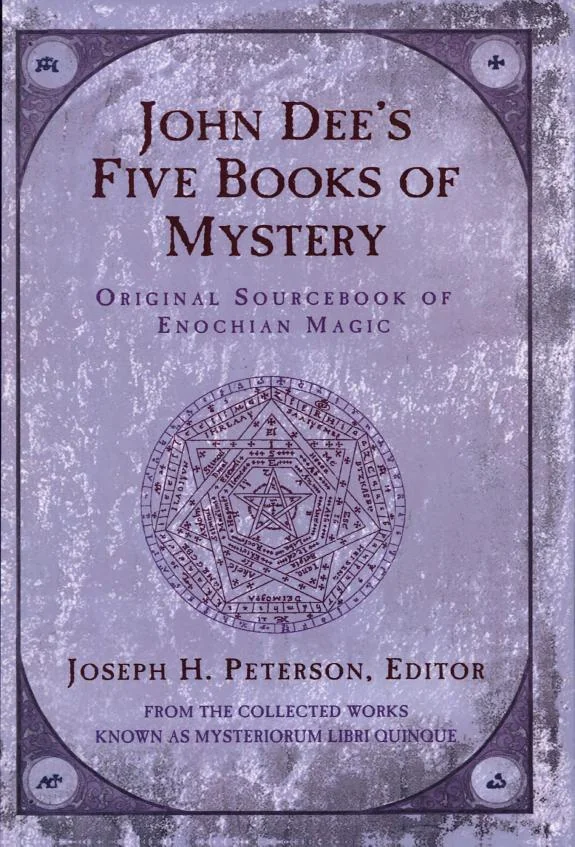
John Dee's Five Books of Mystery
 78
78

John Dee's Five Books of Mystery
Joseph H. Peterson’s meticulous presentation of John Dee’s Five Books of Mystery is an indispensable resource for understanding the practical occultism of the late Renaissance. The sheer detail within Dee’s own transcriptions, particularly regarding the mechanics of his angelic conversations, is staggering. Peterson’s scholarly apparatus, including his biographical notes and explanations of Dee’s intellectual milieu, provides crucial context for navigating these dense texts. One finds the passages detailing the construction and use of the ‘table of practice’ particularly illuminating, revealing the tangible, almost scientific, approach Dee brought to his spiritual inquiries. However, the sheer volume and the arcane nature of the material can present a significant barrier to entry; a more extensive glossary of specialized terms might have been beneficial for readers less familiar with Kabbalistic and alchemical lexicons. The work, despite its challenges, offers an unparalleled, unvarnished look into the mind of a man attempting to bridge the material and spiritual worlds with unprecedented rigor.
📝 Description
78
John Dee's Five Books of Mystery records his attempts to communicate with angels and learn their language.
This volume presents John Dee's private writings from the late 16th century, detailing his experiments in contacting angelic intelligences. Dee, a prominent mathematician and advisor to Queen Elizabeth I, meticulously documented his scrying sessions, visions, and the ceremonial apparatus he used. These books reveal his efforts to understand a supposed divine language and the angelic hierarchy he believed he encountered. The text offers a direct view into the practical application of Renaissance magic and esoteric philosophy by a figure who navigated both scientific inquiry and occult pursuits.
These writings were not intended for public consumption and remained largely hidden for centuries. They require focused attention from readers interested in the history of Western esotericism, particularly Hermeticism, Kabbalah, and Renaissance occultism. The material includes dense theological and philosophical discussions alongside practical magical instructions. It serves as primary source material for scholars of John Dee, Elizabethan England, and the evolution of occult thought, presenting Dee's own meticulously kept records.
John Dee's work on angelic communication and language places him within a late Renaissance tradition of Renaissance Hermeticism and Neoplatonism. His attempts to establish direct contact with divine intelligences and decipher their messages echo earlier magical texts and Kabbalistic interests in celestial hierarchies and divine names. While contemporaries engaged with theoretical cosmology, Dee pursued a more practical, experiential path to divine knowledge, distinguishing his occult investigations from purely philosophical or scientific endeavors of the era. His detailed method of scrying and recording angelic interactions represents a significant, though often concealed, facet of early modern occultism.
💡 Why Read This Book?
• Gain direct access to John Dee's scrying records and angelic communications, offering a unique perspective on Elizabethan occult practices distinct from purely theoretical Hermetic texts. • Understand the foundational concepts and structure of the Enochian language, a complex angelic tongue that Dee believed held the keys to divine revelation, as meticulously transcribed by the author. • Examine Dee's practical approach to ceremonial magic, including his detailed descriptions of the tools and rituals used in his quest for knowledge, providing concrete examples of Renaissance occult methodology.
⭐ Reader Reviews
Honest opinions from readers who have explored this book.
❓ Frequently Asked Questions
What is the primary focus of John Dee's Five Books of Mystery?
The book primarily focuses on John Dee's documented attempts to communicate with angelic beings and decipher the divine language, known as Enochian, which he claimed to receive through scrying sessions in the late 16th century.
Who was John Dee in the context of Elizabethan England?
John Dee (1527-1608) was a prominent mathematician, astronomer, geographer, and advisor to Queen Elizabeth I, renowned for his scientific expertise while also deeply involved in occult philosophy and angelic magic.
What is the significance of the Enochian language presented in the book?
The Enochian language is presented as a primordial, angelic tongue believed by Dee to be the language of creation. Its study is central to Dee's project of spiritual communication and divine revelation.
What kind of material can one expect in this collection?
Readers can expect detailed transcriptions of Dee's scrying sessions, descriptions of angelic hierarchies, instructions for rituals, and explorations of the Enochian language, offering a primary source insight into his occult research.
Is Joseph H. Peterson’s edition of John Dee’s Five Books of Mystery the only version available?
Joseph H. Peterson’s 2003 edition is considered a definitive scholarly presentation, compiling and annotating Dee's manuscripts which were previously scattered and less accessible to the public.
Does this book contain practical instructions for performing angelic magic?
Yes, the book includes detailed descriptions of the tools, tables, and rituals John Dee employed in his attempts at angelic communication, offering practical insights into his magical system.
🔮 Key Themes & Symbolism
Angelic Communication & Language
The central theme is Dee's rigorous pursuit of direct communication with angelic intelligences, meticulously documented in these texts. He details the process of scrying, the apparatus used, and the reception of the Enochian language, which he considered the primordial tongue of creation. This theme explores the mechanics and theology behind his attempts to bridge the human and divine realms through spiritual interaction.
The Enochian System
This theme focuses on the intricate structure of the Enochian language and the angelic hierarchy presented by Dee. The books lay out the alphabet, vocabulary, and grammar of this celestial tongue, alongside the names and functions of numerous angels and their corresponding realms. It represents Dee's ambitious project to map and interact with the spiritual cosmos.
Renaissance Occultism in Practice
The collection offers a rare glimpse into the practical application of occult philosophy during the Elizabethan era. It details Dee's ceremonial magic, the creation of his magical tools like the 'table of practice,' and his systematic approach to spiritual inquiry, moving beyond theoretical discourse to empirical (albeit esoteric) investigation.
The Seeker's Quest for Knowledge
Underlying the specific magical practices is Dee's profound personal quest for divine knowledge and understanding of humanity's place in the universe. The books reveal his dedication, his intellectual struggles, and his unwavering belief in the possibility of accessing higher truths through dedicated spiritual and intellectual effort.
💬 Memorable Quotes
Direct passages from the work, attributed to the author.
“The Angelical Book of Ceremonies.”
— This phrase points to the detailed ritualistic and ceremonial aspects of Dee's angelic work, indicating that his spiritual pursuits were not merely contemplative but involved structured, practical magical operations.
“The substance of the 48 Angels.”
— This suggests a structured cataloging of angelic beings encountered or understood by Dee, likely detailing their natures, functions, or domains within the spiritual hierarchy he was exploring.
“The Table of Practice.”
— A specific, tangible artifact central to Dee's scrying and angelic communication practices. It represents the physical interface through which Dee believed he could interact with the spiritual world.
“The keys of Solomon.”
— Referencing the legendary grimoire, this indicates Dee's engagement with existing magical traditions and his attempt to integrate or adapt their principles into his own unique system of angelic communication.
“The language of Angels.”
— This captures Dee's primary goal: to understand and utilize the Enochian language, which he believed was the direct communication medium of celestial beings, holding secrets of creation.
🌙 Esoteric Significance
Tradition
This work is deeply rooted in the Western Esoteric Tradition, specifically Hermeticism and Renaissance ceremonial magic. It represents a practical, experiential branch of Kabbalah, attempting to establish direct contact with divine emanations rather than solely through theoretical study. Dee's project of angelic communication and the Enochian language can be seen as an attempt to restore a lost, primordial form of divine knowledge, diverging from more purely philosophical or alchemical pursuits.
Symbolism
Key symbols include the 'table of practice,' a scrying mirror or tablet used for angelic communication, representing the interface between the terrestrial and celestial. The 'keys' or 'clavis' of the Enochian language symbolize access to divine secrets and spiritual realms. The intricate angelic sigils and divine names function as symbolic representations of spiritual powers and intelligences that Dee sought to invoke and understand.
Modern Relevance
Dee's work, particularly the Enochian system, continues to influence modern occultists and ceremonial magicians. Groups like the Hermetic Order of the Golden Dawn and subsequent magical traditions have incorporated elements of Enochian magic. Contemporary practitioners and scholars of Western esotericism frequently revisit Dee's texts to understand the historical development of magical practices and the persistent human drive to communicate with higher realms.
👥 Who Should Read This Book
• Students of John Dee and Elizabethan intellectual history seeking primary source material on his occult investigations, offering direct insight beyond biographical accounts. • Practitioners of Western Esotericism, particularly those interested in ceremonial magic, angelology, and the historical development of grimoire traditions, who wish to study a foundational text. • Researchers of comparative religion and mysticism examining the intersection of science, religion, and magic in the early modern period, providing a unique case study.
📜 Historical Context
John Dee's Five Books of Mystery emerged from the vibrant intellectual and spiritual milieu of Elizabethan England. This era, marked by the Renaissance and the Reformation's lingering shadows, fostered a climate where scientific inquiry and occult exploration often intertwined. Dee himself was a polymath, respected by figures like Tycho Brahe for his astronomical work, yet he pursued esoteric knowledge with equal fervor. While contemporaries like William Gilbert explored magnetism, Dee examined alchemy and angelic communication. His work on the angelic language and cosmology was conducted in relative privacy, distinct from the more public philosophical debates of figures like Francis Bacon, who championed a more empirical, less mystical, scientific method. Dee's engagement with angelic realms, however, placed him at the fringes of accepted intellectual discourse, and his occult activities were viewed with suspicion by some, even as he advised the Crown.
📔 Journal Prompts
The structure of the Enochian alphabet.
John Dee's meticulous record-keeping of angelic communications.
The practical construction and use of the 'table of practice'.
The perceived relationship between mathematical science and angelic revelation in Dee's work.
The theological underpinnings of Dee's angelic hierarchy.
🗂️ Glossary
Scrying
The practice of seeking knowledge or divine revelation by gazing into a reflective surface, such as a mirror, crystal ball, or water. Dee used scrying extensively in his attempts to communicate with angels.
Enochian Language
A complex language, purportedly angelic, discovered and transcribed by John Dee and Edward Kelley. Dee believed it to be the original language of creation, a key to divine knowledge.
Angelical Hierarchy
A structured classification of angels and spiritual beings, often based on tradition or direct revelation. Dee documented his understanding of these hierarchies in his esoteric works.
Table of Practice
A specific magical tool designed by John Dee, typically a square tablet inscribed with divine names and angelic characters, used as a focus for scrying and communication with spiritual entities.
Grimoire
A textbook of magic, typically containing instructions for invoking spirits, casting spells, and performing rituals. Dee's works can be considered a unique form of grimoire focused on angelic dialogue.
Hermeticism
A philosophical and religious tradition based on the purported teachings of Hermes Trismegistus. It emphasizes divine knowledge, the interconnectedness of all things, and the potential for human spiritual ascent.
Kabbalah
A body of Jewish mystical teachings that explore the nature of God and the universe, often employing symbolic interpretations of scripture and the Tree of Life. Dee's work shows influence from Christian Kabbalah.
This book appears in 1 collection
🔮 Readers Also Liked
Browse all →








From the “Enochian Magic” Collection
View all →




More Free Magic & Ritual Books
View all →