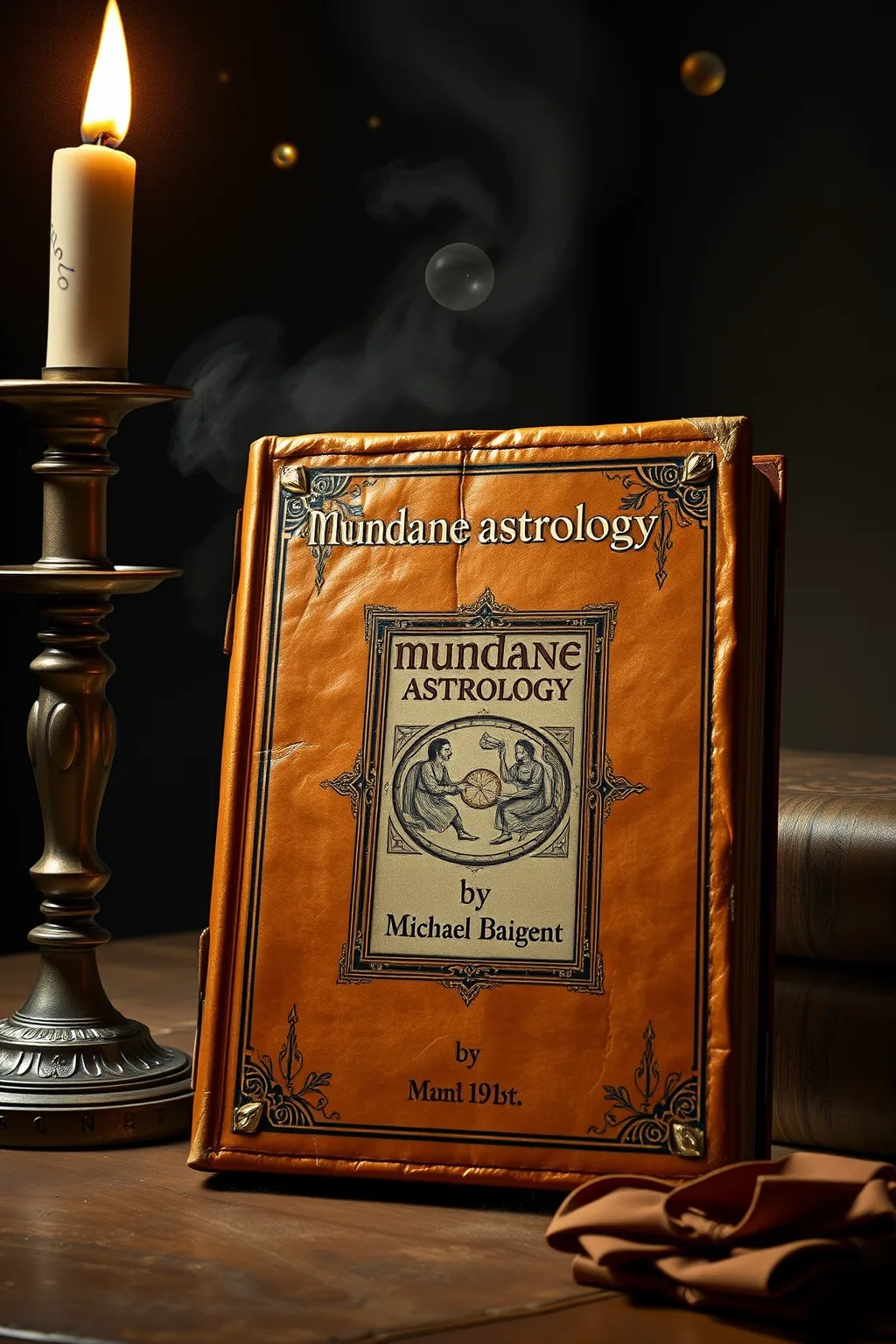
Mundane astrology
 74
74

Mundane astrology
Michael Baigent’s *Mundane Astrology* attempts to map the celestial influences on the grand stage of human history, a bold undertaking that sets it apart from more common astrological texts. The strength of the work lies in its methodical approach to applying astrological principles to national and global events, providing a structured way to analyze historical epochs. Baigent’s examination of ingress charts for nations, for instance, offers a concrete, if debated, method for understanding collective trajectories. However, the book occasionally suffers from a certain academic dryness, which may alienate readers seeking more intuitive or experiential astrological insights. The detailed analysis of specific historical periods, while informative, can sometimes feel overly deterministic. Ultimately, *Mundane Astrology* is a valuable, albeit challenging, contribution for those interested in the astrological interpretation of collective human affairs, offering a unique perspective that rewards careful study.
📝 Description
74
Michael Baigent published *Mundane Astrology* in 1984.
This book examines how astrological principles apply to collective human affairs, moving beyond individual natal charts. Baigent argues that celestial patterns can illuminate the dynamics of nations, cities, and significant global events. He proposes that planetary movements and configurations reflect macro-level human actions, providing a method for interpreting history and anticipating large-scale future developments. The text is suited for those with a basic grasp of astrological symbolism who want to understand its application to societal phenomena. It will interest historians looking for different ways to view societal changes, political analysts studying cyclical patterns, and philosophers of history. Anyone curious about astrological connections to state formations or international conflicts will find material for thought.
Published in 1984, *Mundane Astrology* appeared during a time of renewed interest in esoteric studies and critical historical examination. Astrologers were investigating various sub-disciplines, and Baigent's work added to discussions about astrology's role in explaining large-scale human experience. It connects to earlier traditions linking celestial and terrestrial events, dating back to Babylonian and Hellenistic times. Baigent applies these concepts using a modern, analytical approach, referencing specific historical periods and figures.
💡 Why Read This Book?
• Gain a structured method for analyzing historical periods and global events through astrological symbolism, moving beyond individual natal charts, as demonstrated by Baigent's analysis of ingress charts for nations. • Understand the astrological underpinnings of collective phenomena, such as national fortunes and international relations, by examining planetary cycles and their correlation with historical epochs. • Explore how astrological concepts can be applied to macro-level human affairs, offering a unique lens through which to view societal shifts and political developments, as Baigent does with historical examples.
⭐ Reader Reviews
Honest opinions from readers who have explored this book.
❓ Frequently Asked Questions
What is the primary focus of mundane astrology as presented by Michael Baigent?
Mundane astrology, as explored in Baigent's 1984 work, focuses on celestial influences as they relate to collective entities like nations, cities, and global events, rather than individual horoscopes.
When was Michael Baigent's book 'Mundane Astrology' first published?
Michael Baigent's seminal work on the subject, 'Mundane Astrology', was first published in 1984, contributing to the esoteric discourse of the era.
Does this book offer astrological interpretations for personal horoscopes?
No, the book's scope is deliberately macrocosmic. It deals with the astrology of nations and global affairs, distinguishing itself from personal natal or horary astrology.
What kind of historical events does mundane astrology aim to interpret?
The book explores the astrological interpretation of large-scale human affairs, including the rise and fall of empires, political shifts, international conflicts, and societal trends.
Is a prior knowledge of astrology required to understand this book?
While not strictly required, a foundational understanding of astrological symbolism and principles is beneficial for fully grasping Baigent's application of these concepts to collective phenomena.
How does this book relate to ancient astrological traditions?
Baigent's work engages with older traditions linking celestial events to terrestrial happenings, dating back to Babylonian times, but applies these with a modern, analytical perspective.
🔮 Key Themes & Symbolism
National Destiny Charts
Baigent looks at the concept of creating astrological charts for nations, typically based on significant founding dates or independence moments. These charts, known as ingress charts or founding charts, are analyzed to understand a nation's inherent character, potential challenges, and projected historical trajectory. The work posits that planetary positions at these critical junctures act as a cosmic blueprint, influencing political stability, economic fortunes, and international relations for the entity they represent.
Planetary Cycles and World Events
A central theme is the correlation between specific planetary cycles and large-scale human events. Baigent examines how the slower-moving outer planets, such as Jupiter, Saturn, Uranus, and Neptune, and their significant aspects, might align with periods of major societal transformation, conflict, or peace. The book offers a framework for interpreting historical epochs through the lens of these recurring celestial rhythms, suggesting a cosmic influence on the ebb and flow of civilizations.
The Collective Unconscious and Astrology
The work touches upon the idea that mundane astrology taps into a collective consciousness or psyche that is reflected in the heavens. It suggests that astrological symbolism provides a language to articulate and comprehend the shared experiences and destinies of groups, communities, and entire nations. This perspective positions astrology not merely as a predictive tool but as a symbolic system for understanding the archetypal forces at play in human history and collective psychology.
Historical Analysis through Celestial Lenses
Baigent applies astrological principles to interpret key moments in history, examining how celestial configurations might correspond with significant political events, wars, or societal upheavals. This involves analyzing historical dates and their astrological implications, seeking patterns that suggest a deeper, cosmic order underlying the often chaotic unfolding of human affairs. The aim is to provide an alternative interpretive layer to historical scholarship.
💬 Memorable Quotes
Direct passages from the work, attributed to the author.
“The birth-chart of a nation is as valid as that of an individual.”
— This statement captures the core premise of mundane astrology, asserting that collective entities like nations possess a 'birth' moment with a corresponding celestial configuration that influences their development and destiny, mirroring individual horoscopes.
“Planetary cycles often correlate with periods of significant social upheaval or stability.”
— This highlights the book's focus on identifying patterns between the movements of planets and the historical trends of societies, suggesting that celestial rhythms provide a framework for understanding collective human experience over time.
“Ingress charts provide a blueprint for a nation's character and future.”
— This refers to the astrological charts cast for specific moments, such as a nation's founding or a new year's commencement (ingress), which Baigent uses to analyze the inherent qualities and potential future events of that nation.
“Mundane astrology speaks to the destiny of peoples, not just individuals.”
— This emphasizes the macro-level focus of the discipline, distinguishing it from personal astrology and highlighting its concern with the collective fate, development, and historical arc of entire populations and nations.
💡 Key Ideas
Editorial paraphrase of the work's core concepts — not direct quotes.
History unfolds according to cosmic principles.
This paraphrased concept suggests Baigent's view that events on Earth, particularly those involving large groups of people, are not random but are influenced by or correspond to an underlying celestial order or set of cosmic laws.
🌙 Esoteric Significance
Tradition
The work draws heavily from the Hermetic and Hellenistic astrological traditions, which historically linked celestial movements to the fate of kingdoms and cities. It extends these ancient practices by applying them to modern geopolitical structures and historical analysis. Baigent positions mundane astrology as a continuation and modern application of a venerable esoteric lineage, aiming to reveal the cosmic order underpinning collective human endeavors, rather than focusing solely on individual destinies.
Symbolism
Key symbols include planetary ingress points, particularly those marking the Sun's entry into the cardinal signs (Aries, Cancer, Libra, Capricorn), which are often used to derive charts for new political or calendar years. Nations themselves are treated as entities with symbolic birth charts. The cyclical nature of planetary conjunctions and oppositions is also central, interpreted as markers for periods of collective tension, cooperation, or significant societal change.
Modern Relevance
Contemporary practitioners of geopolitical astrology and some researchers in comparative history utilize Baigent's methodologies. His work informs discussions on the astrological interpretation of international relations and national development. It remains a reference point for those seeking to understand the astrological underpinnings of collective human affairs, influencing modern approaches to analyzing the celestial correlations of historical epochs and global trends.
👥 Who Should Read This Book
• Students of astrological history seeking to understand the application of celestial symbolism to collective phenomena, moving beyond natal chart interpretation. • Historians and political scientists interested in exploring non-traditional frameworks for analyzing societal trends, geopolitical shifts, and the cyclical nature of historical events. • Esoteric practitioners curious about the astrological influences on nations and global affairs, seeking to expand their understanding of astrology's macrocosmic applications.
📜 Historical Context
Michael Baigent’s *Mundane Astrology*, first published in 1984, emerged in a period of burgeoning interest in esoteric subjects and alternative historical interpretations. The 1970s and 80s saw a resurgence of occult studies, with many authors revisiting traditional systems and applying them to contemporary concerns. Baigent’s work contributed to this milieu, offering a structured astrological approach to understanding global events, distinct from the more prevalent personal astrology of the time. It engaged with a long tradition of Hellenistic and later astrological writers who sought to correlate celestial phenomena with the affairs of states. While astrology faced skepticism from mainstream academia, figures like Nicholas Campion were beginning to explore its historical and cultural significance more rigorously. Baigent's text provided a specific methodology for analyzing collective destinies, positioning itself as a serious, albeit controversial, tool for historical and political interpretation.
📔 Journal Prompts
The concept of a nation's birth-chart: How might its planetary placements influence contemporary global politics?
Analyzing historical periods through planetary cycles: Identify a major event and its potential astrological correlations.
The symbolic meaning of planetary ingress charts for collective entities: What does the symbolism reveal about societal trends?
Consider the 'destiny of peoples' versus individual fate: How does this distinction impact your understanding of history?
Reflect on the idea of cosmic principles guiding historical unfolding: How does this perspective challenge conventional historical narratives?
🗂️ Glossary
Mundane Astrology
The branch of astrology concerned with the events and trends of nations, cities, and the world at large, as opposed to individual horoscopes.
Ingress Chart
An astrological chart cast for the moment the Sun enters a cardinal sign (Aries, Cancer, Libra, Capricorn) or for the beginning of a new year, often used to interpret the collective trends of a nation or the world.
Planetary Cycles
The recurring patterns and orbital periods of planets, which are believed by mundane astrologers to correlate with significant historical events and societal shifts.
Natal Chart (of a Nation)
An astrological chart cast for the specific date and time a nation was established or achieved independence, used to analyze its inherent characteristics and destiny.
Collective Phenomena
Events, trends, or experiences that affect large groups of people or entire societies, such as wars, economic cycles, or major political changes.
Geopolitical Astrology
A sub-discipline within mundane astrology that specifically applies astrological principles to the study of international relations, national policies, and global political events.
Hellenistic Astrology
The astrological tradition that flourished in the Greco-Roman world from approximately the 2nd century BCE to the 7th century CE, laying much of the groundwork for later Western astrological systems.
🔮 Readers Also Liked
Browse all →









More by Michael Baigent
All books →





More Free Astrology & Cosmology Books
View all →