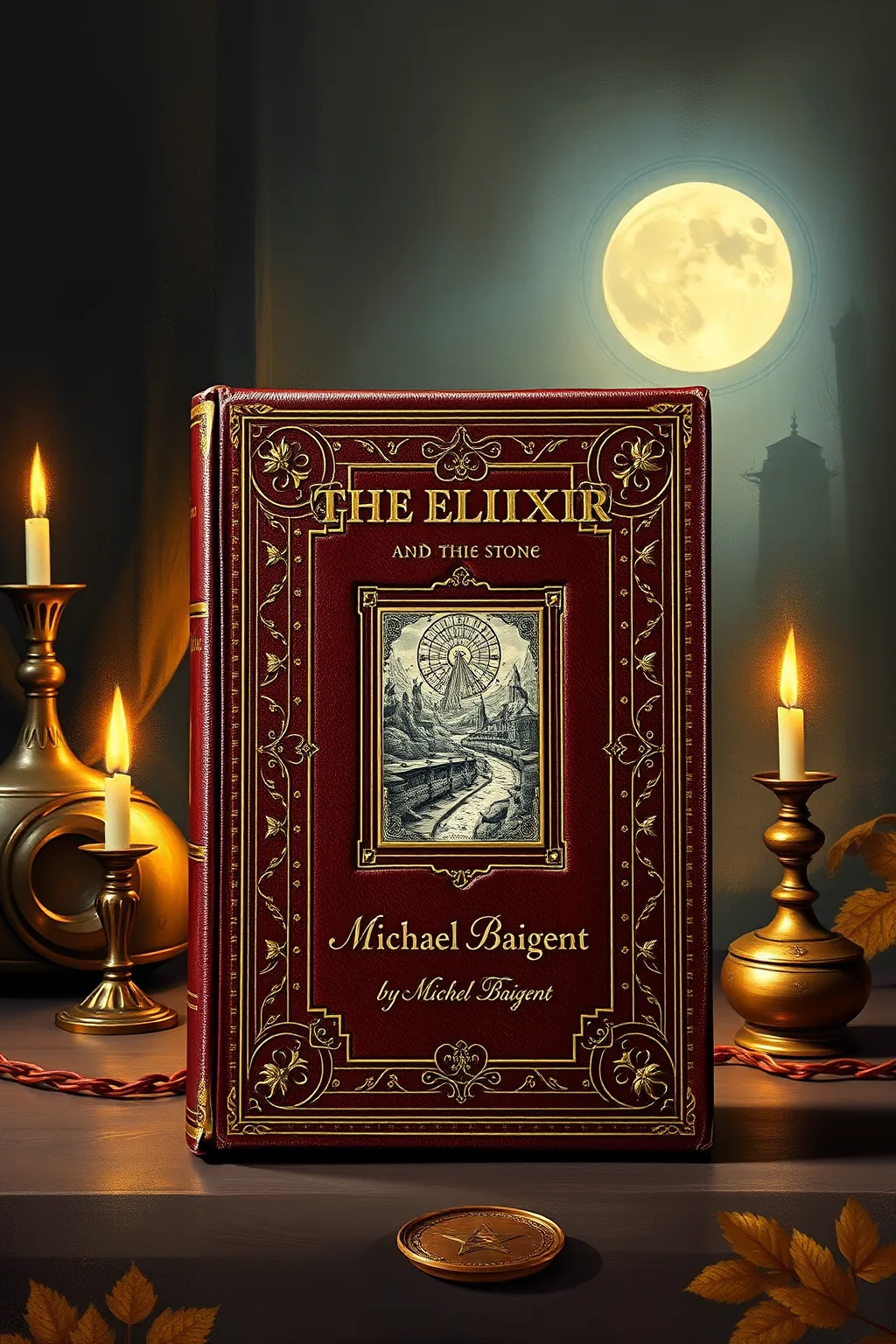
The elixir and the stone
 83
83

The elixir and the stone
Michael Baigent's *The Elixir and the Stone* offers a sober, scholarly approach to alchemy, largely sidestepping the more sensational claims often associated with the subject. Baigent is adept at tracing the philosophical lineage of alchemical thought, particularly its roots in Hermeticism and its evolution through various historical periods. His strength lies in presenting alchemy not merely as proto-chemistry, but as a complex spiritual and psychological discipline. The book effectively communicates the symbolic richness of alchemical texts, demonstrating how they encoded stages of inner transformation. However, the narrative can sometimes feel dense, with a reliance on dense historical detail that might occasionally obscure the core esoteric message for the less initiated reader. A passage discussing the *coniunctio oppositorum* (union of opposites) effectively illustrates the book's depth, showing how seemingly contradictory elements in alchemical symbolism represent stages of integration. Ultimately, it serves as a valuable, albeit demanding, resource for understanding the intellectual currents of alchemical practice.
📝 Description
83
Michael Baigent's 1998 book examines alchemy beyond turning lead into gold.
Published in 1998, The Elixir and the Stone by Michael Baigent scrutinizes the historical and symbolic aspects of alchemical practices. The book moves past simple ideas of transmutation, focusing instead on the deeper spiritual and metaphysical aims within the alchemical tradition. Baigent investigates the symbolic language and philosophical foundations that marked alchemical experimentation over centuries, linking it to broader trends in esoteric thought. His work aims to reveal the practical, personal transformation that alchemists sought, often expressed through allegory and coded writings.
This text appeals to those interested in the history of thought, particularly the development of esoteric philosophies and their practical applications. Readers curious about alchemy, its symbols, and its place in Western esotericism will find considerable material. It suits individuals who value thorough historical research and a precise understanding of old texts and methods, avoiding sensationalized views. Those drawn to the connections between spirituality, early science, and philosophy in pre-modern times will also find it worthwhile.
Baigent's work comes from a period of increased academic and popular attention to Western esotericism, following scholars like Frances Yates. It engages with the long history of alchemy, a tradition with origins in Hellenistic Egypt that developed significantly in medieval and Renaissance Europe. This tradition influenced figures such as Isaac Newton, who secretly studied alchemy. The book argues for a view of alchemy centered on personal transformation, distinct from purely materialistic interpretations.
💡 Why Read This Book?
• You will learn the historical evolution of alchemical symbolism, specifically how concepts like the *Prima Materia* were understood and depicted in texts dating from the medieval period. • You will gain insight into the spiritual and psychological dimensions of the alchemical quest, understanding the *Magnum Opus* as a process of inner refinement, not just material transformation. • You will discover the connections between alchemical traditions and broader esoteric philosophies, as Baigent illustrates how alchemical ideas influenced or were influenced by Hermeticism and Gnosticism.
⭐ Reader Reviews
Honest opinions from readers who have explored this book.
❓ Frequently Asked Questions
What is the primary focus of Michael Baigent's 'The Elixir and the Stone'?
The book focuses on the historical, philosophical, and symbolic dimensions of alchemy, examining its deeper spiritual and metaphysical aspirations beyond the literal pursuit of gold.
When was 'The Elixir and the Stone' first published?
'The Elixir and the Stone' was first published in 1998.
Does the book discuss the philosopher's stone?
Yes, the book extensively discusses the philosopher's stone as a central symbol within alchemy, exploring its meaning in relation to material transmutation and spiritual perfection.
What historical periods does Baigent cover regarding alchemy?
Baigent covers a broad sweep of history, touching upon alchemy's roots in Hellenistic Egypt and its significant developments throughout medieval and Renaissance Europe.
Is this book suitable for beginners in alchemy?
While informative, the book's scholarly depth and detailed historical analysis may be more suited for those with some prior interest or knowledge of esoteric traditions.
What is the 'Magnum Opus' as discussed in the book?
The 'Magnum Opus', or Great Work, is presented as the alchemist's ultimate goal, encompassing the creation of the philosopher's stone and the alchemist's own spiritual purification and transformation.
🔮 Key Themes & Symbolism
The Alchemical Main work
Baigent explores the *Main work*, or Great Work, as the central undertaking of alchemy. This concept extends beyond mere material transformation to encompass a profound process of spiritual purification and self-realization for the alchemist. The book details how alchemical texts often described this process through allegorical stages, mirroring cosmic cycles and the internal journey of the practitioner. The pursuit of the philosopher's stone is intricately linked to this transformative journey, representing the ultimate achievement of spiritual perfection and integration.
Symbolism of the Prima Materia
The *Prima Materia*, or first matter, is presented as a foundational concept in alchemical symbolism. Baigent examines how this primordial substance, often depicted as chaotic or undifferentiated, represents the potential from which all reality arises. Alchemical operations were seen as a means to purify and refine the *Prima Materia*, moving it through various states towards perfection. The book analyzes the diverse symbolic representations of this substance across different alchemical traditions and texts.
Duality and Integration
A significant theme is the alchemical emphasis on the union of opposites, or *coniunctio oppositorum*. Baigent illustrates how alchemical symbolism frequently employs dualistic imagery—such as male/female, sun/moon, gold/silver—to represent fundamental polarities within the cosmos and the human psyche. The Great Work is often understood as the process of reconciling these opposing forces, leading to a state of wholeness and balance. The Elixir and the Stone themselves can be seen as symbolic representations of this integrated state.
Hermetic Roots and Esoteric Lineage
The work traces the lineage of alchemical thought, highlighting its deep connections to Hermetic philosophy, Gnosticism, and Neoplatonism. Baigent investigates how principles derived from these ancient traditions—such as the axiom 'as above, so below'—informed alchemical theories and practices. This contextualization positions alchemy within a broader Western esoteric tradition, demonstrating its role in preserving and transmitting specific spiritual and philosophical ideas across centuries. The book emphasizes alchemy as a spiritual path.
💬 Memorable Quotes
Direct passages from the work, attributed to the author.
“The goal of alchemy was not merely material wealth, but spiritual perfection.”
— This interpretation highlights the core argument that alchemists sought a profound inner transformation, viewing the physical processes as metaphors for spiritual development and the attainment of higher consciousness.
“Alchemical texts are often allegorical, describing inner states through external processes.”
— This highlights Baigent's view that understanding alchemy requires deciphering its symbolic language, recognizing that descriptions of laboratory work often represent psychological or spiritual stages of the alchemist's journey.
“The union of opposites is a crucial step towards achieving the Great Work.”
— This interpretation points to the alchemical concept of integrating dualistic forces, such as masculine and feminine energies, as essential for achieving balance, wholeness, and the ultimate alchemical goal.
💡 Key Ideas
Editorial paraphrase of the work's core concepts — not direct quotes.
The Prima Materia represents the undifferentiated potential from which all creation emerges.
This paraphrase captures the essence of the *Prima Materia* as the fundamental, unformed substance that alchemists believed held the key to understanding and manipulating the very fabric of existence.
The philosopher's stone symbolized ultimate perfection, both material and spiritual.
This paraphrase emphasizes the dual nature of the philosopher's stone's symbolism, representing not only the power to transmute base metals but also the alchemist's own attainment of spiritual enlightenment and integration.
🌙 Esoteric Significance
Tradition
The Elixir and the Stone is firmly situated within the Western Esoteric Tradition, drawing heavily from Hermeticism, Gnosticism, and Neoplatonism. Baigent explores alchemy as a continuation and evolution of these ancient wisdom streams, particularly emphasizing its philosophical underpinnings and spiritual aspirations. The work aligns with traditions that view the universe as imbued with divine intelligence and see human consciousness as capable of participating in cosmic processes. Baigent's interpretation positions alchemy as a practical discipline aimed at spiritual realization, rather than solely a material or chemical pursuit.
Symbolism
Key symbols examined include the philosopher's stone, representing ultimate perfection and the power of transformation, and the Elixir, often associated with immortality or spiritual vitality. The *Prima Materia*, the undifferentiated primordial substance, is explored as the foundation of all existence and the starting point for the alchemical transformation. The book also looks at the symbolism of dualities—such as the sun and moon, king and queen—representing the union of opposites (*coniunctio oppositorum*) necessary for achieving wholeness and completing the *Main work*.
Modern Relevance
Contemporary practitioners of Western esotericism, particularly those involved in Hermeticism and ceremonial magic, continue to draw on the symbolic and philosophical frameworks presented in works like Baigent's. His analysis of alchemy as a psycho-spiritual discipline speaks to modern depth psychology and Jungian interpretations of archetypes. Thinkers and students exploring the history of consciousness, comparative religion, and the intersection of science and spirituality find value in Baigent's meticulously researched accounts of how ancient traditions conceived of transformation and cosmic order.
👥 Who Should Read This Book
• Students of Western Esotericism: Those seeking to understand the historical development and philosophical underpinnings of traditions like Hermeticism, Gnosticism, and alchemy will find a detailed and scholarly examination. • Researchers of Comparative Religion: Individuals interested in how different cultures and eras have conceptualized spiritual transformation, the nature of reality, and humanity's place within the cosmos will benefit from Baigent's insights. • Practitioners of Symbolic Disciplines: Those engaged with symbolic languages, mythology, and the psychological interpretation of ancient texts will find rich material on alchemical allegory and its deeper meanings.
📜 Historical Context
Michael Baigent's *The Elixir and the Stone*, published in 1998, arrived during a resurgence of interest in Western esotericism, building upon scholarly foundations laid by figures like Frances Yates and Antoine Faivre. The late 20th century saw a growing academic and popular engagement with previously marginalized spiritual traditions. Baigent's work contributed to this by presenting a detailed historical and philosophical analysis of alchemy, positioning it within its Hermetic and Gnostic roots. Unlike more sensationalist accounts, Baigent’s approach emphasized the symbolic and spiritual dimensions of alchemical practice, aligning with scholarship that viewed alchemy as a complex philosophical system rather than mere proto-chemistry. While not directly engaging in polemics with specific contemporaries in its text, the book implicitly responded to the prevailing historical-materialist interpretations of alchemy, offering a more nuanced perspective that acknowledged its esoteric significance. The era was also marked by the nascent internet, which democratized access to esoteric texts, yet Baigent’s research remained firmly rooted in traditional scholarship.
📔 Journal Prompts
The concept of the *Prima Materia* as a source of potential.
The symbolic representation of the union of opposites in alchemical texts.
How the *Main work* can be interpreted as a personal spiritual quest.
The historical connection between Hermetic philosophy and alchemical practices.
Reflecting on the dual nature of the Elixir and the Stone symbolism.
🗂️ Glossary
Main work
The 'Great Work' of alchemy, encompassing the entire process of creating the philosopher's stone and achieving spiritual perfection and enlightenment.
Philosopher's Stone
A legendary alchemical substance believed to be capable of transmuting base metals into gold or silver, and often seen as a symbol of spiritual perfection and enlightenment.
Elixir
In alchemy, often refers to a potion or substance believed to grant immortality, eternal youth, or profound healing. It is closely related to the philosopher's stone in its transformative properties.
Prima Materia
The 'first matter,' a fundamental, undifferentiated substance from which all things are believed to originate in alchemical philosophy. It represents pure potential.
Coniunctio Oppositorum
Latin for 'union of opposites.' In alchemy, this refers to the symbolic integration of dualistic forces (e.g., male/female, sun/moon) as a crucial stage towards achieving wholeness.
Hermeticism
A philosophical and religious tradition based on the purported teachings of Hermes Trismegistus, emphasizing divine wisdom, cosmic principles, and the interconnectedness of all things.
Gnosticism
A diverse set of religious ideas and systems, often characterized by a belief in a transcendent God and the existence of hidden knowledge (gnosis) that leads to salvation.
🔮 Readers Also Liked
Browse all →







More by Michael Baigent
All books →



More Free Alchemy & Hermeticism Books
View all →