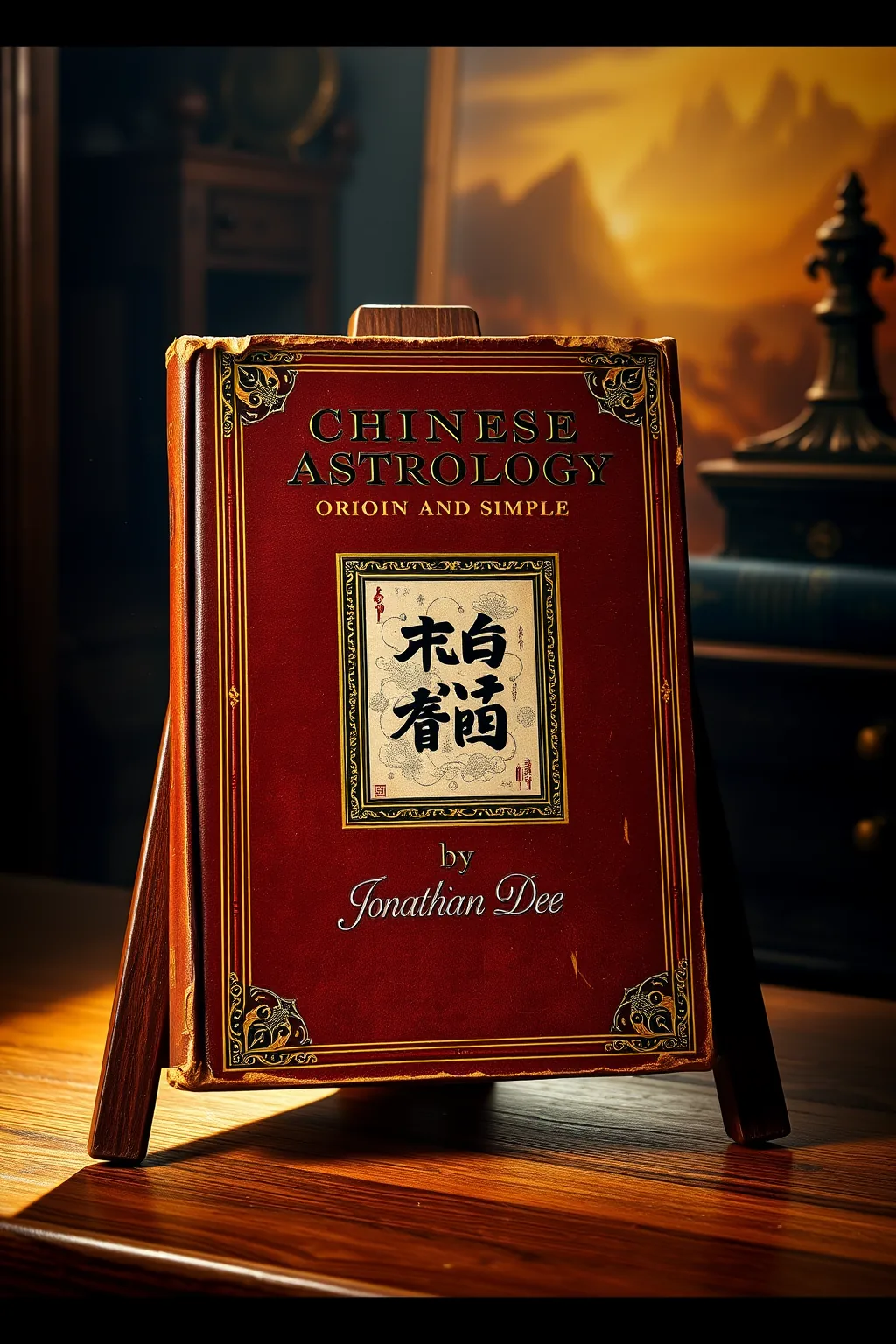
Chinese Astrology, Orion Plain and Simple
 83
83

Chinese Astrology, Orion Plain and Simple
Jonathan Dee’s "Chinese Astrology, Orion Plain and Simple" offers a refreshingly direct approach to a subject often obscured by esoteric jargon. The 2017 publication presents the core mechanics of the Chinese zodiac and the Five Elements with commendable clarity, particularly in its explanation of the Wu Xing cycle. Dee avoids excessive flowery language, which is a significant advantage for newcomers. However, the book’s brevity, while contributing to its accessibility, sometimes leaves one wishing for deeper dives into specific applications or more nuanced discussions on the interaction between the elements and the animal signs. For instance, the section on compatibility between signs could benefit from more detailed case studies or historical examples beyond the basic pairings. Despite this limitation, the work succeeds in providing a solid, foundational understanding. It’s a competent primer for anyone seeking to grasp the essentials of this ancient system without getting lost in overly complex theories.
📝 Description
83
Jonathan Dee's 2017 book demystifies Chinese zodiacal cosmology.
Chinese Astrology, Orion Plain and Simple examines the traditional animal year cycles, the Five Elements (Wu Xing), and Yin-Yang dualities. Dee presents these as interconnected energies influencing personality, relationships, and life paths, rather than strict dogma. This work is accessible for those new to Eastern astrological traditions. It is especially helpful for individuals familiar with Western astrology who want to grasp parallel Chinese frameworks. Readers seeking practical insights for self understanding and interpersonal dynamics will find value here. The book details the twelve animal zodiac signs and their unique characteristics. It also elaborates on the cyclical interactions of the Five Elements – Wood, Fire, Earth, Metal, and Water – and their combinations with Yin and Yang to create distinct energies. Dee argues that the interplay between these elements and animal signs forms a decipherable system for understanding cosmic influences.
Chinese astrology has roots reaching back to the Han Dynasty, developing alongside Taoism and astronomical observation. Its framework is built on the Five Elements, a core concept in Chinese philosophy that views the universe as a dynamic interplay of forces. Dee's book enters this field, aiming for clarity in explaining how these elements and the twelve animal signs combine to map personal destinies and cosmic influences. This tradition offers a distinct cosmological perspective compared to Western astrological systems.
💡 Why Read This Book?
• Learn the fundamental principles of the 12 Chinese zodiac animals and their associated characteristics, providing a distinct lens for self-assessment beyond Western zodiac signs. • Understand the dynamic interplay of the Five Elements (Wu Xing) and Yin-Yang, grasping how these forces shape personality and predict elemental compatibility as presented by Dee. • Gain insight into the historical development of Chinese astrology, situating its origins within the Han Dynasty (206 BCE – 220 CE) and its philosophical underpinnings.
⭐ Reader Reviews
Honest opinions from readers who have explored this book.
❓ Frequently Asked Questions
What is the significance of the Five Elements in Chinese Astrology, Orion Plain and Simple?
The Five Elements (Wu Xing) – Wood, Fire, Earth, Metal, and Water – are central to Dee's explanation, representing fundamental energies that interact cyclically. Their balance or imbalance with Yin and Yang influences personality, relationships, and destiny within the Chinese astrological framework.
How does Jonathan Dee's book differentiate itself from other Chinese astrology guides?
Dee's approach, as seen in its 2017 publication, prioritizes clarity and simplicity ('Plain and Simple'). It aims to demystify the system, focusing on core concepts and practical understanding rather than extensive historical or philosophical digressions found in more academic texts.
Is Chinese Astrology, Orion Plain and Simple suitable for absolute beginners?
Yes, the book is designed for those new to Chinese astrology. It breaks down the 12 animal signs and the Five Elements systematically, making it an accessible starting point for understanding this ancient system of divination and personality assessment.
What are the core components of Chinese astrology discussed in the book?
The book primarily covers the 12 animal zodiac signs associated with yearly cycles and the Five Elements (Wu Xing), along with their associated Yin and Yang polarities. These components are presented as the building blocks for astrological interpretation.
Does the book explain the origins of Chinese astrology?
While not its primary focus, the book touches upon the historical context, linking the development of Chinese astrology to ancient Chinese dynasties and philosophical traditions. It situates the system within its broader cultural and intellectual heritage.
Can I use the information in this book for personal growth?
Absolutely. Dee structures the book to facilitate self-understanding by explaining how one's birth year animal sign and elemental composition might influence traits and relationships, offering practical insights for personal development.
🔮 Key Themes & Symbolism
The Twelve Animal Signs
The book meticulously details the characteristics associated with each of the twelve animals in the Chinese zodiac: Rat, Ox, Tiger, Rabbit, Dragon, Snake, Horse, Goat, Monkey, Rooster, Dog, and Pig. Dee explains how the year of one's birth under a particular animal sign imbues them with specific personality traits, strengths, and potential challenges. This section provides a foundational understanding of how these archetypal energies manifest in individuals, influencing their temperament, social interactions, and life trajectory over the 60-year cycle.
The Five Elements (Wu Xing)
Central to Chinese cosmology, the Wu Xing—Wood, Fire, Earth, Metal, and Water—are presented as dynamic forces that interact in creative and destructive cycles. Dee explains how these elements, when combined with the Yin and Yang polarities, modify the influence of the animal signs. Understanding these elemental interactions is crucial for a deeper interpretation of compatibility, fortune, and the underlying energetic currents that shape events and personalities.
Yin and Yang Dynamics
The concept of Yin and Yang, the primordial dualities of passive/active, dark/light, is integrated throughout the book. Dee illustrates how each animal sign and element possesses a Yin or Yang aspect, creating further layers of complexity and nuance. This binary system is fundamental to understanding balance and harmony within the Chinese astrological framework, offering insights into complementary relationships and the ebb and flow of energies.
Practical Application and Interpretation
Beyond theoretical explanations, the work emphasizes the practical application of Chinese astrological principles. Dee guides readers on how to interpret birth charts, understand relationship compatibility based on animal signs and elements, and potentially forecast general trends. The aim is to equip the reader with tools for self-reflection and navigating interpersonal dynamics through the lens of this ancient system.
💬 Memorable Quotes
Direct passages from the work, attributed to the author.
“The year of your birth grants you an animal, but the interplay of elements shapes its true nature.”
— This highlights the core principle that while the animal sign provides a basic framework, the more nuanced understanding comes from analyzing the accompanying elemental and Yin-Yang influences present at birth.
“Water flows, Fire consumes, Wood grows, Metal cuts, Earth grounds.”
— A concise summary of the fundamental characteristics of the Five Elements (Wu Xing), illustrating their inherent qualities and potential interactions within the Chinese cosmological system.
“Understanding the cycles is key; the universe is in constant motion, not static.”
— This emphasizes the dynamic and cyclical nature of Chinese astrology, contrasting it with static or fixed systems and pointing towards the importance of observing patterns and transitions.
“Compatibility is not just about shared traits, but about how energies complement or challenge each other.”
— This interpretation focuses on the relational aspect of Chinese astrology, suggesting that successful pairings arise from a balance of energies, rather than mere similarity, a concept explored through elemental and Yin-Yang interactions.
“Each animal possesses both a light and a shadow side, dictated by its elemental pairings.”
— This points to the inherent duality within each zodiacal archetype, suggesting that the expression of an animal's traits is significantly modulated by the specific elemental energies associated with that particular birth year.
🌙 Esoteric Significance
Tradition
This work engages with the tradition of Chinese Cosmology, a system deeply embedded in Taoist philosophy and ancient astronomical practices. While not typically classified under Western Hermeticism or Kabbalah, its focus on cyclical energies, elemental correspondences, and the interplay of Yin and Yang shares a conceptual kinship with esoteric systems that seek to map universal forces and their influence on human life. It offers a distinct, Eastern perspective on cosmic order and human destiny.
Symbolism
The primary symbols are the twelve animals of the zodiac (e.g., the Dragon, representing power and auspiciousness; the Rabbit, symbolizing gentleness and longevity) and the Five Elements (Wood, Fire, Earth, Metal, Water). The animals embody archetypal energies, while the elements represent fundamental forces of transformation and interaction. Their combination and the associated Yin-Yang polarities create a rich symbolic language for understanding personality, relationships, and the flow of time.
Modern Relevance
Contemporary practitioners of holistic wellness, mindfulness, and comparative spirituality often draw upon diverse global traditions. Dee's accessible presentation of Chinese astrology makes its principles relevant for modern self-help, relationship counseling, and personal development. It provides a framework for understanding personal strengths and challenges, fostering self-awareness and promoting a more cyclical, nature-aligned perspective on life, echoing current interests in traditional wisdom.
👥 Who Should Read This Book
• Individuals curious about Eastern philosophies and astrological systems seeking a clear, uncomplicated introduction to the Chinese zodiac and the Five Elements. • Students of comparative religion and esotericism looking to understand the foundational concepts of a major non-Western cosmological framework. • Those interested in personal development and relationship dynamics who wish to explore alternative methods for self-understanding beyond Western astrological paradigms.
📜 Historical Context
Jonathan Dee's "Chinese Astrology, Orion Plain and Simple," published in 2017, enters a field with deep historical roots. The origins of Chinese astrology can be traced back to the Han Dynasty (206 BCE – 220 CE), where it intertwined with astronomical observation, calendrical systems, and Taoist philosophy. This era saw the formalization of the 12 animal zodiac and the integration of the Five Elements (Wu Xing), a conceptual framework also central to traditional Chinese medicine and other fields. While Dee’s work focuses on clarity for a modern audience, it stands in contrast to earlier, more complex scholarly interpretations and popularizations. During the 20th century, figures like Lin Yutang attempted to bridge Eastern and Western thought, making Chinese culture, including its astrological systems, more accessible globally. Dee’s contribution lies in providing a streamlined, "plain and simple" entry point, bypassing some of the intricate philosophical discussions that might accompany texts from earlier periods or more academic traditions.
📔 Journal Prompts
The Dragon's influence: Reflect on how the archetypal energies of the Dragon sign might manifest in your own life, considering its symbolic representation of power and change.
Elemental balance: Assess the balance of the Five Elements (Wu Xing) in your daily life and consider how to foster greater harmony.
Yin and Yang in relationships: Identify instances where Yin and Yang energies create balance or tension in your key relationships.
Your birth animal's shadow side: Consider the potential challenges or 'shadow' aspects associated with your birth year's animal sign as presented by Dee.
Reading through the cycles: How can understanding the cyclical nature of the Chinese zodiac inform your approach to upcoming personal or professional transitions?
🗂️ Glossary
Wu Xing
The Chinese concept of the Five Phases or Five Elements: Wood, Fire, Earth, Metal, and Water. They represent fundamental forces and stages of change in the universe, influencing everything from personality to natural phenomena.
Yin and Yang
The fundamental principle of dualism in Chinese philosophy, representing complementary and opposing forces. Yin is typically associated with passivity, darkness, and femininity, while Yang embodies activity, light, and masculinity.
Zodiac Animals
The twelve animals of the Chinese zodiac (Rat, Ox, Tiger, Rabbit, Dragon, Snake, Horse, Goat, Monkey, Rooster, Dog, Pig), each associated with a specific year in a 12-year cycle and believed to influence personality traits.
Elemental Cycle
Refers to the patterns of interaction between the Five Elements (Wu Xing), often described as a 'generating' or 'creative' cycle (e.g., Wood feeds Fire) and a 'controlling' or 'destructive' cycle (e.g., Water extinguishes Fire).
Birth Chart (Chinese Astrology)
An astrological profile based on the year, and sometimes month, day, and hour of a person's birth, which identifies their animal sign, elemental composition, and Yin-Yang polarity.
Han Dynasty
A significant imperial dynasty in Chinese history (206 BCE – 220 CE) during which many foundational elements of Chinese culture, philosophy, and astrology were developed and codified.
Cosmology
A theory or model of the order and origin of the universe. In this context, it refers to the Chinese understanding of how the cosmos functions and its relationship to human existence.
🔮 Readers Also Liked
Browse all →









More by Jonathan Dee
All books →



More Free Astrology & Cosmology Books
View all →