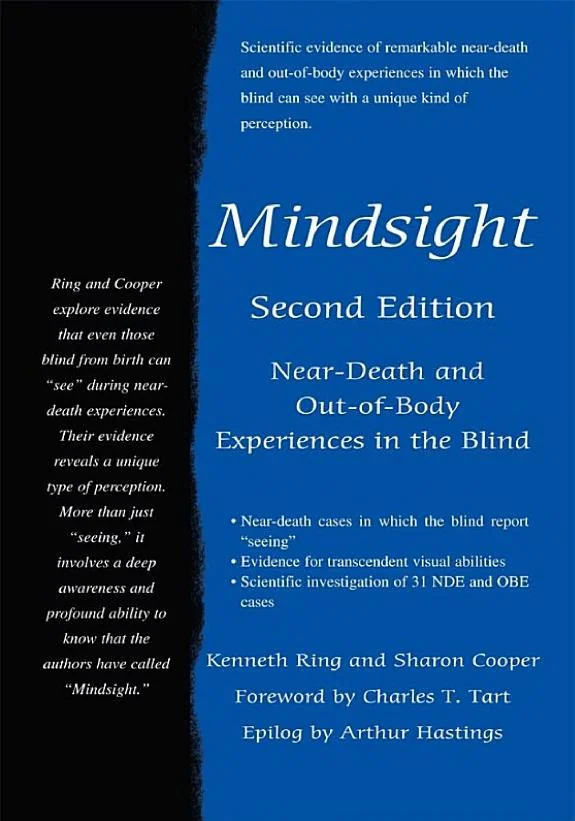
Mindsight
 77
77

Mindsight
Kenneth Ring and Sharon Cooper's *Mindsight* tackles a particularly intriguing facet of consciousness research: the visual perception of the congenitally blind during NDEs. The authors' dedication to presenting detailed case studies is commendable, offering a substantial body of anecdotal evidence. They adeptly manage the delicate task of analyzing subjective reports, striving for a balance between empirical rigor and open-minded inquiry. A notable strength lies in their careful distinction between conventional sight and the 'seeing' reported in altered states, which they term "transcendental awareness." However, the work occasionally leans heavily on interpretation, and while the evidence is suggestive, the leap to definitively proving a non-physical mode of vision remains a philosophical and scientific hurdle. The detailed case of Mrs. P, who had been blind since birth and reported seeing colors and shapes during an OBE, serves as a powerful illustration of the book's central thesis. Ultimately, *Mindsight* offers a significant contribution to the literature on NDEs, particularly for those open to exploring the boundaries of perception.
📝 Description
77
Kenneth Ring and Sharon Cooper's 2008 book, Mindsight, investigates visual experiences during NDEs in the blind.
Mindsight, published in 2008 by Kenneth Ring and Sharon Cooper, examines visual phenomena reported by individuals during near-death and out-of-body experiences, with a specific focus on those who were congenitally blind or had lost their sight. The authors compile and scrutinize numerous case histories, presenting evidence that questions common views of perception and consciousness. They detail accounts where blind individuals report seeing for the first time in these altered states, a phenomenon that suggests perception may not be solely dependent on physical sensory input. The work challenges materialistic models by proposing that consciousness might access visual information through non-physical means. This detailed analysis of exceptional cases aims to advance the understanding of consciousness beyond its biological constraints.
The book is intended for parapsychologists, consciousness researchers, and individuals interested in the connections between spirituality, psychology, and unusual phenomena. It is particularly useful for those contemplating the nature of reality beyond sensory limitations and those who prefer empirical methods for studying subjective states. Ring and Cooper build upon earlier research into altered states, contributing specific case studies to a field that gained attention from the 1970s onward.
This work emerges from the study of altered states of consciousness and subjective reports that diverge from standard materialistic viewpoints. Ring and Cooper extend the discourse on near-death experiences, a field that gained significant visibility starting in the 1970s with researchers like Elisabeth Kübler-Ross and Raymond Moody. Their contribution focuses on specific cases, particularly those involving blind individuals, adding a unique dimension to the broader investigation into phenomena that suggest consciousness operates beyond the confines of the physical body and its sensory apparatus.
💡 Why Read This Book?
• You will learn about the specific phenomenon of "transcendental awareness" as reported by individuals blind from birth during near-death experiences, a concept explored through detailed case studies presented by Ring and Cooper. • You will gain insight into the historical context of NDE research, understanding how *Mindsight* (published 2008) fits within the broader work of figures like Raymond Moody and Elisabeth Kübler-Ross. • You will discover arguments challenging the materialist view of consciousness by examining how perception might operate independently of physical sensory input, as evidenced by the case histories compiled by the authors.
⭐ Reader Reviews
Honest opinions from readers who have explored this book.
❓ Frequently Asked Questions
Can blind individuals truly see during near-death experiences according to *Mindsight*?
Yes, *Mindsight* presents evidence suggesting that individuals blind from birth or by loss of sight have reported visual experiences during NDEs/OBEs. The authors, Kenneth Ring and Sharon Cooper, detail numerous case histories supporting this claim, though they differentiate this perception from ordinary physical sight.
What is "transcendental awareness" as discussed in *Mindsight*?
"Transcendental awareness" is the term Ring and Cooper use to describe the visual perceptions reported by blind individuals during altered states. It's posited not as physical sight, but a form of direct apprehension or consciousness that bypasses the normal sensory apparatus.
When was *Mindsight* by Kenneth Ring and Sharon Cooper first published?
The book *Mindsight* by Kenneth Ring and Sharon Cooper was first published in March 2008, building upon decades of research into near-death experiences and consciousness.
What kind of evidence does *Mindsight* use to support its claims?
The primary evidence presented in *Mindsight* consists of detailed case histories and anecdotal reports from individuals who have experienced near-death or out-of-body episodes. These accounts are scrutinized by the authors.
Is *Mindsight* a scientific study or a philosophical exploration?
*Mindsight* blends elements of both. It is rooted in the empirical collection of subjective reports, akin to qualitative research, but also engages in philosophical interpretation regarding the nature of consciousness and perception.
Who were key figures in the field of NDE research before *Mindsight*?
Pioneers in NDE research prior to *Mindsight*'s 2008 publication include Elisabeth Kübler-Ross, who documented end-of-life experiences, and Raymond Moody, whose 1975 book *Life After Life* popularized the concept of NDEs.
🔮 Key Themes & Symbolism
Perception Beyond the Physical
The core theme of *Mindsight* revolves around the possibility of perception existing independently of physical sensory organs. Ring and Cooper meticulously document instances where individuals blind from birth report visual phenomena during altered states of consciousness. This challenges the materialist assumption that consciousness and perception are solely products of the brain and its sensory inputs. The authors propose that in states like NDEs or OBEs, a different mode of awareness, termed "transcendental awareness," may activate, allowing for a form of seeing that is not contingent on eyes.
The Nature of Consciousness
*Mindsight* directly engages with profound questions about the nature of consciousness itself. By presenting cases of blind individuals experiencing visual phenomena, the book suggests that consciousness might be a fundamental aspect of reality, capable of operating in non-local ways or through dimensions beyond our everyday physical experience. The authors explore whether the "seeing" reported is an artifact of brain activity or evidence of a consciousness that can exist and perceive independently of the physical body, aligning with certain esoteric and philosophical viewpoints on mind-matter interaction.
Near-Death and Out-of-Body Experiences
The book situates its central thesis within the established framework of near-death and out-of-body experiences. Ring and Cooper analyze these extraordinary states as potential windows into the non-physical aspects of existence. The unique focus on blind experiencers serves to isolate the phenomenon of visual perception from the more commonly studied elements of NDEs. By examining these specific accounts, they aim to provide compelling, albeit anecdotal, evidence for the reality of consciousness beyond the physical body, and its capacity for sensory experience.
Evidence and Interpretation
A significant aspect of *Mindsight* is its methodological approach. Ring and Cooper present their findings with scrupulous detail, analyzing numerous case histories to build their argument. They acknowledge the subjective nature of the data but argue for the consistency and compelling nature of the reports. The work grapples with the challenge of interpreting such phenomena, distinguishing between conventional understanding and the possibilities suggested by these extraordinary experiences. The authors aim to present the evidence in a manner that invites critical consideration rather than outright dismissal.
💬 Memorable Quotes
Direct passages from the work, attributed to the author.
“blind persons... can actually "see" during near-death or out-of-body episodes”
— This core assertion of *Mindsight* suggests that the authors found compelling evidence for visual experiences in individuals without sight during altered states, challenging conventional biological explanations.
“the blind do "see" in these moments, but it is not sight as we think of it”
— Ring and Cooper emphasize that the visual phenomena reported are qualitatively different from physical sight, proposing a "transcendental awareness" that operates on principles beyond our ordinary sensory understanding.
“investigating case histories of blind persons who have actually reported visual experiences”
— This highlights the research methodology of *Mindsight*, focusing on meticulously collected personal accounts as the primary basis for their claims about perception in altered states.
“suggest a kind of "transcendental aware”
— This points to the authors' theoretical contribution, offering a conceptual framework to explain how non-physical 'seeing' might occur, distinct from biological vision.
“fascinating evidence that the blind do "see"”
— The authors frame their findings as strongly indicative of a phenomenon beyond ordinary experience, suggesting that the evidence warrants serious consideration of non-physical perception.
🌙 Esoteric Significance
Tradition
The work aligns with esoteric traditions that posit consciousness as primary and potentially separable from the physical body, such as certain schools of idealism, non-dual philosophies, and Western metaphysical movements. While not explicitly framed within a specific lineage like Hermeticism or Kabbalah, its exploration of non-physical perception and consciousness echoes themes found in Theosophy and New Age thought regarding the astral body and subtle senses.
Symbolism
The primary "symbol" explored is sight itself, or rather, the absence and re-emergence of visual perception in non-ordinary states. The concept of "blindness" becomes a symbol for the limitations of the physical senses, while "seeing" in NDEs symbolizes a higher, spiritual, or transcendental mode of apprehension that transcends material constraints.
Modern Relevance
Contemporary discussions in consciousness studies, transpersonal psychology, and even fields like quantum mysticism, often touch upon the ideas explored in *Mindsight*. Thinkers and practitioners interested in out-of-body experiences, lucid dreaming, and the potential for consciousness to exist independently of the brain find resonance in Ring and Cooper's meticulous case collections.
👥 Who Should Read This Book
• Researchers and students of parapsychology and consciousness studies interested in empirical investigations of anomalous subjective experiences. • Individuals who have had near-death or out-of-body experiences, particularly those who are blind or visually impaired, seeking to understand similar reported phenomena. • Philosophers and metaphysicians exploring the mind-body problem and the nature of perception beyond the physical senses.
📜 Historical Context
Published in 2008, *Mindsight* emerged during a period of sustained academic and public interest in near-death experiences (NDEs), building on foundational work by researchers like Raymond Moody in the 1970s and Elisabeth Kübler-Ross. While the broader study of NDEs was gaining acceptance, research specifically on the visual experiences of the congenitally blind during these states remained a niche area. Ring and Cooper's work contributed detailed case studies to this specialized field, challenging purely materialistic explanations of consciousness that were prevalent in mainstream neuroscience. Their approach, while empirical in its collection of anecdotal data, engaged with philosophical debates about the mind-body problem. The era also saw advancements in consciousness studies and parapsychology, though often met with skepticism from established scientific institutions, a reception similar to that faced by earlier NDE researchers.
📔 Journal Prompts
The concept of "transcendental awareness" and its implications for sensory experience.
How the reported visual experiences of the blind during NDEs challenge materialistic models of consciousness.
Personal reflections on the relationship between consciousness and physical senses, inspired by *Mindsight*.
The methodology of collecting and interpreting subjective reports of altered states of consciousness.
Comparing the "seeing" described in *Mindsight* with visionary or mystical experiences in other traditions.
🗂️ Glossary
Near-Death Experience (NDE)
A profound personal experience associated with being close to death, often including feelings of peace, out-of-body sensations, and encounters with light or beings.
Out-of-Body Experience (OBE)
A sensation of floating outside one's body and having the ability to perceive one's physical body and surroundings from a different vantage point.
Congenital Blindness
Blindness present from birth, meaning the individual has never had physical sight.
Transcendental Awareness
The term used by Ring and Cooper to describe the reported visual perception experienced by blind individuals during NDEs/OBEs, distinct from ordinary physical sight.
Materialism
The philosophical view that matter is the fundamental substance in nature, and that all phenomena, including consciousness, are results of material interactions.
Case History
A detailed account of an individual's medical or personal history, often used in research to document specific phenomena or experiences.
Perception
The process of becoming aware of something through the senses, or the way in which something is regarded, understood, or interpreted.
This book appears in 1 collection
🔮 Readers Also Liked
Browse all →








From the “Astral Projection” Collection
View all →







More Free Occult Philosophy Books
View all →