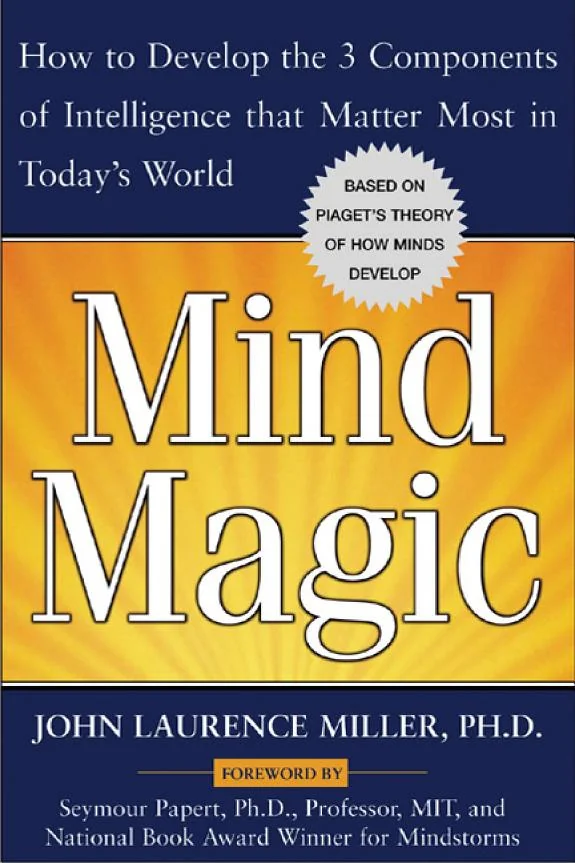
Mind Magic
 72
72

Mind Magic
John Laurence Miller’s "Mind Magic" attempts to distill the complex theories of Jean Piaget into an actionable program for mental enhancement. The book’s strength lies in its direct lineage from Piaget’s work, offering a more structured, less speculative approach than many esoteric texts. Miller’s concept of "mind consciousness"—understanding one's unique cognitive style—is compelling. He posits that this self-awareness is the gateway to increased intelligence and creativity. However, the practical application of these ideas can feel somewhat dry. While the connection to Piaget is clear, the "magic" promised by the title feels more like diligent practice. A passage discussing the identification of individual "thinking best" patterns, for instance, is informative but requires significant reader engagement to yield results. The book offers a solid framework for cognitive self-improvement rooted in established psychological principles, though it demands commitment from the reader to achieve its promised results.
📝 Description
72
John Laurence Miller's Mind Magic, published in October 2004, provides a structured system for mental enhancement.
Published in October 2004, John Laurence Miller's "Mind Magic" is not an abstract collection of theories but a practical manual for improving cognitive abilities. Miller, a former student of Jean Piaget, builds upon Piaget's work on intelligence and child development to create a program for self-improvement. The book aims to help individuals elevate their intellectual performance, increase creativity, and gain a better understanding of their own thought processes.
This text is for those interested in psychology, self-help, and cognitive enhancement, particularly readers familiar with or curious about Piaget's ideas. It requires commitment to personal growth and a willingness to engage with systematic mental exercises. Miller's approach bridges academic psychology with practical self-improvement, offering a method derived from Piagetian principles.
While drawing from developmental psychology, "Mind Magic" enters esoteric traditions by focusing on the conscious manipulation and optimization of mental states. It moves beyond standard psychological frameworks to suggest that awareness of one's 'optimal thinking patterns' can be systematically cultivated. This aligns with esoteric practices that seek to refine inner faculties and achieve higher states of awareness or performance through disciplined mental effort, rather than solely through observation or passive understanding.
💡 Why Read This Book?
• Learn to identify and leverage your unique "mind consciousness," as explored in John Laurence Miller's 2004 work, to optimize your thinking processes for enhanced intelligence. • Gain practical techniques derived from Jean Piaget's foundational theories on cognitive development, offering a structured path to unlock greater creativity and mental agility. • Understand how to systematically improve your cognitive functions by applying Miller's program, moving beyond abstract concepts to concrete, repeatable mental exercises.
⭐ Reader Reviews
Honest opinions from readers who have explored this book.
❓ Frequently Asked Questions
What is "mind consciousness" according to John Laurence Miller in "Mind Magic"?
In "Mind Magic," "mind consciousness" refers to an individual's awareness of their own optimal thinking patterns and cognitive styles. Miller, a former student of Jean Piaget, proposes that understanding how you best process information is the key to unlocking increased intelligence and creativity.
How does "Mind Magic" build upon Jean Piaget's work?
"Mind Magic" extends Jean Piaget's pioneering research on intelligence and mental development by offering a practical program. Miller, having studied under Piaget, translates Piagetian principles into actionable steps for readers to enhance their cognitive abilities and creative potential.
What specific benefits can readers expect from "Mind Magic"?
Readers can anticipate a structured approach to increasing their intelligence, boosting creativity, and improving problem-solving skills. The book provides methods to understand and refine one's thinking processes, leading to greater mental efficiency.
Is "Mind Magic" suitable for beginners in psychology?
Yes, "Mind Magic" is accessible to beginners interested in psychology and self-improvement. While it draws on complex theories from Jean Piaget, John Laurence Miller presents the concepts in a way that is understandable and applicable for those new to the subject.
What is the publication year of John Laurence Miller's "Mind Magic"?
The book "Mind Magic" by John Laurence Miller was first published on October 21, 2004.
What kind of exercises are included in "Mind Magic"?
While the book emphasizes understanding "mind consciousness," it includes exercises designed to help readers identify their optimal thinking patterns. These are practical steps aimed at refining cognitive processes for enhanced intelligence and creativity, rooted in Piagetian developmental psychology.
🔮 Key Themes & Symbolism
Mind Consciousness
The central theme of "Mind Magic" is the concept of "mind consciousness," defined by author John Laurence Miller as an individual's awareness of their unique cognitive style and optimal thinking patterns. This self-awareness is presented as the foundational element for unlocking greater intelligence and creativity. Miller, drawing from his studies with Jean Piaget, suggests that by understanding how one best processes information, learns, and solves problems, individuals can systematically enhance these abilities. The book aims to guide readers in identifying their personal cognitive strengths and weaknesses, providing a framework for targeted mental development and self-mastery.
Cognitive Enhancement Program
"Mind Magic" functions as a practical program for cognitive enhancement, moving beyond theoretical discussions. It outlines a systematic approach for readers to actively improve their mental faculties. Based on principles derived from Jean Piaget's extensive work on intelligence and developmental psychology, the book offers concrete strategies and exercises. The goal is to provide readers with tools to consciously develop their intellectual capacity and creative output. This focus on practical application distinguishes it as a guide for tangible self-improvement rather than mere philosophical exploration.
Piagetian Psychology Application
A significant theme is the application of Jean Piaget's seminal theories on cognitive development to adult mental enhancement. John Laurence Miller, a former student of Piaget, bridges the gap between Piaget's research, primarily focused on children, and its relevance for adult cognitive function and creativity. The book explores how understanding developmental stages and cognitive processes, as theorized by Piaget, can inform strategies for boosting intelligence in mature individuals. This direct engagement with a prominent 20th-century psychological framework provides an intellectual grounding for the book's practical advice.
Intelligence and Creativity Synergy
The book posits a strong link between heightened intelligence and increased creativity, viewing them not as separate abilities but as interconnected aspects of mental function. "Mind Magic" argues that by cultivating "mind consciousness" and employing the program's techniques, readers can foster both analytical sharpness and innovative thinking. The synergy between these two faculties is seen as crucial for comprehensive mental development. Miller's approach suggests that a deeper understanding of one's own cognitive processes can lead to breakthroughs in both logical reasoning and imaginative ideation.
💬 Memorable Quotes
Direct passages from the work, attributed to the author.
“The key to unleashing the mind's power, increased intelligence, and creativity.”
— This concise statement, likely from the original blurb, expresses the book's core promise. It positions "Mind Magic" as a practical manual for cognitive self-improvement, suggesting that the author provides direct methods to access latent mental abilities and enhance both intellectual and creative capacities.
“learning "mind consciousness," or how one thinks best.”
— This highlights the central concept Miller introduces. It defines "mind consciousness" not as mere introspection, but as a practical understanding of one's unique cognitive style and optimal functioning, serving as the foundational principle for the book's program.
“a former Piaget student builds upon his teacher's pioneering work.”
— This establishes the intellectual lineage of "Mind Magic." It signals that the book is grounded in established psychological research, specifically the influential theories of Jean Piaget, and offers a continuation or application of his ideas by an insider.
“Combining pro”
— This fragmented quote likely indicates that the book combines theoretical insights with practical application. It suggests that Miller's program integrates understanding of cognitive processes with actionable steps, offering readers a balanced approach to mental development.
💡 Key Ideas
Editorial paraphrase of the work's core concepts — not direct quotes.
Swiss psychologist Jean Piaget did for intelligence and mental development what Freud did for personality.
This quote emphasizes the lasting impact of Jean Piaget's work on psychology. By drawing this parallel, it frames Piaget's contributions as foundational and revolutionary, thereby lending significant weight and credibility to Miller's own work which is explicitly based on Piaget's research.
🌙 Esoteric Significance
Tradition
While "Mind Magic" is grounded in empirical psychology, its focus on unlocking latent mental powers and achieving self-mastery through internal discipline aligns with broader esoteric traditions emphasizing the development of the inner self. It can be seen as a modern interpretation of Hermetic principles concerning the power of the mind and the adage "As above, so below" applied to one's internal cognitive landscape. The book offers a secularized framework for achieving states of heightened awareness and cognitive function often sought in more overtly mystical practices.
Symbolism
The book itself doesn't heavily rely on traditional esoteric symbols. However, the concept of "mind consciousness" functions as a central motif, representing the inner sanctum of an individual's cognitive architecture. The act of understanding and refining one's thinking patterns can be viewed as an alchemical process, transforming raw mental potential into refined intellectual and creative output. The program's structured nature itself can symbolize the order and discipline required to master the chaotic energies of the mind.
Modern Relevance
Miller's work remains relevant for contemporary thinkers and practitioners interested in cognitive enhancement, personal development, and the intersection of psychology and self-help. It informs current discussions around mindfulness, brain training, and peak performance. Modern practitioners of positive psychology and cognitive behavioral therapy may find Miller's systematic approach to understanding and modifying thought processes particularly resonant, offering a bridge between academic psychology and applied self-improvement methodologies.
👥 Who Should Read This Book
• Individuals interested in cognitive psychology and self-improvement who seek practical methods to boost intelligence and creativity, particularly those familiar with or intrigued by Jean Piaget's theories. • Students and professionals aiming to optimize their learning and problem-solving skills by understanding and refining their unique thinking processes as outlined by Miller. • Those exploring the potential of the human mind beyond conventional limits, looking for a structured, psychology-based program that promises tangible mental enhancement.
📜 Historical Context
Published in October 2004, John Laurence Miller's "Mind Magic" arrived at a time when interest in cognitive psychology, neuroplasticity, and practical self-improvement techniques was high. The book directly engages with the intellectual legacy of Swiss psychologist Jean Piaget, whose theories on child development and intelligence had profoundly shaped 20th-century psychology. Miller, positioning himself as a former student of Piaget, sought to translate these developmental theories into an accessible program for adult cognitive enhancement. This approach distinguished it from more abstract philosophical works on consciousness or purely speculative esoteric texts. While Piaget's work was primarily descriptive of developmental stages, Miller's "Mind Magic" aimed to offer an prescriptive program for active mental improvement. The book’s emphasis on a structured, science-informed approach to enhancing intelligence and creativity resonated with a growing audience seeking tangible self-help strategies.
📔 Journal Prompts
Reflect on your personal "mind consciousness": when do you feel you think best?
Analyze a problem using the cognitive style you identified as your strongest.
How does understanding Piaget's developmental stages inform your view of adult learning?
Consider the synergy between intelligence and creativity in your own work.
Identify one specific technique from the book to practice this week for cognitive enhancement.
🗂️ Glossary
Mind Consciousness
The central concept in Miller's "Mind Magic," referring to an individual's awareness of their optimal thinking patterns and cognitive style. It is presented as the key to unlocking enhanced intelligence and creativity.
Cognitive Enhancement
The process of improving mental functions such as memory, attention, problem-solving, and creativity. Miller's book offers a program designed for this purpose, drawing from psychological principles.
Piagetian Theory
The body of work by Swiss psychologist Jean Piaget concerning cognitive development. Miller's "Mind Magic" builds upon Piaget's foundational research on how intelligence develops.
Intelligence
In the context of "Mind Magic," intelligence refers to a broad capacity for logic, understanding, self-awareness, learning, emotional knowledge, reasoning, planning, creativity, critical thinking, and problem-solving.
Creativity
The ability to generate novel and valuable ideas or solutions. Miller's book aims to enhance this faculty by improving the underlying cognitive processes through "mind consciousness."
Cognitive Style
An individual's preferred way of processing information, learning, and solving problems. Recognizing one's cognitive style is central to achieving "mind consciousness."
Mental Development
The growth and refinement of cognitive abilities over time. Miller's program is designed to foster continuous mental development beyond childhood stages studied by Piaget.
This book appears in 1 collection
🔮 Readers Also Liked
Browse all →









From the “Mind Power” Collection
View all →





More Free Occult Philosophy Books
View all →