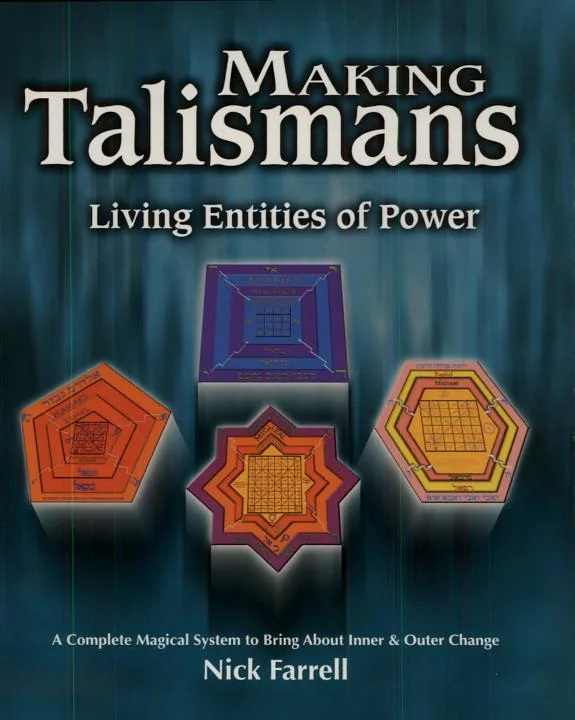
Making Talismans
 79
79

Making Talismans
Nick Farrell’s "Making Talismans" offers a refreshingly direct approach to a complex subject. Rather than relying on vague pronouncements, Farrell grounds the practice in specific, actionable techniques. The section detailing the use of "names of power" is particularly illuminating, showing how these potent syllables are not arbitrary but carry specific energetic weight. A limitation, however, is the book's dense, almost manual-like structure, which might prove daunting for absolute beginners unfamiliar with foundational magical concepts. The explanation of planetary correspondences and their application in talismanic design, while thorough, requires prior knowledge to fully appreciate. Overall, the work provides a solid, if unadorned, guide for the dedicated practitioner seeking to create effective talismans.
📝 Description
79
Nick Farrell's "Making Talismans" clarifies talismanic function as directed magical intent, not mere charms.
This book defines talismans as focal points for directed magical intent, moving beyond the common perception of them as simple charms. Farrell explains the principles behind how talismans are understood to function within Western magical systems, focusing on the transfer and anchoring of specific energies. The work is intended for practitioners and dedicated students of Western esotericism, assuming some prior knowledge of magical concepts while offering detailed guidance for those wishing to construct talismans themselves.
Individuals interested in the practical application of symbolic magic, angelic magic, and color theory within a ritual setting will find this text particularly useful. It traces talismanic practices through historical magical traditions, from ancient Mesopotamian seals to Renaissance grimoires, grounding the presented techniques and theories in established disciplines. The creation process, from initial concept to energetic charging, is broken down into clear, actionable steps, utilizing elements like names of power, angelic hierarchies, magical languages, and color symbolism.
The book places talismanic practices within the historical development of Western esotericism. It acknowledges their use across various periods, citing examples from ancient Mesopotamian seals to the grimoires of the Renaissance. This historical perspective supports the book's focus on established magical disciplines and techniques, showing how talismans have been conceived and employed as instruments of will within these traditions. The emphasis is on the practical application of symbolic and angelic magic, integrating concepts like names of power and color symbolism.
💡 Why Read This Book?
• Learn to construct talismans by understanding the specific application of "names of power" and planetary correspondences, a core element discussed in the book's practical chapters. • Gain insight into the historical lineage of talismanic magic, tracing its use in Western esoteric traditions back through centuries. • Discover concrete methods for consecrating and activating talismans, moving beyond theory to practical application as detailed in the book's instructional sections.
⭐ Reader Reviews
Honest opinions from readers who have explored this book.
❓ Frequently Asked Questions
What are the essential components for creating a talisman according to Nick Farrell?
Farrell emphasizes the use of specific "names of power," angelic names, magical languages, and color symbolism. These elements are crucial for imbuing the talisman with the desired magical intent and energetic signature.
How does "Making Talismans" explain the history of this practice?
The book traces talismanic magic through the Western Magical tradition, acknowledging its presence in various historical periods and its connection to established esoteric systems.
Is "Making Talismans" suitable for absolute beginners in magic?
While it provides practical instruction, the book assumes some familiarity with magical concepts. Beginners might benefit from foundational texts before delving into the detailed techniques presented here.
What is the process for consecrating a talisman as described in the book?
The book outlines methods for consecration, which involves charging the talisman with specific energies and intentions, often using ritualistic elements and the previously incorporated magical components.
Can I learn about destroying talismans from this book?
Yes, "Making Talismans" includes guidance on the proper methods for destroying talismans when they are no longer needed or have fulfilled their purpose, ensuring a complete magical cycle.
What role do angelic languages play in talisman creation?
Angelic languages, often derived from Hebrew or other sacred tongues, are presented as potent tools for inscription and invocation, believed to carry specific spiritual authority and power when used on a talisman.
🔮 Key Themes & Symbolism
The Mechanics of Intent
This work dissects the fundamental principles behind how talismans function, moving beyond superstition to a framework of directed magical energy. It posits that talismans are not inherently magical but become so through the conscious application of will and specific symbolic elements. The book details how concepts like names of power, planetary correspondences, and astrological timings are integrated to focus and anchor magical intent, transforming an object into a potent conduit for specific effects.
Historical Roots of Talismanic Art
Farrell places talismanic creation within the long arc of Western esotericism. The text acknowledges the historical use of such objects across various cultures and magical systems, from ancient practices to medieval and Renaissance grimoires. Understanding this lineage is presented as crucial for appreciating the efficacy and context of modern talismanic work, grounding the practice in centuries of accumulated knowledge and tradition.
The Language of Symbol and Color
A significant portion of the book is dedicated to the symbolic language essential for crafting effective talismans. This includes the strategic use of "names of power," magical alphabets, and the inherent energetic properties of colors. The work explains how to select and combine these symbolic elements to align with specific magical goals, acting as a symbolic grammar for the construction of potent magical artifacts.
Practical Construction and Activation
Beyond theory, "Making Talismans" provides a step-by-step guide to the practical construction and consecration process. This covers material selection, the drawing of symbols, the invocation of energies, and the final charging of the talisman. The book emphasizes that the process of creation itself is a vital part of the magic, imbuing the object with the practitioner's focused will and spiritual energies.
💬 Memorable Quotes
Direct passages from the work, attributed to the author.
“The talisman is a focus for the Will.”
— This concise statement expresses the book's core philosophy: talismans are not passive objects but active tools shaped by the practitioner's focused intention and directed magical energy.
“Names of power are the true currency of magic.”
— This highlights the critical importance Farrell places on specific, often ancient or angelic, names within magical operations, suggesting they possess inherent energetic potency.
“Color acts as a key to the subconscious and spirit.”
— This interpretation underscores the symbolic and psychological power of color in magical work, suggesting its ability to influence both the inner world of the practitioner and the spiritual realms.
“Consecration breathes life into the prepared form.”
— This emphasizes that the ritualistic charging and activation of a talisman are essential steps that transform a mere object into a living, working magical tool.
“The destruction of a talisman is as important as its creation.”
— This points to the cyclical nature of magical work, where the proper release or dissolution of a talisman's energy is a necessary final step in the process.
🌙 Esoteric Significance
Tradition
This work is firmly rooted in the Western Esoteric Tradition, particularly drawing from Hermeticism, Kabbalah, and ceremonial magic. It adheres to a model where magic operates through sympathetic resonance, the power of divine and angelic names, and the manipulation of planetary and elemental forces. Farrell's approach emphasizes the importance of structure, lineage, and the careful application of established magical languages, distinguishing it from more intuitive or modern psychological approaches to magic.
Symbolism
Central to the book's symbolism are "names of power," often derived from Hebrew or angelic hierarchies, believed to channel divine authority and specific cosmic energies. Planetary symbols and their associated colors are also critical, acting as keys to unlock specific forces and influences. The deliberate use of these symbolic languages transforms the physical act of creating a talisman into a profound engagement with the underlying magical architecture of the universe.
Modern Relevance
Contemporary practitioners of Western ceremonial magic, Hermeticism, and Qabalah frequently reference Farrell's work for its clear, operational instructions. Its emphasis on constructing talismans using traditional correspondences and potent names of power remains relevant for those seeking to engage with magic as a structured discipline. The book's direct approach continues to inform modern occultists looking to build tangible tools for magical work, bridging historical practices with contemporary application.
👥 Who Should Read This Book
['• Aspiring practitioners of Western Esotericism seeking to learn the practical construction of magical artifacts, moving beyond theoretical study.', '• Students of Hermeticism and Kabbalah interested in the operational application of divine names, planetary correspondences, and color magic.', '• Occult researchers looking for detailed, step-by-step guidance on historical talismanic techniques and their practical implementation.']
📜 Historical Context
Published in 2001, Nick Farrell's "Making Talismans" emerged during a period of renewed interest in practical Western esotericism, following decades where occult studies often leaned towards theoretical or historical analysis. The work engages with the lineage of practical magic, referencing traditions that informed figures like John Dee and the Renaissance magus. It stands apart from more academic approaches by offering direct, operational instructions. At this time, online forums and early esoteric websites were beginning to connect practitioners, fostering a community that sought tangible magical techniques. While not directly engaging with specific contemporaries like authors associated with chaos magic, Farrell's focus on established symbolic systems and names of power reflects a continuity with earlier Hermetic and Kabbalistic traditions, offering a counterpoint to more eclectic or purely modern magical innovations.
📔 Journal Prompts
The specific application of "names of power" in talisman creation.
Reflect on the historical lineage of talismans in Western magic.
Analyze the symbolic role of color in magical intent.
Detail the process of consecrating a talisman.
Consider the ethical implications of destroying a charged talisman.
🗂️ Glossary
Talisman
An object inscribed or fashioned with specific symbols, names, or images, intended to attract or repel certain influences and serve as a focus for magical intent.
Names of Power
Specific words or phrases, often derived from divine, angelic, or elemental languages, believed to possess inherent magical force and authority when invoked or inscribed.
Consecration
The ritual act of dedicating an object or space for magical use, typically involving purification, invocation, and the charging of the item with specific energies and intentions.
Planetary Correspondences
The system of associating specific days, hours, metals, colors, and deities with the seven classical planets (Sun, Moon, Mercury, Venus, Mars, Jupiter, Saturn) used to enhance magical workings.
Magical Languages
Systems of symbolic writing or phonetic sounds used in ritual magic, such as Hebrew, Enochian, or constructed alphabets, believed to carry specific spiritual power or meaning.
Western Magical Tradition
The cumulative body of esoteric knowledge, practices, and philosophies originating in Europe and the Mediterranean, encompassing Hermeticism, Kabbalah, ceremonial magic, alchemy, and astrology.
Color Magic
The practice of using specific colors and their symbolic associations to influence psychological states, spiritual energies, or achieve desired magical outcomes.
This book appears in 1 collection
🔮 Readers Also Liked
Browse all →









From the “Talismans” Collection
View all →


More Free Occult Philosophy Books
View all →