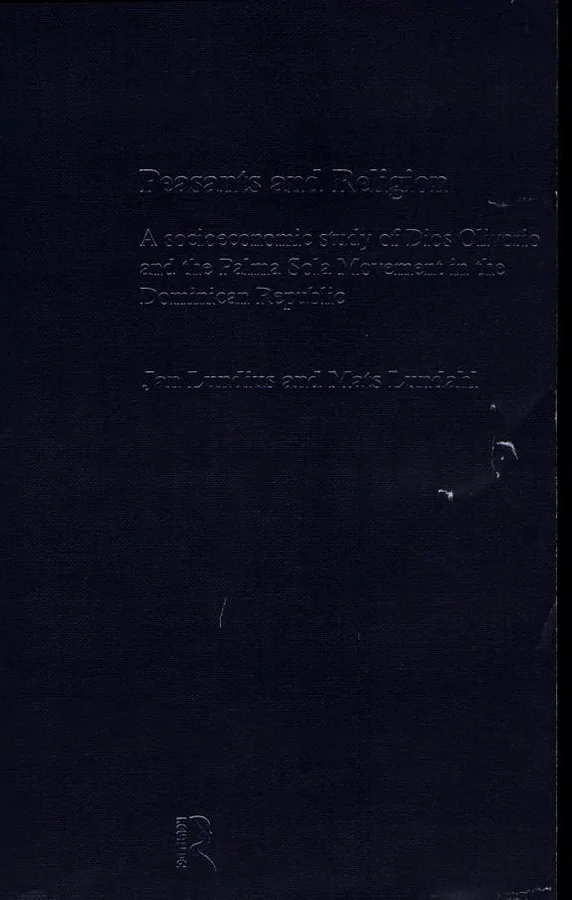
Peasants and Religion
 71
71

Peasants and Religion
Lundius and Lundahl's 'Peasants and Religion' offers a rigorous dissection of a specific millenarian peasant movement in the Dominican Republic. The authors excel at connecting the movement's spiritual fervor to the material realities of economic change, particularly the encroachment of capitalism. A notable strength is the detailed account of the movement's violent suppression, which avoids sensationalism while highlighting the stark power dynamics at play. However, the initial publication date of 2000 means some of the later developments in global economic theory or post-millennial studies are not directly engaged. The book's focus on the Dominican Republic, while specific, might leave readers wanting broader comparative analysis. The strength lies in its granular examination of how faith and economics intertwine. Ultimately, 'Peasants and Religion' provides a valuable, if somewhat dated, case study for understanding religious social movements.
📝 Description
71
Published in 2000, Peasants and Religion examines a Dominican religious movement's rise and suppression.
Jan Lundius and Mats Lundahl's 2000 book, Peasants and Religion, provides a scholarly account of a millenarian peasant movement in the Dominican Republic. The authors trace the movement's origins, its deeply held beliefs, and the violent state response it encountered. Their analysis connects the movement's development to significant socio-economic changes, particularly the integration of local communities into a global capitalist system. The book situates this case study within the Dominican Republic's history of foreign intervention and economic vulnerability. It suggests that periods of economic hardship often precede such millenarian outbreaks. The authors discuss peasant revolts and religious movements, focusing on how international economic shifts can ignite intense spiritual and social unrest.
This work engages with the study of millenarianism, a tradition of belief focused on imminent, radical societal transformation. It examines how religious ideas can inspire collective action and manifest in movements that challenge existing power structures. By analyzing the interaction between faith, economic forces, and political control, the book contributes to understanding how spiritual aspirations can become a force for social change, particularly in contexts of economic dependency and upheaval.
💡 Why Read This Book?
• Learn how the arrival of capitalism in a specific region, as detailed in 'Peasants and Religion', can directly fuel millenarian peasant movements. • Understand the dynamics of violent repression against religious dissent by examining the Dominican Republic case study presented in the book. • Gain insight into the relationship between economic shifts and the emergence of fervent spiritual beliefs, a core concept explored by Lundius and Lundahl.
⭐ Reader Reviews
Honest opinions from readers who have explored this book.
❓ Frequently Asked Questions
What specific Dominican Republic region does 'Peasants and Religion' focus on?
While the blurb doesn't specify a precise region, the book analyzes a millenarian religious peasant movement within the Dominican Republic, connecting its rise and repression to economic changes occurring in the area.
When was the religious peasant movement discussed in 'Peasants and Religion' active?
The book was first published in 2000, but the exact period of the movement's activity is not specified in the provided blurb. It likely corresponds to a period of significant economic transition in the Dominican Republic.
What is millenarianism as discussed in 'Peasants and Religion'?
Millenarianism, as explored in the book, refers to the belief in an imminent, radical transformation of society, often driven by religious conviction, leading to the formation of active social movements.
How does 'Peasants and Religion' link economics to religion?
The book links economic factors, specifically the arrival and expansion of capitalism in the Dominican Republic, to the emergence and dynamics of a religious peasant movement, suggesting economic shifts can catalyze spiritual and social upheaval.
Who are Jan Lundius and Mats Lundahl, the authors of 'Peasants and Religion'?
Jan Lundius and Mats Lundahl are the authors of 'Peasants and Religion,' a scholarly work first published in 2000 that examines a religious peasant movement in the Dominican Republic.
What does the book say about the repression of the peasant movement?
The book analyzes the violent repression faced by the millenarian religious peasant movement in the Dominican Republic, situating it within the context of socio-economic changes and the arrival of capitalism.
🔮 Key Themes & Symbolism
Millenarianism and Social Change
The work meticulously details the phenomenon of millenarianism, a potent force within the Dominican peasant movement studied. It illustrates how fervent beliefs in an impending, radical societal transformation can mobilize agrarian populations. The authors show how these eschatological visions are not detached from material concerns but are deeply intertwined with the socio-economic conditions experienced by the peasantry, particularly in the face of disruptive external forces like globalization.
Capitalism's Impact on Agrarian Societies
'Peasants and Religion' critically examines the arrival and integration of capitalism into a specific locale. It posits that this economic system can destabilize traditional social structures, alter land ownership, and create conditions ripe for social unrest and the emergence of alternative belief systems. The book highlights how the expansion of global economic forces directly influences local religious and social movements, often leading to conflict.
Religion as a Force of Resistance
The book presents religion not merely as a passive belief system but as an active agent of resistance and social organization. The millenarian movement studied utilized religious ideology to forge a collective identity and to challenge existing power structures. The authors explore how shared faith provided a framework for collective action, offering solace and a vision of a different future in the face of hardship and repression.
Repression and State Power
A significant aspect of the book is its analysis of the violent repression directed at the peasant movement. This section looks at how dominant powers, likely state apparatuses or allied forces, respond to religious and social challenges that threaten the established order. The work underscores the often brutal methods employed to quell dissent and maintain control when movements gain traction and pose a perceived threat to economic or political stability.
💬 Memorable Quotes
Direct passages from the work, attributed to the author.
“The arrival of capitalism in the area.”
— This concise phrase captures the book's central argument about how external economic forces, specifically the introduction and expansion of capitalist structures, acted as a catalyst for the peasant movement's emergence and subsequent conflict.
“Success and violent repression of a religious peasant movement.”
— This expresses the dual narrative arc of the book: the initial growth and influence of the millenarian movement, followed by the harsh suppression it encountered, highlighting the volatile relationship between grassroots religious fervor and established power.
“Changes in the international economic system.”
— This points to the global context that Lundius and Lundahl emphasize, suggesting that local events are deeply influenced by broader macroeconomic shifts, providing a framework for understanding the movement's origins and trajectory.
“Analysis of a millenarian religious peasant movement.”
— This directly states the book's core subject matter, signaling its focus on a specific type of social and religious phenomenon rooted in agrarian communities and characterized by apocalyptic expectations.
“The Dominican Republic as a case study.”
— This highlights the specific geographical and political setting for the authors' research, grounding their theoretical analysis in a concrete historical and social reality.
🌙 Esoteric Significance
Tradition
While not overtly occult, the study of millenarian movements taps into a long-standing esoteric interest in apocalyptic prophecies and societal transformation. These beliefs often share roots with Gnostic ideas of world-redemption and the establishment of a divine kingdom, as well as messianic currents found across various mystical traditions. The movement's fervent belief in imminent change aligns with esoteric concepts of cyclical history and transformative events.
Symbolism
The symbolism within such movements often revolves around purification, divine intervention, and the overturning of earthly hierarchies. Concepts like 'the elect' (those chosen for salvation) and 'the end times' are potent motifs. In the context of the Dominican Republic movement, symbols of agricultural renewal or divine judgment could have been prominent, representing both a break from oppressive economic conditions and the promise of a new, divinely ordained social order.
Modern Relevance
Contemporary thinkers exploring social justice movements, the psychology of belief, and the impact of economic inequality on radicalization can draw parallels from this work. Scholars of new religious movements and anthropologists studying belief systems in the face of globalization find value in understanding historical precedents. The book's analysis of how economic pressures can ignite spiritual fervor remains relevant in discussions of political extremism and social upheaval today.
👥 Who Should Read This Book
• Academic researchers in sociology, anthropology, and religious studies focusing on Latin America. • Students of millenarianism and apocalyptic belief systems seeking concrete case studies. • Individuals interested in the intersection of global economic systems, peasant societies, and religious movements.
📜 Historical Context
Published in 2000, 'Peasants and Religion' entered a scholarly landscape increasingly focused on globalization's impact on local communities and the resurgence of religious movements. The late 20th century saw extensive debate on the modernization theory versus dependency theory, with scholars like Immanuel Wallerstein examining global economic systems. Lundius and Lundahl's work engages with these currents by analyzing how the penetration of capitalism in the Dominican Republic fostered a specific millenarian peasant movement. The book's focus on a Latin American context aligns with a rich tradition of studying peasant revolts and liberation theology, though its focus on millenarianism offers a distinct lens. Reception of such studies often depends on their contribution to understanding social unrest and the role of ideology in pre- and post-modern societies. The work implicitly engages with scholars who view religious movements as responses to economic dislocation and state control.
📔 Journal Prompts
The success and violent repression of the Dominican religious peasant movement.
The arrival of capitalism and its effect on agrarian belief systems.
Analysis of the millenarian ideology driving the peasant movement.
Connecting international economic changes to local social phenomena.
The role of religion in peasant resistance and mobilization.
🗂️ Glossary
Millenarianism
A religious or social belief system anticipating a major, transformative event, often a radical societal restructuring, followed by an era of peace and happiness (a millennium).
Peasant Movement
An organized social or political movement composed primarily of rural agricultural workers or small landholders, often seeking social, economic, or political change.
Capitalism
An economic and political system characterized by private ownership of the means of production and their operation for profit, involving market competition and wage labor.
Repression
The act of subduing someone or something by force, typically used to describe actions by governments or authorities against dissenting groups.
Agrarian Societies
Societies whose economies are primarily based on agriculture, where land ownership and farming are central to social structure and livelihood.
Religious Movement
A social movement whose members are united by shared religious beliefs and practices, often seeking to bring about religious or social change.
International Economic System
The network of global financial markets, trade agreements, and economic policies that govern the exchange of goods, services, and capital across national borders.
This book appears in 1 collection
🔮 Readers Also Liked
Browse all →







From the “Messianism” Collection
View all →







More Free Occult Philosophy Books
View all →