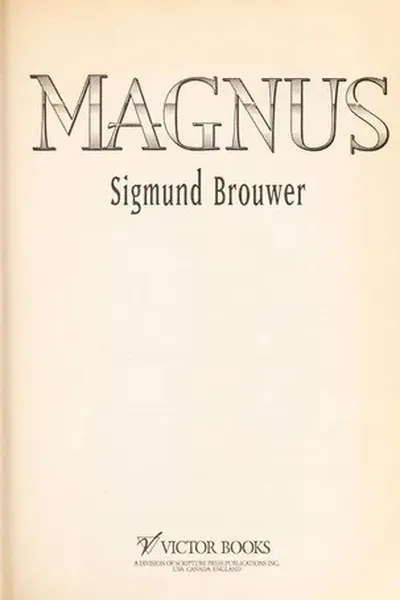
Magnus

 76
76

Magnus
Sigmund Brouwer's Magnus presents an ambitious exploration of consciousness, though its execution can feel uneven. The novel’s strength lies in its willingness to tackle profound philosophical questions head-on, particularly the concept of subjective reality shaping objective experience. Brouwer’s depiction of the protagonist’s descent into a more esoteric understanding of existence, marked by synchronicities and altered perceptions, is compelling. However, the narrative occasionally falters under the weight of its own conceptual density, sometimes sacrificing character development for philosophical exposition. A passage that stands out is the protagonist’s encounter with the 'Observer Effect' in everyday life, which vividly illustrates the book’s central thesis. While not without its narrative challenges, Magnus offers a unique perspective on perception and reality that will linger with the dedicated reader.
📝 Description
76
Magnus, published in 1994, engages with esoteric themes and challenges conventional understanding.
Sigmund Brouwer's 1994 novel, Magnus, delves into philosophical and spiritual concepts, inviting readers into a world where ordinary perceptions are questioned. The book operates within the esoteric literature category, focusing on hidden knowledge and alternative viewpoints. It is intended for readers curious about non-mainstream philosophical inquiries and narrative explorations of consciousness. Those who appreciate complex ideas and literature that encourages deeper reflection on existence and perception will find Magnus rewarding. The work appeals to individuals seeking intellectual engagement beyond typical genre boundaries.
The narrative of Magnus centers on the exploration of consciousness, the nature of reality, and an individual's place within a larger cosmic order. It examines the idea of hidden patterns and interconnectedness, suggesting that perception itself unlocks deeper truths. Brouwer employs allegory and symbolism to convey these central ideas. This invites readers to interpret the book's layers of meaning and apply them to their own understanding of the world.
Magnus appeared in 1994 during a period of renewed interest in esoteric traditions, following the late 20th century's resurgence of occult studies. This era saw many works re-examining ancient wisdom through contemporary lenses, often incorporating Jungian psychology and postmodern thought. The book's release coincided with a broader cultural acceptance of alternative spirituality and philosophical discourse, moving away from the rigid rationalism of earlier decades.
💡 Why Read This Book?
• Gain a new perspective on the power of subjective experience, as illustrated through the protagonist's journey of altered perception, a core element explored in Magnus. • Understand the symbolic language used to represent hidden realities, drawing parallels to concepts like synchronicity and interconnectedness discussed in the text. • Explore the philosophical underpinnings of reality as it was being discussed in esoteric circles around 1994, providing a specific snapshot of intellectual currents.
⭐ Reader Reviews
Honest opinions from readers who have explored this book.
❓ Frequently Asked Questions
What is the primary philosophical theme explored in Sigmund Brouwer's Magnus?
Magnus primarily explores the theme of subjective reality and how individual perception actively shapes one's experience of the objective world. It suggests that consciousness is not merely a passive observer but an active participant in creating reality.
When was Magnus first published and what was the literary climate like?
Magnus was first published in 1994. This period saw a growing interest in esoteric studies and alternative philosophies, with many authors exploring the intersection of psychology, spirituality, and narrative.
Does Magnus require prior knowledge of esoteric philosophy to understand?
While prior knowledge can enhance the reading experience, Magnus is structured to guide readers through its concepts. The narrative itself introduces and explores its esoteric themes, making it accessible to those new to the subject.
What kind of symbolism can readers expect to find in Magnus?
Readers can expect symbolism related to consciousness, perception, and the interconnectedness of all things. The book uses allegorical elements to represent abstract philosophical ideas and spiritual awakenings.
Is Magnus a work of fiction or non-fiction?
Magnus is a work of fiction that uses a narrative structure to explore esoteric and philosophical concepts. It is not a direct instructional text but rather a story that embodies its themes.
What is the significance of the title 'Magnus' in relation to the book's themes?
The title 'Magnus,' meaning 'great' or 'large' in Latin, likely alludes to the grand scale of the philosophical questions explored, such as the vastness of consciousness and the expansive nature of reality.
🔮 Key Themes & Symbolism
Perception as Reality
The central tenet of Magnus revolves around the idea that reality is not a fixed, objective entity but is profoundly shaped by the observer's perception. The narrative illustrates how shifts in consciousness can alter one's experienced world, moving beyond mere opinion to suggest a fundamental principle of existence. This theme challenges readers to question their own assumptions about the nature of what is 'real' and how their internal state influences external circumstances.
Interconnectedness of All Things
Magnus explores the esoteric concept that all phenomena, from the smallest particle to the grandest cosmic event, are interconnected. It suggests an underlying unity that is often obscured by ordinary sensory experience and rational thought. The book uses narrative devices to reveal these hidden links, encouraging a holistic view of existence where individual events are part of a larger, unified whole.
The Nature of Consciousness
The work looks at the mystery of consciousness itself, positing it as more than a byproduct of the brain. It examines consciousness as a fundamental aspect of the universe, capable of influencing and interacting with the material world. Through the protagonist's journey, Brouwer probes the boundaries of self-awareness and the potential for expanded states of consciousness to unlock deeper understanding.
Symbolism and Hidden Meaning
Throughout Magnus, symbolism is employed as a key tool for conveying esoteric truths. The narrative is rich with motifs and metaphors that are intended to be interpreted on multiple levels, pointing towards deeper, often spiritual, meanings. This approach invites the reader to engage actively with the text, seeking out the hidden layers of significance that are not immediately apparent.
💬 Memorable Quotes
Direct passages from the work, attributed to the author.
“Reality bends to the will of the observer.”
— This statement expresses the book's core thesis: that our perception is not merely a passive reception of external events, but an active force that shapes our experienced reality. It suggests a profound agency in our subjective experience.
“The universe whispers its secrets to those who listen.”
— This highlights the idea that profound truths and hidden knowledge are accessible not through forceful inquiry, but through a receptive and attentive state of being. It points to intuition and inner awareness as conduits for understanding.
“What you seek is already within you.”
— This concept emphasizes the internal nature of spiritual or philosophical discovery. It suggests that the answers or enlightenment one pursues externally are, in fact, latent within their own consciousness.
“The map is not the territory, but it can guide you.”
— This is an interpretation of the idea that conceptual frameworks or symbolic representations (the map) are useful tools for understanding reality (the territory), but they should not be mistaken for reality itself.
“Synchronicity reveals the underlying order.”
— This refers to the meaningful coincidences that occur in life, suggesting they are not random but indicative of a deeper, ordered pattern or intelligence governing events.
🌙 Esoteric Significance
Tradition
Magnus engages with themes prevalent in Neo-Platonism and Gnosticism, focusing on the idea of a fundamental, unified reality from which the perceived material world emanates. It reflects the Gnostic concept of hidden knowledge (gnosis) as the path to liberation and understanding, suggesting that true reality is accessible through altered states of consciousness and esoteric insight, rather than empirical observation alone.
Symbolism
The book frequently employs symbols related to light and darkness, representing knowledge versus ignorance or awakened consciousness versus mundane awareness. Another recurring motif is the 'veil,' symbolizing the illusory nature of ordinary perception that conceals a deeper, more fundamental reality. These symbols function as conceptual gateways, inviting readers to look beyond the literal narrative to its underlying esoteric meanings.
Modern Relevance
Contemporary interest in consciousness studies, quantum physics interpretations of reality, and mindfulness practices can be seen as drawing from the same wellspring of ideas explored in Magnus. Thinkers and practitioners in fields ranging from transpersonal psychology to certain strands of contemporary spirituality often revisit these concepts of subjective reality and interconnectedness, finding in Brouwer’s work an early fictional exploration of these enduring themes.
👥 Who Should Read This Book
• Readers interested in the philosophical implications of consciousness and perception, seeking narratives that challenge conventional views of reality. • Students of comparative spirituality and esoteric traditions who wish to explore fictional interpretations of concepts like Gnosticism and Neo-Platonism. • Individuals drawn to allegorical storytelling that prompts introspection on the nature of existence and the power of the human mind.
📜 Historical Context
Sigmund Brouwer's Magnus emerged in 1994, a year situated within a broader late 20th-century revival of esoteric thought. This period saw a significant cultural shift, with increased interest in Eastern philosophies, New Age concepts, and the re-examination of Western Hermeticism and Gnosticism. Authors like Joseph Campbell had already popularized comparative mythology, paving the way for narratives that explored spiritual and psychological depths. The intellectual climate was receptive to ideas that challenged materialist paradigms, influenced by figures like Carl Jung whose work on archetypes and the collective unconscious resonated deeply. While not directly censored, works engaging with such themes often operated outside mainstream literary circles, finding their audience among those actively exploring alternative spiritual and philosophical paths, distinct from the prevailing secular humanism or traditional religious doctrines.
📔 Journal Prompts
The protagonist's evolving perception of 'reality' in Magnus:
Reflections on synchronicities and their potential meaning:
The symbolic weight of the 'veil' in understanding hidden truths:
Personal experiences of reality shifting with internal states:
The relationship between seeking and inherent knowledge:
🗂️ Glossary
Subjective Reality
The philosophical concept that reality is fundamentally based on individual consciousness and perception, rather than an independent objective existence.
Esoteric
Relating to or having knowledge or understanding that is intended for or likely to be understood by only a small number of people with a specialized background or interest.
Gnosis
A Greek term meaning 'knowledge,' often referring to spiritual or mystical knowledge that leads to salvation or enlightenment, particularly in Gnostic traditions.
Neo-Platonism
A school of philosophy that emerged in the 3rd century CE, heavily influenced by Plato, emphasizing a mystical and hierarchical view of reality emanating from a supreme 'One'.
Synchronicity
The occurrence of events that appear meaningfully related but lack a discernible causal connection, often interpreted as having a deeper, underlying significance.
Allegory
A story, poem, or picture that can be interpreted to reveal a hidden meaning, typically a moral or political one.
Materialism
The philosophical view that matter is the fundamental substance in nature, and that all phenomena, including mental states and consciousness, are results of material interactions.
🔮 Readers Also Liked
Browse all →








More by Sigmund Brouwer
All books →

More Free Occult Philosophy Books
View all →