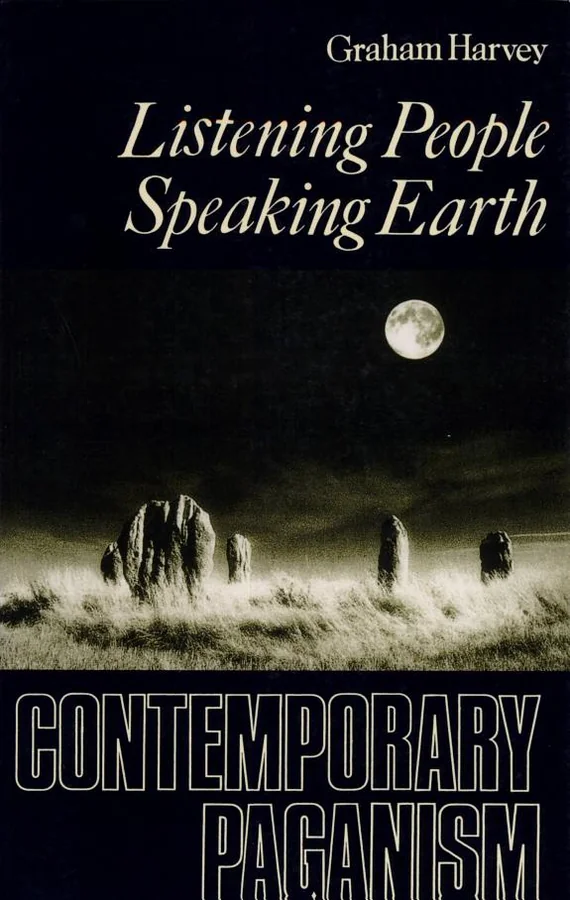
Listening People, Speaking Earth
 78
78

Listening People, Speaking Earth
Graham Harvey's "Listening People, Speaking Earth" stands as a solid, if somewhat dated, introduction to the diverse currents of modern Paganism. Its strength lies in its clear, chapter-by-chapter breakdown of distinct traditions like Druidry and Heathenism, presenting them without undue sensationalism. Harvey's discussion of shamanism, for instance, is grounded and avoids the more fanciful interpretations that sometimes cloud the subject. A limitation is that, by necessity of its 1997 publication, it cannot account for the digital revolution's impact on Pagan communities or the subsequent evolution of certain movements. The section on geomancy, while informative, feels a bit brief compared to the more established traditions. Nevertheless, for its time, it offered a crucial, well-researched overview of a spiritual landscape then rapidly expanding. It remains a valuable historical document for understanding the foundations of contemporary Pagan studies.
📝 Description
78
Graham Harvey's 1997 book surveys contemporary Pagan movements as they formed in the late 20th century.
Published in 1997, "Listening People, Speaking Earth" offers a systematic look at the Pagan spiritual landscape as it was solidifying. Graham Harvey introduces readers to major traditions like Druidry, witchcraft, Heathenism, and Goddess spirituality. He also covers shamanism and geomancy, showing the breadth of these nature-based beliefs. The book is a good starting point for anyone interested in how these spiritual paths grew and changed around the end of the last century.
Harvey discusses how "Paganism" functions as a broad category for many different practices. He looks at what inspires these traditions, separating those that draw directly from history from those that are newer creations. A central idea is the ecological awareness and ritual practices common to many Pagans, demonstrating their connection to the natural world. The book captures a moment in time, before the internet fully reshaped how spiritual communities connect and share information.
This book sits within the study of modern Paganism, a field that gained academic traction in the late 20th century. Harvey's work documents the emergence and diversification of these nature-based spiritualities, distinguishing between historical reconstructions and newer imaginative paths. It reflects an era when scholars began to systematically examine traditions previously on the cultural margins. The book captures a specific period of growth and public recognition for these paths.
💡 Why Read This Book?
• Understand the foundational structures of modern Paganism by examining specific chapters on Druidry and Heathenism, learning how these traditions articulated their beliefs and practices in the late 20th century. • Gain insight into the ecological and theological dimensions of Paganism through Harvey's exploration of rites of passage and earth-centered spirituality, which contrasts with earlier spiritual movements. • Appreciate the diverse sources of inspiration for Paganism, from historical research to poetic phenomena, as detailed in the book's dedicated section on inspiration.
⭐ Reader Reviews
Honest opinions from readers who have explored this book.
❓ Frequently Asked Questions
What specific Pagan traditions are covered in Graham Harvey's "Listening People, Speaking Earth"?
The book covers several key traditions, including Druidry, witchcraft, Heathenism, and Goddess spirituality. It also explores shamanism and geomancy, offering a broad spectrum of nature-based spiritual practices from its 1997 publication.
When was "Listening People, Speaking Earth" first published?
The book was first published in 1997, providing a snapshot of contemporary Paganism during that era.
Does the book discuss the ecological aspects of Paganism?
Yes, "Listening People, Speaking Earth" concludes with an exploration of the ecological activities, theologies, and rites of passage undertaken by Pagans, highlighting their connection to the earth.
What kind of sources does Harvey examine for Pagan inspiration?
Harvey considers a range of sources, from documented historical accounts to more imaginative or poetic phenomena, discussing how these influence modern Pagan beliefs and practices.
Is "Listening People, Speaking Earth" suitable for beginners in Pagan studies?
Absolutely. Its systematic introduction to main movements and trends makes it an accessible starting point for anyone curious about contemporary Paganism and its diverse expressions.
What spiritual movements are discussed alongside witchcraft and Druidry?
Beyond witchcraft and Druidry, the book also focuses on Heathenism, Goddess spirituality, shamanism, and geomancy, presenting a comprehensive overview of its subject matter.
🔮 Key Themes & Symbolism
Diversity of Pagan Movements
Harvey meticulously details the varied range of modern Paganism, moving beyond monolithic interpretations. He dedicates focused attention to distinct traditions such as Druidry, witchcraft, and Heathenism, illustrating their unique mythologies, rituals, and organizational structures. This approach underscores that Paganism is not a singular entity but a constellation of diverse spiritual paths, each with its own historical roots and contemporary expressions, as evidenced by the distinct explorations of Goddess spirituality and shamanism.
Nature-Centric Spirituality and Ecology
A central theme is the profound connection many Pagans feel towards the natural world. The book explores how this reverence translates into ecological activism, earth-based theologies, and seasonal rites of passage. Harvey highlights the inherent animism and immanence found in these traditions, where the Earth itself is often viewed as sacred or a living entity. This perspective is crucial for understanding the environmental ethics and practices prevalent in many contemporary Pagan communities.
Sources of Pagan Identity
Harvey investigates the complex origins that inform modern Pagan identities. He differentiates between movements drawing directly from reconstructed historical practices, such as certain forms of Heathenism or Druidry, and those that are more inspired by poetic, mythological, or even imaginative reconstructions. This critical examination addresses the ongoing dialogue within Paganism regarding authenticity, historical accuracy, and the role of personal revelation or creative interpretation in spiritual development.
Shamanism and Geomancy
Beyond the more commonly discussed Pagan paths, the work offers introductions to shamanism and geomancy. These chapters explore practices focused on altered states of consciousness, spirit communication, and earth divination. Harvey contextualizes these within broader Pagan frameworks, examining their appeal and integration into nature-based spiritualities. This inclusion broadens the scope of the book, showcasing less mainstream but significant esoteric and divinatory traditions.
💬 Memorable Quotes
Direct passages from the work, attributed to the author.
“The book introduces the main movements and trends in paganism.”
— This statement frames the work as a foundational survey, aiming to provide readers with a structured understanding of the diverse spiritual range of contemporary Paganism as it was understood in 1997.
“Individual chapters focus on druidry, witchcraft, heathenism, goddess spirituality and magic.”
— This highlights the book's methodical approach, dedicating specific sections to explore distinct traditions, allowing for focused examination of their unique characteristics and practices.
“These are followed by discussions of shamanism and geomancy.”
— This indicates the book's breadth, extending its coverage beyond the most prominent Pagan paths to include other esoteric and nature-based spiritual disciplines.
“Sources of inspiration are treated next: from real history to more imaginative or poetic phenomena.”
— This points to Harvey's critical analysis of how modern Pagan traditions construct their identities, acknowledging the interplay between historical research and creative or mythological influences.
“The book concludes with an exploration of the ecological activities, theologies and rites of passage of pagans.”
— This emphasizes the book's focus on the practical and ethical dimensions of Paganism, particularly its deep-seated connection to the environment and its cyclical rituals.
🌙 Esoteric Significance
Tradition
While not strictly aligning with a single esoteric lineage like Hermeticism or Gnosticism, Harvey's work engages with traditions that draw upon animistic, polytheistic, and nature-mystical currents. It operates within the broad field of modern Western esotericism by documenting and analyzing spiritual paths that emphasize immanence, earth-based divinity, and direct experience with the sacred in nature, often diverging from the hierarchical or strictly transcendent focus of older esoteric schools.
Symbolism
Key symbols explored implicitly include the Earth itself as a living entity, embodying the sacred feminine and masculine principles often discussed in Goddess spirituality. The cycle of seasons, represented in rites of passage and agricultural festivals, symbolizes death and rebirth. The interconnectedness of all life, a core tenet, is often symbolized through natural elements like trees (as in Druidry) or the web of life, signifying the holistic worldview prevalent in these paths.
Modern Relevance
Contemporary Pagans, particularly those involved in eco-Paganism, Heathenism, and modern Druidry, continue to draw upon the foundational understandings presented by Harvey. Thinkers and practitioners exploring the intersection of spirituality and environmentalism find his documentation of Pagan ecological ethics particularly relevant. His work remains a touchstone for understanding the historical development and conceptual frameworks of the Pagan movements that have continued to evolve into the 21st century.
👥 Who Should Read This Book
• Students of comparative religion seeking to understand the origins and diversity of contemporary nature-based spiritualities. • Individuals exploring personal paths rooted in earth-centered practices and seeking foundational knowledge about traditions like Druidry or witchcraft. • Cultural historians and sociologists interested in documenting and analyzing spiritual movements of the late 20th century and their engagement with ecological themes.
📜 Historical Context
Published in 1997, "Listening People, Speaking Earth" emerged during a central moment for contemporary Paganism. The late 20th century witnessed a significant expansion and diversification of these nature-based spiritualities, moving from relative obscurity into broader public awareness. Academic study of these traditions was also gaining momentum, with scholars like Ronald Hutton already establishing critical historical perspectives on witchcraft and pre-Christian religions. Harvey's work provided a much-needed, accessible overview at a time when resources were less abundant than today. It documented a burgeoning spiritual renaissance, reflecting the intellectual currents that sought to reconnect with perceived ancient wisdom and earth-centered practices, offering a counterpoint to more established religious paradigms.
📔 Journal Prompts
The diverse Pagan movements discussed, from Druidry to Heathenism.
Sources of inspiration: real history versus imaginative phenomena.
Ecological activities and theologies of Pagans.
The concept of shamanism and its place within Paganism.
Geomancy as a divinatory practice explored in the text.
🗂️ Glossary
Paganism
An umbrella term for a range of contemporary nature-based spiritualities that often draw on pre-Christian European traditions, emphasizing reverence for the earth and often polytheistic or animistic beliefs.
Druidry
A modern spiritual path inspired by the ancient Celtic priests, focusing on nature, wisdom, and often polytheistic or pantheistic beliefs, with an emphasis on ecological connection.
Witchcraft
A diverse spiritual practice, often associated with Wicca, that typically involves nature-based rituals, magic, and veneration of a God and Goddess, with roots in folk traditions.
Heathenism
A modern revival of pre-Christian Germanic, Norse, and Anglo-Saxon polytheistic religions, focusing on the gods, ancestors, and cultural heritage of these groups.
Goddess Spirituality
A spiritual focus centered on the divine feminine, often viewing the Goddess as the primary or sole deity, encompassing diverse traditions that venerate female creative and destructive powers.
Shamanism
A spiritual practice involving a practitioner (shaman) who is believed to interact with a spirit world, often through altered states of consciousness, to heal or mediate between worlds.
Geomancy
An ancient form of divination involving the interpretation of patterns formed by casting earth or sand, or by marking points randomly on the ground.
This book appears in 1 collection
🔮 Readers Also Liked
Browse all →







From the “Paganism” Collection
View all →








More Free Witchcraft & Paganism Books
View all →




![ERIC ED481283: Salem Witch Trials. [Lesson Plan].](/img/thumb/eric-ed481283-salem-witch-trials-lesson-plan-eric.webp)