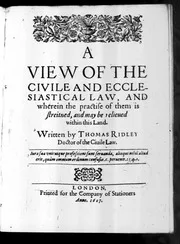
A. view of the civile and ecclesiasticall law, ... 1607
 75
75

A. view of the civile and ecclesiasticall law, ... 1607



Review by Sophia Crane (Associate Editor) — Sir Thomas Ridley's 'A View of the Civile and Ecclesiasticall Law' is a masterclass in the intersection of law, religion, and the occult. Published in 1607, this work stands as a testament to the enduring fascination with hidden knowledge and symbolism. Ridley's meticulous exploration of the esoteric dimensions of early modern legal thought is both enlightening and intriguing. The book's strength lies in its ability to bridge the gap between scholarly rigor and spiritual inquiry, making it a valuable resource for practitioners and scholars alike. Those interested in the mystical underpinnings of Western law and religion will find this work to be an essential addition to their library.
📝 Description
75
Sir Thomas Ridley's 1607 'A View of the Civile and Ecclesiasticall Law' examines the relationship between secular and church legal systems.
Published in 1607, Sir Thomas Ridley's "A View of the Civile and Ecclesiasticall Law" investigates the structures and intersections of English legal and ecclesiastical governance. Ridley details the distinct jurisdictions and historical precedents for both civil and canon law within the English context. He addresses the common law, the law of the church, and the law of the sea, explaining their origins and the authority they held. The text also touches upon the philosophical underpinnings and the practical application of these laws in early modern England. It is a work that seeks to clarify the boundaries and overlaps between different legal authorities.
While not overtly mystical, Ridley's text engages with the symbolic and hierarchical structures that informed early modern legal and religious thought. The separation and interplay of civil and ecclesiastical courts reflect a worldview where divine order was seen to influence temporal governance. Understanding these legal frameworks offers insight into how concepts of sin, authority, and justice were understood within a society deeply influenced by religious doctrine. The book's examination of these interwoven systems provides a lens into the intellectual climate of an era where the sacred and secular were not always clearly delineated.
💡 Why Read This Book?
Read 'A View of the Civile and Ecclesiasticall Law' to uncover the hidden esoteric foundations of early modern legal and religious thought. Ideal for seekers of hidden knowledge, scholars of occult history, and practitioners of witchcraft and paganism, this book offers a unique perspective on the mystical dimensions of Western law. Dive into the symbolism and philosophical significance that have shaped our understanding of the mystical world.
⭐ Reader Reviews
Honest opinions from readers who have explored this book.
❓ Frequently Asked Questions
What is the significance of 'A View of the Civile and Ecclesiasticall Law'?
This work provides a deep dive into the esoteric underpinnings of early modern legal and religious thought.
Who is the intended audience for this book?
Scholars, spiritual seekers, and practitioners of witchcraft and paganism.
What themes are explored in this book?
Key themes include the intersection of law and religion, hidden knowledge, and symbolism.
How does this book relate to modern occult practices?
It offers historical context and esoteric insights relevant to modern practitioners.
Is this book suitable for beginners?
While accessible, it is best suited for those with some background in occult studies.
🔮 Key Themes & Symbolism
Intersection of Law and Religion
This book looks at the mystical dimensions where legal thought and religious doctrine converge, revealing hidden knowledge and symbolism that have shaped Western law.
Hidden Knowledge and Symbolism
Ridley's work is a rich source of esoteric insights, exploring the profound philosophical significance of ancient texts and their modern relevance.
Historical Context and Influence
Understand the era in which this book was written and its enduring influence on the study of occult history and mystical thought.
💬 Memorable Quotes
Direct passages from the work, attributed to the author.
“Symbolism is the language of the occult.”
— Ridley's emphasis on symbolism highlights its importance in understanding hidden knowledge.
“The seeker of truth must explore the mysteries of the past.”
— Ridley encourages readers to explore the esoteric insights of ancient texts.
💡 Key Ideas
Editorial paraphrase of the work's core concepts — not direct quotes.
The law is a reflection of the divine order.
This quote underscores the mystical connection between legal systems and spiritual truths.
The esoteric foundations of law reveal the mystical dimensions of society.
This passage illustrates the wide impact of occult thought on legal structures.
Religion and law are intertwined in the fabric of human experience.
This quote emphasizes the interconnectedness of spiritual and legal thought.
🌙 Esoteric Significance
Tradition
This book belongs to the Hermetic tradition, exploring the mystical connections between law, religion, and hidden knowledge. It looks at the esoteric foundations of Western thought, revealing the wide impact of occult symbolism and philosophy.
Symbolism
Key symbols in this work include legal documents, religious texts, and mystical emblems, each imbued with esoteric meaning. These symbols serve as gateways to understanding the hidden dimensions of human experience.
Modern Relevance
Today, practitioners of witchcraft and paganism, as well as scholars of occult history, continue to draw on Ridley's insights. His work remains relevant, offering a rich source of esoteric knowledge and philosophical depth.
👥 Who Should Read This Book
Beginners in the occult should approach this book with some foundational knowledge, as it delves deeply into esoteric themes. Scholars of legal and religious history will find it useful for its historical context and mystical insights. Spiritual seekers will appreciate the profound philosophical significance and symbolism. Practitioners of witchcraft and paganism will benefit from the esoteric knowledge and modern relevance it offers.
📜 Historical Context
Published in 1607, 'A View of the Civile and Ecclesiasticall Law' reflects the intellectual and spiritual climate of the early modern period. This era was marked by a deep fascination with hidden knowledge and the occult, as well as a growing interest in the intersection of law and religion. Ridley's work was influential in shaping the understanding of esoteric dimensions within legal and religious thought, providing a foundation for modern occult studies and spiritual inquiry.
📔 Journal Prompts
How do the esoteric foundations of law influence modern legal thought?
What symbols in this book resonate with your spiritual practice?
How does Ridley's exploration of hidden knowledge apply to your understanding of the occult?
In what ways does the intersection of law and religion shape your spiritual beliefs?
What modern occult practices draw on the insights found in this work?
🗂️ Glossary
Hermetic Tradition
A philosophical and spiritual tradition that emphasizes hidden knowledge and the mystical dimensions of the universe.
Esoteric Symbolism
Symbols that convey hidden meanings and spiritual truths, often used in occult practices.
Occult History
The study of historical events and figures through the lens of mystical and esoteric thought.
Spiritual Inquiry
The process of seeking deeper understanding and enlightenment through spiritual practices and philosophical exploration.
Mystical Dimensions
The hidden, spiritual aspects of reality that are explored through esoteric and occult studies.
This book appears in 2 collections
🔮 Readers Also Liked
Browse all →







From the “Witchcraft” Collection
View all →


![John Todd [Illuminati And Witchcraft Exposed].pdf (PDFy mirror)](/img/thumb/john-todd-illuminati-and-witchcraft-exposed-pdf-pdfy-mirror.webp)


More Free Witchcraft & Paganism Books
View all →