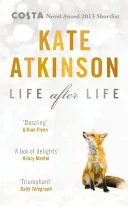
Life After Life
 74
74

Life After Life
Kate Atkinson’s *Life After Life* doesn't simply tell a story; it meticulously reconstructs it, again and again. The novel’s most striking feature is its relentless revisiting of Ursula Todd’s birth and subsequent deaths, each iteration a precise recalibration of circumstance and outcome. This structural ambition, while fascinating, occasionally threatens to become a theoretical exercise. A particular strength lies in Atkinson's ability to imbue even the most fleeting existence with palpable emotional weight, especially in Ursula's wartime experiences. However, the sheer volume of repeated scenarios can, at times, dilute the narrative momentum. The scene where Ursula navigates the Blitz, facing death multiple times, is a potent example of the book’s thematic core and its potential for narrative fatigue. Ultimately, *Life After Life* is a challenging, intellectually rigorous novel that probes the nature of existence through a remarkable formal invention.
📝 Description
74
Kate Atkinson's *Life After Life* begins with Ursula Todd dying on the night of her birth in 1910.
Kate Atkinson's 2022 novel *Life After Life* follows Ursula Todd, a woman who lives and dies countless times. Each life begins with the same circumstances: her birth during a snowstorm in 1910. However, small alterations in her fate lead each subsequent life down a different path. This structure allows Atkinson to examine causality and the many directions a single life can take, without adhering to a linear timeline.
The book is not a typical ghost story; instead, it is a deep consideration of existence and the impact of choices. It will appeal to readers who enjoy experimental fiction that pushes the boundaries of traditional storytelling. Those interested in philosophical questions about determinism, free will, and the nature of reality, all presented through a personal narrative, will find this novel rewarding. Readers who like literary fiction with a speculative element, offering both intellectual engagement and emotional resonance, will appreciate *Life After Life*.
Published in 2022, *Life After Life* engages with literary traditions that question linear time and explore the potential of multiple realities. It echoes writers like Jorge Luis Borges who played with narrative structure and existential themes. The novel's focus on repeated lives and branching possibilities can be seen as a modern take on existentialist inquiries into fate and the "what if" scenarios that shape human experience. It revisits concepts found in mid-20th century thought concerning individual agency within a predetermined or fluid reality.
💡 Why Read This Book?
• Gain a unique perspective on causality and consequence by tracing Ursula Todd's numerous lives, each initiated by her birth during a specific snowstorm in 1910. • Explore the philosophical interplay of fate and free will through Atkinson's innovative narrative structure, which revisits key historical moments like the Blitz. • Experience the emotional resonance of a life lived and re-lived, understanding how small choices can dramatically alter destiny, as demonstrated by Ursula's repeated attempts to survive.
⭐ Reader Reviews
Honest opinions from readers who have explored this book.
❓ Frequently Asked Questions
What is the central premise of Kate Atkinson's *Life After Life*?
The novel follows Ursula Todd, who is born repeatedly under the same conditions but dies differently each time, allowing her to live through various potential lives and historical events.
When was *Life After Life* by Kate Atkinson first published?
Kate Atkinson's *Life After Life* was first published in 2022.
Does the book explore supernatural elements?
While the premise involves repeated lives and deaths, the book is more a literary exploration of causality and possibility than a traditional ghost story or supernatural thriller.
What historical periods does *Life After Life* cover?
The novel spans from Ursula's birth in 1910, through both World Wars, including the Blitz in London, and into later 20th-century periods.
Is *Life After Life* related to other works by Kate Atkinson?
While *Life After Life* shares Atkinson's signature prose and thematic concerns, it is a standalone novel, not part of a series, though its characters and themes may echo in her other works.
What makes the narrative structure of *Life After Life* unique?
Its unique structure involves Ursula Todd reliving her life from birth multiple times, with each iteration branching off due to different circumstances or choices, creating a mosaic of possibilities.
🔮 Key Themes & Symbolism
Causality and Choice
The novel’s core revolves around exploring the intricate web of causality, demonstrating how seemingly minor events or decisions can lead to vastly different outcomes. Ursula Todd’s repeated existence allows Atkinson to meticulously dissect the 'what ifs' of life. Each death, from the early 20th century through wartime London, becomes a pivot point, prompting a new beginning where different paths are taken. This iterative process highlights the wide impact of individual agency against the backdrop of historical forces and personal circumstances, questioning the extent to which our lives are predetermined or self-directed.
The Nature of Identity
Through Ursula’s perpetual rebirths, *Life After Life* probes the enduring question of identity. Is identity tied to a specific life trajectory, or is there an essential self that persists across different experiences? Ursula retains fragments of memory and a sense of self that carries through her numerous incarnations, even as her circumstances and relationships change dramatically. This exploration challenges the notion of a singular, fixed identity, suggesting instead that who we are is a fluid construct shaped by the sum of our lived moments and the choices made within them.
Historical Echoes and Personal Fate
Atkinson uses Ursula’s recurring lives to refract significant historical events, most notably the lead-up to and experience of World War II, including the Blitz. The novel illustrates how grand historical narratives intersect with intimate personal destinies. Ursula’s attempts to navigate these turbulent periods, often dying in ways connected to the conflict, underscore the vulnerability of individual lives within the sweep of history. The repeated encounters with war and its aftermath serve as a powerful commentary on collective trauma and the resilience of the human spirit.
The Unfolding of Time
Rather than a linear progression, time in *Life After Life* unfolds in a cyclical, branching manner. The novel’s structure mirrors Ursula’s experience, presenting life not as a straight line but as a series of interconnected possibilities. This non-linear approach allows readers to witness the same events from multiple perspectives and to understand the profound influence of temporal and circumstantial variations. The constant reset and re-evaluation of Ursula’s life offers a unique meditation on the subjective experience of time and the ever-present potential for a different outcome.
💬 Memorable Quotes
Direct passages from the work, attributed to the author.
“What if Ursula Todd, born during a snowstorm in 1910, dies in the bathtub, only to be reborn and live again?”
— This is a conceptual summary of the novel's central premise, framing the extraordinary nature of Ursula's recurring existence and inviting the reader into the book's unique narrative experiment.
“She had been born, had lived and died, had been born again. She had lived and died. She had been born again. She had lived and died. She had been born again. She had lived and died. She had been born again. She had lived and died. She had been born again. She had lived and died. She had been born again. She had lived and died. She had been born again. She had lived and died.”
— This repetitive passage expresses the core mechanic of the novel: Ursula's cyclical birth and death. It emphasizes the relentless nature of her repetitions and the central question of how each new life will unfold differently.
“She felt herself to be, in the best possible way, quite ordinary.”
— This statement, likely from Ursula herself, highlights the contrast between her extraordinary circumstances (repeated lives) and her desire for or perception of a normal existence, grounding the fantastical premise in human experience.
“How many times could a person be born? How many times could a person die?”
— This rhetorical question captures Ursula's internal struggle and the reader's curiosity about the limits and possibilities of her unique condition. It speaks to the existential nature of the narrative.
💡 Key Ideas
Editorial paraphrase of the work's core concepts — not direct quotes.
She thought that if she could only live her life backwards, she would be able to avoid all the mistakes. But that was not how life worked.
This paraphrased concept reflects the novel's engagement with the impossibility of truly undoing the past or perfectly correcting errors, even with the chance to relive events. It underscores the theme of learning through experience.
🌙 Esoteric Significance
Tradition
While not explicitly aligned with a single esoteric lineage, *Life After Life* engages with concepts resonant in Gnosticism and Hermeticism, particularly the idea of cyclical existence and the search for meaning within a potentially deterministic universe. The novel’s exploration of multiple life paths can be seen as a secular interpretation of reincarnation or the Akashic records, where all possibilities exist simultaneously. Ursula’s repeated lives suggest a soul or consciousness learning and evolving through diverse experiences, a common theme in esoteric thought concerning spiritual development and the overcoming of fate.
Symbolism
The recurring snowstorm at Ursula’s birth serves as a potent symbol of her unique, perhaps fated, beginning, marking the point from which countless realities diverge. The various deaths Ursula experiences—drowning, illness, wartime bombings—function as recurring motifs of vulnerability and the ever-present threat of annihilation, forcing her to confront mortality repeatedly. The concept of the 'life' itself, in its myriad forms, becomes a symbol for the infinite potential and interconnectedness of all existence, a core tenet explored in many mystical traditions.
Modern Relevance
In contemporary spiritual and philosophical discourse, *Life After Life* speaks to current fascinations with quantum physics' implications for reality, parallel universes, and the nature of consciousness. Thinkers exploring simulation theory or the idea of living multiple lives through digital avatars might find parallels. Esoteric practitioners interested in exploring past-life regression or understanding karma through a literary lens could also find resonance. The novel’s themes align with modern interest in mindfulness and finding meaning in the present moment, even amidst the awareness of countless unrealized possibilities.
👥 Who Should Read This Book
• Readers interested in speculative fiction that challenges narrative conventions will appreciate the novel's unique structure and exploration of alternate realities. • Those fascinated by philosophical questions surrounding free will, determinism, and the nature of existence will find ample material for contemplation. • Literary fiction enthusiasts who enjoy character-driven stories with emotional depth, even when presented through experimental forms, will be drawn to Ursula’s many-sided journey.
📜 Historical Context
Kate Atkinson's *Life After Life*, published in 2022, arrived at a time when literary fiction frequently engaged with complex narrative structures and existential themes. While Atkinson’s novel is contemporary, its exploration of alternate realities and the impact of important moments carries the metafictional experiments of writers like Jorge Luis Borges in the mid-20th century. The novel’s detailed depiction of life in Britain leading up to and during World War II, particularly the Blitz of London, places it in dialogue with a long tradition of British war literature. However, Atkinson’s unique approach—focusing on the myriad potential lives stemming from a single birth and death—sets it apart from more linear accounts. The book’s reception was largely positive, lauded for its originality and emotional depth, though some critics noted the structural complexity could be demanding. It did not face significant controversy or censorship, unlike some earlier experimental works that challenged societal norms more directly.
📔 Journal Prompts
Ursula Todd's repeated births and deaths frame the novel's exploration of causality.
Reflect on the significance of the recurring snowstorm at Ursula's birth.
Consider the emotional impact of Ursula's wartime experiences across different lives.
Analyze the balance between fate and free will as depicted in Ursula's multiple existences.
Explore the concept of identity through Ursula's persistent consciousness despite changing circumstances.
🗂️ Glossary
Causality
The principle that every event has a cause and effect. In *Life After Life*, the novel meticulously examines how altering even minor causes leads to drastically different effects in Ursula's repeated lives.
Determinism
The philosophical position that every event, including human cognition, decision, and action, is causally determined by an unbroken chain of prior occurrences. The novel questions the extent to which Ursula's lives are predetermined.
Metafiction
Fiction that self-consciously draws attention to its status as a work of fiction, often by discussing its own structure or narrative devices. *Life After Life*'s experimental form is a key example.
The Blitz
The sustained bombing of Britain by Nazi Germany between 7 September 1940 and 11 May 1941, during World War II. Ursula experiences this period multiple times, with varying outcomes.
Existentialism
A philosophical theory that emphasizes the existence of the individual person as a free and responsible agent determining their own development through acts of the will. The novel explores this through Ursula's choices.
Narrative Structure
The way in which a story is put together, including the order of events, the use of flashbacks or flash-forwards, and the division into chapters or sections. Atkinson's novel employs a highly distinctive, cyclical structure.
Alternate Realities
Hypothetical or fictional universes that run parallel to our own, often differing in historical events or laws of nature. The novel explores numerous 'what if' scenarios for Ursula's life.
🔮 Readers Also Liked
Browse all →









More by Kate Atkinson
All books →
More Free Occult Philosophy Books
View all →