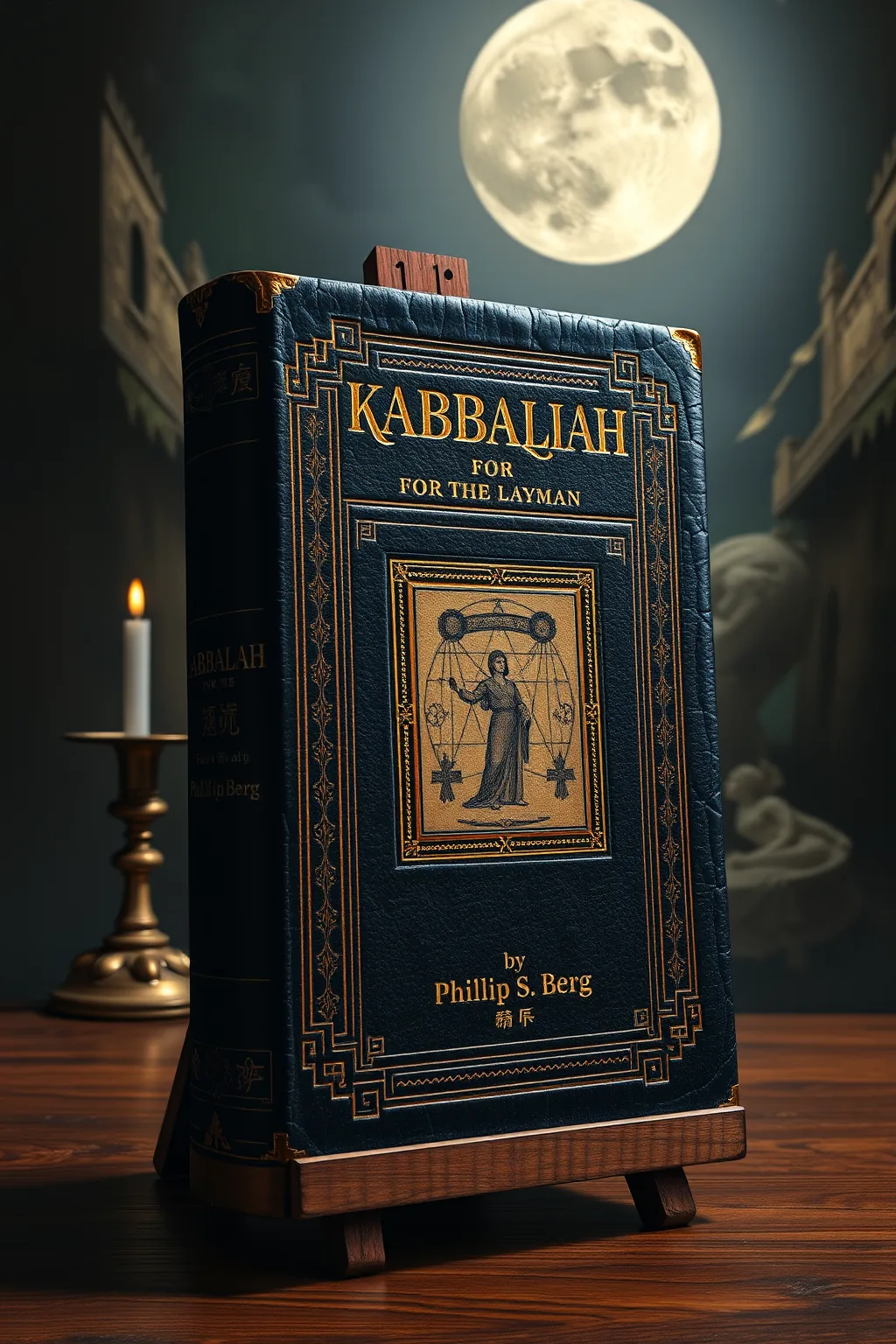
Kabbalah for the Layman (Chinese)
 61
61

Kabbalah for the Layman (Chinese)


Philip S. Berg's "Kabbalah for the Layman" stands as a beacon for those venturing into the arcane depths of Jewish mysticism. Berg's accessible yet profound exposition unravels the intricate tapestry of Kabbalistic thought, making its esoteric principles digestible for the uninitiated. He masterfully elucidates the Tree of Life, a central symbol, revealing its spiritual and psychological dimensions with clarity. This work is particularly valuable for its ability to bridge ancient wisdom with contemporary inquiry. It is a compelling invitation to explore the hidden architecture of the cosmos and our place within it, offering a potent framework for spiritual growth and self-discovery.
📝 Description
61
Philip S. Berg's 1980 book aims to make Kabbalah accessible to a general audience.
Philip S. Berg's "Kabbalah for the Layman" attempts to translate the core concepts of Jewish mysticism for those unfamiliar with its traditions. The book focuses on the Tree of Life as a central symbolic map, detailing its structure and the emanations it represents. Berg outlines how these spiritual forces, originating from a primordial light, ultimately manifest in the physical world. The text aims to provide readers with an understanding of these dynamics and their connection to existence. It encourages personal reflection on life's deeper meanings and the pursuit of spiritual awareness. The book presents Kabbalistic ideas as a means for self-improvement and a way to connect with the divine.
Through its explanations, "Kabbalah for the Layman" seeks to demystify a spiritual system often perceived as complex. It addresses the underlying principles of reality as understood within this esoteric framework. The author's intention is to offer practical insights for individuals interested in exploring the esoteric dimensions of life and consciousness. The work covers fundamental Kabbalistic symbolism and cosmology, making it a starting point for newcomers to the subject.
This book situates itself within the tradition of Kabbalah, a form of Jewish mysticism that gained prominence in the medieval period. Kabbalah concerns itself with the divine nature, creation, and humanity's relationship with God, often through symbolic interpretation of scripture and mystical contemplation. The Tree of Life, a diagram depicting ten divine emanations or sephirot, is a primary visual and conceptual tool used to understand these concepts. Berg's work aims to present these complex theological and metaphysical ideas in a manner intended for accessibility, distinguishing it from more scholarly or strictly devotional texts.
💡 Why Read This Book?
This book is essential for spiritual seekers, students of mysticism, and anyone intrigued by the profound questions of existence. It offers a clear, yet deeply insightful, introduction to Kabbalah, demystifying its complex symbolism and philosophical underpinnings. Readers will gain a foundational understanding of cosmic principles, personal spiritual growth, and the interconnectedness of all things, providing a map for inner exploration and a deeper connection to the divine.
⭐ Reader Reviews
Honest opinions from readers who have explored this book.
❓ Frequently Asked Questions
What is the core message of Kabbalah for the Layman?
The core message is to demystify Kabbalah, revealing its universal principles of creation, consciousness, and spiritual growth. It aims to provide a practical understanding of these ancient teachings for personal transformation and a deeper connection to the divine essence.
Is prior knowledge of Judaism required to read this book?
No, prior knowledge of Judaism is not strictly required. While the book originates from Jewish mystical tradition, Philip S. Berg presents the concepts in a universally accessible manner, focusing on their spiritual and philosophical implications.
What is the significance of the Tree of Life in Kabbalah?
The Tree of Life is a central diagram in Kabbalah representing the structure of the universe and the divine emanations. It serves as a map of consciousness, guiding practitioners through different spiritual states and revealing the interconnectedness of all things.
How can this book help with personal spiritual growth?
The book offers practical insights and symbolic interpretations that can foster self-awareness, understanding of one's inner world, and a more profound connection to the spiritual dimension. It provides a framework for navigating life's challenges and seeking deeper meaning.
What makes this book suitable for a 'layman'?
Philip S. Berg's approach is characterized by its clarity and directness. He avoids overly academic jargon, making complex Kabbalistic concepts accessible and relatable to a general audience interested in spiritual exploration and esoteric knowledge.
🔮 Key Themes & Symbolism
The Tree of Life as a Cosmic Blueprint
The Tree of Life is presented not merely as a diagram but as the fundamental architecture of the universe and human consciousness. Its ten Sefirot (divine emanations) and twenty-two paths represent the stages of creation, the flow of divine energy, and the interconnectedness of all existence. Understanding its structure offers a useful insights into the divine mind and the mechanics of manifestation, providing a map for spiritual ascent and a deeper comprehension of reality's intricate design.
Unveiling the Hidden Light
Kabbalah posits that beneath the surface of the material world lies an infinite, divine light, the source of all being. This book guides the reader in understanding how this primordial light manifests and how individuals can reconnect with it. It explores the concept of 'breaking the vessels' and the subsequent tikkun (rectification), clear the path to spiritual fulfillment and the restoration of cosmic harmony. The journey is one of self-discovery and the awakening of dormant spiritual potential.
The Nature of Reality and Divine Providence
Philip S. Berg examines the Kabbalistic understanding of reality, where seemingly random events are viewed as expressions of a divinely ordered system. The book explores how to perceive the underlying patterns and purpose within life's experiences, fostering a sense of trust and connection to a higher power. It encourages readers to look beyond the superficial and recognize the intricate web of divine providence that guides and sustains all creation, offering solace and a profound sense of meaning.
💬 Memorable Quotes
Direct passages from the work, attributed to the author.
“Nothing but our equally unfathomable instincts, intuitions, and reasoning abilities.”
— Highlights the inner faculties that humans possess to comprehend their world, suggesting these are the innate tools to begin the journey of spiritual understanding.
“To tell us where we came from, why we are here and what we are supposed to do.”
— Articulates the fundamental existential questions that drive spiritual inquiry, for which Kabbalah offers profound answers and a transformative path.
“Begin a study of self-discovery and spiritual awakening.”
— A call to action, inviting the reader to engage with the teachings for personal growth and a deeper connection to their divine essence.
“Unlock the ancient secrets of Jewish mysticism.”
— Promises the revelation of hidden knowledge, emphasizing the esoteric and profound nature of the wisdom contained within the book.
💡 Key Ideas
Editorial paraphrase of the work's core concepts — not direct quotes.
Into this mysterious universe we are born, with no apparent set of instructions.
This quote speaks to the inherent human quest for meaning and guidance in working through the complexities of existence, setting the stage for Kabbalah's role as a map for the soul.
🌙 Esoteric Significance
Tradition
This book is a key entry point into the esoteric tradition of Kabbalah, a mystical interpretation of Judaism that seeks to understand the nature of God, creation, and the human soul. It draws upon ancient texts and symbolic systems, aiming to reveal the hidden dimensions of reality and provide a pathway for spiritual ascent and divine connection.
Symbolism
Central to the esoteric significance of Kabbalah, as presented here, is the Tree of Life. This intricate diagram, with its ten Sefirot and connecting paths, serves as a symbolic representation of the divine emanations, the structure of the cosmos, and the journey of the soul. Other key symbols include Hebrew letters, divine names, and celestial bodies, all imbued with deep spiritual meaning.
Modern Relevance
In an era often characterized by spiritual seeking and a desire for deeper meaning, "Kabbalah for the Layman" offers a timeless framework for personal growth and understanding. Its emphasis on consciousness, interconnectedness, and the hidden forces of the universe provides relevant tools for navigating modern life, fostering self-awareness, and cultivating a profound sense of purpose and spiritual connection.
👥 Who Should Read This Book
This book is ideally suited for spiritual seekers yearning for a deeper understanding of life's mysteries, and for students of comparative religion and mysticism. Beginners to Kabbalah will find it an invaluable and accessible introduction, explaining complex concepts. Scholars and practitioners of esoteric traditions will appreciate Berg's clear exposition and the foundational insights offered. Anyone curious about the hidden architecture of the universe, the nature of consciousness, and the path to spiritual fulfillment will find profound guidance within its pages.
📜 Historical Context
Written during a period of burgeoning interest in esoteric traditions and spiritual exploration, Philip S. Berg's "Kabbalah for the Layman" emerged as a central work in making complex Kabbalistic concepts accessible to a wider audience. The latter half of the 20th century saw a growing desire for deeper meaning beyond materialistic pursuits, and books like this offered a bridge to ancient wisdom. Berg’s work, while rooted in traditional Kabbalah, also sought to present its principles in a universally applicable framework, resonating with individuals from diverse backgrounds seeking spiritual enlightenment and a deeper understanding of existence.
📔 Journal Prompts
Reflect on the concept of 'unfathomable instincts' and 'intuitions' as guides in your life. How have they served you?
Meditate on the Tree of Life. Which Sefirah resonates most with your current life circumstances, and why?
Consider the idea of a 'hidden light' within and around you. How can you become more aware of its presence in your daily life?
Write about a moment when you felt a profound sense of interconnectedness with the universe. What did it feel like?
How can understanding the principles of Kabbalah help you navigate a specific challenge you are currently facing?
🗂️ Glossary
Sefirot
The ten divine emanations or attributes through which God reveals Himself and creates the universe. They form the structure of the Tree of Life and represent stages of divine unfolding.
Tree of Life (Etz Chaim)
A central diagram in Kabbalah, consisting of ten interconnected circles (Sefirot) and twenty-two paths, representing the structure of the cosmos, the divine emanations, and the path of spiritual development.
Ein Sof
The Kabbalistic term for the 'Infinite' or 'Without End,' referring to God in His absolute, unknowable, and transcendent state before any manifestation or creation occurred.
Tikkun
The concept of 'rectification' or 'repair.' In Kabbalah, it refers to the cosmic process of restoring harmony and elevating the divine sparks that were scattered during creation, a process in which humanity plays a crucial role.
Malkuth
The tenth Sefirah, representing the Kingdom or Presence, often associated with the material world, the physical body, and the culmination of divine emanation into manifest reality.
This book appears in 1 collection
🔮 Readers Also Liked
Browse all →







More by Philip S. Berg
All books →



From the “Kabbalah” Collection
View all →









More Free Kabbalah & Jewish Mysticism Books
View all →