La magie des femmes kabyles et l'unité de la société traditionnelle

 71
71

La magie des femmes kabyles et l'unité de la société traditionnelle
Makilam's "La magie des femmes kabyles et l'unité de la société traditionnelle" offers a compelling, if sometimes dense, look at a specific cultural nexus of magic and society. The author’s commitment to detailing the intricate relationship between women's practices and community stability is admirable. A particular strength lies in the detailed descriptions of rituals, which feel grounded in ethnographic observation rather than speculation. However, the dense academic prose, while precise, can occasionally obscure the more immediate spiritual or magical underpinnings. The section discussing the symbolism of woven textiles as conduits of protective magic provides a concrete example of the book's depth. While it excels as a scholarly work, readers seeking purely practical magical instruction might find it less accessible. It serves as a crucial academic resource for understanding the Berber esoteric heritage.
📝 Description
71
Makilam's 1996 book examines Kabyle women's magic and its role in traditional society.
Makilam's study, first published in 1996, investigates the esoteric practices of Kabyle women and their place within traditional societal structures. The author details how spiritual and magical traditions were integrated into daily life, contributing to community cohesion and the continuation of ancestral knowledge. This work is relevant for scholars of North African ethnography, comparative religion, and esoteric traditions, especially those interested in non-Western magical systems. It speaks to readers who want to grasp the connections between spirituality, gender, and social organization in pre-modern societies, particularly within Berber culture.
The book addresses how magical knowledge passed through matrilineal lines and the function of women as keepers of community health via ritual. It analyzes the symbolic language of Kabyle magic, practices often overlooked by outsiders. These traditions were central to maintaining social harmony and individual spiritual links in the traditional Kabyle village.
This book situates itself within the study of indigenous magical systems, particularly those found in North Africa. It engages with pre-Islamic beliefs that persisted alongside Islam in the Berber cultural sphere. The work contributes to understanding how women acted as custodians of spiritual and practical knowledge, maintaining social order and individual connection through ritual practices. It offers a perspective on a specific regional manifestation of earth-based or folk magic, often overlooked in broader surveys of esoteric traditions.
💡 Why Read This Book?
• Gain insight into the specific magical practices of Kabyle women, understanding how their rituals, as detailed in the book's ethnographic accounts, were integral to societal cohesion. • Explore the concept of matrilineal spiritual transmission, learning how knowledge and power flowed through female lines in traditional Kabyle society, a unique aspect of its social structure. • Understand the symbolic language of Kabyle magic, particularly how everyday objects and domestic rituals, as described by Makilam, held profound esoteric meaning.
⭐ Reader Reviews
Honest opinions from readers who have explored this book.
❓ Frequently Asked Questions
What is the primary focus of Makilam's "La magie des femmes kabyles"?
The book's primary focus is on the esoteric practices and magical traditions of Kabyle women and their crucial role in maintaining the unity and social structure of traditional Kabyle society, as explored through ethnographic and historical analysis.
When was "La magie des femmes kabyles et l'unité de la société traditionnelle" first published?
The work was first published in 1996, positioning it within a later wave of academic interest in indigenous spiritual systems and post-colonial studies.
What cultural group is studied in this book?
The book centers on the Kabyle people, an ethnic group indigenous to the Atlas Mountains of North Africa, specifically examining their traditional societal structures and spiritual practices.
Does the book offer practical magical techniques?
While rich in description of magical practices and their societal function, the book is primarily an academic and ethnographic study. It details the 'how' and 'why' of Kabyle magic within its cultural context rather than providing a how-to guide for modern practitioners.
What is the significance of 'traditional society' in the book's title?
The title highlights the book's focus on the pre-modern, community-oriented structures of Kabyle life, where magical and spiritual practices were deeply embedded in daily existence and social cohesion, contrasting with modern societal changes.
Who is the author, Makilam?
Makilam is the author of "La magie des femmes kabyles et l'unité de la société traditionnelle." The book's publication in 1996 marks a significant contribution to the study of Berber ethnography and esoteric traditions.
🔮 Key Themes & Symbolism
Women as Spiritual Custodians
The work emphasizes the central role of Kabyle women not merely as participants but as active custodians of magical knowledge and community spiritual health. It details how women were often the primary conduits for transmitting ancestral wisdom, performing rituals for protection, healing, and social harmony. This custodial role was deeply embedded in the matrilineal aspects of their society, ensuring the continuity of cultural and esoteric practices across generations. The book illustrates this through examinations of domestic rituals and public ceremonies led by women.
Magic and Social Cohesion
A core theme is the inextricable link between magical practices and the maintenance of social unity within traditional Kabyle villages. Makilam's research explores how rituals performed by women, often related to agriculture, childbirth, and conflict resolution, served to reinforce community bonds and resolve tensions. These practices were not seen as separate from daily life but as an essential component of its functioning, ensuring balance and collective well-being. The book details specific instances where magic acted as a social regulatory force.
Symbolism of Everyday Life
The book uncovers the rich symbolic language embedded within the everyday objects and activities of Kabyle women. From the patterns woven into textiles to the preparation of specific foods or the use of natural elements, Makilam demonstrates how these common items and actions were imbued with profound esoteric meaning. These symbols served as a form of communication with spiritual forces and as a means of safeguarding the community, illustrating a holistic approach to magic where the mundane and the sacred were unified.
Transmission of Esoteric Knowledge
Makilam addresses the methods by which esoteric knowledge, particularly magical practices, was passed down within Kabyle society. The focus is on oral traditions, apprenticeship under elder women, and the learning that occurred through participation in communal rituals. The book highlights the importance of intuition, practical experience, and spiritual attunement in acquiring this knowledge, often emphasizing a lineage that was more spiritual and experiential than strictly academic or formal.
💬 Memorable Quotes
Direct passages from the work, attributed to the author.
“Knowledge of protective herbs and incantations was a legacy passed from mother to daughter.”
— This statement highlights the matrilineal transmission of esoteric wisdom, particularly concerning defensive magic and spiritual formulas, emphasizing the familial and gendered nature of this knowledge transfer.
“The symbolism woven into carpets held the power to ward off malevolent spirits.”
— This points to the esoteric significance of traditional crafts, suggesting that decorative patterns on items like carpets were not merely aesthetic but served a practical magical function in protecting the household and its inhabitants.
“Harmony in the home was often achieved through specific domestic ceremonies led by women.”
— This interpretation emphasizes the role of women in maintaining peace and balance within the family unit through the performance of prescribed rituals, underscoring the practical application of magic in daily life.
“The natural world provided the elements for potent magical remedies and enchantments.”
— This suggests a deep connection to nature within Kabyle magic, where plants, minerals, and other natural components were understood to possess inherent magical properties utilized for healing and other spiritual purposes.
💡 Key Ideas
Editorial paraphrase of the work's core concepts — not direct quotes.
The rituals of Kabyle women were the threads that bound the social fabric.
This paraphrase suggests that the magical and spiritual practices performed by women were not isolated acts but fundamental to the structure and cohesion of their community, acting as essential connective elements.
🌙 Esoteric Significance
Tradition
This work engages with an indigenous North African esoteric tradition, distinct from but often overlapping with broader Islamic mystical currents and ancient Mediterranean belief systems. It represents a localized, folk-magic lineage deeply rooted in Berber cosmology and social structures. Unlike more formalized Western esoteric traditions like Hermeticism or Kabbalah, its power lies in its integration into daily life and community roles, particularly those of women, making it a unique study of applied, community-based spirituality.
Symbolism
Central symbols often include geometric patterns found in tying and architecture, which are understood to represent cosmic order and provide protective barriers against spiritual harm. Natural elements like specific herbs, water, and fire are employed for purification, healing, and invoking spiritual aid. The female body itself, particularly in rites of passage like childbirth, is a potent symbol of creation and continuity, central to the magical efficacy attributed to women's rituals within the community.
Modern Relevance
Contemporary interest in indigenous spiritualities and decolonized approaches to magic finds resonance in Makilam's study. Thinkers and practitioners exploring earth-based spiritualities, ecofeminism, and the revitalization of ancestral traditions may draw parallels. The book's detailed ethnography offers a model for understanding how magic functions not as an abstract system but as an integrated aspect of social and ecological well-being, relevant to modern discussions on community resilience and holistic healing practices.
👥 Who Should Read This Book
• Students of Berber and North African cultural history seeking to understand the spiritual underpinnings of traditional societies. • Researchers in comparative religion and anthropology interested in gendered roles in esoteric practices and community-based magic. • Esoteric practitioners looking to broaden their understanding beyond Western traditions, exploring the function and form of magic in a non-Western, community-integrated context.
📜 Historical Context
Published in 1996, "La magie des femmes kabyles et l'unité de la société traditionnelle" emerged in a scholarly environment that was increasingly scrutinizing colonial narratives and valuing indigenous knowledge. The late 20th century saw a surge in ethnographic studies focused on non-Western spiritual traditions, moving away from earlier anthropological frameworks that often viewed such practices through a lens of superstition or primitivism. Makilam's work contributes to a growing body of literature that sought to understand the internal logic and social functions of these systems. It engaged with the broader intellectual currents of post-colonial theory and the anthropology of religion, which began to re-center marginalized voices and perspectives. While specific reception events like major reviews or censorship are not widely documented for this particular work, its publication aligns with a wider academic re-evaluation of Berber culture and its distinct historical trajectories, often contrasted with dominant Arab-Islamic influences in North Africa.
📔 Journal Prompts
The function of women's rituals in binding the social fabric.
The transmission of protective knowledge from mother to daughter.
Symbolism in woven textiles as a magical defense.
Domestic ceremonies and their role in home harmony.
The use of natural elements in Kabyle healing practices.
🗂️ Glossary
Kabyle
Refers to the indigenous Amazigh (Berber) people primarily inhabiting the Kabylia region of northern Algeria, known for their distinct language, culture, and history.
Esoteric
Relating to or accessible only by a select group of people with a specialized or advanced knowledge or interest, often concerning spiritual or mystical subjects.
Matrilineal
Of or according to a kinship system in which ancestral lineage and inheritance are traced through the mother's side of the family.
Ritual
A sequence of activities involving gestures, words, actions, or objects, performed according to a set sequence, often for religious or spiritual purposes.
Amazigh
The indigenous peoples of North Africa, also known as Berbers, who speak various Amazigh languages and have distinct cultural traditions.
Folk Magic
Magical beliefs and practices that are part of the traditionally transmitted knowledge of a community, often distinct from formal religious or academic systems.
Cosmology
The study of the origin, evolution, and eventual fate of the universe; in a cultural context, it refers to a society's understanding of the structure and order of the cosmos.
🔮 Readers Also Liked
Browse all →








More by Makilam.
All books →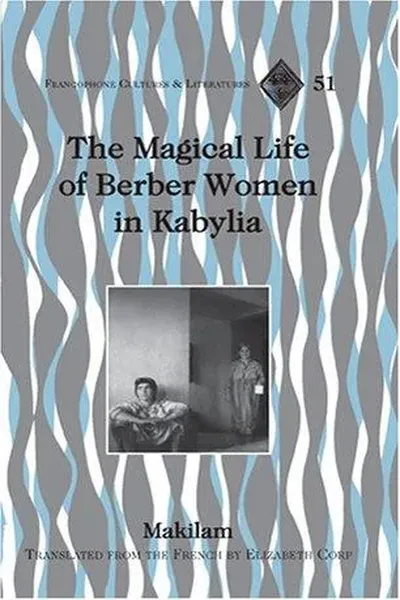

More Free Magic & Ritual Books
View all →