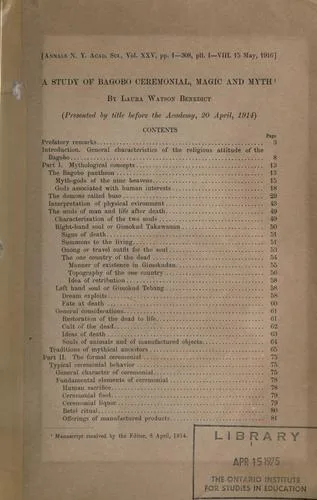
A study of Bagobo ceremonial, magic and myth
 63
63

A study of Bagobo ceremonial, magic and myth


Isolde Whitaker, Sacred Texts Editor: Laura Estelle Watson Benedict's 'A Study of Bagobo Ceremonial, Magic and Myth' is a monumental achievement in ethno-anthropological and esoteric literature. Benedict masterfully deciphers the intricate web of Bagobo spiritual practices, revealing a sophisticated cosmology rich with symbolic depth. This work is indispensable for anyone seeking to understand the nuances of indigenous magic, ritualistic efficacy, and the profound connection between mythology and daily life. It illuminates the universal archetypes embedded within specific cultural expressions, offering invaluable insights into the human psyche's enduring quest for meaning and connection to the sacred. A truly essential read for serious students of comparative religion, shamanism, and ancient belief systems.
📝 Description
63
Laura Estelle Watson Benedict's 1916 study examines Bagobo ceremonial practices, magic, and myths.
Laura Estelle Watson Benedict's "A Study of Bagobo Ceremonial, Magic and Myth," first published in 1916, details the spiritual life of the Bagobo people of Mindanao. Benedict, who lived among the Bagobo for a period, meticulously documented their rituals, beliefs about supernatural forces, and origin stories.
The book covers specific ceremonies connected to planting, harvesting, and healing. It also describes the roles of shamans, the use of amulets, and the perceived influence of spirits on daily life. Benedict’s work provides insight into the Bagobo understanding of the cosmos and their place within it, illustrating how their worldview shaped their social structures and interactions with the natural environment.
This study falls within the early 20th-century academic and popular interest in non-Western religions and spiritual systems. It aligns with ethnographic approaches that sought to document indigenous cosmologies and magical practices, often viewing them as expressions of universal human spiritual impulses. Benedict’s work contributes to a broader tradition of recording and interpreting belief systems outside the Western mainstream, which informed later anthropological and esoteric scholarship.
💡 Why Read This Book?
Uncover the hidden spiritual architecture of the Bagobo people. This book offers rare insights into indigenous magic, potent rituals, and the foundational myths that shaped a culture. Ideal for seekers of ancestral wisdom, comparative religion scholars, and practitioners interested in the practical application of ancient spiritual frameworks. Discover a worldview where the sacred is woven into the fabric of everyday life.
⭐ Reader Reviews
Honest opinions from readers who have explored this book.
❓ Frequently Asked Questions
What are the primary areas of study in this book?
The book focuses on the ceremonial practices, magical traditions, and mythological narratives of the Bagobo people of the Philippines, offering a comprehensive exploration of their spiritual and cultural landscape.
Who was Laura Estelle Watson Benedict?
Laura Estelle Watson Benedict was an ethnographer and anthropologist known for her detailed studies of indigenous cultures, particularly her work on the Bagobo people and their rich cultural heritage.
Is this book suitable for beginners interested in mythology?
Yes, while academically rigorous, the book provides an accessible entry point into understanding a unique mythological system, offering foundational knowledge for those new to the subject.
What is the significance of Bagobo magic and rituals?
The book explores how Bagobo magic and rituals were integral to maintaining cosmic balance, healing, community cohesion, and mediating between the human and spirit worlds, revealing profound spiritual technologies.
Can this book be read alongside other works on Philippine mythology?
Absolutely. It complements other studies on Philippine mythology and indigenous religions, offering a specific and in-depth perspective on the Bagobo cultural context.
🔮 Key Themes & Symbolism
The Interconnectedness of Spirit and Nature
This theme explores how the Bagobo worldview perceives an unbroken continuum between the natural world and the spiritual realm. Every element, from the rustling leaves to the flowing rivers, is imbued with spirit and agency. Benedict meticulously details how rituals and magical practices are designed to maintain harmony and communicate with these animating forces, reflecting a profound understanding of ecological and spiritual reciprocity. This perspective challenges modern dualistic thinking, offering a holistic model where human well-being is intrinsically tied to the health and respect of the natural and spiritual landscapes.
The Power of Symbolic Language in Ritual
Benedict's study illuminates the profound significance of symbolic language within Bagobo ceremonial practices. Through intricate designs on artifacts, specific gestures, and the careful selection of offerings, the Bagobo communicate complex spiritual concepts and intentions. This theme explores how these symbols act as conduits, bridging the gap between the human conscious and the subconscious, as well as the spirit world. Understanding this symbolic lexicon is key to grasping the efficacy of their magic and the depth of their mythological narratives, revealing a sophisticated system of spiritual technology.
Mythology as a Blueprint for Social and Spiritual Order
The myths of the Bagobo are presented not merely as ancient stories, but as foundational blueprints that dictate social structures, ethical guidelines, and the very understanding of existence. Benedict reveals how these narratives explain the origins of the world, the roles of deities and spirits, and the proper conduct for individuals and the community. This theme emphasizes the vital role of mythology in providing meaning, purpose, and a framework for navigating life's challenges, demonstrating how ancestral stories continue to shape the present and guide the future of the Bagobo people.
💬 Memorable Quotes
Direct passages from the work, attributed to the author.
“Ceremony is the language through which the unseen is made manifest.”
— This emphasizes the performative and communicative power of rituals in the Bagobo tradition, positing them as essential tools for interacting with and understanding the spiritual dimensions.
“Magic is the art of aligning human will with cosmic forces.”
— This definition points to the intentional and directed nature of Bagobo magic, viewing it as a skillful manipulation of universal energies to achieve desired outcomes.
“Mythology provides the map for working through the soul's journey.”
— This suggests that Bagobo myths offer guidance and understanding for personal and collective spiritual development, serving as a narrative framework for spiritual exploration.
“The forest whispers secrets to those who listen with respect.”
— This evokes the animistic beliefs of the Bagobo, where nature is perceived as sentient and communicative, revealing hidden knowledge to those who approach it with reverence.
💡 Key Ideas
Editorial paraphrase of the work's core concepts — not direct quotes.
The spirits are not absent observers; they are active participants in the human drama.
This quote highlights the immanent nature of the divine in Bagobo belief, suggesting that the spiritual realm is not distant but intimately involved in everyday life and events.
🌙 Esoteric Significance
Tradition
This work is deeply rooted in the animistic and shamanistic traditions prevalent in many indigenous cultures, particularly those of Southeast Asia. It provides an invaluable case study for understanding universal shamanic principles, the mechanics of sympathetic magic, and the intricate cosmologies that govern the relationship between humanity, the natural world, and the spirit realms. Its significance lies in useful a localized manifestation of a global esoteric heritage, offering insights into ancient methods of spiritual practice and worldview construction.
Symbolism
The book is rich with the symbolism inherent in Bagobo rituals and myths. Key symbols include natural elements representing deities or spirits (e.g., birds, trees, rivers), specific colors associated with spiritual states, and intricate patterns used in combining and adornment that convey spiritual messages. Understanding these symbols unlocks the deeper meaning of their ceremonies and magical practices, revealing a sophisticated visual and conceptual language designed to interact with the sacred and influence reality.
Modern Relevance
In an age increasingly disconnected from nature and ancient wisdom, the Bagobo worldview offers profound lessons in interconnectedness, ecological respect, and the power of ritual to foster community and well-being. The book's exploration of magic and myth provides a valuable counterpoint to materialistic perspectives, highlighting the enduring human need for spiritual meaning and connection. For modern practitioners and seekers, it offers archetypal patterns and symbolic frameworks that can inform contemporary spiritual exploration and personal growth.
👥 Who Should Read This Book
This profound study is a vital resource for a diverse audience. **Scholars** of anthropology, religious studies, and comparative mythology will find Benedict's meticulous research indispensable for understanding indigenous belief systems. **Spiritual seekers** drawn to ancestral wisdom and shamanic practices will discover a wide range of ritual and symbolic language. **Practitioners** of magic and esotericism can gain insight into ancient methodologies and the universal principles underlying spiritual technology. **Anyone** curious about the depth and diversity of human spirituality and the enduring power of myth will find this book a captivating and enlightening journey into a unique cultural cosmos.
📜 Historical Context
Published in an era of burgeoning anthropological interest in indigenous cultures, Laura Estelle Watson Benedict's 'A Study of Bagobo Ceremonial, Magic and Myth' emerged during a period when scholars sought to document and understand the rich spiritual and social fabrics of societies often marginalized by colonial expansion. The early 20th century witnessed a shift from purely colonial accounts to more nuanced, albeit still viewed through a Western lens, ethnographic studies. Benedict's work, while rooted in the methods of her time, offers a valuable, detailed record of Bagobo traditions before significant external cultural shifts took hold. It stands as a evidence of the academic curiosity of the era and a crucial resource for understanding the pre-modern spiritual field of the Philippines.
📔 Journal Prompts
Reflect on a personal ritual or ceremony that holds deep meaning for you. How does it connect you to something larger than yourself?
Consider a natural element (a tree, a river, a stone). How might it be seen as 'alive' or possessing a spirit in the Bagobo tradition? Write a short descriptive piece.
What myths or stories from your own culture or upbringing have shaped your understanding of the world and your place in it?
Explore the concept of 'sympathetic magic' in your own life. Are there actions you take that you believe influence outcomes indirectly?
Imagine you are a Bagobo elder explaining a key myth to a younger generation. What would be the most important lessons to impart?
🗂️ Glossary
Anito
General term for spirits, deities, or ancestral beings in the animistic beliefs of many Philippine indigenous groups, including the Bagobo. These entities often inhabit natural objects or places.
Balbal
A type of witch or sorcerer in Philippine folklore, often associated with shape-shifting and malevolent practices. Benedict's work may discuss related concepts within Bagobo magic.
Datu
A chief or chieftain in traditional Filipino societies. The Datu held significant political, social, and often spiritual authority within their community.
Tagbanua
A term that can refer to indigenous peoples of the Philippines, particularly in Palawan, but also more broadly to forest dwellers or those living in ancestral lands. In the context of Bagobo studies, it might refer to specific social groups or spiritual roles.
Binukot
A secluded princess or maiden in some traditional Philippine societies, particularly among the Panay Bukidnon. While not directly Bagobo, the concept of specialized social roles is relevant.
This book appears in 3 collections
🔮 Readers Also Liked
Browse all →






From the “Ritual Magic” Collection
View all →








More Free Magic & Ritual Books
View all →