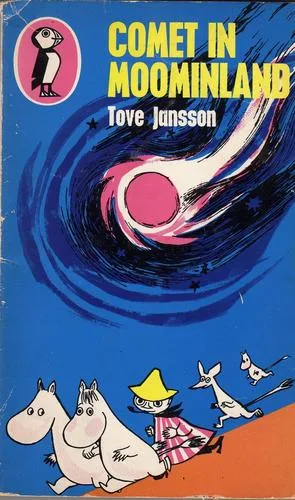
Kometen kommer (Kometjakten)

 72
72

Kometen kommer (Kometjakten)
Tove Jansson's Kometen kommer, while a precursor to her more famous Moomin adventures, presents a surprisingly potent exploration of existential dread and communal response. Its strength lies in its deceptively simple narrative, which builds a palpable sense of unease around the approaching comet. Jansson masterfully uses the Moomin characters to personify different reactions to crisis – from the pragmatic Sniff to the philosophical Moominpappa. However, the book's pacing can feel somewhat deliberate, particularly in its early stages, as it establishes the atmosphere of anticipation. A particularly striking passage involves the characters gathering at the observatory, a scene that captures both the scientific attempt to understand the threat and the underlying emotional terror. While not as whimsical as later Moomin tales, Kometen kommer offers a stark, allegorical reflection on facing the unknown. It is a quiet, yet effective, examination of vulnerability and resilience.
📝 Description
72
Tove Jansson's 1946 novel, Kometen kommer, anticipates a comet's arrival in Moominvalley.
First published in 1946, Kometen kommer follows the Moomin family and their neighbors as they prepare for an approaching comet. This celestial event disrupts the usual calm of Moominvalley, prompting them to consider their safety and the unknown.
Tove Jansson crafts a narrative that balances gentle humor with a thoughtful examination of how a community confronts impending change. The story is not simply for children; it functions as a fable about facing anxieties and wonders that arise from unpredictable circumstances. Its dreamlike quality, a hallmark of Jansson's Moomin tales, encourages readers to view the world from a unique vantage point.
This book is well-suited for those who enjoy allegorical stories and understated social observation. Readers interested in early 20th-century Scandinavian literature will find a significant work that predates Jansson's more famous Moomin picture books. Those looking for narratives that use accessible characters to explore existential questions will also find it rewarding. The work's distinct atmosphere and its consideration of fear and bravery make it a reflective read for adults and older young readers.
Published in the shadow of World War II, Kometen kommer reflects a post-war atmosphere of uncertainty and a desire for stability. Jansson's narrative of a world facing a potentially catastrophic, yet natural, event can be interpreted as an allegory for the collective anxieties of war and an unpredictable future. This approach distinguishes it from more overtly political or nationalistic literature of the time, offering a more introspective, almost philosophical, contemplation of humanity's response to overwhelming external forces.
💡 Why Read This Book?
• Gain insight into the allegorical power of celestial events by examining the comet's arrival as a narrative device, a concept explored vividly in Jansson's 1946 novel. • Understand communal responses to existential threats through the varied reactions of the Moominvalley inhabitants, a central theme in the book's depiction of crisis. • Appreciate the subtle philosophical underpinnings of Tove Jansson's early work, particularly her nuanced portrayal of fear and preparedness as seen in the characters' actions leading up to the comet's appearance.
⭐ Reader Reviews
Honest opinions from readers who have explored this book.
❓ Frequently Asked Questions
When was Kometen kommer originally published?
Kometen kommer, also known as The Comet, was first published in 1946. This marked an early entry in Tove Jansson's beloved Moomin series.
What is the main plot of Kometen kommer?
The story follows the Moomin family and their friends as they learn of an approaching comet that threatens to destroy their home, Moominvalley. They grapple with fear and decide how to face the impending disaster.
Who are the main characters in Kometen kommer?
The central characters are the Moomin family, including Moominpappa, Moominmamma, and Moomintroll, alongside their friends Sniff and the Hemulens, who all react to the news of the approaching comet.
Is Kometen kommer suitable for young children?
While part of the Moomin series, Kometen kommer deals with more serious themes of fear and potential destruction than some later books. It is best suited for mature young readers or adults who appreciate allegorical storytelling.
What makes Kometen kommer different from other Moomin books?
Published earlier in 1946, this novel is often considered more allegorical and somber, focusing on the existential threat of the comet. Later Moomin books tend to be more whimsical and adventurous.
Does Kometen kommer have a happy ending?
The ending of Kometen kommer is complex. While the immediate threat of destruction is averted through a twist of fate, the characters are profoundly changed by their experience and the shared fear they endured.
🔮 Key Themes & Symbolism
Fear of the Unknown
The approaching comet in Kometen kommer serves as a potent symbol for any overwhelming, unpredictable force that threatens to disrupt established lives. The narrative meticulously details the various psychological responses to this impending doom, from denial and panic to stoic acceptance and collective action. Characters like the Hemulens, who seek to document and categorize the phenomenon, represent the human desire for control through understanding, even when faced with the incomprehensible. This theme speaks to the post-war anxieties of 1946, reflecting a world grappling with unprecedented uncertainties and the profound human experience of confronting potential annihilation.
Community and Preparedness
As the comet nears Moominvalley, the inhabitants are forced to confront their shared vulnerability. The story highlights the complexities of community response, showcasing both cooperation and individualistic actions. Moominpappa's efforts to build a refuge and the general populace's preparations, however futile they might seem, underscore the human instinct to act in the face of disaster. Jansson explores the idea that while physical preparedness might be limited against cosmic forces, the act of coming together and sharing the experience can offer a form of solace and resilience, a crucial element in navigating collective fear.
The Nature of Home
Moominvalley, with its cozy Moominhouse, represents an idyllic and secure home. The threat of the comet forces the characters to re-evaluate what 'home' truly means. Is it merely a physical structure, or is it the relationships and sense of belonging within it? The narrative questions whether the essence of home can be preserved even if its physical form is threatened or destroyed. The characters' actions, driven by a desire to protect their familiar world, explore the deep emotional attachment to place and the psychological impact of its potential loss, making the concept of home a central concern throughout the story.
Existential Contemplation
Beneath its surface narrative, Kometen kommer invites contemplation on larger existential questions. The impending celestial event prompts reflections on the fragility of existence, the insignificance of individual lives against cosmic scales, and the search for meaning in a potentially indifferent universe. Jansson avoids providing easy answers, instead allowing the characters' experiences and dialogues to guide the reader through these profound considerations. The novel, published in 1946, can be seen as an artistic response to the profound existential questioning that followed the global conflicts of the preceding years.
💬 Memorable Quotes
Direct passages from the work, attributed to the author.
“The comet is coming. It will fall on Moominvalley.”
— This simple, direct statement expresses the core premise of the book. It establishes the central threat and the overwhelming sense of inevitability that pervades the narrative, setting the stage for the characters' reactions and the exploration of fear.
“What is the use of being brave if you are going to be burned up anyway?”
— This sentiment, likely expressed by a character grappling with the impending doom, captures the existential despair and the questioning of purpose when faced with overwhelming, uncontrollable forces. It touches upon the futility of human efforts against cosmic events.
“They gathered at the observatory to watch the stars and await the comet.”
— This describes a central scene where scientific observation meets existential dread. It symbolizes humanity's attempt to understand and confront the unknown through knowledge, even as the emotional weight of the situation becomes paramount.
💡 Key Ideas
Editorial paraphrase of the work's core concepts — not direct quotes.
Perhaps it is better to have no home than to have a home that is not safe.
This paraphrase reflects the characters' dilemma regarding the safety of Moominvalley. It highlights the conflict between the desire for security and the reality of potential danger, questioning the very definition and value of 'home' when threatened.
The Moomins decided to build a special shelter.
This paraphrased action reflects the theme of preparedness and communal effort. It shows the characters actively responding to the threat, demonstrating the instinct to protect oneself and one's loved ones, even in the face of seemingly insurmountable odds.
🌙 Esoteric Significance
Tradition
While not explicitly tied to a single esoteric lineage, Kometen kommer can be viewed through a lens of existential philosophy and archetypal psychology, which often intersect with esoteric thought. The comet itself functions as a potent, external catalyst for introspection and societal examination, akin to how astrological or prophetic events are interpreted in various traditions. The focus on communal preparation and the confrontation with overwhelming forces echoes themes found in Gnostic narratives concerning cosmic disruption and the search for salvation or meaning amidst chaos.
Symbolism
The comet is the primary symbol, representing unavoidable change, cosmic destiny, and potential destruction. Its approach forces characters to confront their mortality and the limitations of their world. The Moominhouse, as a symbol of home and safety, becomes a focal point of the characters' efforts to preserve their way of life, highlighting the deep human need for security and belonging against external threats. The observatory, where characters gather to observe the comet, symbolizes humanity's quest for knowledge and understanding in the face of the unknown, a recurring motif in both scientific and esoteric pursuits.
Modern Relevance
The work's exploration of anxiety surrounding large-scale, unpredictable events remains highly relevant. Contemporary thinkers and writers concerned with climate change, global pandemics, or societal collapse often draw parallels to narratives like Kometen kommer, which depict communal responses to existential threats. The book's allegorical nature makes it a touchstone for discussions on resilience, collective psychology, and the human condition when faced with forces beyond individual control, resonating with modern audiences seeking to understand and navigate periods of profound global uncertainty.
👥 Who Should Read This Book
• Readers interested in allegorical literature who seek to understand how societal anxieties are reflected in fiction, particularly post-war European narratives. • Students of Tove Jansson's work who wish to explore her earlier, more thematically dense writings that laid the groundwork for the Moomin phenomenon. • Individuals drawn to philosophical fiction that uses accessible characters and settings to examine profound questions about fear, community, and the human response to crisis.
📜 Historical Context
Published in 1946, Tove Jansson's Kometen kommer emerged in a world still reeling from the devastation of World War II. The pervasive sense of uncertainty and the fear of future catastrophes provided a fertile ground for narratives exploring existential threats. Jansson's novel, with its focus on an impending comet, tapped into this collective anxiety, offering an allegorical framework for understanding societal responses to disaster. In the literary sphere, while authors like Albert Camus were exploring existentialism in works like 'The Stranger' (published 1942), Jansson presented these themes through a more fable-like, accessible lens, using the Moomin characters. Her work offered a unique counterpoint to the more direct political or philosophical treatises of the era, focusing on emotional and communal reactions. The novel's reception, while perhaps less documented than later Moomin books, marked a significant moment in post-war Scandinavian children's literature, offering a thoughtful, if somewhat somber, engagement with the anxieties of the time.
📔 Journal Prompts
The comet's trajectory and its effect on Moominvalley's inhabitants.
The varying degrees of preparedness among the valley's residents.
Moominpappa's efforts to create a safe haven.
The symbolic meaning of the observatory's role in the narrative.
Reflections on the concept of 'home' when faced with existential threats.
🗂️ Glossary
Moominvalley
The idyllic, fictional home of the Moomins and their friends, characterized by its natural beauty and the cozy Moominhouse at its center.
Comet
The celestial body whose imminent arrival drives the plot of Kometen kommer, symbolizing an external, uncontrollable threat and impending change.
Moominpappa
The patriarch of the Moomin family, known for his adventurous spirit and philosophical musings, who takes charge of preparing for the comet.
Hemulen
A character type in Jansson's works, often depicted as bureaucratic, rule-bound, and overly focused on collecting or cataloging, representing a particular societal mindset.
Observatory
A location in the story where characters gather to scientifically observe the approaching comet, symbolizing the human desire for knowledge and control.
Allegory
A narrative in which characters and events represent abstract ideas or principles, used in Kometen kommer to explore themes of fear and societal response.
Existential Threat
A danger that could lead to the annihilation of humanity or a specific community, as represented by the approaching comet in the novel.
🔮 Readers Also Liked
Browse all →









More by Tove Jansson
All books →

More Free Occult Philosophy Books
View all →