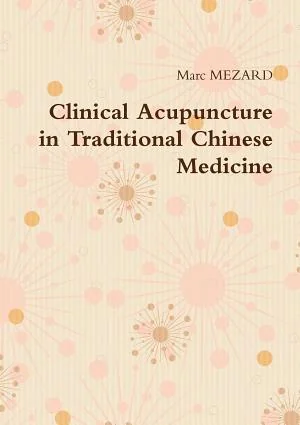
Clinical Acupuncture in Traditional Chinese Medicine
 75
75

Clinical Acupuncture in Traditional Chinese Medicine
Marc MEZARD's "Clinical Acupuncture in Traditional Chinese Medicine" attempts to demystify the often-intimidating aspects of MTC for students and the intellectually curious. The author's ambition to unpack the "black boxes" of Chinese Medicine, particularly through the lens of the "5 elements" law, is commendable. The initial promise of connecting ancient diagnostic methods to modern concepts like endocrinology is intriguing. However, the execution sometimes leans towards oversimplification, especially when attempting to integrate complex biological systems with a purely elemental framework. A notable strength is the book's direct address to students seeking to complete their knowledge, providing a clear, albeit sometimes abstract, pathway. The limitation lies in the depth of integration; while it suggests a connection to the genetic code, the practical clinical application of this link remains underdeveloped within the text. The work explores how the "5 elements" can serve as a diagnostic key, a core concept MEZARD revisits throughout.
📝 Description
75
Marc Mezard's 2016 book, Clinical Acupuncture in Traditional Chinese Medicine, clarifies TCM diagnostic methods.
Published in 2016, Marc Mezard's Clinical Acupuncture in Traditional Chinese Medicine focuses on diagnostic approaches within Traditional Chinese Medicine (TCM). The book aims to connect theoretical concepts with practical clinical use, especially for students wanting to move past basic principles. It highlights an old diagnostic method based on the "5 elements" law, meant to make difficult TCM ideas clearer.
This text is specifically for students of Traditional Chinese Medicine who want to supplement their studies. It also provides an introduction for general readers interested in this ancient diagnostic system. Mezard's work attempts to explain complex TCM topics, like endocrinology and genetic patterns, by applying its core principles.
Clinical Acupuncture in Traditional Chinese Medicine taps into the long history of Traditional Chinese Medicine, a system developed over many centuries in China. Its diagnostic principles, such as the "5 elements" (Wu Xing), have roots in ancient philosophical and medical texts. Mezard's work connects these historical frameworks to current clinical practice, showing how ancient medical thought can inform modern approaches.
💡 Why Read This Book?
• Gain a structured understanding of the "5 elements" law as a diagnostic tool, moving beyond memorization to comprehension, as detailed in MEZARD's framework. • Discover how ancient TCM diagnostic principles, like those discussed in relation to the "black boxes" of MTC, can be applied to modern clinical scenarios. • Explore the potential connections between Traditional Chinese Medicine concepts and contemporary fields such as endocrinology, as suggested by the author's expansive view.
⭐ Reader Reviews
Honest opinions from readers who have explored this book.
❓ Frequently Asked Questions
What specific diagnostic method does "Clinical Acupuncture in Traditional Chinese Medicine" focus on?
The book centers on an ancestral diagnostic method derived from the "5 elements" law, a foundational principle in Traditional Chinese Medicine used to understand physiological and pathological processes.
Who is the primary audience for Marc MEZARD's book?
The primary audience consists of MTC (Médecine Traditionnelle Chinoise) students seeking to supplement their knowledge, as well as "curious" individuals interested in learning an ancient method of diagnosis.
What does the book mean by "black boxes" of MTC?
The term "black boxes" refers to complex, often obscure, diagnostic or therapeutic mechanisms within Traditional Chinese Medicine that learners may find difficult to grasp. The book aims to illuminate these areas.
Does the book discuss modern scientific concepts?
Yes, the book suggests that its methods can lead to an understanding of concepts like endocrinology and the genetic code within the framework of Chinese Medicine.
When was "Clinical Acupuncture in Traditional Chinese Medicine" first published?
The book was first published on December 30, 2016.
What is the core philosophical concept underpinning the diagnostic method presented?
The core concept is the "Law of the 5 elements" (Wu Xing), which posits dynamic relationships between Wood, Fire, Earth, Metal, and Water, influencing health and disease.
🔮 Key Themes & Symbolism
The Law of 5 Elements
This ancient Chinese cosmological model, known as Wu Xing, is central to MEZARD's diagnostic approach. It posits that all phenomena, including human physiology and pathology, can be understood through the interactions of five fundamental elements: Wood, Fire, Earth, Metal, and Water. The book details how these relationships (generating, controlling, and overacting cycles) provide a framework for analyzing symptoms, identifying root causes, and formulating treatment strategies in acupuncture and TCM. It moves beyond simple categorization to explore the dynamic interplay that governs health.
Diagnostic "Black Boxes"
MEZARD addresses the perceived opacity of certain TCM diagnostic and therapeutic mechanisms, referring to them as "black boxes." This theme focuses on clarifying these complex areas for students and practitioners. By applying the systematic logic of the "5 elements" law and other core TCM principles, the book aims to provide clarity and understanding. The goal is to make accessible intricate aspects of TCM, enabling a deeper appreciation of its sophisticated diagnostic capabilities and treatment rationales.
Bridging Ancient and Modern
A significant theme is the endeavor to connect traditional TCM knowledge with contemporary scientific understanding. The book suggests that the clear insights of Chinese Medicine, particularly in diagnosis, can offer valuable perspectives on modern physiological and even genetic concepts. MEZARD's work explores how ancient diagnostic frameworks can potentially illuminate areas like endocrinology, suggesting that the wisdom of TCM is not static but can offer relevant insights for current medical inquiry.
Clinical Application Focus
The emphasis is on "Clinical Acupuncture," indicating a practical orientation rather than purely theoretical study. The book is designed to equip MTC students with enhanced diagnostic skills that can be directly applied in clinical settings. It moves beyond academic understanding to provide tools and perspectives that inform patient assessment and treatment planning. This focus ensures that the theoretical concepts discussed are grounded in their utility for practitioners aiming to improve patient outcomes.
💬 Memorable Quotes
Direct passages from the work, attributed to the author.
“Starting from the secret of the Law of the "5 elements".”
— This highlights the foundational importance of the Wu Xing system as the key entry point for understanding the diagnostic methods presented in the book.
“This method makes it possible to open the "Black boxes" of the MTC.”
— This phrase signifies the book's core objective: to explain complex or obscure aspects of Traditional Chinese Medicine, making them accessible and understandable to students.
“Finally to understand the greatness of the Chinese Medicine.”
— This suggests that by grasping the principles explained, particularly the diagnostic methods, readers will achieve a profound appreciation for the depth and sophistication of TCM.
“Endocrinology, genetic code .... everything is within your reach.”
— This bold claim indicates the book's ambition to show how TCM principles can be conceptually linked to modern biological sciences, making advanced topics seem attainable through the book's teachings.
“Just read and digest this exceptional information.”
— This serves as a direct encouragement to the reader, emphasizing the value of the content and the need for careful study to fully benefit from the knowledge offered.
🌙 Esoteric Significance
Tradition
While Traditional Chinese Medicine is a sophisticated medical system, its foundational principles, particularly the "5 elements" and concepts like Qi (vital energy), are often interpreted through an esoteric lens. These concepts resonate with broader Taoist philosophy and cosmological frameworks that view the universe and human body as interconnected energetic systems. MEZARD's work, by focusing on these core principles for diagnosis, touches upon a tradition that sees health as a manifestation of energetic harmony, aligning with perennialist ideas of universal energetic laws.
Symbolism
The "5 elements" (Wood, Fire, Earth, Metal, Water) are not merely descriptive but deeply symbolic, representing dynamic processes, phases, and qualities found throughout nature and the human body. Wood symbolizes growth and expansion, Fire represents transformation and activity, Earth signifies stability and nourishment, Metal embodies structure and refinement, and Water denotes fluidity and potential. Their cyclical relationships (generation, control) symbolize the constant flux and balance required for health, a core tenet in many esoteric traditions that explore universal patterns.
Modern Relevance
Contemporary thinkers and practitioners in fields ranging from holistic health and wellness to consciousness studies often draw upon the energetic and systemic principles found in TCM. The "5 elements" framework, as explored by MEZARD, offers a model for understanding complex interdependencies that is increasingly relevant in systems thinking and ecological approaches. Modern practitioners of integrative medicine and even some psychotherapists utilize these ancient concepts to understand patient well-being holistically, seeing them as complementary to conventional scientific models.
👥 Who Should Read This Book
• MTC students seeking to deepen their diagnostic skills beyond foundational knowledge, particularly those interested in understanding the theoretical underpinnings of the "5 elements" law. • Practitioners of acupuncture and Traditional Chinese Medicine who wish to refine their approach to complex cases by revisiting the "black boxes" of MTC diagnosis. • Individuals curious about ancient healing systems and their potential connections to modern biological concepts like endocrinology, looking for a structured introduction.
📜 Historical Context
Marc MEZARD's "Clinical Acupuncture in Traditional Chinese Medicine" emerges from a long lineage of medical thought stretching back millennia in China. The diagnostic framework it champions, the "Law of the 5 Elements" (Wu Xing), has been a core part of Chinese medical philosophy since at least the Han Dynasty (206 BCE – 220 CE), appearing in foundational texts like the *Huangdi Neijing* (Yellow Emperor's Inner Canon). MEZARD's work, published in 2016, situates itself within a contemporary global interest in Traditional Chinese Medicine, often contrasting with or seeking integration with Western biomedical paradigms. While MEZARD doesn't explicitly engage with specific contemporary authors or reception events in the provided blurb, the book implicitly addresses the ongoing discourse between traditional Asian medicine and Western scientific inquiry, a dialogue prominent since the mid-20th century. The "5 elements" concept itself has been a subject of extensive study and interpretation by scholars and practitioners worldwide, including figures like Ted Kaptchuk, whose work *The Web That Has No Weaver* (1983) significantly influenced Western understanding of TCM.
📔 Journal Prompts
The "5 elements" law as a diagnostic key.
Opening the "black boxes" of MTC: what remains opaque?
Connecting the "5 elements" to endocrine function.
The "greatness" of Chinese Medicine: what makes it exceptional?
Integrating ancestral methods with clinical practice.
🗂️ Glossary
MTC
Abbreviation for Médecine Traditionnelle Chinoise, the French term for Traditional Chinese Medicine. It refers to the system of medicine originating in China, encompassing acupuncture, herbal medicine, and other practices.
5 elements
Also known as Wu Xing, this is a fundamental concept in Traditional Chinese Medicine and Chinese philosophy, describing the five phases or movements: Wood, Fire, Earth, Metal, and Water. They represent interconnected forces and processes in nature and the human body.
Law of the "5 elements"
The principles governing the relationships and interactions between the five elements (Wu Xing), including the generating (sheng) and controlling (ke) cycles. This law is used to explain physiological functions, pathological changes, and guide diagnosis and treatment in TCM.
Black boxes
A metaphor used in the book to describe complex, intricate, or poorly understood mechanisms within Traditional Chinese Medicine that are often challenging for students to grasp fully. The book aims to clarify these areas.
Endocrinology
The branch of medicine concerned with the study of hormones and endocrine glands. The book suggests that TCM diagnostic principles can offer insights relevant to understanding endocrine functions.
Genetic code
The set of rules by which information encoded in genetic material (DNA or RNA sequences) is translated into proteins by living cells. The book implies a connection between TCM principles and this fundamental biological concept.
Ancestral method of diagnosis
Refers to the traditional diagnostic techniques developed and refined over centuries within Traditional Chinese Medicine, particularly those rooted in ancient philosophical and energetic concepts like the "5 elements."
This book appears in 1 collection
🔮 Readers Also Liked
Browse all →









From the “Acupuncture” Collection
View all →






More Free Occult Philosophy Books
View all →