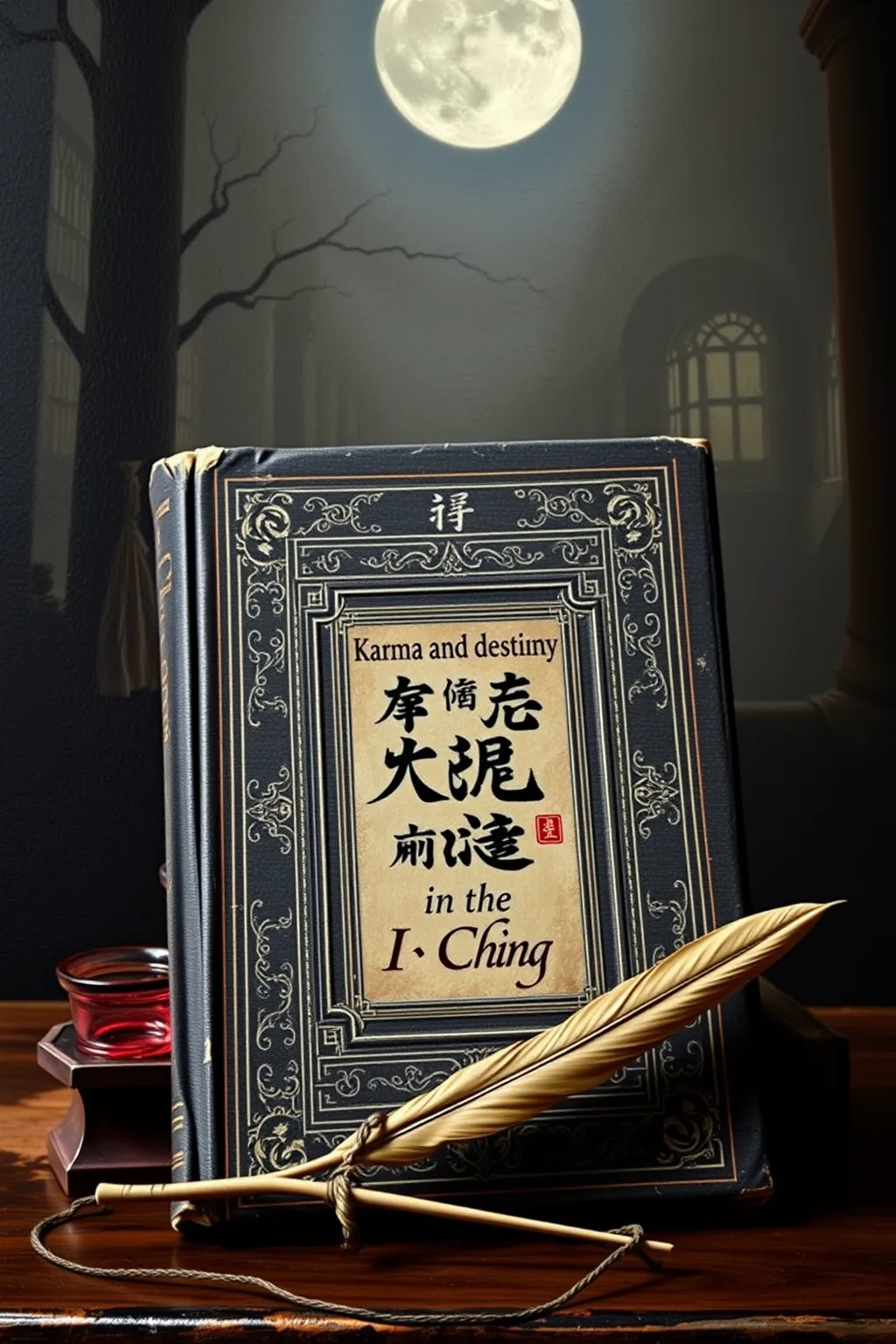
Karma and destiny in the I Ching
 83
83

Karma and destiny in the I Ching
Guy Damian-Knight’s *Karma and Destiny in the I Ching* offers a compelling, albeit somewhat dense, reinterpretation of the ancient oracle. Rather than presenting the I Ching as purely predictive, Damian-Knight frames it as a sophisticated map of karmic causality, a perspective that adds significant depth for Western readers accustomed to concepts of free will. The book's strength lies in its persistent effort to reconcile Eastern fatalism with Western notions of personal agency, particularly through its analysis of the changing lines as junctures of karmic consequence. However, the prose can occasionally feel academic, sometimes obscuring the practical application of its intricate theories. A notable passage details how Hexagram 1, Qian (The Creative), though representing pure potential, still operates within a framework of cosmic law, implying that even primordial power is subject to a form of destiny. While the work provides a robust intellectual framework, it might leave practitioners seeking simple divinatory guidance wanting more direct methods. Ultimately, it’s a valuable contribution for those who approach the I Ching as a philosophical and ethical text.
📝 Description
83
Guy Damian-Knight's 1987 book connects the I Ching to Western esoteric thought.
Published in 1987, Karma and Destiny in the I Ching by Guy Damian-Knight analyzes the ancient Chinese text through Western esoteric concepts. The book aims to reconcile Eastern ideas of fate with Western understandings of free will. It treats the I Ching's hexagrams and changing lines as indicators of karmic patterns and potential future paths, not merely predictive devices.
Damian-Knight argues for a view where destiny results from the interaction between past actions and current decisions. This work is for readers of the I Ching seeking a deeper philosophical framework beyond basic divination. It will also interest students of comparative esotericism, particularly those examining the intersection of Eastern fate philosophies and Western concepts of spiritual growth and personal choice. Scholars of Jungian psychology, karmic astrology, and Western occult traditions may find its interpretations valuable. The book is for practitioners or academics wanting a more thorough grasp of the text's ethical and metaphysical dimensions, moving past simple memorization of hexagram meanings.
Damian-Knight's work appeared in 1987, a time of growing Western interest in Eastern philosophies and esoteric systems. This period saw continued engagement with Carl Jung's ideas, particularly his theories on synchronicity and archetypes, which had already made the I Ching accessible as a psychological and symbolic tool. The book fits into a larger trend of reinterpreting Eastern wisdom for a Western audience, often through occult or psychological perspectives.
💡 Why Read This Book?
• Understand the I Ching through a karmic lens: Learn to interpret hexagrams and changing lines not just for fortune-telling, but as indicators of past actions and future potentials, as detailed in Damian-Knight's analysis of hexagrammatic causality. • Reconcile Eastern fate with Western free will: Discover how the book bridges these philosophical divides, presenting destiny as a dynamic interplay of karmic patterns and conscious choice, a concept explored through the I Ching's structure. • Deepen your esoteric studies: Gain a framework for integrating I Ching wisdom with Western occult traditions and psychological concepts, particularly Jungian ideas, as Damian-Knight applies them to the text's symbolism.
⭐ Reader Reviews
Honest opinions from readers who have explored this book.
❓ Frequently Asked Questions
What is the primary focus of Karma and Destiny in the I Ching?
The book focuses on interpreting the I Ching's hexagrams and changing lines through the framework of karma and destiny, aiming to reconcile Eastern concepts of fate with Western ideas of free will.
When was Karma and Destiny in the I Ching first published?
The book was first published in 1987, placing it within a period of significant Western engagement with Eastern esoteric traditions.
Does the book offer practical I Ching readings?
While it analyzes the I Ching's structure and symbolism, its primary aim is philosophical and conceptual exploration rather than providing direct, step-by-step divination techniques.
Who is the author of Karma and Destiny in the I Ching?
The author is Guy Damian-Knight, known for his work exploring the intersection of Western esotericism and Eastern philosophies.
What makes this book different from other I Ching commentaries?
Its unique approach lies in its dedicated focus on karmic causality and the synthesis of Eastern and Western metaphysical viewpoints, offering a distinct perspective on the text's ethical dimensions.
What Western philosophical concepts does the book connect with the I Ching?
It particularly engages with Western notions of free will, personal agency, and spiritual development, contrasting and integrating them with the I Ching's presentation of destiny.
🔮 Key Themes & Symbolism
Karmic Causality
The work posits karma as a fundamental principle shaping destiny within the I Ching framework. It interprets the sixty-four hexagrams and their constituent trigrams as complex expressions of cause and effect, where past actions or karmic imprints influence present circumstances and future possibilities. Damian-Knight examines how the changing lines within a hexagram represent critical junctures where karmic patterns can be understood, potentially modified, or resolved through conscious awareness and action. This perspective moves beyond simple prediction to a view of the I Ching as a dynamic ethical and metaphysical map.
Destiny and Free Will
A central theme is the reconciliation of the I Ching's seemingly deterministic nature with Western concepts of free will and personal agency. The book argues that destiny is not a rigid, inescapable fate but a fluid landscape shaped by karmic momentum. It explores how understanding these karmic currents, as revealed by the I Ching, empowers individuals to make conscious choices that can alter their trajectory. This synthesis suggests that the oracle provides insights into the forces at play, offering wisdom for navigating challenges and opportunities with greater awareness.
The I Ching as a Metaphysical Map
Damian-Knight treats the I Ching not merely as a divination tool but as a profound symbolic system mapping the fundamental principles of the cosmos and human experience. The arrangement of hexagrams, the interplay of yin and yang, and the textual commentaries are analyzed for their deeper philosophical and spiritual meanings. The book positions the I Ching as a guide for understanding the underlying order of existence, the cyclical nature of life, and the ethical responsibilities inherent in human action within this cosmic structure.
Symbolic Interpretation of Hexagrams
The work looks at the symbolic language of the I Ching, interpreting the imagery and meaning of each hexagram and trigram. It emphasizes how these symbols represent archetypal forces, psychological states, and situational dynamics. By dissecting the structure and associated texts, Damian-Knight provides a method for understanding the nuanced messages of the oracle, highlighting how the combination of trigrams and the specific nature of changing lines offer distinct insights into the karmic and destined aspects of a situation.
💬 Memorable Quotes
Direct passages from the work, attributed to the author.
“The I Ching presents a universe governed by dynamic principles, not fixed decrees.”
— This suggests that the oracle's insights into destiny are not about immutable fate, but rather about understanding the underlying forces and patterns that shape events, allowing for a more nuanced approach to life's challenges.
“Karmic patterns are etched into the fabric of existence, revealed through the hexagrams.”
— This interpretation highlights the book's core idea: the I Ching serves as a symbolic language that communicates the nature of karmic cause and effect, showing how past actions manifest in present circumstances.
“Understanding the changing lines offers a gateway to conscious karmic navigation.”
— This points to the practical application of the I Ching according to Damian-Knight, where awareness of transitional moments within a hexagram can empower individuals to influence their destiny.
“Destiny is not a prison, but a landscape to be traversed with wisdom.”
— This conveys the book's optimistic perspective, framing destiny as a path influenced by knowledge and conscious choice, rather than an unchangeable sentence, thereby emphasizing the role of agency.
“The hexagrams map the consequences of actions, both seen and unseen.”
— This emphasizes the comprehensive scope of the I Ching as analyzed in the book, suggesting it offers insights into the far-reaching effects of our deeds, extending beyond immediate observable outcomes.
🌙 Esoteric Significance
Tradition
This work fits within the Hermetic and Theosophical traditions, which historically sought to find universal truths across diverse religious and philosophical systems. Damian-Knight's approach of applying Western esoteric concepts like karma and personal agency to an Eastern text like the I Ching aligns with the Hermetic principle of 'As Above, So Below,' seeking correspondences between macrocosmic laws and human experience. It departs from purely scholarly or traditional Chinese interpretations by foregrounding a karmic-ethical framework familiar to Western occultists.
Symbolism
The book frequently engages with the symbolism of the yin and yang, the fundamental dual forces represented in the trigrams and hexagrams. These are interpreted not just as opposites, but as dynamic, interacting energies whose balance or imbalance dictates karmic outcomes. The imagery associated with specific hexagrams, such as 'The Cauldron' (Ding) or 'The Wanderer' (Lu), is explored for its symbolic representation of life's cyclical phases and the karmic lessons inherent within them, offering a deeper esoteric understanding of their prophetic significance.
Modern Relevance
Contemporary practitioners of comparative esotericism, Jungian psychology, and karmic astrology continue to draw upon works like Damian-Knight's. Modern interpretations of divination systems often seek to integrate psychological depth and ethical considerations, a path significantly illuminated by this book's approach to the I Ching. Thinkers exploring the intersection of fate, consciousness, and causality in spiritual development find its framework valuable for understanding personal evolution within a larger cosmic order.
👥 Who Should Read This Book
• Students of comparative esotericism: Individuals seeking to understand how Eastern divination systems like the I Ching can be integrated with Western metaphysical concepts of karma and destiny. • Practitioners of Jungian psychology: Those interested in exploring the archetypal symbolism of the I Ching and its application to understanding the psyche and personal development through a karmic lens. • Dedicated I Ching students: Readers who have moved beyond basic divination and are seeking a deeper philosophical and ethical framework for interpreting the oracle's complex messages.
📜 Historical Context
Published in 1987, Guy Damian-Knight's *Karma and Destiny in the I Ching* emerged during a vibrant period for Western esoteric thought, characterized by a deep interest in synthesizing Eastern philosophical traditions with Western psychological and occult frameworks. This era saw continued influence from figures like Carl Jung, whose work on synchronicity and the collective unconscious had already established the I Ching as a subject of serious study beyond its traditional divination uses. Damian-Knight's contribution positioned itself within this intellectual current, aiming to bridge the perceived gap between Eastern fatalism and Western notions of free will. It engaged with a landscape populated by earlier, foundational translations and commentaries, such as Richard Wilhelm's influential German version first published in 1924, which had already introduced the I Ching to a broad Western audience. The book's specific focus on karma and destiny offered a particular interpretive lens, contributing to the ongoing discourse on how ancient wisdom could be recontextualized for modern spiritual seekers.
📔 Journal Prompts
The karmic implications of Hexagram 25, Innocence (Wu Wang).
How the concept of changing lines in the I Ching offers opportunities for karmic navigation.
Reflect on the balance between destiny and free will as presented through the hexagrams.
The symbolism of the yin and yang forces in shaping one's personal destiny.
Interpreting the I Ching's ethical landscape through the lens of karmic causality.
🗂️ Glossary
Hexagram
A figure composed of six stacked horizontal lines, each line being either solid (yang) or broken (yin). There are 64 hexagrams in the I Ching, representing fundamental archetypes and situations.
Trigram
A figure composed of three stacked horizontal lines, each line being either solid (yang) or broken (yin). There are 8 basic trigrams, which combine to form the 64 hexagrams.
Changing Lines
Specific lines within a hexagram that are in the process of transforming into their opposite (yin to yang, or yang to yin). These lines indicate dynamic shifts and potential outcomes.
Karma
In this context, the principle of cause and effect where intent and actions of an individual influence their future. It's viewed as a force shaping destiny.
Destiny
The predetermined course of events, or the sum of all events that will happen. In Damian-Knight's work, it is presented as influenced by karmic patterns but also open to conscious navigation.
Yin and Yang
The two fundamental, complementary principles in Chinese philosophy. Yin is typically associated with feminine, passive, dark, and receptive qualities, while Yang is associated with masculine, active, light, and creative qualities.
Wu Wang
The Chinese term for Hexagram 25, often translated as 'Innocence' or 'Without Worry/Deception'. It relates to acting naturally and spontaneously in accordance with the Tao.
🔮 Readers Also Liked
Browse all →








More by Guy Damian-Knight
All books →





More Free Occult Philosophy Books
View all →