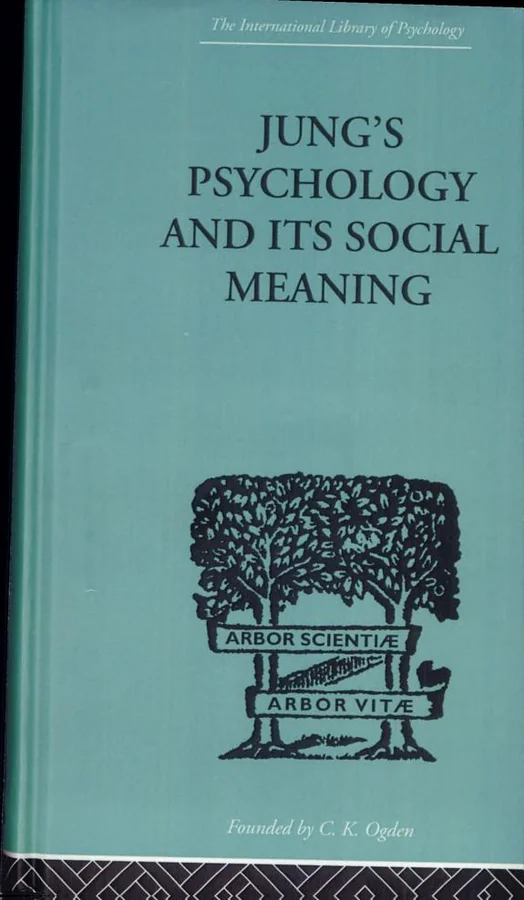
Jung's Psychology and It's Social Meaning
 74
74

Jung's Psychology and It's Social Meaning
Progoff’s analysis of Jung’s impact on social thought offers a valuable perspective, moving beyond purely clinical applications. The strength of the book lies in its diligent tracing of Jungian concepts into fields like sociology and philosophy, demonstrating their wider applicability. However, the text occasionally feels dense, assuming a familiarity with Jungian terminology that might alienate newcomers. The discussion of how the collective unconscious might manifest in political movements, for instance, is compelling but requires careful reading. While the 1999 publication date means it doesn't engage with the most recent academic discourse, it provides a solid, foundational look at the social dimensions of Jung's work. This is a serious academic study for those invested in Jungian theory's broader implications.
📝 Description
74
Ira Progoff's 1999 book connects Carl Jung's ideas to societal structures and cultural thought.
First published in 1999, Ira Progoff's "Jung's Psychology and Its Social Meaning" looks at how Carl Jung's analytical psychology impacts society beyond the therapy room. Progoff examines Jung's theories, including the collective unconscious and archetypes, and how they relate to social systems, cultural practices, and philosophical ideas. The book argues that Jung's work is not just a psychological system but a way to understand shared human experiences and how consciousness changes over time.
This book is for people already interested in depth psychology and its connections to culture. It suits academics, advanced students in psychology, philosophy, and sociology, and anyone wanting to grasp the societal effects of Jungian thought. Readers curious about the link between individual minds and collective patterns, and how psychological ideas influence our view of society, will find this work useful. Progoff discusses Jung's core concepts like archetypes as universal psychic patterns and individuation as a lifelong growth process. He also analyzes the collective unconscious as a psychic inheritance common to all humans.
Published in 1999, this book sits within a tradition that views psychology as a lens for understanding deeper, often hidden, currents in human collective life. It follows thinkers like Erich Fromm and Karen Horney who sought to connect psychoanalytic ideas to social dynamics. The book's place within Routledge's series on psychological works suggests an academic engagement with ideas that have long been considered outside mainstream empirical psychology, touching on the occult philosophy tradition's interest in universal symbols and psychic inheritance.
💡 Why Read This Book?
• Gain insight into how Jung’s concept of the collective unconscious, as discussed by Progoff, offers a framework for understanding shared cultural myths and societal patterns beyond individual psychology. • Understand the process of individuation, as articulated by Jung and examined in this book, and its relevance to personal development within a social context. • Explore the social meaning of archetypes, specific symbolic patterns identified by Jung and analyzed by Progoff, to better interpret cultural narratives and human behavior.
⭐ Reader Reviews
Honest opinions from readers who have explored this book.
❓ Frequently Asked Questions
What specific Jungian concepts does Ira Progoff examine in relation to society?
Progoff's work focuses on core Jungian concepts such as the collective unconscious, archetypes, and the process of individuation, exploring how they manifest and influence societal structures and cultural phenomena.
When was "Jung's Psychology and Its Social Meaning" first published?
The book was first published in 1999 by Routledge as part of a series of significant works in psychology.
Who are some contemporaries or influences mentioned in the context of this book's series?
The series in which this book appears includes works by C.G. Jung, Sigmund Freud, Jean Piaget, Otto Rank, James Hillman, Erich Fromm, and Karen Horney, contextualizing Progoff's study within a broad psychological tradition.
Is this book suitable for someone new to Jungian psychology?
While valuable, the book assumes some familiarity with Jungian terminology. Readers new to Jung might benefit from consulting introductory texts before delving into Progoff's more complex societal analysis.
What is the 'social meaning' Progoff attributes to Jung's psychology?
Progoff argues that Jung's psychology provides tools for understanding collective human experience, cultural evolution, and the interplay between individual consciousness and broader social forces, extending beyond individual therapy.
What is the significance of the 'International Library of Psychology' series?
This series, originally published between 1910 and 1965, comprises foundational texts by key figures in psychology, re-issued to make these influential works accessible to contemporary scholars and readers.
🔮 Key Themes & Symbolism
Collective Unconscious and Society
Progoff examines Carl Jung's theory of the collective unconscious, proposing it as a shared psychic inheritance influencing societal norms, cultural expressions, and collective behavior. This theme explores how universal patterns, or archetypes, manifest in myths, religions, and social structures, providing a framework for understanding shared human experiences and their societal implications beyond individual consciousness.
Archetypes in Cultural Narratives
This theme looks at how Jungian archetypes, such as the Hero, the Shadow, or the Great Mother, serve as fundamental psychic structures that shape human understanding and are recurrent motifs in global mythology, art, and literature. Progoff analyzes how recognizing these archetypal patterns can illuminate the deeper psychological currents within societal narratives and cultural phenomena.
Individuation and Social Integration
The book investigates Jung's concept of individuation—the process of psychological differentiation and integration—and its relationship to social life. Progoff considers how the pursuit of wholeness impacts an individual's engagement with societal expectations, exploring the tension between personal development and conformity within collective frameworks.
Jungian Psychology as a Social Lens
This theme positions Jung's analytical psychology as a critical tool for analyzing social phenomena. Progoff illustrates how Jungian concepts can offer new perspectives on social movements, political ideologies, and the evolution of consciousness within culture, moving the discussion from personal pathology to collective psychological dynamics.
💬 Memorable Quotes
Direct passages from the work, attributed to the author.
“The work explores Jung's ideas regarding the collective unconscious as a psychic inheritance.”
— This highlights Progoff's focus on Jung's concept of a shared, transpersonal layer of the psyche that influences human behavior and cultural patterns across different societies and eras.
“Archetypes are presented as universal patterns shaping perception and behavior.”
— This interpretation underscores the book's engagement with Jung's theory of archetypes as fundamental structures of the psyche that manifest in myths, symbols, and recurring human experiences.
“Individuation is discussed as a process of psychological integration within a social context.”
— This points to Progoff's analysis of Jung's individuation process, emphasizing its dynamic interplay with societal influences and the challenge of achieving personal wholeness while engaged with the collective.
“The book analyzes the social implications of Jung's analytical psychology.”
— This captures the core objective of Progoff's study: to extend the understanding of Jungian psychology beyond individual therapy and explore its relevance to broader societal structures and cultural phenomena.
“Progoff examines how Jung's theories can interpret cultural phenomena.”
— This signifies the book's approach to using Jungian psychology as a hermeneutic tool for deciphering the psychological underpinnings of myths, art, and collective human narratives.
🌙 Esoteric Significance
Tradition
While primarily an academic work on psychology, Progoff's exploration of Jungian concepts touches upon traditions concerned with the collective psyche and universal symbolism. It aligns with Hermetic and Gnostic interests in hidden patterns of consciousness and the archetypal forces that shape human experience, viewing Jung's work as a modern articulation of these ancient concerns about the soul's connection to the cosmos.
Symbolism
The book frequently engages with Jungian archetypes, which function as symbolic blueprints of the psyche. Concepts like the 'Shadow' represent the repressed aspects of the individual and collective personality, while the 'Anima/Animus' symbolize the contrasexual aspects of the psyche. These archetypes, according to Jung and explored by Progoff, act as symbolic mediators between the conscious and unconscious realms, influencing both personal development and societal expression.
Modern Relevance
Contemporary scholars and practitioners in depth psychology, cultural studies, and even fields like ecopsychology continue to draw upon Jungian frameworks for understanding collective anxieties, societal crises, and the human relationship with nature. Progoff's analysis of Jung's social meaning remains relevant for those seeking to understand how psychological theories can illuminate contemporary cultural narratives and collective psychological dynamics.
👥 Who Should Read This Book
• Students of depth psychology and Jungian analysis seeking to understand the societal applications of concepts like archetypes and the collective unconscious. • Cultural theorists and sociologists interested in applying psychological frameworks to analyze social phenomena, myths, and collective behaviors. • Philosophers and intellectual historians examining the development of 20th-century psychological thought and its impact on broader philosophical discourse.
📜 Historical Context
Ira Progoff's "Jung's Psychology and Its Social Meaning," published in 1999, entered a field already shaped by decades of Jungian scholarship and critique. Its inclusion in Routledge's "International Library of Psychology" series, which reissued foundational texts from 1910-1965, places it in dialogue with figures like C.G. Jung himself, Sigmund Freud, and Otto Rank. The late 20th century saw Jungian psychology engage increasingly with post-structuralist thought and continental philosophy, with thinkers like James Hillman offering distinct interpretations. Progoff's work contributes to this ongoing discourse, examining how Jung's concepts, particularly the collective unconscious and archetypes, offer a framework for understanding societal patterns, cultural expressions, and the evolution of consciousness, extending beyond the purely clinical realm. The book emerged when psychoanalytic theory was being critically assessed for its social and political implications, making its focus on Jung's societal meaning particularly relevant.
📔 Journal Prompts
The collective unconscious as a source of societal patterns: what personal experiences echo this?
Archetypes in modern media: identify one and analyze its societal role.
Reflecting on individuation: how does societal pressure shape your personal integration process?
The interplay between personal psychology and collective consciousness: observe an example.
Jung's social meaning: how might these concepts influence contemporary social movements?
🗂️ Glossary
Collective Unconscious
A concept in Jungian psychology referring to a shared, inherited layer of the human psyche containing universal patterns of behavior and imagery, known as archetypes.
Archetype
Universal, archaic patterns and images that derive from the collective unconscious and are the psychic counterpart of a biological instinct.
Individuation
The psychological process of integrating the conscious and unconscious aspects of the self to achieve wholeness and self-realization.
Analytical Psychology
The school of psychology founded by Carl Jung, emphasizing the unconscious, archetypes, and the process of individuation.
Psychic Inheritance
The idea that certain psychological structures, patterns, and predispositions are inherited across generations, forming the basis of the collective unconscious.
Social Meaning
The interpretation of psychological concepts in terms of their relevance to and impact on societal structures, cultural norms, and collective human behavior.
Mythology
The body of myths and legends of a particular culture or people, often seen by Jungians as expressions of archetypal patterns.
This book appears in 1 collection
🔮 Readers Also Liked
Browse all →









From the “Jungian Psychology” Collection
View all →








More Free Occult Philosophy Books
View all →