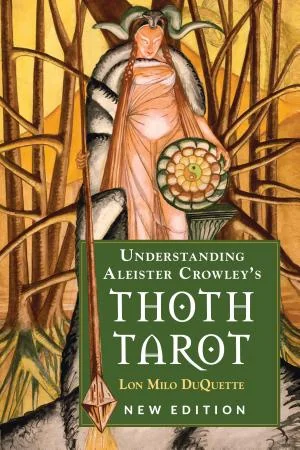
Understanding Aleister Crowley's Thoth Tarot
 81
81

Understanding Aleister Crowley's Thoth Tarot
Lon Milo DuQuette's guide to the Thoth Tarot is, frankly, the benchmark against which all other introductions to this challenging deck are measured. His strength lies in his unparalleled ability to demystify Crowley's dense symbolism without sacrificing its esoteric potency. He manages to explain the Qabalistic underpinnings of a card like The Fool, connecting it to the Hebrew letter Aleph and its astrological correspondence with Uranus, in a way that feels both authoritative and accessible. However, the book's sheer depth can also be a limitation for absolute beginners. While DuQuette aims for clarity, the inherent complexity of the Thoth system, as presented, might still leave neophytes feeling overwhelmed. A passage discussing the "elements of the divine fire" on the Aces, for instance, requires a foundational understanding of Crowley's magickal cosmology that isn't always explicitly laid out in preceding sections. Despite this, DuQuette's exposition remains the clearest pathway into understanding the Thoth deck's intricate design and magickal purpose. It is an indispensable, if demanding, resource.
📝 Description
81
Lon Milo DuQuette's 2003 book deciphers Aleister Crowley's complex Thoth Tarot.
Published in 2003 and later revised, Lon Milo DuQuette's guide to Aleister Crowley's Thoth Tarot moves beyond simple card meanings. It examines the deck as a system for divination and ceremonial magick. DuQuette, a known scholar of Crowley's work, details each of the 78 cards. His interpretations connect traditional tarot concepts with their specific use within Thelema and occult practices.
This book is for those who want a deeper understanding of the Thoth Tarot, especially its complex symbolism and Crowley's philosophical ideas. Readers who find the deck's density challenging will benefit from DuQuette's clear explanations. It also appeals to those interested in the intersection of art, spirituality, and esoteric philosophy as seen in this unique creation.
The Thoth Tarot, conceived by Aleister Crowley in the early 20th century, emerged during a period of intense interest in occultism. Developed with artist Lady Frieda Harris from the 1930s to 1940s, the deck drew heavily on Golden Dawn teachings, Kabbalah, and Crowley's own system of Thelema. Its complex iconography, which includes astrological and alchemical elements, aimed to represent Crowley's view of the universe. Lon Milo DuQuette's work places this deck within that specific esoteric lineage.
💡 Why Read This Book?
• Learn the specific Qabalistic and astrological correspondences that Lon Milo DuQuette details for each of the Thoth Tarot's 78 cards, offering a unique interpretive framework beyond traditional tarot systems. • Understand the historical context of the Thoth Tarot's creation, including the collaboration between Aleister Crowley and Lady Frieda Harris during the mid-20th century, to appreciate its esoteric origins. • Gain practical insights into applying the Thoth Tarot for magickal purposes, as DuQuette outlines the expanded, occult meanings of each card beyond divination.
⭐ Reader Reviews
Honest opinions from readers who have explored this book.
❓ Frequently Asked Questions
What makes the Thoth Tarot deck different from other tarot decks?
The Thoth Tarot, created by Aleister Crowley and Lady Frieda Harris, is distinguished by its dense, intricate artwork and its deep integration of Qabalistic, astrological, and alchemical symbolism, reflecting Crowley's unique magical philosophy, Thelema.
Who was Lon Milo DuQuette and why is he qualified to write about the Thoth Tarot?
Lon Milo DuQuette is a prominent author and occultist, widely recognized as an authority on Aleister Crowley and thelema. He has spent decades studying and practicing the magickal arts, making him uniquely positioned to interpret the Thoth Tarot.
When was the Thoth Tarot deck originally conceived and created?
Aleister Crowley conceived of the Thoth Tarot in the early 1930s, and the artwork by Lady Frieda Harris was developed over a period spanning approximately 1938 to 1944.
Does this book cover the traditional meanings of tarot cards as well as Crowley's interpretations?
Yes, DuQuette's work systematically addresses both traditional tarot perspectives and the expanded, magickal viewpoints specific to Crowley's system and the Thoth deck's unique symbolism.
Is this book suitable for someone completely new to tarot?
While DuQuette's explanations are thorough, the Thoth Tarot itself is complex. This book is best suited for those with some prior exposure to tarot or a strong interest in occultism and esoteric symbolism.
What is Thelema and how does it relate to the Thoth Tarot?
Thelema is Aleister Crowley's philosophical and religious system, centered on the principle 'Do what thou wilt shall be the whole of the Law.' The Thoth Tarot is designed as a visual representation and tool for understanding Thelemic principles and magick.
🔮 Key Themes & Symbolism
Qabalistic Framework
The book meticulously details how the Thoth Tarot integrates the Qabalistic Tree of Life, assigning specific cards and Hebrew letters to its paths and spheres. This Qabalistic foundation is crucial for understanding the interconnectedness of the Major Arcana and the elemental attributions within the suits, offering a structured, esoteric map of consciousness and creation.
Thelemic Magickal Application
DuQuette emphasizes that the Thoth Tarot is not just for divination but serves as a vital tool in ceremonial magick, as envisioned by Aleister Crowley. The book explores how each card's symbolism, when understood through a Thelemic lens, can be invoked or meditated upon to achieve specific magical results and personal transformation.
Symbolism of Lady Frieda Harris
A significant portion of the book is dedicated to deciphering the rich, often abstract, symbolism within Lady Frieda Harris's artwork. DuQuette explains how her unique visual language translates Crowley's esoteric concepts into potent imagery, detailing the specific colors, figures, and geometric patterns that carry profound occult meaning.
Astrological Attributions
The work provides a comprehensive overview of the astrological correspondences assigned to each card, which differ significantly from those in many other tarot systems. Understanding these attributions, such as the planetary, zodiacal, and elemental influences on each card, is presented as essential for unlocking the deck's deeper layers of meaning.
💬 Memorable Quotes
Direct passages from the work, attributed to the author.
“The Book of Thoth is the key to the initiation of the universe.”
— This statement underscores Crowley's intent for the Thoth Tarot: not merely a divinatory tool, but a comprehensive guide and symbolic representation of the entire cosmos and the path of spiritual attainment within his system.
“The twenty-two Major Trumps are the Great Arcanum.”
— This interpretation points to the profound significance Crowley attributed to the Major Arcana, viewing them as fundamental archetypes and cosmic principles that govern existence, far beyond simple fortune-telling.
“The suit of Cups is the element of Water.”
— A direct attribution, this illustrates the book's systematic approach to elemental correspondences, linking the suit of Cups to Water, representing emotion, intuition, and the subconscious, as depicted in the Thoth deck.
💡 Key Ideas
Editorial paraphrase of the work's core concepts — not direct quotes.
The Ace of Swords is the Magus of the Invisible.
This quote highlights Crowley's unique nomenclature, rebranding a card often seen as 'the Ace of Swords' to 'Magus of the Invisible,' emphasizing its connection to pure intellect, divine inspiration, and the unmanifest potential within the Air element.
Each card is a vibration of the Divine.
This paraphrase captures the essence of how Crowley viewed the tarot, seeing each card as a distinct energetic frequency or aspect of the Godhead, capable of being understood and worked with on multiple esoteric levels.
🌙 Esoteric Significance
Tradition
The Thoth Tarot is deeply rooted in the Western Esoteric Tradition, specifically Hermeticism and the Qabalistic system as transmitted through orders like the Hermetic Order of the Golden Dawn. Aleister Crowley's Thelemic philosophy provides the overarching framework, integrating these ancient systems with his own spiritual revelations. This work is a departure from purely divinatory systems, presenting itself as a key to understanding the universe and the path of magickal attainment.
Symbolism
Central to the Thoth Tarot's symbolism are its Qabalistic attributions, linking the cards to the Tree of Life's Sephiroth and Paths, and its complex astrological and elemental correspondences. For instance, the suit of Wands represents the element of Fire and its connection to spiritual will and inspiration, while the Major Arcana cards often depict complex mythological or alchemical scenes imbued with planetary and zodiacal energies.
Modern Relevance
Contemporary practitioners of Thelema and ceremonial magick continue to rely heavily on the Thoth Tarot as their primary divinatory and meditational tool. Its intricate symbolism also attracts artists, philosophers, and students of comparative religion interested in esoteric art and the intersection of consciousness, spirituality, and symbolic systems.
👥 Who Should Read This Book
• Students of Aleister Crowley's philosophy and Thelema, seeking a visual and interpretive key to his complex magickal system. • Tarot enthusiasts interested in exploring decks beyond the Rider-Waite-Smith tradition, particularly those drawn to intricate symbolism and esoteric depth. • Practitioners of Western Esotericism and ceremonial magick looking for a robust tool for divination, meditation, and ritual work aligned with Qabalistic and Hermetic principles.
📜 Historical Context
The Thoth Tarot emerged from the fertile esoteric range of the early to mid-20th century, a period when figures like Aleister Crowley were actively synthesizing Western esotericism. Crowley, a prominent occultist and founder of Thelema, collaborated with artist Lady Frieda Harris from the late 1930s to the early 1940s on this ambitious project. Influenced by his extensive study of the Golden Dawn's teachings, Kabbalah, and various mystical traditions, Crowley sought to create a tarot deck that was a more accurate and comprehensive representation of the universe than existing decks, particularly the Rider-Waite-Smith. Unlike the more naturalistic art of Pamela Colman Smith, Harris's abstract and vibrant style presented a radical visual interpretation of occult concepts. This deck stood in contrast to the burgeoning psychological interpretations of tarot gaining traction with figures like Carl Jung, offering instead a distinctly magickal and Thelemic perspective.
📔 Journal Prompts
The Ace of Swords' representation as the Magus of the Invisible.
The astrological attributions of the Major Arcana.
Lady Frieda Harris's artistic interpretations of the court cards.
The relationship between the Tree of Life and the suit of Swords.
The concept of 'Do what thou wilt' as applied to the tarot's guidance.
🗂️ Glossary
Thelema
The religious philosophy established by Aleister Crowley, based on his reception of the Book of the Law. Its central tenet is 'Do what thou wilt shall be the whole of the Law.'
Qabalah
An esoteric system of Jewish mysticism, which Aleister Crowley and others adapted into Western esoteric traditions, notably through the structure of the Tree of Life.
Tree of Life
A diagram used in Qabalistic teachings, consisting of ten spheres (Sephiroth) and twenty-two paths, representing the structure of the cosmos and the process of creation.
Magus
In the context of the Thoth Tarot, this term refers to a powerful magician or adept, often associated with the Ace of Swords and its connection to divine intellect.
Major Arcana
The 22 trump cards of the tarot deck, representing significant spiritual lessons, archetypal forces, and major life events.
Minor Arcana
The 56 cards of the tarot deck, divided into four suits (Wands, Cups, Swords, Disks/Pentacles), representing everyday events and situations.
Ceremonial Magick
A complex system of ritualistic magic often involving elaborate preparations, invocations, and the use of symbolic tools, aiming for spiritual transformation or the manipulation of external forces.
This book appears in 1 collection
🔮 Readers Also Liked
Browse all →









From the “Divination” Collection
View all →





More Free Occult Philosophy Books
View all →