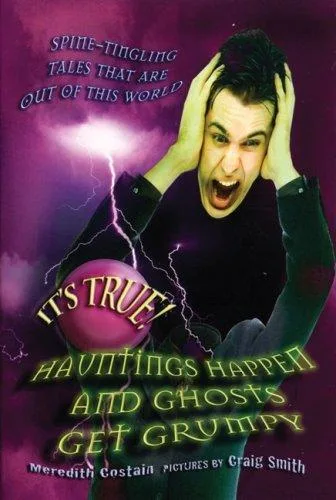
It's True! Hauntings Happen and Ghosts Get Grumpy (It's True!)
 78
78

It's True! Hauntings Happen and Ghosts Get Grumpy (It's True!)
Costain and Smith's "It's True! Hauntings Happen and Ghosts Get Grumpy (It's True!)" offers a surprisingly organized approach to a chaotic subject. Its strength lies in its cataloging of diverse phenomena, moving beyond mere sensationalism to present distinct types of hauntings with specific examples, such as differentiating between residual and intelligent hauntings. A notable limitation, however, is the reliance on anecdotal evidence without rigorous debunking or consistent scientific scrutiny, which is expected given the subject matter but leaves certain claims unsubstantiated. The discussion on the 2010 publication context, while brief, anchors the work in its contemporary popular culture milieu. Ultimately, it serves as a comprehensive, albeit credulous, compilation for enthusiasts.
📝 Description
78
Published in 2010, It's True! Hauntings Happen and Ghosts Get Grumpy collects accounts of paranormal phenomena.
Meredith Costain and Craig Smith's 2010 book presents a catalog of reported hauntings and spectral encounters. The authors organize various types of paranormal activity, including poltergeist events, using anecdotal evidence and historical accounts. They aim to structure these occurrences without imposing a single explanation, instead documenting reported cases for readers. This work is suited for those intrigued by the supernatural, especially documented ghost stories and hauntings. It offers case studies that might interest amateur paranormal investigators. Readers who appreciate collections of unexplained phenomena or the cultural history of ghost beliefs will also find material here. The book is accessible to a general audience open to exploring the edges of common understanding.
Released in 2010, this book emerged during a period of sustained popular interest in the paranormal, influenced by media and online communities. It continues a long tradition of ghost story collection, similar to Charles Fort's work in the early 20th century. While not directly academic, it taps into the enduring human fascination with unexplained encounters and spectral phenomena.
💡 Why Read This Book?
• You will learn to differentiate between residual and intelligent hauntings, a key concept discussed by Costain and Smith, helping you categorize reported paranormal events more precisely. • Gain insight into the specific types of poltergeist activity detailed by the authors, providing concrete examples that illustrate the disruptive potential of such phenomena. • Understand the historical context of paranormal belief collection, as the book was published in 2010, a period of significant popular media interest in ghost stories.
⭐ Reader Reviews
Honest opinions from readers who have explored this book.
❓ Frequently Asked Questions
What is the main difference between residual and intelligent hauntings according to the book?
The book explains residual hauntings as replays of past events, like an imprint, while intelligent hauntings involve interactive spirits that can respond to the living.
Does the book offer scientific explanations for hauntings?
While the book presents various theories, it primarily focuses on cataloging reported experiences rather than providing definitive scientific explanations.
Who are the authors of 'It's True! Hauntings Happen and Ghosts Get Grumpy (It's True!)'?
The book is authored by Meredith Costain and Craig Smith, and was first published in 2010.
What kind of phenomena does the book cover besides ghosts?
Beyond spectral apparitions, the book discusses poltergeist activity, unexplained noises, and other disturbances often associated with haunted locations.
Is this book suitable for skeptics?
Skeptics might find the anecdotal nature challenging, but it offers a comprehensive overview of reported phenomena and common beliefs about hauntings.
When was the book originally published?
The book 'It's True! Hauntings Happen and Ghosts Get Grumpy (It's True!)' was first published in 2010.
🔮 Key Themes & Symbolism
Categorizing Spectral Activity
The work meticulously distinguishes between different manifestations of the paranormal. It defines residual hauntings as non-interactive energy imprints, akin to an environmental echo of past events, and intelligent hauntings as conscious entities capable of interaction. This categorization is crucial for understanding the varied nature of reported ghostly encounters, moving beyond a monolithic concept of 'haunting' to acknowledge nuanced differences in how spirits or energies present themselves to observers in the 2010 context of paranormal investigation.
Poltergeist Phenomena
A significant portion of the book is dedicated to poltergeist activity, characterized by physical disturbances such as moving objects, unexplained noises, and even aggression. The authors explore theories linking these events to intense emotional states or specific individuals, often referred to as the 'agent.' This focus highlights a subset of hauntings that are particularly disruptive and perplexing, often challenging simpler explanations and suggesting a more dynamic, perhaps even willful, presence.
Anecdotal Evidence and Belief
The foundation of the book rests heavily on collected accounts and personal testimonies. It implicitly examines the power of belief in shaping or perceiving paranormal experiences. By presenting numerous case studies, the authors underscore how widespread belief in ghosts and hauntings influences cultural narratives and individual interpretations of unusual events, reflecting the enduring human fascination with the afterlife and the unknown.
The Grumpy Ghost Archetype
The title itself points to a specific thematic element: the personality of spirits. The book explores instances where apparitions or phenomena are described as malevolent, agitated, or 'grumpy,' suggesting that spectral entities are not always benign observers but can exhibit distinct emotional states or intentions, complicating the traditional image of ghosts and adding a layer of characterization to paranormal reports.
💬 Memorable Quotes
Direct passages from the work, attributed to the author.
“Hauntings aren't always polite visitors; some are quite agitated.”
— This sentiment, reflected in the book's title, suggests that paranormal entities can possess distinct emotional states, challenging the notion of ghosts as mere passive echoes and implying active, perhaps even negative, sentience.
“Residual hauntings are like a film playing on repeat.”
— This analogy effectively explains the concept of residual hauntings as non-interactive replays of past events, emphasizing their mechanical and detached nature compared to interactive spirits.
“Poltergeists often seem tied to emotional storms.”
— This points to a key theory discussed regarding poltergeist activity, linking the disruptive phenomena to heightened emotional states or psychological turmoil in individuals present.
“Not every unexplained noise is a ghost, but some might be.”
— This acknowledges the need for critical evaluation while remaining open to the possibility that certain auditory phenomena could indeed be paranormal in origin.
“Intelligent hauntings suggest a conscious presence.”
— This highlights the distinction between mere energetic imprints and interactive spirits, implying awareness and agency on the part of the paranormal entity.
🌙 Esoteric Significance
Tradition
While not explicitly tied to a specific esoteric lineage like Hermeticism or Kabbalah, this work engages with the broad, popular tradition of spiritism and ghost lore that has roots in 19th-century Spiritualism. It reflects a modern, accessible facet of the broader interest in the afterlife and non-corporeal existence that permeates many esoteric traditions, presenting spectral phenomena in a manner digestible for a general audience rather than within a formalized ritualistic or philosophical framework.
Symbolism
The primary 'symbol' explored is the ghost itself, which traditionally symbolizes death, the unknown, unresolved issues, or lingering past energies. The book further refines this by exploring the 'grumpy' ghost, which can symbolize repressed anger, trauma, or a warning. Poltergeist activity, characterized by physical disruption, symbolizes chaotic energy or emotional unrest breaking through into the material plane, often tied to psychological distress.
Modern Relevance
In contemporary times, the book's themes remain relevant to the ongoing popular fascination with ghosts, fueled by social media, ghost hunting tours, and a continued interest in the paranormal. While perhaps less academic than contemporary works on cryptozoology or consciousness studies, its accessible cataloging of phenomena appeals to individuals exploring spiritualism, mediumship, or simply seeking explanations for unexplained experiences, bridging popular culture with enduring questions about life after death.
👥 Who Should Read This Book
• Individuals curious about paranormal phenomena: Those who enjoy reading case studies of hauntings, spectral sightings, and unexplained disturbances will find a comprehensive overview. • Amateur paranormal investigators: Readers seeking to categorize different types of hauntings and understand common phenomena reported in the field will benefit from the book's classifications. • Students of folklore and belief systems: Anyone interested in how cultures perceive and document supernatural occurrences, and the evolution of ghost stories, will find valuable anecdotal material.
📜 Historical Context
Published in 2010, Meredith Costain and Craig Smith's "It's True! Hauntings Happen and Ghosts Get Grumpy" emerged during a period of fervent popular engagement with the paranormal. Reality television shows dedicated to ghost hunting were at their peak, creating a market for accessible explorations of spectral phenomena. While the book doesn't directly engage with academic parapsychology, it taps into a lineage of ghost lore collection that stretches back at least to the work of Charles Fort in the early 20th century, who similarly compiled strange occurrences. The book's approach, focusing on anecdotal evidence and categorizing types of hauntings, contrasts with more skeptical analyses or rigorous scientific investigations that were also present in the intellectual landscape, such as those emanating from the Koestler Parapsychology Unit at the University of Edinburgh. The work benefited from a public already primed by media and a growing online community sharing such experiences.
📔 Journal Prompts
The nature of residual hauntings versus intelligent hauntings.
Manifestations of poltergeist activity and their potential triggers.
Personal experiences or beliefs regarding spectral 'grumpiness'.
The role of emotional storms in unexplained phenomena.
Interpreting unexplained noises and disturbances.
🗂️ Glossary
Residual Haunting
A type of haunting where paranormal energy replays past events like a recording, lacking interactive consciousness.
Intelligent Haunting
A haunting involving a conscious spirit or entity that can interact with the living.
Poltergeist
A type of haunting characterized by physical disturbances such as moving objects, noises, and other disruptive phenomena.
Agent
In the context of poltergeist activity, the person, often unconsciously, believed to be the source of the disturbances.
Spectral
Relating to or resembling a ghost or apparition; ghostly.
Anecdotal Evidence
Information based on personal accounts rather than on fact or research; often used in paranormal literature.
Paranormal
Beyond what is normal or natural; relating to phenomena that cannot be explained by accepted scientific knowledge.
🔮 Readers Also Liked
Browse all →








More by Meredith Costain, Craig Smith
All books →
More Free Occult Philosophy Books
View all →