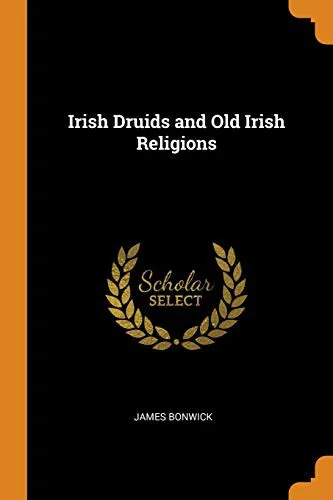
Irish Druids and old Irish religions
 79
79

Irish Druids and old Irish religions
Bonwick’s "Irish Druids and Old Irish Religions" is a fascinating artifact, offering a window into late Victorian scholarship on ancient Celtic beliefs. Its primary strength lies in its earnest attempt to synthesize available historical accounts and archaeological evidence from an era where such studies were nascent. Bonwick’s descriptions of the Druids as societal figures—philosophers, judges, and priests—are particularly compelling, moving beyond simplistic portrayals. However, the work suffers from the inherent limitations of its time; interpretations are often colored by contemporary biases and a lack of modern critical methodology. For instance, the discussion around Druidic astronomical knowledge, while intriguing, lacks the rigor expected today. A specific passage detailing the perceived sanctity of natural sites, like groves and wells, exemplifies both the book's evocative power and its tendency to rely on anecdotal evidence. Ultimately, Bonwick provides a valuable, if imperfect, historical snapshot of early attempts to understand Irish paganism.
📝 Description
79
James Bonwick's 1894 book examines pre-Christian Irish spiritual practices.
Published in 1894, James Bonwick's "Irish Druids and Old Irish Religions" presents an early attempt to reconstruct the beliefs and rituals of ancient Ireland's Celtic peoples. Bonwick gathered historical accounts and archaeological evidence available in the late 19th century to describe the Druidic class, their societal roles, religious concepts, and purported magical practices. The work is a scholarly, though dated, look at a subject that was then beginning to attract serious attention.
This volume is most useful for those studying ancient Celtic history, comparative religion, and the origins of esoteric thought. It offers insight into how these topics were understood and approached before modern academic methods became standard. Readers interested in the historical development of occult studies and the texts that influenced later movements will find it informative. It allows for a direct engagement with a late Victorian interpretation of Irish paganism.
Bonwick's work emerged during the late 19th century's Celtic Revival, a period marked by renewed interest in Irish folklore and mythology, often alongside spiritualist and occult movements. It reflects the era's engagement with national mythologies and ancient belief systems, placing it within the broader context of early esoteric scholarship that sought to uncover forgotten traditions. The book represents a Victorian-era attempt to understand Irish paganism through the lenses of available historical and archaeological data.
💡 Why Read This Book?
• Understand the late 19th-century academic perspective on ancient Irish religion, including Bonwick's specific interpretations of Druidic roles and beliefs, which differed significantly from modern scholarship. • Gain insight into the specific historical sources Bonwick consulted, such as classical writers, to reconstruct early Irish spirituality, providing a foundation for comparative religious studies. • Explore the concept of sacred natural sites like groves and stone circles as presented by Bonwick, offering a historical viewpoint on the pagan reverence for the land.
⭐ Reader Reviews
Honest opinions from readers who have explored this book.
❓ Frequently Asked Questions
When was James Bonwick's 'Irish Druids and Old Irish Religions' first published?
James Bonwick's "Irish Druids and Old Irish Religions" was first published in 1894, reflecting the scholarly interests and available knowledge of the late Victorian era.
What kind of evidence does Bonwick use to describe ancient Irish religions?
Bonwick draws upon a range of historical accounts, particularly those from classical writers who encountered Celtic peoples, alongside emerging archaeological findings and interpretations available in the late 19th century.
Does the book discuss specific Druidic rituals?
Yes, the work explores purported Druidic rituals, including those associated with natural sites like sacred groves and stone circles, and examines their perceived significance within ancient Irish society.
How does Bonwick portray the role of Druids in society?
Bonwick presents Druids not just as religious figures but as integral societal leaders, functioning as philosophers, judges, and educators within ancient Irish communities, according to the sources he consulted.
Is this book considered a modern academic text on Irish Druidry?
No, "Irish Druids and Old Irish Religions" is a historical text from 1894. While valuable for understanding past scholarship, it does not reflect contemporary archaeological or historical research methods and findings.
What historical period does Bonwick focus on?
Bonwick focuses on the period of pre-Christian Ireland, attempting to reconstruct the religious and spiritual practices of the ancient Celtic peoples and their Druidic class.
🔮 Key Themes & Symbolism
Druidic Societal Function
Bonwick's work emphasizes the complex role of the Druid in ancient Irish society, extending beyond mere religious observance. He posits them as philosophers, judges, and arbiters of law, deeply embedded in the social and political fabric. This perspective, drawn from classical observers like Caesar, highlights a complex hierarchy where spiritual authority was intertwined with secular governance. The text explores how this societal integration shaped the perception and influence of Druids, positioning them as central figures in maintaining order and transmitting knowledge within Celtic communities.
The Sacred Landscape
A significant theme is the profound connection between the ancient Irish and their natural environment, as interpreted through the lens of Druidic practices. Bonwick details the reverence shown to natural landmarks such as sacred groves, ancient stone circles, and natural springs or wells. These locations were not merely scenic but were considered potent sites for ritual, divination, and spiritual communion. The text examines how these places served as focal points for communal worship and individual devotion, reflecting a worldview where the divine was immanent within the natural world.
Celtic Pantheon and Beliefs
The book looks at the religious beliefs of the ancient Irish, focusing on their pantheon of gods and goddesses who often personified natural forces and cosmic phenomena. Bonwick attempts to reconstruct the nature of their worship, the types of offerings made, and the underlying cosmological understanding. While direct evidence is scarce, he synthesizes available historical fragments and comparative mythological insights to paint a picture of a polytheistic system deeply connected to cycles of nature, seasonal festivals, and the perceived influence of supernatural beings on human affairs.
Druidic Knowledge and Practices
Bonwick explores the perceived esoteric knowledge attributed to the Druids, including their supposed understanding of astronomy, calendars, and divination. The text discusses their role as keepers of oral traditions and lore, responsible for educating the elite. While cautioning against sensationalism, Bonwick touches upon practices that might be interpreted as magical or supernatural, often framing them within the context of ancient wisdom and natural philosophy rather than overt sorcery. This theme highlights the Druids as intellectual and spiritual guides.
💬 Memorable Quotes
Direct passages from the work, attributed to the author.
“The Druids were the philosophers, the judges, and the priests of the ancient Celts.”
— This statement captures Bonwick's view of the Druids as central figures in multiple societal domains, not confined to religious roles. It suggests their influence extended into law, education, and intellectual life, reflecting a holistic societal structure.
“Sacred groves and ancient stones were central to their worship.”
— This highlights the importance of natural landmarks in ancient Irish religious practice as presented by Bonwick. It points to a form of nature-based spirituality where specific locations held profound religious significance.
“Their knowledge of the stars guided their rituals and prophecies.”
— This suggests the integration of astronomical observation into Druidic practices, indicating a sophisticated understanding of celestial cycles and their perceived influence on earthly events and religious observances.
“The Celts believed in a divine pantheon that governed the world.”
— This points to the polytheistic nature of ancient Irish religion as Bonwick understood it, where multiple deities represented various aspects of the natural world and human experience.
“Oral tradition was the primary means of preserving their wisdom.”
— This emphasizes the importance of oral transmission in Druidic culture, where knowledge, laws, and history were passed down through generations, underscoring the role of Druids as educators and custodians of lore.
🌙 Esoteric Significance
Tradition
Bonwick's work predates the formal establishment of many modern esoteric orders like the Hermetic Order of the Golden Dawn (founded 1888) but aligns with the broader Victorian interest in ancient mystery traditions. It taps into a fascination with indigenous European paganism that would later influence movements like Neo-Paganism and certain branches of Theosophy seeking pre-Christian spiritual roots. While not strictly Hermetic or Kabbalistic, it contributes to the late 19th-century milieu that sought to rediscover and reinterpret ancient spiritual systems outside the dominant Abrahamic religious frameworks.
Symbolism
The book frequently touches upon the symbolism inherent in natural elements revered by the Druids. Sacred groves, for instance, symbolize the immanence of the divine in nature and the concept of a living, interconnected cosmos. Ancient stone circles are presented as sites of astronomical observation and ritual, representing cosmic order and the cyclical nature of time. These symbols, as interpreted by Bonwick, point to a worldview where the physical landscape was imbued with spiritual power and meaning, serving as a conduit between the human and the divine.
Modern Relevance
Contemporary practitioners of modern Druidry and Heathenry often engage with historical texts like Bonwick's, albeit critically, to understand the evolution of their traditions and the sources that have shaped modern interpretations. While Bonwick's specific conclusions may be debated, his compilation of early accounts and his focus on the sacredness of nature continue to resonate with modern eco-spiritual movements and those seeking a connection to ancestral European traditions.
👥 Who Should Read This Book
• Students of comparative religion and ancient European mythologies seeking to understand early academic approaches to Celtic paganism. • Researchers interested in the history of occult studies and esoteric thought, particularly how pre-Christian beliefs were interpreted in the late 19th century. • Individuals exploring ancestral spiritual paths who wish to examine historical perspectives on Druidic practices and their connection to the natural world.
📜 Historical Context
Published in 1894, "Irish Druids and Old Irish Religions" emerged during the Celtic Revival, a period marked by resurgent interest in Irish culture, mythology, and history. This era saw a confluence of academic scholarship, nationalistic sentiment, and burgeoning occult interests. Bonwick's work is situated within this milieu, reflecting the late Victorian fascination with ancient paganism and the reconstruction of pre-Christian societies. He drew upon classical sources, such as the writings of Roman historians, and the limited archaeological evidence available at the time. This was also a period where figures like W.B. Yeats were exploring Irish folklore and myth, though their approaches differed; Yeats leaned more towards literary and symbolic interpretations, while Bonwick aimed for a more historical-anthropological synthesis. The reception of such works often blended academic curiosity with romanticized notions of the 'Celtic soul,' contributing to a complex understanding of Irish identity and its ancient roots.
📔 Journal Prompts
Consider the Druid's role as philosopher and judge; how might these roles have intersected in ancient Irish society?
Reflect on the significance of sacred groves and stone circles as described by Bonwick; what enduring power do natural sites hold?
Analyze the limitations of historical sources (like classical writers) in reconstructing ancient religions.
Explore the concept of a pantheon governing natural forces; how does this contrast with monotheistic beliefs?
How did the oral tradition, as practiced by Druids, shape the transmission of knowledge and cultural memory?
🗂️ Glossary
Druid
In the context of Bonwick's work, a member of the learned class in ancient Celtic societies, serving as priest, teacher, judge, and often possessing knowledge of philosophy, astronomy, and divination.
Sacred Grove
A natural woodland area considered holy and used for religious rituals and ceremonies by ancient Celtic peoples, often associated with Druidic practices.
Stone Circle
Ancient megalithic monuments consisting of a ring of standing stones, believed by some scholars, including Bonwick, to have been used for astronomical observation or religious ceremonies by ancient peoples.
Pantheon
A collective term for all the gods and goddesses belonging to a particular mythology or religion, in this case, the deities worshipped by the ancient Irish Celts.
Classical Sources
Writings from ancient Greek and Roman authors (e.g., Caesar, Tacitus) who described the cultures and practices of peoples they encountered, including the Celts.
Oral Tradition
The transmission of knowledge, history, laws, and beliefs through spoken words and stories from one generation to the next, a primary method for Druids.
Divination
The practice of seeking knowledge of the future or the unknown by supernatural means, which Bonwick suggests Druids may have employed.
🔮 Readers Also Liked
Browse all →








More by James Bonwick
All books →




More Free Occult Philosophy Books
View all →