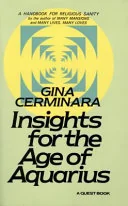
Insights for the Age of Aquarius
 73
73

Insights for the Age of Aquarius
Gina Cerminara’s "Insights for the Age of Aquarius" offers a refreshingly analytical approach to biblical interpretation, moving beyond dogma to examine the very structure of communication within scripture. Her application of general semantics principles to ancient texts is a standout strength, revealing how linguistic frameworks can shape theological understanding. The book’s primary limitation lies in its accessibility; the dense prose and specialized terminology may pose a challenge for readers not already familiar with semantic theory. A particularly striking point is Cerminara’s re-examination of creation narratives, where she suggests the 'days' of creation are not temporal units but rather distinct levels of awareness or structural organization, a concept that significantly reframes the traditional understanding. It is a scholarly yet unconventional contribution to esoteric studies.
📝 Description
73
Gina Cerminara's 1976 book applies general semantics to biblical narratives.
Published in 1976, "Insights for the Age of Aquarius" by Gina Cerminara examines biblical narratives through the lens of general semantics. Cerminara challenges literal readings of religious texts, proposing that their language and symbolism function as communication systems. These systems, she argues, are subject to the same potential for ambiguity and misunderstanding as any other discourse. This perspective invites readers to consider the psychological and philosophical underpinnings of religious thought.
The book suggests that the structure of language shapes our perception of reality and spiritual concepts. Cerminara emphasizes that grasping the limits and possibilities of human communication is vital for interpreting sacred scriptures. Central to her analysis of biblical accounts are ideas such as the distinction between a map and the territory it represents, and the significance of awareness in semantic interactions. This approach is particularly relevant for those who question established religious doctrines and seek alternative interpretations.
This book appeared in 1976, a time marked by significant interest in esoteric traditions, New Age philosophies, and psychological readings of religion. The cultural milieu saw a rise in alternative spiritualities and a questioning of conventional Western religious frameworks. Cerminara's work aligns with this broader cultural current, offering a distinct method for analyzing religious language that was ahead of many contemporary discussions on the topic.
💡 Why Read This Book?
• Understand how linguistic structures in religious texts can create meaning, a concept explored through Cerminara's semantic analysis of biblical accounts, allowing for a deeper appreciation of textual interpretation. • Gain a new perspective on spiritual narratives by examining them through the principles of general semantics, mirroring the intellectual currents of the 1970s New Age movement. • Develop critical thinking skills applicable to all forms of communication, inspired by Cerminara's examination of ambiguity in scripture, which highlights the importance of awareness in understanding.
⭐ Reader Reviews
Honest opinions from readers who have explored this book.
❓ Frequently Asked Questions
What is the primary argument of Gina Cerminara's "Insights for the Age of Aquarius"?
The book's core argument is that general semantics can illuminate ambiguities within the Bible. Cerminara suggests that by applying principles of language analysis, one can better understand the symbolic and communicative aspects of religious texts, moving beyond literal interpretations.
When was "Insights for the Age of Aquarius" first published?
The book was first published in 1976, placing it within the broader context of New Age thought and esoteric studies that gained significant traction in the mid-20th century.
Who is Gina Cerminara?
Gina Cerminara was an author and lecturer known for her work in esoteric and metaphysical subjects, particularly her earlier book "Many Mansions," which explored reincarnation.
What is general semantics?
General semantics is a discipline focused on how language affects human behavior and perception. It was notably developed by Alfred Korzybski and emphasizes the importance of precise language and awareness of the map-territory relationship.
Is "Insights for the Age of Aquarius" suitable for beginners in esoteric studies?
While accessible, the book requires some engagement with abstract concepts. Readers new to general semantics might find it beneficial to familiarize themselves with basic principles, though the exploration of biblical themes offers an entry point.
How does this book relate to the 'Age of Aquarius' mentioned in the title?
The title suggests a connection to the astrological Age of Aquarius, often associated with a shift towards greater consciousness, knowledge, and perhaps a re-evaluation of traditional beliefs. Cerminara's work offers a framework for this re-evaluation through linguistic analysis.
🔮 Key Themes & Symbolism
Semantics and Sacred Texts
The central theme is the application of general semantics to biblical interpretation. Cerminara posits that the language used in scriptures, like any other communication, is subject to inherent ambiguities and can be analyzed to reveal deeper layers of meaning. This approach moves away from purely theological or historical readings, focusing instead on how the structure of language itself shapes our understanding of divine concepts and narratives. The work explores how words function as symbols and how our perception of reality is influenced by the linguistic tools we employ, drawing parallels between ancient texts and modern communication theory.
Reinterpreting Creation Narratives
A significant aspect of the book involves a re-examination of creation accounts found in the Bible. Cerminara suggests that terms like 'days' might not refer to literal 24-hour periods but could represent distinct stages of consciousness or phases in the development of cosmic order. This interpretation, grounded in semantic principles, aims to reconcile scientific understandings with spiritual narratives by focusing on the symbolic and structural aspects of the text rather than a literal, chronological reading. It encourages readers to consider the underlying message and symbolic framework.
The Nature of Truth and Perception
The work engages with the philosophical implications of language on our perception of truth. Cerminara highlights how our linguistic frameworks can limit or expand our understanding of spiritual realities. By dissecting biblical language, she invites readers to question their own assumptions and the ways in which language shapes their beliefs about the divine and the universe. This theme encourages a more critical and self-aware approach to spiritual inquiry, emphasizing that 'truth' can be complex and dependent on the observer's semantic environment.
Symbolism and Archetypes
Beyond linguistic structure, the book studies the symbolic and archetypal dimensions of religious narratives. Cerminara suggests that biblical stories function on multiple levels, conveying not just historical or moral lessons but also profound psychological and spiritual truths through universal symbols. The interpretation of these symbols, she argues, is enhanced by an understanding of semantic principles, allowing for a more nuanced appreciation of their enduring relevance and their role in the collective human psyche.
💬 Memorable Quotes
Direct passages from the work, attributed to the author.
“The Bible is a book of words, and words are tools.”
— This statement underscores Cerminara's core thesis: that the biblical text, like any other human construct, is built from language. It implies that understanding the nature and limitations of these linguistic tools is essential for correctly interpreting the messages they convey.
“We create our reality as much through what we say as through what we do.”
— This concept, central to general semantics, suggests that language plays a central role in shaping our perception and experience of reality. Cerminara applies this to spiritual understanding, implying our interpretation of the divine is filtered through our linguistic constructs.
“The map is not the territory.”
— This foundational principle of general semantics, often attributed to Alfred Korzybski, means that our representations of reality (the 'map,' including our words and concepts) are not the same as reality itself (the 'territory'). Cerminara uses this to caution against mistaking biblical descriptions for literal, absolute truth.
💡 Key Ideas
Editorial paraphrase of the work's core concepts — not direct quotes.
Ambiguity in scripture is not necessarily a flaw, but a feature of symbolic language.
This paraphrase highlights Cerminara's view that the layered meanings and potential for multiple interpretations within religious texts are not errors but intentional aspects of their symbolic nature, requiring careful semantic analysis.
Understanding the structure of communication is key to understanding spiritual messages.
This paraphrased idea emphasizes the book's focus on the mechanics of how meaning is conveyed. Cerminara suggests that by analyzing the 'how' of biblical communication, one can unlock deeper spiritual insights.
🌙 Esoteric Significance
Tradition
Cerminara's work can be situated within the broader tradition of esoteric hermeneutics, which seeks hidden meanings within religious texts. While not strictly adhering to a single lineage like Hermeticism or Kabbalah, it draws upon the principle of allegorical interpretation common to many mystical traditions. Her specific contribution lies in applying the modern framework of general semantics, developed by Alfred Korzybski, as a tool for uncovering these hidden layers. This bridges analytical philosophy with spiritual inquiry, offering a method distinct from traditional exegesis.
Symbolism
The book implicitly engages with biblical symbolism, viewing narratives not just as literal accounts but as carriers of deeper psychological and spiritual truths. While specific symbols aren't cataloged, Cerminara's approach suggests reinterpreting common motifs like the 'days of creation' or the structure of covenants. The underlying symbolism points towards universal archetypes and the human quest for meaning, suggesting that the enduring power of these stories lies in their symbolic resonance rather than their historical accuracy.
Modern Relevance
Cerminara's application of semantic analysis to spiritual texts finds echoes in contemporary fields like neuro-linguistic programming (NLP) and certain branches of cognitive science that explore how language shapes belief systems. Thinkers interested in the intersection of psychology, language, and spirituality, as well as those within comparative religion studies who focus on textual deconstruction, might find her approach prescient. Her work contributes to an ongoing dialogue about demythologizing religious language for modern understanding.
👥 Who Should Read This Book
• Students of comparative religion and biblical studies seeking alternative interpretive frameworks beyond traditional theological approaches. • Individuals interested in the history of esoteric thought and the New Age movement, particularly those exploring the intellectual currents of the 1970s. • Readers familiar with general semantics or Alfred Korzybski's work who wish to see its application in analyzing spiritual and philosophical texts.
📜 Historical Context
Published in 1976, "Insights for the Age of Aquarius" emerged during a period of significant cultural and intellectual ferment. The United States was reading through the aftermath of the Vietnam War, the Civil Rights Movement, and a growing counter-culture that questioned traditional institutions, including established religion. The New Age movement was gaining momentum, with widespread interest in Eastern philosophies, mysticism, parapsychology, and alternative spiritual paths. Authors like Marilyn Ferguson, with her influential book "The Aquarian Conspiracy" (1980), captured this zeitgeist of seeking new paradigms. Cerminara’s work, utilizing general semantics—a field popularized by Alfred Korzybski in the mid-20th century—offered a unique, analytical lens for re-examining religious texts, distinguishing itself from more purely devotional or mystical approaches prevalent at the time. Its reception likely appealed to those seeking rational frameworks for spiritual exploration.
📔 Journal Prompts
The map-territory distinction as applied to a personal spiritual belief.
Ambiguity in a religious text and its potential for multiple meanings.
How language shapes your understanding of the divine.
Analyzing a familiar story for its underlying symbolic structure.
The influence of communication frameworks on spiritual interpretation.
🗂️ Glossary
General Semantics
A discipline focused on the relationship between language, thought, and behavior. It emphasizes awareness of how our words and symbols shape our perception of reality and encourages clearer, more accurate communication.
Ambiguity
The quality of being open to more than one interpretation; inexactness. In the context of the book, it refers to the potential for multiple meanings within biblical language.
Symbolic Language
Language that uses symbols to represent abstract ideas or concepts. Religious texts often employ symbolic language to convey spiritual truths that transcend literal description.
Map-Territory Relation
A core concept in general semantics, stating that our mental representations of reality (the 'map,' including words and concepts) are not the same as reality itself (the 'territory').
Interpretation
The action of explaining the meaning of something. In this context, it refers to the process of understanding the meaning within religious or symbolic texts.
Age of Aquarius
An astrological concept referring to a future era characterized by heightened consciousness, humanitarianism, and technological advancement, often associated with the New Age movement.
Biblical Narratives
The stories and accounts found within the Judeo-Christian Bible. Cerminara analyzes these narratives through a semantic lens.
This book appears in 1 collection
🔮 Readers Also Liked
Browse all →







From the “Telekinesis” Collection
View all →






More Free Occult Philosophy Books
View all →