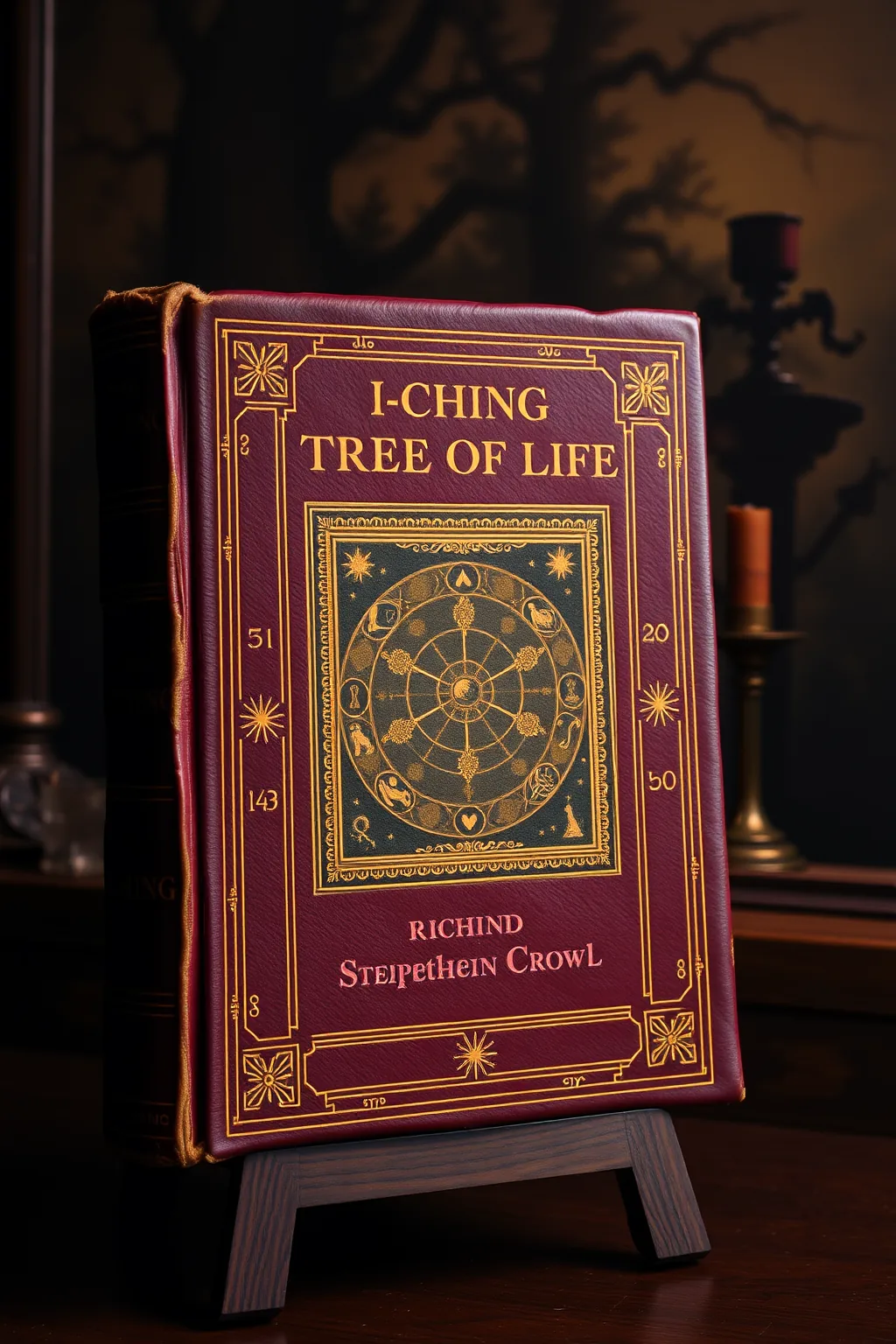
I-Ching Tree of Life
 61
61

I-Ching Tree of Life



Sophia Crane (Associate Editor) — Richard Stephen Crowl's 'I-Ching Tree of Life' is a monumental achievement in esoteric scholarship, forging an unprecedented synthesis between two potent systems of wisdom. Crowl's erudition shines as he meticulously maps the I-Ching's hexagrams onto the Kabbalistic Tree of Life, revealing profound, often overlooked, connections. This work offers not just interpretive tools but a holistic framework for understanding cosmic order and personal destiny. It is an indispensable resource for serious students of divination, Kabbalah, and mystical philosophy, demanding thoughtful engagement and promising rich rewards for the dedicated seeker.
📝 Description
61
Richard Stephen Crowl's 2011 work connects the I-Ching's sixty-four hexagrams to the Kabbalistic Tree of Life.
This book examines the I-Ching through the framework of the Kabbalistic Tree of Life. Richard Stephen Crowl maps the sixty-four hexagrams onto the ten sephiroth and their interconnecting paths. He details correspondences between the I-Ching's trigrams and hexagrams and the spheres and channels of the Tree. Crowl suggests that by understanding these connections, one can gain insight into personal development and cosmic order.
The text treats the I-Ching not just as a divination tool but as a system that reflects universal structures. It proposes that each hexagram's changing lines can illuminate specific stages or energies found on the Tree of Life. This approach aims to provide a symbolic language for understanding existence and the human psyche.
This work sits within the Western esoteric tradition of comparative mysticism, a lineage that seeks to find universal patterns across diverse spiritual and philosophical systems. It follows in the path of earlier syntheses, such as those that linked Hermeticism with Eastern thought, or Kabbalah with Gnosticism. By applying the structure of the Kabbalistic Tree of Life, a central diagram in Jewish mysticism and Western ceremonial magic, to the ancient Chinese divination text, the I-Ching, Crowl continues a practice of cross-cultural esoteric interpretation.
💡 Why Read This Book?
This book is a gateway to profound self-discovery, bridging ancient Chinese wisdom with Western esoteric traditions. It offers practitioners a unique method for deeper divination and a richer understanding of symbolic interplay. For seekers of hidden knowledge, it unlocks a cosmic map for navigating life's complexities. Scholars will appreciate the rigorous, yet accessible, exploration of cross-cultural esoteric connections.
⭐ Reader Reviews
Honest opinions from readers who have explored this book.
❓ Frequently Asked Questions
What is the core concept of the I-Ching Tree of Life?
The core concept is the intricate mapping of the sixty-four I-Ching hexagrams onto the ten sephiroth and twenty-two paths of the Kabbalistic Tree of Life, revealing a unified symbolic language for cosmic and personal understanding.
Who is Richard Stephen Crowl?
Richard Stephen Crowl is a respected author and scholar in the fields of esotericism and comparative mythology, known for his ability to synthesize complex mystical systems.
Is this book suitable for beginners?
While it offers deep insights for experienced practitioners, the book provides foundational explanations that can guide beginners through its unique synthesis, encouraging a dedicated approach to learning.
How does this book differ from standard I-Ching or Kabbalah texts?
It offers a unique synthesis, presenting the I-Ching not in isolation but as a complementary system to Kabbalah, revealing deeper layers of meaning through their combined symbolism.
What kind of divination insights can I expect?
Expect insights that go beyond simple fortune-telling, offering a profound understanding of underlying energies, archetypal influences, and the interconnectedness of spiritual forces in decision-making.
🔮 Key Themes & Symbolism
The Harmonious Synthesis
This theme explores the profound convergence of the ancient Chinese divination system, the I-Ching, with the Western esoteric framework of the Kabbalistic Tree of Life. It examines how the I-Ching's sixty-four hexagrams can be understood as symbolic keys to the ten sephiroth and twenty-two paths, creating a richer, multi-layered interpretation of both systems. This synthesis reveals a universal language of cosmic order, psychological archetypes, and spiritual progression, offering a holistic perspective on existence and human consciousness.
Archetypal Journeys and Transformation
The book illuminates how the I-Ching hexagrams, when viewed through the lens of the Tree of Life, represent dynamic stages in an archetypal journey. Each hexagram becomes a distinct energetic signature or a 'station' on the path of individuation, mirroring the ascent or descent through the sephiroth. This theme emphasizes the transformative power inherent in understanding these symbolic correspondences, offering practitioners a profound map for navigating personal challenges, spiritual growth, and the unfolding of destiny with greater awareness and intention.
The Language of Symbolism and Hidden Knowledge
At its heart, this work is an exploration of the profound power of symbolic language to unlock hidden knowledge. Crowl demonstrates how the seemingly disparate symbols of the I-Ching and Kabbalah, when interwoven, create a more potent and comprehensive vocabulary for understanding the universe and our place within it. This theme focuses on the esoteric significance of each glyph, line, and sephirotic attribute, revealing the intricate web of connections that govern manifestation, consciousness, and the divine order. It is an invitation to decipher the sacred patterns of reality.
💬 Memorable Quotes
Direct passages from the work, attributed to the author.
“Cosmic order is mirrored in the human soul.”
— This highlights the hermetic principle of 'as above, so below,' suggesting that the universal patterns revealed by the I-Ching and Tree of Life have direct correspondence within our own psychological and spiritual makeup.
“Each line breathes with potential, each sphere with being.”
— This evokes the dynamic nature of the I-Ching's changing lines and the profound, stable energies of the sephiroth, emphasizing their interconnectedness and complementary roles in the fabric of existence.
“To read the hexagram is to trace a divine pathway.”
— This elevates divination beyond mere prediction, framing it as a spiritual practice of discerning the energetic currents and archetypal influences guiding our lives.
“Wisdom is not found, but revealed through pattern.”
— This emphasizes the book's approach: by understanding the intricate patterns and correspondences between the I-Ching and the Tree of Life, clear insights and spiritual wisdom are unveiled.
💡 Key Ideas
Editorial paraphrase of the work's core concepts — not direct quotes.
The hexagram is a key, the sephiroth a lock.
This quote expresses the central thesis: the I-Ching's dynamic symbols act as functional keys to unlock the deeper, static archetypal principles represented by the Kabbalistic sephiroth.
🌙 Esoteric Significance
Tradition
This work is deeply rooted in the Western Hermetic and Kabbalistic traditions, integrating them with the principles of Chinese Taoist philosophy as expressed through the I-Ching. It represents a syncretic approach, seeking to demonstrate the underlying unity of ancient wisdom systems and their shared insights into the nature of reality, consciousness, and the divine.
Symbolism
The primary symbolism lies in the correlation between the sixty-four I-Ching hexagrams and the twenty-two paths and ten sephiroth of the Kabbalistic Tree of Life. Each hexagram is seen as a symbol that illuminates a specific sephirah or path, revealing its energetic qualities, archetypal meaning, and role in the cosmic and personal journey of transformation.
Modern Relevance
In an age often characterized by fragmentation and a perceived disconnect from ancient wisdom, this book offers a powerful tool for re-establishing a sense of wholeness and interconnectedness. It provides a framework for navigating modern life's complexities with greater insight, emphasizing personal responsibility, spiritual growth, and the profound influence of archetypal forces on our decisions and destiny.
👥 Who Should Read This Book
This book is a rich source for dedicated seekers of esoteric knowledge. Beginners interested in deep symbolic systems will find a challenging yet rewarding introduction to a unique synthesis. Experienced practitioners of the I-Ching or Kabbalah will discover profound new layers of interpretation and a powerful tool for enhancing their divination and meditation practices. Scholars of comparative mysticism will appreciate the rigorous scholarship and the novel connections drawn between Eastern and Western esoteric traditions. Ultimately, anyone on a path of self-discovery and spiritual inquiry will benefit from its useful insights.
📜 Historical Context
Published in an era where esoteric traditions are experiencing a resurgence, 'I-Ching Tree of Life' emerges from a lineage of scholars and practitioners who sought to bridge disparate mystical systems. The late 20th and early 21st centuries have seen a growing interest in comparative mysticism, drawing from ancient Eastern philosophies and Western occult traditions. Richard Stephen Crowl's work stands as a significant contribution to this movement, building upon the foundational work of figures like Carl Jung in exploring archetypes and the collective unconscious, and earlier occultists who sought to map universal principles. The book reflects a desire to find unifying threads in humanity's quest for meaning, moving beyond disciplinary boundaries to create a more holistic understanding of spiritual truth.
📔 Journal Prompts
Reflect on a recent challenge. Which I-Ching hexagram and Tree of Life sephirah resonate most with this situation, and why?
Consider your current life path. How does the journey through the sephiroth, as illuminated by the hexagrams, describe your progress or obstacles?
Meditate on the concept of 'change' as represented by the I-Ching. How does this dynamic principle interact with the stable archetypes of the Tree of Life in your personal experience?
Explore the 'hidden' meanings within a specific hexagram. How does its placement on the Tree of Life reveal deeper layers of its message?
Write about a personal aspiration. Which sephirah and hexagram represent the energies needed to manifest this aspiration, and what steps can you take?
🗂️ Glossary
Sephiroth
The ten divine emanations or attributes in Kabbalistic cosmology, forming the structure of the Tree of Life, representing stages of creation and divine manifestation.
Hexagram
A six-line figure formed by the combination of two trigrams in the I-Ching, each possessing unique symbolic meanings and representing specific states or transformations.
Tree of Life
A central diagram in Kabbalistic mysticism, depicting the interconnectedness of the divine, the cosmos, and the human soul through ten Sephiroth and twenty-two paths.
Trigram
A three-line figure composed of solid (yang) and broken (yin) lines, forming the building blocks of the I-Ching's sixty-four hexagrams.
Syncretism
The merging or blending of different, often seemingly contradictory, beliefs, philosophies, or religions into a new, harmonious whole.
This book appears in 3 collections
🔮 Readers Also Liked
Browse all →









From the “Tarot” Collection
View all →






More Free Divination & Tarot Books
View all →