I Ching Divination
 61
61

I Ching Divination



Marcus Thorne, Esoteric Sciences Reviewer: Saanu Aqa's 'I Ching Divination' is a masterful exposition of this ancient oracle. Far from a superficial guide, Aqa delves into the profound philosophical and esoteric dimensions, illuminating the I Ching as a dynamic system of cosmic understanding. The author's profound grasp of symbolism and archetypal patterns is evident, offering practitioners and scholars alike an unparalleled pathway to deeper insight. This text serves as an essential resource for anyone seeking to move beyond simple prognostication and engage with the I Ching on a truly spiritual and transformative level, revealing its enduring relevance in navigating the complexities of modern life.
📝 Description
61
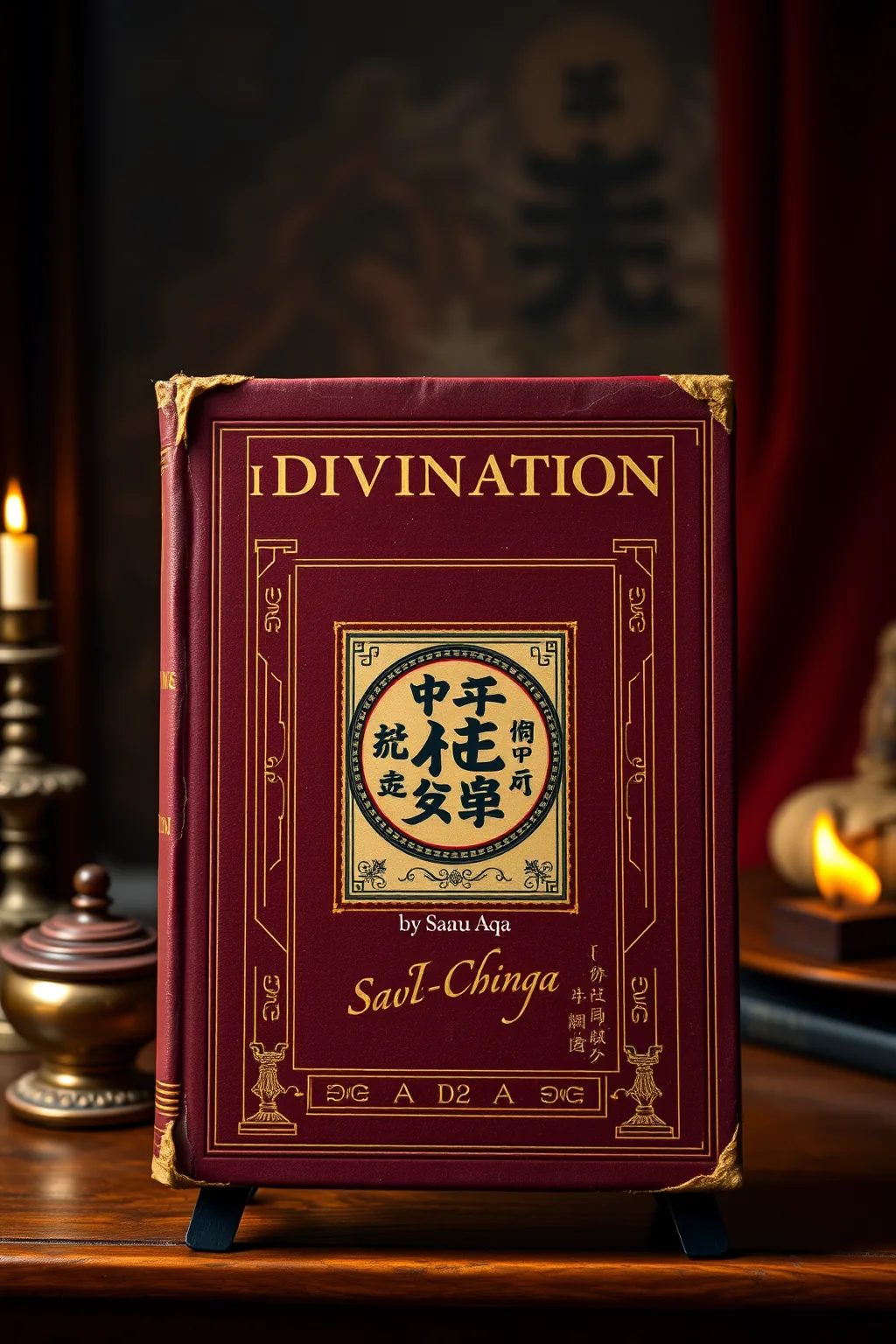
Saanu Aqa's 'I Ching Divination' published in 2023 examines the Book of Changes.
This volume by Saanu Aqa looks at the I Ching beyond simple fortune-telling. It explains the philosophical ideas and symbolic meanings within the Book of Changes. Aqa presents the hexagrams not just as predictions but as guides for spiritual understanding. The writing style respects the text's historical importance and its hidden meanings. The book shows how the I Ching reflects the universe's changes. It gives insight into personal fate, spiritual development, and how everything connects.
It is a guide for those seriously seeking knowledge, for thoughtful students, and for anyone wanting to understand the forces that control our lives. The aim is to help readers interpret the patterns of destiny and become aware of the subtle influences affecting our existence. The book encourages a more balanced connection with the Tao.
The I Ching, or Book of Changes, is a classical Chinese text with a history spanning millennia. It is one of the oldest Chinese philosophical books, used for divination and as a guide to life. Its system of sixty-four hexagrams, derived from combinations of yin and yang lines, is believed to represent the fundamental principles of the universe and human experience. This book, 'I Ching Divination' by Saanu Aqa, engages with this tradition, focusing on the deeper meanings and symbolic language found within the hexagrams.
💡 Why Read This Book?
Uncover the profound philosophical depths of the I Ching, moving beyond simple divination to understand its role as a map for spiritual evolution. Saanu Aqa offers a unique esoteric perspective, revealing hidden layers of symbolism and cosmic interconnectedness. Ideal for seekers of ancient wisdom, practitioners of divination arts, and scholars of metaphysical traditions looking for authentic, transformative insights.
⭐ Reader Reviews
Honest opinions from readers who have explored this book.
❓ Frequently Asked Questions
What is the I Ching?
The I Ching, or Book of Changes, is an ancient Chinese divination text and philosophical classic. It comprises 64 hexagrams, each representing a fundamental life situation and its corresponding transformations, offering guidance and insight through symbolic interpretation.
How does I Ching Divination work?
Divination with the I Ching typically involves posing a question and then generating a hexagram through a process of coin tosses or yarrow stalk manipulation. The resulting hexagram, and any changing lines within it, are then interpreted based on its symbolic meaning and context.
Is this book suitable for beginners?
Yes, while deeply esoteric, Saanu Aqa's writing style is accessible, guiding newcomers through the core concepts and practices of I Ching divination with clarity and reverence.
What is the philosophical significance of the I Ching?
Philosophically, the I Ching explores the principles of change, balance, and harmony within the universe. It emphasizes the dynamic nature of reality and the importance of aligning oneself with the natural flow of the Tao.
Can the I Ching be used for personal growth?
Absolutely. The I Ching is a powerful tool for self-reflection and personal development, offering insights into one's current situation, potential challenges, and pathways toward greater wisdom and self-understanding.
🔮 Key Themes & Symbolism
The Tao and the Flow of Change
This theme explores the fundamental concept of the Tao, the primordial principle underlying all existence. It explores how the I Ching illustrates the ceaseless dance of transformation, Yin and Yang, and the cyclical nature of all phenomena. Understanding this flow is presented not as passive acceptance, but as active participation, allowing individuals to navigate life's currents with wisdom and grace. The text emphasizes aligning one's actions and intentions with the natural order, fostering harmony and resilience in the face of inevitable change.
Hexagrammatic Symbolism and Archetypes
Central to the book is the profound symbolism embedded within each of the 64 hexagrams. Saanu Aqa meticulously deciphers the visual language and archetypal meanings of these six-lined figures, revealing them as potent keys to understanding universal patterns of human experience and cosmic forces. Each hexagram is presented not just as a predictive tool, but as a narrative of potentiality, offering clear insights into relationships, career, spiritual development, and the very essence of one's path. The exploration of these archetypes empowers readers to recognize recurring themes in their lives.
Divination as a Spiritual Practice
Beyond mere fortune-telling, 'I Ching Divination' frames the practice as a sacred dialogue with the universe and one's higher self. Saanu Aqa guides readers to approach the oracle with intention, reverence, and an open heart, transforming the act of consultation into a profound spiritual discipline. The book emphasizes that true divination is not about predicting a fixed future, but about gaining clarity, fostering self-awareness, and making conscious choices that lead to spiritual growth and alignment with one's destiny. It’s about co-creating reality through mindful engagement.
💬 Memorable Quotes
Direct passages from the work, attributed to the author.
“To consult the I Ching is to engage in a sacred dialogue with the unfolding present.”
— This emphasizes the active and spiritual nature of I Ching practice, portraying it as a participatory process of seeking wisdom and guidance for navigating life's journey.
“The oracle reflects not what will be, but what can be, shaped by conscious intention.”
— This highlights the agency inherent in I Ching divination, suggesting it offers potential pathways rather than predetermined outcomes, empowering the user to influence their destiny.
“Seek not the answer, but the wisdom to ask the right question.”
— This profound statement underscores the importance of introspection and framing meaningful inquiries when using the I Ching, guiding the user towards self-discovery.
💡 Key Ideas
Editorial paraphrase of the work's core concepts — not direct quotes.
The hexagrams are the whispers of the cosmos, speaking in the language of symbols.
This quote highlights the I Ching's nature as a symbolic oracle, suggesting that the patterns revealed are not random but carry profound cosmic meaning, accessible to those who learn to listen.
In the flux of change lies the seed of true understanding.
This quote speaks to the core philosophy of the I Ching, asserting that by embracing and understanding the constant nature of change, one can achieve deeper insight and wisdom.
🌙 Esoteric Significance
Tradition
The I Ching is a foundational text within the Chinese esoteric traditions, particularly Taoism and its philosophical offshoots. It is viewed as a living embodiment of the Tao, the fundamental principle of the universe. Its cyclical patterns, Yin-Yang dynamics, and the concept of constant transformation are central to Taoist cosmology. Furthermore, its integration into practices like Feng Shui and traditional Chinese medicine demonstrates its pervasive influence as a system for understanding and harmonizing with natural forces and cosmic energies.
Symbolism
The core symbolism of the I Ching resides in its 64 hexagrams, each composed of six lines representing either Yin (broken) or Yang (solid). These lines, combined in specific ways, create archetypal images and narratives that symbolize universal forces, human situations, and stages of development. The trigrams (three-lined figures) that form the hexagrams, such as Heaven, Earth, Water, and Fire, are themselves potent symbols of elemental energies and cosmic principles. The interpretations of the hexagrams and their changing lines offer a wide range of symbolic meaning for guidance.
Modern Relevance
In the modern era, the I Ching continues to serve as a powerful tool for navigating complexity and seeking inner wisdom. Its emphasis on adaptability, balance, and understanding the cyclical nature of life resonates deeply with contemporary challenges. Esoteric practitioners, psychologists, and individuals seeking personal growth find value in its ability to provide perspective, foster self-awareness, and encourage mindful decision-making. The I Ching offers a timeless framework for understanding change, making it an enduring source of insight for those seeking meaning and guidance in a rapidly evolving world.
👥 Who Should Read This Book
This volume is an essential acquisition for dedicated practitioners of divination seeking to deepen their understanding of the I Ching beyond mere prognostication. Scholars of Eastern philosophies and ancient esoteric systems will find Saanu Aqa's scholarly yet accessible approach invaluable. Aspiring seekers of spiritual wisdom and self-discovery will be guided through the profound philosophical underpinnings of the Book of Changes. Those interested in archetypal psychology and the symbolic language of the universe will discover rich insights. Ultimately, anyone drawn to the ancient currents of wisdom and seeking a profound, transformative connection with the cosmic order will benefit immensely.
📜 Historical Context
The I Ching, or Book of Changes, boasts an unbroken lineage stretching back over three millennia, originating in ancient China. Its earliest roots are intertwined with shamanic practices and early forms of divination, likely using burnt bones and tortoise shells. Over centuries, it evolved from a practical oracle into a foundational text of Chinese philosophy, deeply influencing Confucianism and Taoism. During the Zhou Dynasty (c. 1046–256 BCE), the text was systematically compiled and annotated, with significant contributions attributed to King Wen and the Duke of Zhou. Later, commentaries by Confucius and his disciples further cemented its status as a profound philosophical work. Its influence permeated various aspects of Chinese culture, from governance and warfare to art and medicine, establishing it as a core part of East Asian esoteric thought and cosmology.
📔 Journal Prompts
Reflect on a recent significant change in your life. How does the I Ching's concept of flux apply?
Choose a hexagram that speaks to you today. What archetypal energies does it represent in your current situation?
Consider a recurring pattern in your life. How might the I Ching's symbolism offer a new perspective or path forward?
How can the principles of Yin and Yang, as illustrated by the I Ching, help you find balance in your daily life?
What question would you pose to the I Ching today, and what intention do you bring to the consultation?
🗂️ Glossary
Hexagram
A figure composed of six stacked horizontal lines, which can be either solid (Yang) or broken (Yin). There are 64 unique hexagrams in the I Ching, each representing a fundamental situation or concept.
Trigram
A figure composed of three stacked horizontal lines, either solid (Yang) or broken (Yin). The eight basic trigrams (e.g., Heaven, Earth, Water) form the building blocks of the hexagrams.
Yin
In I Ching philosophy, Yin represents the passive, receptive, dark, feminine, and contracting principle. It is depicted by a broken line ( -- ).
Yang
In I Ching philosophy, Yang represents the active, creative, light, masculine, and expanding principle. It is depicted by a solid line ( — ).
Tao
The fundamental principle of the universe in Taoism; the 'Way' or 'Path.' It signifies the natural order, the source of all things, and the underlying reality that governs existence.
This book appears in 3 collections
🔮 Readers Also Liked
Browse all →








From the “Tarot” Collection
View all →





More Free Divination & Tarot Books
View all →