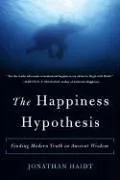
The Happiness Hypothesis
 73
73

The Happiness Hypothesis



By Cassian Rothmann (Senior Critic, Ancient Wisdom) — Jonathan Haidt's 'The Happiness Hypothesis' is a revelation, a luminous bridge between the archaic depths of wisdom traditions and the intricate workings of the modern mind. Haidt doesn't merely present psychological findings; he decodes them through the lens of enduring spiritual narratives, revealing the universal truths about divinity, love, and meditation that underpin true happiness. His application of the H=S+C+V formula, grounded in both ancient teachings and neurological insights, offers a powerful framework for self-transformation. This book is a must-read for anyone seeking to unlock the profound, often hidden, levers of personal contentment, offering a potent synthesis of intellect and intuition.
📝 Description
73
Jonathan Haidt's 2006 book connects ancient wisdom to modern science.
Jonathan Haidt's 'The Happiness Hypothesis' examines the enduring ideas about happiness found in ancient texts and compares them with contemporary scientific findings. The book is structured around ten 'Great Ideas' about happiness, each starting with a belief from ancient traditions and then assessing it through the lens of modern psychology and neuroscience. Haidt explores concepts like the division of the mind into a rider and a horse, the idea that we are happier when we are virtuous, and the importance of relationships for well-being.
He argues that while ancient thinkers did not have empirical data, their intuitions often align with what science now demonstrates. The book aims to show how these historical perspectives can inform our understanding of ourselves and guide us toward a more fulfilling life. Haidt bridges the gap between philosophy and science, making complex psychological theories accessible and relevant to everyday experience. It is a thoughtful consideration of what truly contributes to human flourishing.
This book engages with traditions that have long pondered the nature of happiness and the good life. It looks to figures like Plato, Buddha, and Jesus, whose teachings are often considered part of a broader esoteric or wisdom tradition. Haidt treats these ancient pronouncements not just as historical artifacts but as hypotheses to be tested. He seeks to find empirical support for long held beliefs about inner peace and moral development, suggesting that these older systems of thought contain valuable insights relevant today.
💡 Why Read This Book?
Uncover the ancient secrets to lasting joy, validated by cutting-edge brain science. 'The Happiness Hypothesis' provides a practical, yet profound, roadmap to understanding your own well-being. Ideal for seekers of wisdom, students of human nature, and anyone yearning to cultivate a more fulfilling and contented life through the fusion of ancient insights and modern knowledge.
⭐ Reader Reviews
Honest opinions from readers who have explored this book.
❓ Frequently Asked Questions
What is the core formula for happiness presented in the book?
The book introduces the 'happiness formula': H=S+C+V, which translates to Happiness = your biological Setpoint + the Conditions of your life + the Voluntary activities you engage in. This formula provides a foundational understanding of the drivers of well-being.
How does the book connect ancient wisdom with modern psychology?
Haidt meticulously examines parables, religious texts, and philosophical teachings from various ancient cultures, demonstrating how their insights into human nature and happiness are remarkably consistent with contemporary findings in psychology and neuroscience.
Who is Jonathan Haidt and what is his expertise?
Jonathan Haidt is a renowned social psychologist and professor, specializing in moral psychology and the science of happiness. His work bridges behavioral science with philosophical and religious traditions.
Can this book help me find more happiness in my daily life?
Absolutely. By understanding the interplay of your biological predispositions, life circumstances, and intentional actions, the book offers actionable strategies and profound insights to cultivate greater joy and fulfillment.
What is the 'divinity' aspect in relation to happiness?
The book explores how concepts of divinity, transcendence, and connection to something greater than oneself, as understood in ancient traditions, often correlate with psychological states that contribute to happiness and meaning in modern life.
🔮 Key Themes & Symbolism
The Divine Switchboard of the Mind
Haidt explores the profound connection between our understanding of divinity and our capacity for happiness. Ancient philosophies consistently linked spiritual or transcendent experiences with a sense of deep contentment and meaning. This theme looks at how concepts of the sacred, the numinous, and our connection to something larger than ourselves can act as powerful regulators of our emotional state, influencing our perception of life and fostering resilience against suffering. It examines how the mind, through its engagement with the divine, can unlock hidden potentials for joy and purpose.
The Symbiotic Dance of Love and Connection
Love, in its myriad forms – romantic, familial, platonic, and even altruistic – is presented as a central to human happiness. This theme unpacks the evolutionary and psychological underpinnings of our innate need for connection, drawing parallels between ancient teachings on compassion and modern research on social bonding. Haidt illustrates how strong social ties and acts of love create a fertile ground for well-being, contributing to our sense of belonging, security, and overall life satisfaction. It’s a evidence of the idea that our deepest happiness is often found in our relationships.
Reading through the Currents of Consciousness
The book looks at the transformative power of voluntary activities, particularly those that engage our consciousness in profound ways. Meditation, mindfulness, and the pursuit of flow states are examined not just as psychological techniques but as ancient practices designed to harmonize the mind and foster inner peace. Haidt shows how intentionally directing our attention and engaging in activities that align with our values can significantly alter our happiness trajectory, offering a potent antidote to the randomness of life's conditions and the limitations of our biological setpoint.
💬 Memorable Quotes
Direct passages from the work, attributed to the author.
“The mind is like a rider on an elephant.”
— A powerful metaphor illustrating the struggle between rational thought (the rider) and automatic, emotional impulses (the elephant), a common theme in wisdom traditions.
“Happiness comes from within.”
— This classic adage is given modern weight, suggesting that true contentment is cultivated through internal states rather than solely external circumstances.
“We are all connected.”
— A fundamental principle across many spiritual and mystical traditions, highlighting the interconnectedness of all beings and its contribution to a sense of belonging and well-being.
💡 Key Ideas
Editorial paraphrase of the work's core concepts — not direct quotes.
We are divided beings.
This quote speaks to the duality within us, the interplay between our conscious desires and our unconscious drives, mirroring ancient concepts of the divided self.
The purpose of life is not to be happy. The purpose of life is to be useful, to be honorable, to be compassionate, to have it make some difference that you have lived and lived well.
This quote reframes happiness not as an end goal, but as a byproduct of living a meaningful and virtuous life, aligning with Stoic and Buddhist philosophies.
🌙 Esoteric Significance
Tradition
The book draws heavily from the esoteric traditions of Eastern philosophies (Buddhism, Hinduism) and Western thought (Stoicism, Neoplatonism), highlighting their shared insights into the nature of consciousness, the self, and the pursuit of inner peace. It uncovers the 'hidden knowledge' within these ancient systems concerning the cultivation of virtues, the understanding of suffering, and the path to enlightenment, reinterpreting them through a modern, scientific lens.
Symbolism
Haidt uses powerful metaphors, such as the 'rider and the elephant,' to symbolize the interplay between our rational minds and our instinctive, emotional selves. This duality is a recurring motif in esoteric literature, representing the internal struggle for balance and self-mastery. Other symbols implicitly explored include the 'divine spark' within, the interconnectedness of all beings, and the transformative power of intentional practices like meditation, all of which carry deep symbolic weight in mystical traditions.
Modern Relevance
In an age often characterized by superficial pursuits and existential angst, 'The Happiness Hypothesis' offers a profound reorientation. It demonstrates that the ancient quest for happiness is not an abstract philosophical exercise but a practical, scientifically verifiable pursuit. By validating esoteric insights with empirical data, the book empowers individuals to reclaim agency over their well-being, fostering a sense of purpose and resilience that is desperately needed in contemporary society.
👥 Who Should Read This Book
This book is a treasure for the introspective seeker who wishes to understand the deeper currents of human happiness, moving beyond fleeting pleasures to cultivate enduring contentment. Scholars of psychology, philosophy, and religious studies will find Haidt's interdisciplinary approach clear, bridging the gap between ancient texts and modern research. For practitioners of mindfulness, meditation, or personal growth, it offers a robust theoretical framework and practical validation for their chosen paths. Even the curious beginner, seeking to unravel the mysteries of well-being, will find a clear and compelling guide through the complex range of the human heart and mind.
📜 Historical Context
Published in 2006, 'The Happiness Hypothesis' emerged during a period of burgeoning interest in positive psychology and the scientific study of well-being. This era saw a growing desire to move beyond a purely deficit-based model of psychology towards understanding human flourishing. Haidt's work capitalized on this, drawing from a wide range of philosophical and religious thought that has evolved over millennia, from ancient Greek Stoicism and Epicureanism to Eastern traditions like Buddhism and Hinduism. The book gained significant traction by offering a compelling synthesis, demonstrating that timeless wisdom traditions were not superseded by modern science but were, in fact, prescient in their understanding of the human condition and the pursuit of happiness.
📔 Journal Prompts
Reflect on your 'happiness setpoint.' How do you perceive its influence on your daily experiences?
Identify one 'condition of your life' that significantly impacts your happiness, and one voluntary activity that could positively alter this.
How do the ancient symbols or parables discussed in the book resonate with your personal understanding of divinity or transcendence?
Consider a time you experienced profound happiness. What role did love and connection play in that moment?
What is one voluntary activity you can consciously integrate into your life to foster greater inner harmony, inspired by the book's insights?
🗂️ Glossary
Setpoint Theory
A psychological concept suggesting that each individual has a genetically determined baseline level of happiness, to which they tend to return after significant life events, positive or negative.
Voluntary Activities
Actions and choices that individuals consciously make, such as engaging in hobbies, practicing meditation, or pursuing personal goals, which can influence their overall happiness.
Conditions of Life
External circumstances and situational factors that affect an individual's happiness, including relationships, work, health, and socio-economic status.
Duality
The philosophical concept that human beings are composed of two distinct parts, often understood as mind and body, or reason and emotion, and the interplay between them.
Eudaimonia
A Greek philosophical term often translated as 'flourishing' or 'living well,' representing a state of profound well-being and fulfillment achieved through virtuous activity and self-realization.
This book appears in 3 collections
🔮 Readers Also Liked
Browse all →








More by Jonathan Haidt
All books →


From the “Tarot” Collection
View all →








More Free Divination & Tarot Books
View all →