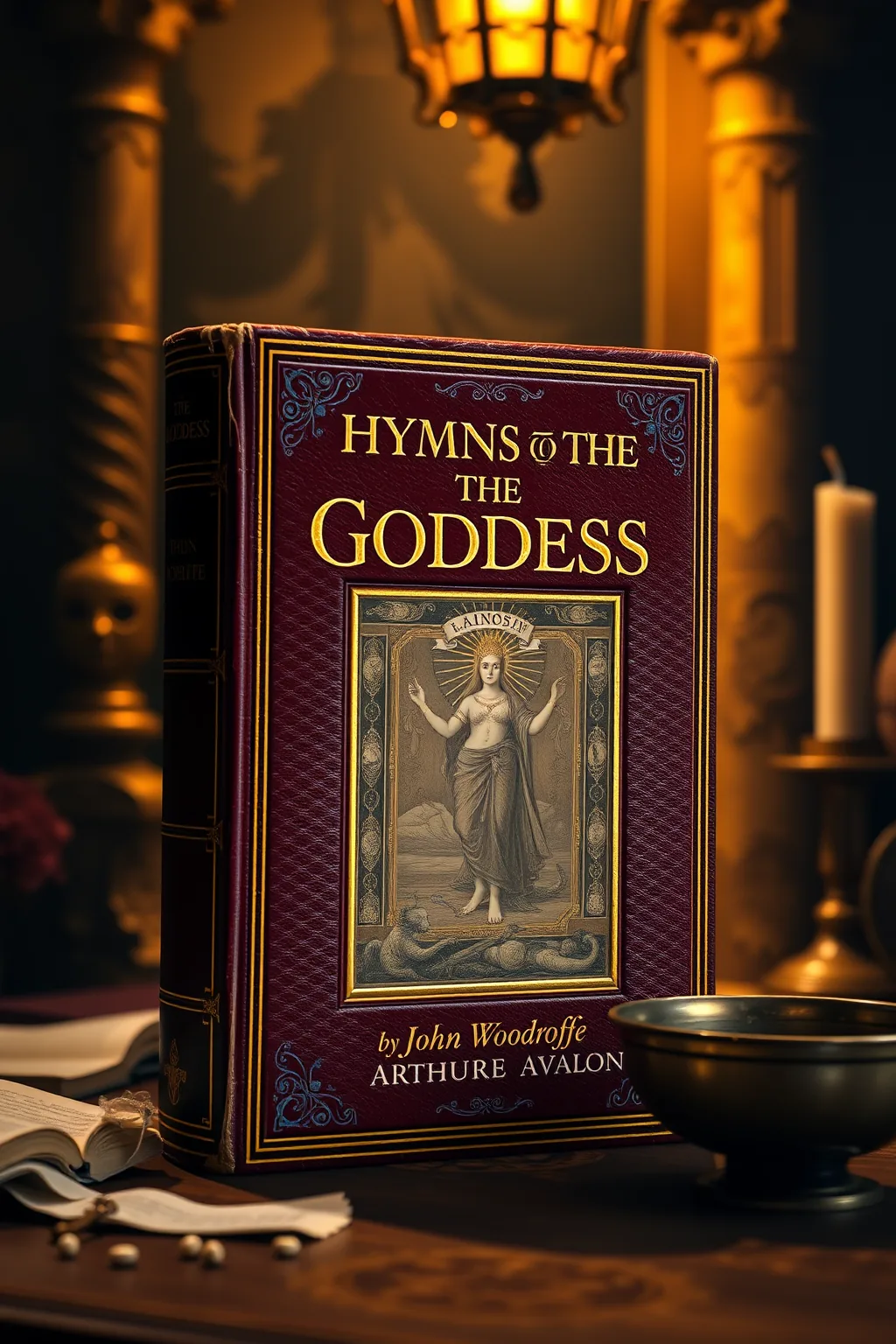
Hymns to the Goddess
 84
84

Hymns to the Goddess


As an editor at Sacred Texts, I find John Woodroffe's 'Hymns to the Goddess' to be an unparalleled exploration of the Devi, the Divine Mother, within the rich tapestry of Indian Tantric and Vedic traditions. Avalon's meticulous scholarship and poetic prose breathe life into these ancient hymns, unveiling layers of meaning often lost to the uninitiated. The book excels in demystifying complex philosophical concepts and devotional practices, making the path to understanding the Goddess accessible without sacrificing its esoteric depth. It is an essential read for anyone serious about exploring the spiritual significance of the feminine divine, offering profound insights for both academic study and personal spiritual growth.
📝 Description
84
John Woodroffe (Arthur Avalon) published 'Hymns to the Goddess' to introduce Sanskrit devotional texts to a Western audience.
This book presents English translations of Sanskrit hymns dedicated to the Great Goddess. Woodroffe, writing as Arthur Avalon, sought to convey not only the literal meaning of these verses but also their deeper symbolic and philosophical import. He includes extensive commentary that elucidates the concepts of the Goddess as the supreme cosmic power, encompassing creation, preservation, and dissolution.
The hymns themselves cover various aspects and forms of the Goddess, reflecting her significance within Hindu traditions, particularly Tantra. Avalon's approach aims to make these ancient devotional practices accessible, highlighting their spiritual and mystical dimensions. The work is intended for those interested in comparative religion, esoteric studies, and the philosophical underpinnings of Hindu goddess worship.
Published in the early 20th century, 'Hymns to the Goddess' is a product of the Theosophical and Orientalist movements that sought to translate and interpret Eastern spiritual traditions for Western readers. Woodroffe, a key figure in this field, aimed to reveal the depth of Indian philosophy and religious practice. This work falls within the study of comparative religion and esoteric traditions, specifically focusing on Hindu goddess worship and its Tantric aspects, making these complex ideas available to a broader, non-specialist audience.
💡 Why Read This Book?
Embark on a transformative spiritual odyssey. 'Hymns to the Goddess' offers direct access to the profound wisdom of the Divine Feminine, vital for personal growth and understanding cosmic principles. Ideal for spiritual seekers, students of Tantra and Yoga, and anyone yearning to connect with the foundational energies of creation and liberation.
⭐ Reader Reviews
Honest opinions from readers who have explored this book.
❓ Frequently Asked Questions
What is the primary focus of 'Hymns to the Goddess'?
The book primarily focuses on the worship and understanding of the Great Goddess (Devi) within Hindu Tantric and Vedic traditions, exploring her multifaceted nature and cosmic significance through ancient hymns and insightful commentary.
Who was Arthur Avalon?
Arthur Avalon was the pseudonym of Sir John Woodroffe, a British scholar and judge who became a leading authority on Indian philosophy and Tantra. His translations and commentaries are highly regarded for their accuracy and depth.
Is this book suitable for beginners in spiritual studies?
Yes, while it delves into complex esoteric concepts, Woodroffe's clear explanations and the devotional nature of the hymns make it accessible and inspiring for sincere beginners interested in the Divine Feminine.
What makes this translation special?
Woodroffe's translation is renowned for its scholarly rigor, its faithful rendering of the original Sanskrit's poetic and spiritual essence, and his extensive annotations that unlock deeper symbolic and philosophical meanings.
Can this book be used for ritual or devotional practice?
Absolutely. The hymns themselves are devotional in nature and can be recited or contemplated as part of personal spiritual practice, fostering a connection with the Goddess energy described within.
🔮 Key Themes & Symbolism
The Divine Feminine as Cosmic Principle
This theme explores the concept of the Goddess not merely as a deity, but as the supreme, all-pervading cosmic energy that is the source of creation, sustenance, and dissolution. It explores her immanent and transcendent aspects, highlighting her role as the ultimate reality and the primal feminine power that animates the universe. The hymns reveal her many-sided nature, encompassing both fierce and nurturing attributes, and her inseparable connection to consciousness and bliss.
Tantric Philosophy and Symbolism
The book provides a profound introduction to Tantric philosophy, a complex system of spiritual practice aimed at realizing the divine within oneself and the cosmos. It unpacks the detailed symbolism embedded in the hymns, explaining the esoteric meanings of deities, rituals, and mantras as pathways to spiritual liberation. This theme illuminates the Tantric understanding of the union of Shiva and Shakti, the masculine and feminine principles, as essential for spiritual realization and the transcendence of duality.
Devotional Practice and Spiritual Awakening
Central to the work is the transformative power of devotion (bhakti) and its role in spiritual awakening. The hymns themselves are acts of worship, designed to evoke deep reverence and a sense of intimate connection with the Goddess. Woodroffe's commentary guides the reader in understanding how sincere devotion can purify the mind, dissolve egoic limitations, and lead to direct experience of the divine, fostering inner peace and spiritual liberation.
💬 Memorable Quotes
Direct passages from the work, attributed to the author.
“She is the essence of all existence.”
— This phrase expresses the Goddess's omnipresence and her role as the fundamental reality underlying all manifest and unmanifest phenomena.
“In Her is the universe, and from Her it proceeds.”
— Highlights the Goddess as both the container and the origin of all creation, emphasizing her supreme generative power and ultimate source.
“She is the Supreme Consciousness.”
— Defines the Goddess as the ultimate awareness, the substratum of all experience, and the highest form of divine intelligence.
“Devotion to Her opens the path to liberation.”
— Underscores the redemptive power of sincere love and surrender to the Goddess as a direct means to achieve spiritual freedom.
“The Great Goddess is the source of all power.”
— Asserts the Goddess's dominion over all forms of energy and manifestation, identifying her as the ultimate wellspring of cosmic force.
🌙 Esoteric Significance
Tradition
This work is deeply rooted in the Shakta tradition of Hinduism, a major branch that venerates the Goddess (Devi or Shakti) as the supreme being. It specifically draws from Tantric and Vedic texts, offering insights into the complex philosophical underpinnings and devotional practices that characterize this lineage. The esoteric significance lies in its revelation of Shakti as the dynamic, creative force of the universe, essential for both worldly existence and spiritual liberation.
Symbolism
The hymns are rich with symbolic language, representing the Goddess in her various forms (e.g., Kali, Lakshmi, Saraswati) and through cosmic imagery. These symbols are not mere decorative elements but represent profound metaphysical concepts: the womb of creation, the cycles of time, the interplay of duality and non-duality, and the journey of the soul towards divine union. Understanding this symbolism unlocks the deeper esoteric meanings of the hymns and the Tantric worldview.
Modern Relevance
In an age often characterized by fragmentation and a disconnect from the sacred, 'Hymns to the Goddess' offers a powerful reconnection with the primal feminine energy that sustains life. Its exploration of the Divine Feminine resonates deeply with contemporary movements seeking balance, empowerment, and a holistic understanding of existence. The book provides timeless wisdom for navigating personal challenges, fostering inner strength, and cultivating a profound sense of spiritual awareness and interconnectedness.
👥 Who Should Read This Book
This monumental work is essential for a diverse audience. **Spiritual Seekers** will find profound inspiration and a direct connection to the worship of the Divine Feminine, opening new avenues for personal growth and inner peace. **Students of Comparative Religion and Philosophy** will benefit from Woodroffe's authoritative scholarship, gaining useful insights into Hindu Tantra, Vedanta, and the concept of Shakti. **Practitioners of Yoga and Meditation** will discover the philosophical underpinnings and devotional aspects that enrich their practice, fostering a more profound understanding of consciousness. **Anyone interested in the esoteric wisdom of the East** will find 'Hymns to the Goddess' an indispensable key to unlocking the subtle energies and profound truths of Indian spirituality.
📜 Historical Context
Published in 1913, 'Hymns to the Goddess' emerged during a period of intense Western fascination with Eastern spirituality, particularly Hinduism and its esoteric traditions. Theosophy and the burgeoning interest in Yoga and Vedanta had paved the way for works like this, which sought to introduce the profound philosophical and spiritual insights of India to a Western audience. Sir John Woodroffe, under his pseudonym Arthur Avalon, was a key figure in this movement. His extensive scholarship and deep immersion in Sanskrit texts allowed him to present Tantric philosophy and devotional practices with an unprecedented level of accuracy and depth. The era was marked by a search for alternative spiritualities and a critique of Western materialism, making Woodroffe's work highly influential in shaping Western perceptions of Indian mysticism and contributing significantly to the global dissemination of these sacred teachings.
📔 Journal Prompts
Reflect on the various manifestations of the Goddess described in the hymns. Which aspects resonate most deeply with your current life experiences?
Consider the concept of Shakti as the creative force. How can you consciously engage with this energy in your daily life?
The hymns often speak of transcendence through devotion. What does 'devotion' mean to you, and how can you cultivate it more fully?
Explore the symbolism of light and darkness in the hymns. How do these concepts relate to your own inner journey and understanding of duality?
How does embracing the Divine Feminine, as depicted in this text, challenge or affirm your current worldview and personal spiritual path?
🗂️ Glossary
Shakti
The supreme creative power or energy in Hinduism, often personified as the Goddess. It represents the dynamic force of the universe, essential for creation, preservation, and dissolution.
Tantra
A complex system of spiritual traditions originating in India, focusing on ritual, meditation, yoga, and mantra to achieve spiritual liberation and realize the divine within the material world.
Bhakti
A devotional path in Hinduism characterized by intense love, surrender, and service to a personal deity, leading to spiritual realization and union.
Devi
The Sanskrit word for 'Goddess.' In the Shakta tradition, Devi is the supreme cosmic power and the ultimate reality, often referred to as the Great Goddess.
Mantra
A sacred sound, word, or phrase, often repeated during meditation or ritual, believed to possess spiritual power and evoke specific states of consciousness.
This book appears in 4 collections
🔮 Readers Also Liked
Browse all →









From the “Transcendental Meditation” Collection
View all →








More Free Spiritual Development Books
View all →