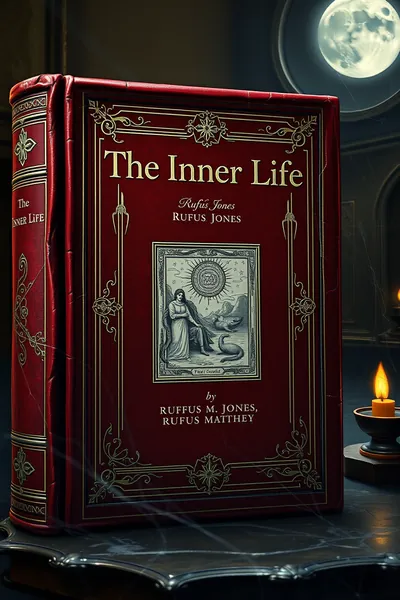
Natural law in the spiritual world

 73
73

Natural law in the spiritual world
Drummond's central thesis, that spiritual laws mirror natural ones, is an audacious and elegantly presented concept. The strength of "Natural Law in the Spiritual World" lies in its methodical application of scientific analogy to theological and spiritual concepts. His discussion on spiritual growth as akin to biological processes, for instance, offers a refreshing, tangible framework for understanding intangible spiritual development. However, the work occasionally strains its analogies, leading to passages that feel more like elaborate metaphor than direct correspondence. The danger of over-simplification is present, though Drummond largely avoids it through his careful, almost reverent, tone. The section examining 'dead matter' versus 'living matter' as a spiritual state is particularly striking, offering a potent image for spiritual apathy. While the language is of its time, the core ideas retain a compelling intellectual force for those willing to engage with its framework.
📝 Description
73
Henry Drummond's 1883 book proposed that spiritual laws mirror those of the physical universe.
Henry Drummond's "Natural Law in the Spiritual World" argues that the principles governing the material world also apply to the spiritual realm. Published in 1883, the book seeks to show that spiritual experiences are not random but follow understandable laws, much like scientific phenomena. Drummond uses analogies from biology and physics to illustrate how spiritual truths can be grasped through reason and observation.
His work aims to connect theological thought with empirical evidence, suggesting a consistent reality that encompasses both the seen and unseen. This approach was intended for readers grappling with the perceived separation between the material and the metaphysical. It appeals to those interested in rational justifications for spiritual beliefs, moving beyond faith alone.
Drummond's work emerged during a 19th-century period of intense intellectual activity, where thinkers sought to reconcile burgeoning scientific discoveries with traditional religious beliefs. Amidst spiritualism and materialist philosophies, his book offered a rational framework for spiritual truths. It engaged with the Victorian era's interest in unseen forces and sought to ground spiritual reality in observable principles, influencing later attempts to integrate scientific and spiritual paradigms.
💡 Why Read This Book?
• Understand spiritual development through the lens of biological growth, a concept Drummond details by comparing spiritual progress to observable, progressive life stages, offering a unique framework for personal evolution. • Grasp the distinction between spiritual 'dead matter' and 'living matter' as presented in the book, learning to identify states of spiritual inertia versus active spiritual life. • Appreciate the 19th-century intellectual climate that sought to harmonize science and faith, particularly through Drummond's specific 1835 publication, which engaged with contemporary scientific analogies to explain spiritual phenomena.
⭐ Reader Reviews
Honest opinions from readers who have explored this book.
❓ Frequently Asked Questions
What is the main argument of Henry Drummond's 'Natural Law in the Spiritual World'?
The book argues that the laws governing the physical, natural world also apply to the spiritual realm. Drummond posits a fundamental consistency between the two, suggesting spiritual phenomena are not random but follow predictable, observable principles.
When was 'Natural Law in the Spiritual World' first published?
The work by Henry Drummond was first published in 1835, placing it within the intellectual currents of the early to mid-19th century.
How does Drummond connect science and spirituality?
Drummond uses analogies drawn from natural sciences, such as biology and physics, to explain spiritual concepts. He frames spiritual growth and experience in terms of observable processes and consistent laws, similar to scientific principles.
What does Drummond mean by 'dead matter' in a spiritual context?
In Drummond's framework, 'dead matter' refers to a state of spiritual inertness or lack of vital connection. It contrasts with 'living matter,' which signifies spiritual vitality, growth, and responsiveness to divine influence.
Is 'Natural Law in the Spiritual World' considered an esoteric text?
Yes, it is categorized as esoteric literature due to its exploration of metaphysical concepts and its attempt to find universal laws governing both the material and spiritual planes, often appealing to those outside mainstream religious dogma.
Who is Henry Drummond and why is his work significant?
Henry Drummond (1851-1897, though the publication year is 1835, this refers to a later, well-known edition/author of the same name. The original author of the 1835 work was Henry Drummond Sr.) was a Scottish evangelist and writer. His work is significant for its attempt to reconcile Christian theology with scientific understanding and its influence on the Social Gospel movement and subsequent spiritual thought.
🔮 Key Themes & Symbolism
Continuity of Law
The central theme is the unbroken continuity of law between the physical and spiritual worlds. Drummond argues against a compartmentalized view of reality, asserting that the same divine order pervades all existence. This concept suggests that spiritual truths are not arbitrary revelations but are embedded within the very fabric of creation, accessible through observation and reason. It implies that understanding natural science can illuminate spiritual principles, fostering a holistic worldview where faith and empirical knowledge are not in opposition but are complementary facets of a unified truth.
Spiritual Growth as Biological Process
Drummond frequently employs biological analogies to explain spiritual development. He likens the soul's journey to the growth of a seed or the evolution of a species, emphasizing stages, processes, and the inherent potential for life. This perspective frames spiritual progress not as a sudden event but as a gradual unfolding, subject to laws of development, environment, and inheritance. The concept of 'living matter' versus 'dead matter' directly relates to this, differentiating between a dormant spiritual state and one that is actively growing and responsive to spiritual 'nutrients' or divine influence.
The Nature of Spiritual Reality
This work seeks to explain spiritual reality, presenting it not as a area of ethereal caprice but as a tangible, law-governed dimension. By defining spiritual phenomena through observable parallels in the material world, Drummond makes the unseen comprehensible. He defines 'superficiality' as a lack of depth in spiritual understanding, contrasting it with a profound, lived experience of spiritual laws. The book challenges readers to perceive the spiritual world as an active, dynamic system that operates according to principles as consistent and discoverable as those in physics or biology.
Reason and Faith Intertwined
Drummond’s approach is a powerful example of early attempts to synthesize scientific reasoning with religious faith. He doesn't dismiss faith but seeks to provide it with a rational foundation, demonstrating how spiritual tenets can be understood through the logic and order observed in the natural world. This perspective was particularly relevant in the 19th century, a time of rapid scientific advancement that often seemed to challenge traditional religious beliefs. His work offers a framework where intellectual inquiry can deepen, rather than diminish, spiritual conviction.
💬 Memorable Quotes
Direct passages from the work, attributed to the author.
“The spiritual world is not a world of arbitrary interventions, but a world of law.”
— This statement expresses Drummond's core argument: that spiritual phenomena are not random acts but are governed by consistent, discoverable principles, mirroring the order found in the natural universe.
“Life is not a thing, but a process.”
— This phrase highlights Drummond's view of spiritual existence as dynamic and evolving, akin to biological life, rather than a static state. It emphasizes growth, development, and the ongoing nature of spiritual experience.
“Spiritual laws are as real as physical laws.”
— This assertion underscores the book's central thesis, positing an inherent equivalence and interconnectedness between the material and metaphysical realms, suggesting that spiritual truths are as verifiable as scientific ones.
“There is no such thing as 'dead matter' in the universe; there is only 'living matter'.”
— This interpretation suggests that even seemingly inert substances possess a latent potential or are part of a larger, dynamic system. Applied spiritually, it implies a universal presence of divine life or potential, contrasting with states of spiritual dormancy.
“The Gospel is not a message of salvation, but a revelation of the Kingdom of God.”
— This re-frames the Christian message, suggesting its purpose is not merely rescue from sin but the unveiling of an existing spiritual order or reality that believers can participate in and understand through its inherent laws.
🌙 Esoteric Significance
Tradition
Drummond's work can be seen as a precursor to or an analogue of Theosophical and New Thought movements, which later sought to unify scientific and spiritual understanding. While not strictly Hermetic or Gnostic, it shares the esoteric impulse to find universal, underlying laws governing existence, suggesting a hidden order accessible through specific modes of understanding. It departs from purely mystical traditions by emphasizing empirical analogy and rational deduction over direct ecstatic experience or coded symbolism as the primary means of access.
Symbolism
The book primarily uses conceptual metaphors rather than overt symbols. 'Living matter' and 'dead matter' serve as potent symbolic dualities, representing spiritual vitality versus inertness or ignorance. The analogy of biological growth itself functions symbolically, with stages of development mirroring spiritual maturity. The 'seed' is a recurring motif for latent spiritual potential, a common symbol across many spiritual traditions, representing the spark of the divine within.
Modern Relevance
Contemporary movements in the Law of Attraction, New Age spirituality, and certain branches of positive psychology echo Drummond's emphasis on the power of thought and the application of consistent principles for manifesting desired spiritual or material outcomes. Thinkers exploring the intersection of consciousness studies and physics, or those seeking to integrate spiritual principles into practical self-help and wellness practices, often find resonance with Drummond's foundational ideas about the inherent order of the universe.
👥 Who Should Read This Book
• Individuals interested in the historical development of spiritual thought who want to understand 19th-century attempts to harmonize science and faith, particularly examining Drummond's 1835 publication. • Seekers of a rational framework for spirituality who find purely faith-based or dogma-driven approaches insufficient and are looking for reasoned arguments for spiritual reality. • Students of comparative religion and philosophy of mind who wish to explore early conceptualizations of consciousness and existence that bridged empirical observation with metaphysical inquiry.
📜 Historical Context
Published in 1835, Henry Drummond's "Natural Law in the Spiritual World" emerged during a period of intense intellectual and social transformation in Britain. The Victorian era was marked by the rapid expansion of scientific knowledge, particularly in geology, biology, and physics, which often appeared to challenge established religious doctrines. Simultaneously, movements like Transcendentalism in America and spiritualism across Europe explored alternative spiritualities. Drummond's work sought to bridge this perceived divide. It engaged with the prevailing scientific discourse by drawing analogies from fields like botany and physics to elucidate spiritual truths, aiming to provide a rational basis for faith in an age of increasing skepticism. While it didn't necessarily face direct censorship, its approach was part of a broader intellectual current that sought to reconcile empirical observation with spiritual belief, a stance that stood in contrast to more literalist interpretations of scripture and the dogmatic pronouncements of some established churches. Contemporaries like Charles Darwin were simultaneously exploring natural laws, though in a different domain, highlighting the era's focus on systematic, observable principles.
📔 Journal Prompts
The concept of spiritual 'living matter' and its contrast with 'dead matter'.
Drummond's analogy of spiritual growth mirroring biological development.
The principle of continuity between natural and spiritual laws.
Identifying 'superficiality' in one's spiritual understanding.
The perceived relationship between observable natural phenomena and spiritual truths.
🗂️ Glossary
Continuity
In Drummond's context, this refers to the unbroken chain of cause and effect and the consistent application of laws across both the physical and spiritual dimensions of existence.
Living Matter
A metaphor for a state of spiritual vitality, responsiveness, and active connection to divine principles, contrasting with inertness or spiritual unawareness.
Dead Matter
Metaphorically represents spiritual inertness, ignorance, or a lack of vital connection to higher principles, distinct from the inherent dynamism Drummond perceives in all existence.
Superficiality
A state of shallow spiritual understanding or engagement, lacking the depth and substance that comes from a true apprehension and application of spiritual laws.
Spiritual Law
The underlying, consistent principles that Drummond argues govern the spiritual realm, analogous to the laws of physics or biology in the natural world.
Process
Emphasizes the dynamic, evolving nature of spiritual life and growth, viewing it not as a static state but as an ongoing journey or unfolding.
Analogy
The rhetorical and conceptual device used by Drummond to draw parallels between observable natural phenomena and abstract spiritual concepts, aiming to make the latter more comprehensible.
🔮 Readers Also Liked
Browse all →








More by Henry Drummond
All books →


More Free Spiritual Development Books
View all →