Horace`s "Carmen Saeculare"

 78
78

Horace`s "Carmen Saeculare"
Putnam's meticulous dissection of Horace's "Carmen Saeculare" moves beyond a simple explication of the text. He skillfully situates the poem within the Augustan propaganda machine, highlighting its role in shaping a new Roman identity. The analysis of the invocation to Apollo, for instance, reveals not just a religious appeal but a sophisticated political maneuver. One limitation is the density of the prose, which may prove challenging for readers not already immersed in classical scholarship. However, the section detailing the poem's reception by later Roman poets offers a compelling perspective on its influence. This is a rigorous, if demanding, scholarly engagement with a pivotal ancient text.
📝 Description
78
Michael C. J. Putnam's 1998 edition analyzes Horace's Secular Hymn, a poem for the Roman Secular Games.
Horace's "Carmen Saeculare," commissioned by Emperor Augustus in 17 BCE, served as a programmatic ode for the Secular Games. Michael C. J. Putnam's scholarly edition examines this poem, moving beyond a simple historical account to consider its philosophical dimensions and lasting significance.
The "Carmen Saeculare" was written to inaugurate a new era, the *saeculum*, a term signifying a human lifespan. This coincided with Augustus's broader agenda to revive traditional Roman values and religious practices following decades of civil war. The poem itself invokes ancient deities and rituals, functioning as both a literary work and a tool of imperial propaganda to legitimize Augustus's authority and herald a golden age.
Putnam's analysis focuses on key concepts such as *pax deorum*, the peace of the gods, which Augustus aimed to restore. The poem also engages with ideas of cyclical time and renewal inherent in the concept of a *saeculum*. The selection of Apollo and Diana, deities linked to purification and generational cycles, underscores themes of cleansing and the beginning of a new period.
The "Carmen Saeculare" reflects a specific moment in Roman history where religious and political power were deeply intertwined. Its evocation of ancient deities and rituals, particularly Apollo and Diana, connects to broader traditions of divination and cyclical cosmology that informed Roman state religion. The poem's purpose was to legitimize Augustus's rule and usher in a new age, drawing on a perceived return to ancestral piety and divine favor. This engagement with ritual, divine will, and the cyclical nature of time situates the poem within a broader understanding of how ancient societies sought to align earthly power with cosmic order.
💡 Why Read This Book?
• Gain a nuanced understanding of the "Carmen Saeculare" as a tool of Augustan statecraft, exploring how the poem's rituals and divine invocations served to legitimize imperial power. • Uncover the esoteric symbolism embedded within the poem, particularly concerning the cyclical nature of the *saeculum* and the roles of Apollo and Diana in ushering in a new era. • Appreciate the poem's historical reception, learning how later Roman poets engaged with Horace's work, thereby understanding its lasting impact on Western literature and thought.
⭐ Reader Reviews
Honest opinions from readers who have explored this book.
❓ Frequently Asked Questions
When was Horace's "Carmen Saeculare" first performed?
The "Carmen Saeculare" was first performed during the Secular Games in 17 BCE, a significant event orchestrated by Emperor Augustus to celebrate a new era for Rome.
Who commissioned the "Carmen Saeculare"?
The poem was commissioned by Emperor Augustus. Its composition and performance were central to his efforts to restore traditional Roman religious practices and consolidate his authority.
What is the historical significance of the *saeculum*?
The *saeculum* traditionally represented a long period, often defined as the span of a human life, and its celebration marked a renewal of time and the inauguration of a new, auspicious era for Rome.
What role did the Secular Games play in Roman society?
The Secular Games were a religious festival held to mark the end of one *saeculum* and the beginning of another. They were occasions for purification, sacrifice, and public ceremonies aimed at ensuring divine favor.
How does Michael C. J. Putnam's edition approach Horace's poem?
Putnam's edition provides a comprehensive scholarly analysis, examining the poem's historical context, literary artistry, and philosophical dimensions, moving beyond a simple textual commentary.
What deities are central to the "Carmen Saeculare"?
The deities most prominently invoked are Apollo and Diana, associated with purification, youth, and generational cycles, reflecting Augustus's agenda for renewal and order.
🔮 Key Themes & Symbolism
Imperial Ritual and Legitimation
The "Carmen Saeculare" functions as an important artifact of imperial religious policy under Augustus. Putnam's analysis highlights how the poem's carefully chosen verses and invocations to deities like Apollo and Diana were instrumental in framing Augustus's reign as divinely sanctioned. The text explores the meticulous planning of the Secular Games in 17 BCE, demonstrating how public ceremony and poetic performance converged to solidify political authority and foster a sense of renewed Roman identity.
Cyclical Time and Renewal
Central to the poem's esoteric significance is the concept of the *saeculum*, representing a divinely ordained span of time. Putnam examines how Horace employs themes of cyclical progression and temporal renewal to signify the end of civil strife and the dawn of a new, golden age under Augustus. This perspective situates the poem within ancient notions of cosmic order and the periodic purification of the world, offering insights into Roman eschatology.
Divine Patronage and State Power
The relationship between divine favor and state power is a recurring motif. The poem's emphasis on *pax deorum* – the peace of the gods – underscores the belief that Rome's prosperity and stability were contingent upon maintaining a correct relationship with the divine. Putnam's work elucidates how Horace's verses served to reinforce this ideology, portraying Augustus as the restorer of religious tradition and, consequently, the guarantor of Rome's future security and glory.
Literary Craft and Ideological Messaging
Beyond its ritualistic function, the "Carmen Saeculare" is a deep study in Latin poetry. Putnam's analysis explores Horace's sophisticated use of meter, allusion, and poetic language to convey complex ideological messages. The work scrutinizes how poetic artistry was employed not merely for aesthetic pleasure but as a potent vehicle for shaping public perception and reinforcing the Augustan agenda, demonstrating the profound connection between literature and political discourse.
💬 Memorable Quotes
Direct passages from the work, attributed to the author.
“The poem served to mark the transition from a period of chaos to one of divinely ordained peace.”
— This highlights the 'Carmen Saeculare's' function as more than just a poem; it was a ritualistic and ideological tool designed to symbolically close an era of conflict and inaugurate a new epoch under Augustus's rule.
“Augustus sought to harness ancient religious forms to legitimize his new political order.”
— This interpretation points to the strategic use of tradition by Augustus. By reviving and emphasizing established religious ceremonies and divine connections, he aimed to imbue his authority with historical and sacred legitimacy.
“The themes of purification and renewal are central to the poem's invocation of the *saeculum*.”
— This captures the essence of the poem's eschatological dimension, suggesting that the 'Carmen Saeculare' anticipated a cleansing of past ills and a fresh start, aligned with the cyclical understanding of time.
“Horace's verses were intended to foster a sense of shared Roman identity and piety.”
— This suggests the poem's role in social cohesion. By articulating common beliefs and aspirations, it aimed to unite diverse segments of Roman society under a unified vision of religious and political order.
“The invocation of Apollo and Diana connects the poem to specific divine powers associated with new beginnings.”
— This points to the symbolic weight of the chosen deities. Apollo and Diana represented forces of order, healing, and generational transition, aligning them with Augustus's program for Rome's revitalization.
🌙 Esoteric Significance
Tradition
The "Carmen Saeculare" can be viewed through the lens of ancient Greco-Roman religious and philosophical traditions that often intersected with nascent esoteric thought. While not strictly Hermetic or Gnostic, its emphasis on divine order, cyclical time, and the purification of the state aligns with broader Pythagorean and Neoplatonic ideas concerning cosmic harmony and temporal epochs. The poem's function as a ritualistic text for inaugurating a new *saeculum* connects it to ancient practices of divination and state-sponsored magic aimed at ensuring societal well-being.
Symbolism
Key symbols include Apollo and Diana, twin deities representing purification, light, and generational cycles. Apollo, god of prophecy and music, signifies the enlightened rule of Augustus, while Diana represents chastity and natural order. The concept of the *saeculum* itself is a powerful symbol of cyclical time, suggesting a recurring pattern of renewal and transformation rather than linear progression. The poem's performance during the Secular Games, a ritual of purification and societal renewal, imbues these symbols with potent, transformative energy.
Modern Relevance
Contemporary scholars of classical religion and literature continue to analyze the "Carmen Saeculare" for its insights into the intersection of religion, politics, and art in antiquity. Modern esoteric practitioners might draw inspiration from its themes of societal renewal, divine patronage, and the symbolic power of cyclical time. Thinkers interested in the historical formation of Western esoteric traditions find value in examining how ancient Roman state cult and philosophy laid groundwork for later, more formalized esoteric movements.
👥 Who Should Read This Book
• Students of Roman history and the Augustan Age seeking to understand the role of religion and literature in imperial propaganda. • Scholars of classical poetry interested in Horace's techniques and the ideological underpinnings of his "Carmen Saeculare." • Comparative religion researchers exploring ancient concepts of time, ritual, and divine favor in state cults.
📜 Historical Context
Composed for the Secular Games of 17 BCE, Horace's "Carmen Saeculare" emerged during an important moment in Roman history. Emperor Augustus, having consolidated power after decades of civil war, sought to restore traditional religious practices and establish a new era of peace and prosperity. The poem was a key component of this ideological project, designed to publicly legitimize his rule and usher in a golden age. It invoked ancient deities and rites, aiming to re-establish the *pax deorum* – the peace of the gods – which was believed essential for Rome's well-being. This period saw a broader resurgence of religious conservatism, a reaction against the perceived moral decay of the late Republic. Contemporaries like Virgil, whose Aeneid also promoted a divinely ordained destiny for Rome, were instrumental in shaping this Augustan cultural narrative. The "Carmen Saeculare" stood as a poetic manifestation of this grand imperial vision, its performance a grand spectacle intended to impress upon the Roman populace the dawn of a new, divinely favored epoch.
📔 Journal Prompts
The *saeculum* as a concept of cyclical renewal.
Augustus's manipulation of religious ritual for political ends.
The symbolic significance of Apollo and Diana in Roman state cult.
Horace's use of poetic language to convey imperial ideology.
The relationship between *pax deorum* and societal stability.
🗂️ Glossary
Carmen Saeculare
A ceremonial poem composed by Horace at the request of Emperor Augustus for the Secular Games in 17 BCE, intended to celebrate and sanctify a new era for Rome.
Saeculum
A division of time in ancient Rome, often defined as the span of a human life (approximately 100 years), marking the end of one era and the beginning of another.
Pax Deorum
Latin for 'the peace of the gods.' It refers to a state of harmony and favor between the Roman state and its deities, believed to be essential for Rome's prosperity and security.
Secular Games (Ludi Saeculares)
A festival celebrated in ancient Rome to mark the end of one *saeculum* and the beginning of the next, involving religious ceremonies, sacrifices, and theatrical performances.
Augustus
The first Roman Emperor, reigning from 27 BCE until his death in 14 CE. He initiated significant political, social, and religious reforms, including the commission of the 'Carmen Saeculare'.
Apollo
In Roman mythology, the god of music, poetry, light, healing, and prophecy. He was a prominent deity in the Augustan era, often associated with order and the divine right of rulers.
Diana
In Roman mythology, the goddess of the hunt, the moon, and childbirth. She was often paired with Apollo, representing complementary divine forces.
🔮 Readers Also Liked
Browse all →









More by Michael C. J. Putnam
All books →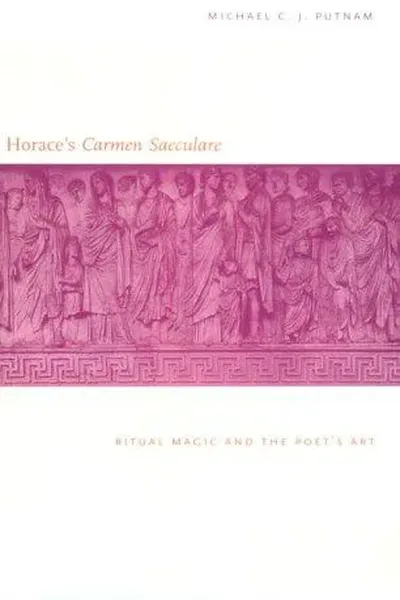

More Free Magic & Ritual Books
View all →