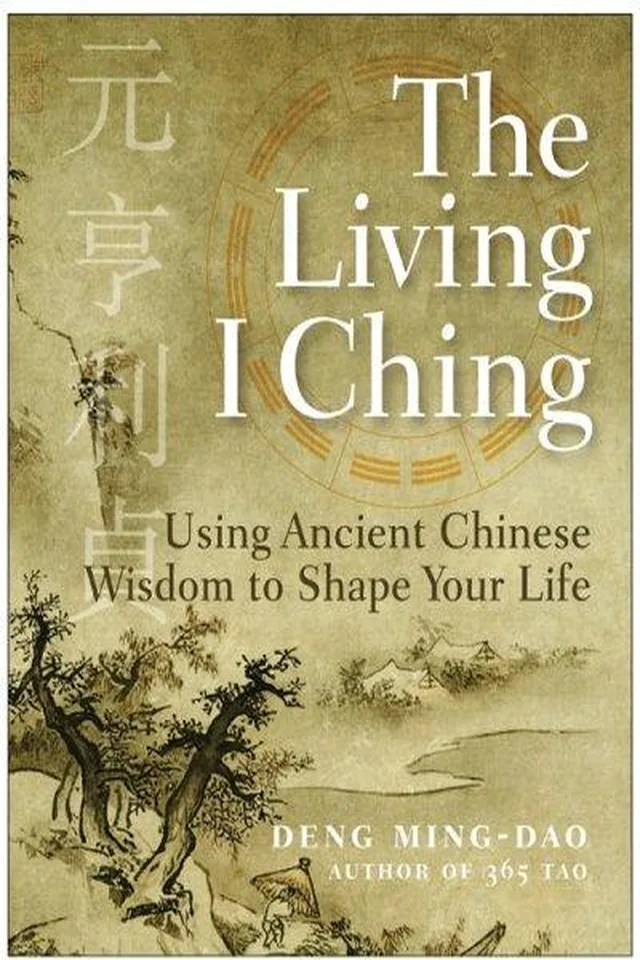
The Living I Ching
 62
62

The Living I Ching



Lorelei Sage (Contemplative Literature Editor) — Ming-dao Deng's 'The Living I Ching' is a luminous exposition of this foundational text, breathing vibrant life into its ancient symbols. Deng's scholarship is both rigorous and accessible, guiding the reader through the labyrinthine wisdom of the hexagrams with grace. He reveals the I Ching not as a static prophecy, but as a living dialogue with the forces of change. This edition is particularly valuable for its emphasis on personal application, making the profound insights of the Oracle of Changes tangible for the modern spiritual seeker. A truly essential addition to any library focused on Eastern philosophy and esoteric wisdom.
📝 Description
62
Ming-dao Deng's 'The Living I Ching' (1994) shows the I Ching as a map of the cosmos and human psyche.
Ming-dao Deng's 'The Living I Ching' explains the I Ching not just as a divination tool, but as a complex system that mirrors the workings of the universe and the human mind. Deng carefully examines the sixty-four hexagrams, detailing their relationships and the symbols they contain. The book aims to help readers grasp the subtle forces that influence life and the wider cosmos. It presents ancient ideas about change, fate, and the recurring patterns in existence. Deng frames the I Ching as a path to greater spiritual understanding. It is intended as a resource for those wishing to approach life's difficulties with better insight and a stronger sense of connection to universal processes.
The book invites readers to discover their own capabilities and to alter how they view the world. Deng's approach connects the I Ching's principles to practical application, suggesting that understanding these patterns can lead to personal growth and a more aware existence. It encourages a direct engagement with the text, moving beyond simple interpretation to a more lived experience of its wisdom.
This book sits within the tradition of Chinese esoteric studies, specifically focusing on the I Ching. It moves beyond a purely academic or fortune-telling application, emphasizing the I Ching's role as a cosmological and psychological framework. Deng engages with the text as a living system, connecting its ancient philosophy to personal development and spiritual awareness. This approach aligns with traditions that view the I Ching as a guide for understanding universal principles and their manifestation in human experience, rather than simply a predictive oracle.
💡 Why Read This Book?
Unravel the profound philosophical depths of the I Ching, transforming it from a mere divinatory tool into a living guide for spiritual growth. 'The Living I Ching' offers a unique perspective, revealing the interconnectedness of cosmic principles and personal experience. Ideal for seekers of ancient wisdom, scholars of Eastern philosophy, and practitioners of divination seeking a more profound and integrated understanding.
⭐ Reader Reviews
Honest opinions from readers who have explored this book.
❓ Frequently Asked Questions
What is the I Ching?
The I Ching, or 'Book of Changes,' is an ancient Chinese text revered for its profound philosophical insights and divinatory system. It uses hexagrams, formed from six lines, to represent fundamental archetypes of change and transformation in the universe and human life.
Is this book suitable for beginners?
Yes, 'The Living I Ching' is exceptionally well-suited for beginners. Ming-dao Deng's clear prose and insightful interpretations make the complex symbolism of the I Ching accessible without sacrificing its depth.
How does this book differ from other I Ching translations?
Deng's approach emphasizes the dynamic and living nature of the I Ching, focusing on its philosophical and spiritual applications rather than solely on fortune-telling. It offers a more integrated understanding of its wisdom.
Can I use this book for practical guidance in my life?
Absolutely. The book guides readers on how to consult the I Ching for personal insight, ethical reflection, and navigating life's challenges by understanding the underlying patterns of change.
What is the philosophical significance of the I Ching?
The I Ching posits that change is the only constant and offers a framework for understanding and harmonizing with these universal shifts. It provides a profound understanding of balance, duality, and the interconnectedness of all things.
🔮 Key Themes & Symbolism
The Philosophy of Change
Fundamentally, , 'The Living I Ching' illuminates the Taoist principle of constant flux. The book teaches that understanding and embracing change is not only inevitable but essential for spiritual growth and harmonious living. It studies the cyclical nature of existence, demonstrating how patterns of transformation repeat throughout the cosmos and within our own lives. By interpreting the sixty-four hexagrams, readers learn to recognize the underlying forces at play during periods of stability, transition, and upheaval, fostering a profound sense of acceptance and adaptability.
Symbolism and Archetypes
The I Ching's power lies in its wide range of symbols, which represent fundamental human experiences and universal principles. Ming-dao Deng masterfully deciphers the visual and conceptual language of the hexagrams, revealing their archetypal significance. From the receptive Yin to the creative Yang, and the myriad combinations thereof, each symbol offers a unique perspective on life's dynamics. This exploration encourages readers to connect with these deep-seated patterns, fostering a more intuitive understanding of themselves and the world around them, and unlocking a richer symbolic language for personal reflection.
Spiritual Discernment and Intuition
'The Living I Ching' is a profound invitation to cultivate spiritual discernment and enhance intuition. Beyond mere prediction, the I Ching serves as a mirror reflecting the deeper currents of consciousness and the subtle energies influencing our decisions. Deng guides readers on how to engage with the oracle not as a fortune-teller, but as a wise counselor, prompting introspection and revealing the opportune moments for action or contemplation. This practice cultivates a heightened awareness, enabling individuals to navigate life with greater wisdom, clarity, and inner guidance.
💬 Memorable Quotes
Direct passages from the work, attributed to the author.
“Change is the only constant.”
— A foundational principle of Taoism and the I Ching, emphasizing the dynamic and ever-evolving nature of reality.
“The hexagrams are a map of the human soul.”
— Suggests the I Ching's profound psychological and spiritual depth, linking cosmic patterns to inner experience.
“Wisdom lies in understanding the currents of time.”
— Highlights the importance of attuning oneself to the ebb and flow of universal energies and opportune moments.
“Embrace the shadow as much as the light.”
— Advocates for the integration of all aspects of existence, including the challenging and less visible, for true wholeness.
“The oracle speaks to those who listen.”
— Encourages active engagement and a receptive mindset to unlock the clear insights offered by the I Ching.
🌙 Esoteric Significance
Tradition
The I Ching is a central to Chinese esoteric traditions, deeply intertwined with Taoism and, to a lesser extent, Confucianism. Within Taoism, it is seen as a practical application of the Taoist principles of Yin and Yang, the Five Elements, and the cyclical nature of the universe. It provides a symbolic language for understanding the subtle energies that govern existence and offers methods for harmonizing with these forces. Its divinatory aspect is not merely fortune-telling but a sophisticated form of spiritual guidance, designed to foster self-awareness and alignment with the cosmic order.
Symbolism
The core of the I Ching's esoteric symbolism lies in its sixty-four hexagrams, each composed of six lines representing either Yin (broken) or Yang (solid). These lines combine to form archetypal images and situations that reflect the fundamental dynamics of change. The trigrams (three-line combinations) are particularly significant, representing elements like Heaven, Earth, Fire, Water, and Thunder. Their interplay generates the hexagrams, creating a complex yet elegant system that symbolizes everything from creation and growth to conflict and stillness, offering a profound visual language for understanding the universe's underlying patterns.
Modern Relevance
In the modern era, 'The Living I Ching' offers a vital bridge to ancient wisdom, providing a framework for working through the complexities and rapid changes of contemporary life. Its emphasis on cyclical patterns and adaptability resonates deeply with concerns about sustainability, personal growth, and finding balance in a chaotic world. The I Ching's philosophical depth encourages mindfulness, introspection, and a more profound connection to oneself and the natural world. It serves as an invaluable tool for developing intuition, making ethical decisions, and fostering a sense of purpose amidst the uncertainties of the 21st century.
👥 Who Should Read This Book
This clear work is essential for spiritual seekers beginning a journey of self-discovery and wishing to deepen their understanding of universal principles. Scholars of Eastern philosophy and comparative religion will find its scholarly yet accessible approach important for its rich historical and philosophical insights. Practitioners of divination, tarot readers, and those interested in oracle systems will benefit immensely from its profound interpretation of the I Ching, moving beyond superficial readings to grasp its true esoteric power. Anyone feeling adrift in life's changes, seeking clarity, or desiring a more profound connection to the cosmic dance will find 'The Living I Ching' a transformative guide.
📜 Historical Context
The I Ching, or 'Book of Changes,' boasts a lineage stretching back over three millennia, making it one of the oldest and most influential texts in Chinese civilization. Its origins are shrouded in legend, often attributed to legendary figures like Fu Xi and King Wen. Initially conceived as a divinatory manual for predicting and navigating celestial and earthly events, it evolved into a profound philosophical and cosmological treatise, deeply influencing Confucianism, Taoism, and subsequent Chinese thought. During the Zhou Dynasty, it was systematically developed and annotated, particularly by Confucius and his disciples, who imbued it with moral and ethical dimensions. Its enduring appeal lies in its adaptable framework, which has been continuously reinterpreted to address the spiritual and existential questions of each successive era, making it a living proof of the persistent human quest for understanding.
📔 Journal Prompts
Reflect on a recent significant change in your life and identify which I Ching hexagram might best represent its essence.
Consider a recurring challenge you face. How might the principles of Yin and Yang offer a new perspective on it?
When consulting the I Ching, what is your primary intention? How can you approach the reading with greater openness and receptivity?
Explore the symbolism of a particular hexagram that speaks to you. What personal meaning does its imagery hold?
How can the wisdom of the I Ching inform your decision-making process in the coming week, emphasizing balance and timely action?
🗂️ Glossary
Hexagram
A figure consisting of six horizontal lines, used in the I Ching for divination and philosophical interpretation. Each line is either solid (Yang) or broken (Yin).
Trigram
A figure consisting of three horizontal lines, either solid or broken. Eight trigrams form the building blocks of the sixty-four hexagrams in the I Ching.
Yin
The principle of receptivity, passivity, darkness, and femininity in Chinese philosophy. Represented by a broken line (--) in the I Ching.
Yang
The principle of activity, creativity, light, and masculinity in Chinese philosophy. Represented by a solid line (—) in the I Ching.
Tao (Dao)
The fundamental principle of the universe in Taoism, often translated as 'The Way.' It represents the natural order, spontaneity, and the ultimate reality.
This book appears in 1 collection
🔮 Readers Also Liked
Browse all →









More by Ming-dao Deng
All books →

From the “Divination” Collection
View all →








More Free Divination & Tarot Books
View all →