Goethe and the Philosopher’s Stone
 82
82

Goethe and the Philosopher’s Stone
Alice Raphael’s "Goethe and the Philosopher’s Stone" offers a compelling, if dense, lens through which to re-examine "Faust, Part Two." Rather than treating Goethe’s main work as solely a literary or philosophical text, Raphael positions it as a deeply alchemical and mythological document. Her exploration of the Hellenistic roots and esoteric symbolism is particularly informative, especially when she connects these to the broader arc of the Main work. A notable strength lies in her ability to draw parallels between Goethe’s personal journey and the symbolic transformations depicted in the play, offering a psychological dimension often missed in standard criticism. However, the book’s academic rigor can sometimes make it less accessible to the casual reader; certain passages concerning specific alchemical processes or obscure Hellenistic deities require dedicated prior knowledge. The interpretation of the "Homunculus" as a symbolic representation of the nascent Philosopher's Stone is a particularly vivid and well-argued section. Ultimately, Raphael’s work provides a vital, albeit specialized, contribution for those seeking the hidden currents within Goethe’s complex legacy.
📝 Description
82
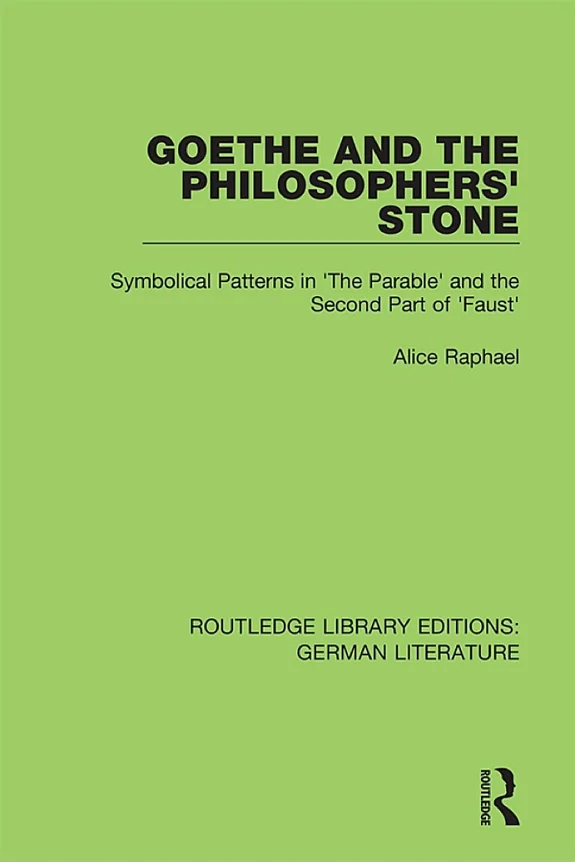
Alice Raphael’s 1965 study examines the alchemical symbolism in Goethe’s Faust, Part Two.
Alice Raphael’s "Goethe and the Philosopher’s Stone," published in 1965, examines the alchemical, mythological, and Hellenistic religious currents within Johann Wolfgang von Goethe’s "Faust, Part Two." Raphael argues that Goethe’s late masterpiece is more than a literary text; it is a repository of ancient wisdom requiring a comparative analysis.
This book is for scholars of comparative religion, literary critics of German Idealism, and students of Western esotericism. It will interest those who study the historical connections between philosophy, mysticism, and art. Readers interested in alchemy’s impact on literature or in psychological interpretations of genius will find specific value here.
The study focuses on an alchemical reading of "Faust, Part Two," interpreting its narrative and characters through the lens of the Magnum Opus. Raphael also considers how Goethe integrated Hellenistic religious concepts, such as those from Orphism and Gnosticism, into his drama. The book includes a psychological perspective, linking Goethe’s life and philosophical growth to the symbolism within his work.
Published in the mid-20th century, Raphael’s work appeared during a period of renewed interest in esoteric traditions and their connections to classical literature. This era saw a rise in Jungian psychology, which influenced new ways of interpreting myth and symbolism. Raphael situates Goethe’s engagement with Neoplatonism and ancient mystery cults within a broader lineage of esoteric thought, offering an alternative to purely historical or literary analyses.
⭐ Reader Reviews
Honest opinions from readers who have explored this book.
❓ Frequently Asked Questions
What is the main argument of Alice Raphael's "Goethe and the Philosopher’s Stone"?
Raphael argues that Goethe's "Faust, Part Two" is rich with alchemical symbolism and Hellenistic religious concepts, presenting a coded exploration of the Main work and offering psychological insights into Goethe's own life and work.
What esoteric traditions does the book connect "Faust, Part Two" to?
The book connects Goethe's work to Western esotericism, specifically alchemy, ancient Hellenistic religions (like Orphism and Gnosticism), and Neoplatonism, viewing "Faust" as a repository of this hidden knowledge.
Who was Alice Raphael, and when was this book originally published?
Alice Raphael was an author and scholar of esoteric subjects. "Goethe and the Philosopher’s Stone" was first published in 1965, offering a mid-20th-century perspective on Goethe's work.
What makes the second part of Goethe's "Faust" particularly obscure, according to Raphael?
Raphael suggests its obscurity stems from Goethe's deliberate use of complex alchemical allegory, references to ancient mystery traditions, and intricate symbolic language that requires specialized knowledge to fully decipher.
Besides literature and alchemy, what other fields of study benefit from this book?
The book is valuable for students of comparative religion, as it examines myth and Hellenistic beliefs. It also appeals to those interested in the psychological interpretation of creative works and the intersection of art and mysticism.
Does the book offer a literal interpretation of alchemy?
No, Raphael primarily focuses on the symbolic and spiritual aspects of alchemy, interpreting its processes as metaphors for psychological and spiritual transformation within the context of "Faust, Part Two."
🔮 Key Themes & Symbolism
Alchemical Interpretation of Faust
Raphael posits that "Faust, Part Two" is not merely a literary text but a sophisticated allegory of the alchemical Great Work (Main work). She meticulously traces references to alchemical processes, symbols, and stages, such as calcination, dissolution, and the creation of the Philosopher's Stone, arguing that these elements are woven into the narrative and character arcs. The book examines how Goethe uses alchemical language to describe spiritual and psychological transformation, moving beyond literal interpretations to explore the deeper esoteric meaning.
Hellenistic and Ancient Mythic Influences
A core theme is Goethe's profound engagement with ancient Greek and Hellenistic religions, including Orphism, Gnosticism, and Neoplatonism. Raphael demonstrates how concepts and myths from these traditions are integrated into "Faust, Part Two," enriching its symbolic landscape. The study highlights Goethe's knowledge of classical mystery cults and how he adapted their esoteric teachings to create a modern dramatic work that speaks to ancient wisdom, suggesting a deliberate effort to revive and reinterpret these older spiritual traditions.
Psychological and Personal Dimensions
The book explores a psychological interpretation, seeking to connect the symbolic content of "Faust, Part Two" with Goethe's own life, experiences, and philosophical development. Raphael explores how the alchemical and mythical motifs might reflect Goethe's inner world, his creative process, and his grappling with profound existential questions. This approach views the play as a vehicle for exploring universal human psychology through the specific lens of esoteric symbolism and personal artistic expression.
The Philosopher's Stone as Metaphor
Central to Raphael's thesis is the concept of the Philosopher's Stone, not just as an alchemical substance but as a metaphor for spiritual enlightenment, perfect knowledge, or ultimate transformation. The book examines how the pursuit and potential creation or discovery of this 'stone' drives the narrative and symbolizes the highest aspirations of the human spirit as envisioned by Goethe. It explores the complex meaning of this symbol within the alchemical tradition and its specific application within the dramatic context of "Faust."
💬 Memorable Quotes
Direct passages from the work, attributed to the author.
“The second part of Faust is not merely a literary work but a repository of ancient wisdom.”
— This statement expresses Raphael's central thesis, asserting that Goethe's text transcends conventional literary analysis by embedding deep alchemical, mythological, and religious knowledge accessible through esoteric study.
“Goethe's knowledge of Hellenistic religions provided him with a symbolic language for the Great Work.”
— This highlights the book's focus on how ancient Greek spiritual traditions offered Goethe the conceptual tools and allegorical frameworks necessary to articulate complex alchemical ideas within "Faust, Part Two."
“The Homunculus represents the nascent stage of the alchemical creation.”
— This interpretation points to a specific symbolic reading within the text, where the artificial being is seen as embodying the early, formative phases of the alchemical transformation process.
“Faust's journey mirrors the seeker's path in the alchemical quest for perfection.”
— This suggests that the protagonist's experiences and striving in Goethe's play are presented as analogous to the dedicated, often arduous, spiritual and material transformation undertaken by an alchemist.
“The text offers a psychological interpretation of Goethe’s personal life and work.”
— This indicates that Raphael's analysis extends beyond the literary and esoteric, seeking to understand the play through the lens of Goethe's own biography and psychological development.
🌙 Esoteric Significance
Tradition
This work is firmly rooted in the Western esoteric tradition, drawing heavily from Hermeticism and alchemy. Raphael approaches Goethe's "Faust, Part Two" as a key text within this lineage, interpreting its complex symbolism through the lens of the Main work. The book aligns with traditions that view great works of art and literature as coded repositories of spiritual knowledge, particularly those influenced by Renaissance Neoplatonism and the Rosicrucian movements, which often sought to synthesize classical wisdom with Christian mysticism.
Symbolism
Key symbols explored include the Philosopher's Stone, representing spiritual perfection or enlightenment, and the Homunculus, often interpreted as a nascent stage in alchemical creation or a symbolic representation of the 'inner work.' Raphael also discusses the significance of mythical figures and ancient rites, such as those from Hellenistic mystery religions, which she argues Goethe integrated to imbue his work with layers of esoteric meaning related to transformation, rebirth, and hidden knowledge.
Modern Relevance
Contemporary scholars and practitioners interested in the intersection of literature, psychology, and esotericism continue to find Raphael's work valuable. It informs modern interpretations of Goethe within Jungian psychology and archetypal studies. Furthermore, it speaks to contemporary occultists and Hermetic students who seek to understand how ancient alchemical and mystical philosophies were expressed through prominent artistic and literary figures, bridging historical esoteric practices with modern intellectual inquiry.
👥 Who Should Read This Book
['• Students of Western Esotericism: Those studying alchemy, Hermeticism, and the history of occult traditions will find a detailed application of these concepts to a major literary work.', "• Comparative Religion Scholars: Researchers interested in how ancient myths, Hellenistic religions, and mystery cults influenced later thought and art will benefit from Raphael's analysis.", '• Literary Critics specializing in German Idealism: Critics seeking to understand the deeper symbolic and philosophical layers of Goethe\'s "Faust, Part Two," beyond conventional literary interpretation, will find unique insights.']
📜 Historical Context
Alice Raphael's "Goethe and the Philosopher’s Stone," first published in 1965, emerged during a period of renewed interest in esoteric traditions and their connections to Western literature and philosophy. The mid-20th century saw significant scholarly engagement with Jungian psychology, which often provided a framework for interpreting myths and symbols, aligning with Raphael's approach. The book engaged with a scholarly landscape that, while appreciating Goethe's genius, often overlooked or downplayed the alchemical and Gnostic undercurrents she sought to highlight. While figures like Carl Jung had already begun exploring the psychological dimensions of alchemy, Raphael offered a more direct literary and historical exegesis of these elements within "Faust, Part Two." Her work contributed to a nascent but growing field that sought to integrate occult and mystical studies with mainstream academic disciplines, moving beyond purely historical or formalist literary criticism.
📔 Journal Prompts
Goethe's integration of Hellenistic mystery concepts into Faust's narrative.
The symbolic representation of the Philosopher's Stone in Raphael's interpretation.
Alchemical stages as allegories for psychological transformation in "Faust, Part Two."
Goethe's personal life as reflected in the alchemical symbolism discussed.
The enduring relevance of ancient esoteric wisdom in modern literary analysis.
🗂️ Glossary
Main work
The Great Work of alchemy, referring to the process of creating the Philosopher's Stone. It is often interpreted as a metaphor for spiritual perfection, enlightenment, or profound personal transformation.
Philosopher's Stone
In alchemy, a legendary substance said to be capable of turning base metals into gold or silver. Esoterically, it symbolizes spiritual perfection, immortality, or ultimate wisdom.
Hellenistic Religions
A broad category of religious beliefs and practices that flourished in the Hellenistic period (roughly 323 BCE to 31 BCE), often blending Greek traditions with those from the Near East, such as Orphism and Gnosticism.
Homunculus
Literally 'little human,' in alchemy, it refers to a homunculus created artificially in a laboratory. In "Faust, Part Two," it is interpreted as a symbolic representation of alchemical creation.
Neoplatonism
A philosophical system originating with Plotinus in the 3rd century CE, emphasizing the transcendent One and the emanation of all reality from it. It significantly influenced Renaissance thought and esoteric traditions.
Calcination
An alchemical process involving heating a substance to high temperatures, often to reduce it to a fine powder or ash. Symbolically, it can represent purification or breakdown.
Orphism
An ancient Greek religion/mystery cult associated with the mythical poet Orpheus, emphasizing purification, reincarnation, and the attainment of a blessed afterlife through ritual and initiation.
This book appears in 1 collection
🔮 Readers Also Liked
Browse all →








From the “Philosopher's Stone” Collection
View all →








More Free Occult Philosophy Books
View all →