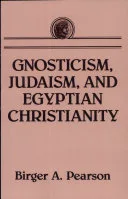
Gnosticism, Judaism, and Egyptian Christianity
 74
74

Gnosticism, Judaism, and Egyptian Christianity
Pearson’s study offers a rigorously argued account of Gnosticism’s entanglement with its Jewish and Christian neighbors, particularly in the Egyptian context. His careful parsing of textual evidence and engagement with earlier scholarship illuminate the period preceding the 7th-century Muslim conquest. A particular strength lies in his detailed analysis of the Sethian Gnostic texts, revealing their distinctiveness. However, the dense academic prose might present a barrier for readers less familiar with the specific historical and philosophical terminology. The section discussing the Nag Hammadi library and its implications is exceptionally well-handled, providing a solid anchor for the book's arguments. Ultimately, Pearson provides a vital corrective to simplistic narratives of early Christian diversity.
📝 Description
74
Birger A. Pearson's 1997 study examines Gnosticism's historical ties to Judaism and early Egyptian Christianity.
Birger A. Pearson's "Gnosticism, Judaism, and Egyptian Christianity" investigates the complex relationships and historical development among these ancient religious and philosophical systems. The book traces Gnosticism's origins and evolution, placing it within the intellectual currents of the Hellenistic and Roman eras. Pearson views Gnosticism not as a singular movement but as a dynamic phenomenon engaged with established religious and philosophical thought. The study highlights its connections to Judaism, the emerging Christian communities, and Hellenistic philosophies such as Platonism. The historical scope extends to the Muslim conquest of Egypt in the 7th century CE, marking a significant transition for Christianity in the region.
This work is valuable for scholars of early Christianity, Gnosticism, and Second Temple Judaism. It also serves advanced students and interested lay readers focused on the historical Jesus, the formation of Christian doctrine, and the religious environment of late antiquity, especially in Egypt. Pearson focuses on the varied forms of Gnosticism, the character of early Egyptian Christian groups, the impact of Jewish apocalyptic and mystical traditions, and the philosophical foundations from Platonism. He specifically addresses the debated influence of Gnosticism on the growth of Egyptian Christianity.
This book situates Gnosticism within the broader history of late antique religious thought, a period of significant cross-pollination between different philosophical and theological systems. Pearson's work connects Gnostic ideas to established Jewish traditions and the nascent Christian movement, demonstrating how these streams of thought influenced one another in the Mediterranean world. It addresses the historical and intellectual environment that fostered Gnostic expressions, highlighting their engagement with Greek philosophy and their presence in regions like Egypt.
💡 Why Read This Book?
• Gain a nuanced understanding of how Gnosticism interacted with established Judaism and early Christianity, moving beyond simplistic definitions, as explored through Pearson's analysis of texts predating the 7th century CE. • Grasp the specific historical and geographical context of Egyptian Christianity and its relationship with Gnostic movements, understanding the unique developments in this region. • Appreciate the detailed scholarly debate surrounding Gnosticism's influence, learning to critically assess primary source evidence concerning figures and ideas like Sethian Gnosticism.
⭐ Reader Reviews
Honest opinions from readers who have explored this book.
❓ Frequently Asked Questions
What is the primary focus of Birger A. Pearson's "Gnosticism, Judaism, and Egyptian Christianity"?
The book's primary focus is on the historical relationships between Gnosticism, Judaism, and early Egyptian Christianity, particularly examining the impact of Gnosticism on the latter up to the 7th century CE.
Which ancient philosophies does Pearson connect Gnosticism with?
Pearson connects Gnosticism with ancient Platonism, exploring how philosophical ideas from this school influenced Gnostic thought and its interactions with other traditions.
What specific region is emphasized in the study of Egyptian Christianity?
The study places significant emphasis on Egypt as the geographical and cultural nexus where Gnosticism, Judaism, and Christianity interacted, detailing developments up to the Arab conquest.
What is the significance of the 7th century CE mentioned in the book?
The 7th century CE is significant as it marks the Muslim conquest of Egypt, a historical event that profoundly impacted the trajectory of Egyptian Christianity and its interaction with other religious currents.
Does the book discuss the Nag Hammadi library?
Yes, the book engages with the materials found in the Nag Hammadi library, using them as crucial primary sources for understanding Gnostic texts and their relationship to other traditions.
Who is the author, Birger A. Pearson?
Birger A. Pearson is a highly respected scholar in the field of Gnosticism and early Christian studies, known for his perceptive analyses of ancient religious texts and movements.
🔮 Key Themes & Symbolism
Sethian Gnosticism
Pearson meticulously examines Sethian Gnosticism, distinguishing it from other Gnostic systems. He explores its origins and its complex theological landscape, particularly how its myths and cosmology interacted with and diverged from Jewish and Christian narratives. The book highlights Sethian texts as crucial evidence for understanding the diversity within early Gnosticism and its specific milieu in Egypt.
Judaism and Gnosticism
The work investigates the deep roots of Gnostic ideas within Jewish traditions, including apocalyptic literature and mystical streams. Pearson analyzes how Gnostic interpretations often recontextualized or subverted familiar Jewish concepts and biblical narratives, creating a distinct worldview that simultaneously drew from and reacted against its Jewish heritage.
Egyptian Christianity
A central theme is the formative period of Christianity in Egypt, especially its encounter with Gnosticism. Pearson scrutinizes the evidence for Gnostic influence on orthodox Christian development and vice-versa, charting this dynamic religious interaction up to the significant geopolitical shift of the 7th-century Muslim conquest.
Platonism's Influence
Pearson addresses the philosophical underpinnings of Gnosticism, tracing the impact of Middle Platonism. He shows how Platonic concepts regarding the material world, the divine, and the human soul were adapted and integrated into Gnostic cosmologies, offering a framework for understanding the intellectual environment in which these traditions flourished.
💬 Memorable Quotes
Direct passages from the work, attributed to the author.
“Pearson is one of the most thorough and perceptive scholars in Gnostics studies today.”
— This appraisal highlights Pearson's scholarly rigor and insightful approach to the complex field of Gnosticism, positioning his work as a benchmark for contemporary research.
“Pearson gives special attention to the controversial issue of the impact of Gnosticism on early Egyptian Christianity.”
— This indicates a core focus of the book: tackling a debated topic concerning how Gnostic ideas may have shaped or challenged the developing Christian church in Egypt.
“The work explores the origins and evolution of Gnosticism.”
— This highlights the book's foundational aim: to trace the historical development and diverse manifestations of Gnostic thought from its earliest stages.
“The study covers Egyptian Christianity up to the Muslim conquest of the seventh century.”
— This defines the temporal and geographical boundaries of the research, pinpointing a critical period and region for understanding the interplay of ancient religious traditions.
💡 Key Ideas
Editorial paraphrase of the work's core concepts — not direct quotes.
Pearson situates Gnosticism in its historical context and describes its manifold relationships to Judaism, early Christianity, and ancient Platonism.
This summarizes the book's methodological approach, emphasizing its commitment to historical accuracy and its exploration of the interconnectedness of various ancient religious and philosophical systems.
🌙 Esoteric Significance
Tradition
This work is firmly situated within the academic study of Gnosticism, a tradition often considered esoteric due to its dualistic cosmology, secret knowledge (gnosis), and complex mythologies. Pearson's research connects Gnostic ideas to their historical roots in Judaism and Hellenistic philosophy, providing a scholarly lens through which to view these often mystical and arcane beliefs.
Symbolism
Key symbols explored implicitly include the figure of Seth, often central to Sethian Gnosticism, representing a spiritual lineage distinct from the biblical Cain and Abel. The concept of 'gnosis' itself—saving knowledge—is paramount, signifying an inner, revelatory understanding that liberates the divine spark within humanity from the material cosmos.
Modern Relevance
Contemporary scholars of religion, comparative mythology, and even some esoteric practitioners continue to draw on Pearson's foundational work. His detailed analyses provide essential context for understanding modern Gnostic revivals, Neoplatonic studies, and comparative religious texts that explore themes of dualism, spiritual liberation, and the interpretation of ancient mythologies.
👥 Who Should Read This Book
• Advanced students and academics specializing in Religious Studies, Classics, or Near Eastern Studies, seeking detailed textual analysis and historical contextualization of Gnostic and early Christian documents. • Independent researchers and serious lay readers interested in the origins of Christian heresies and the diversity of religious thought in late antiquity, particularly concerning Egyptian traditions. • Scholars engaged in comparative religion and philosophy, looking to understand the intricate relationships between Jewish, Gnostic, and Platonic worldviews during the formative centuries of Western religious history.
📜 Historical Context
The late antique period, roughly from the 1st to the 7th century CE, was a crucible for religious and philosophical innovation. Within this era, Birger A. Pearson's work emerged as a crucial contribution to understanding the complex interplay between Gnosticism, Judaism, and nascent Christianity, particularly in Egypt. This period witnessed intense intellectual ferment, with Hellenistic philosophies like Platonism coexisting and often merging with emerging religious movements. Competing schools of thought, including various forms of Judaism, proto-orthodox Christianity, and diverse Gnostic systems, vied for adherents and intellectual dominance. Pearson's meticulous research engages directly with these dynamics, challenging earlier, more simplistic understandings of Gnosticism's origins and its relationship to the developing Christian church. His work acknowledges the ongoing scholarly debates, building upon and refining the insights of contemporaries and predecessors who grappled with texts like those discovered at Nag Hammadi.
📔 Journal Prompts
The relationship between Sethian Gnosticism and its Jewish antecedents.
Pearson's analysis of Egyptian Christianity's development up to the 7th century.
The role of Platonism in shaping Gnostic cosmology.
Comparing Gnostic interpretations of biblical figures with traditional Jewish ones.
The impact of the Muslim conquest on religious traditions discussed in the book.
🗂️ Glossary
Gnosticism
A diverse set of religious and philosophical movements prominent in the early centuries CE, characterized by an emphasis on salvific knowledge (gnosis) and often a dualistic worldview separating a transcendent God from a flawed creator of the material world.
Sethian Gnosticism
A prominent branch of Gnosticism that traced its spiritual lineage back to Seth, the third son of Adam and Eve, viewing him as a key revealer of divine knowledge in opposition to the conventional biblical narrative.
Nag Hammadi library
A collection of Gnostic and early Christian texts discovered near Nag Hammadi, Egypt, in 1945, providing invaluable primary source material for understanding Gnosticism and early Christianity.
Platonism
A philosophical tradition originating with Plato, emphasizing the existence of ideal Forms or essences distinct from the material world, and often positing a hierarchy of being culminating in the Good or the One.
Second Temple Judaism
The period of Jewish history extending from the rebuilding of the Second Temple in Jerusalem (c. 516 BCE) to its destruction by the Romans in 70 CE, a time of significant diversity in Jewish thought and practice.
Hellenistic period
The period of ancient history following the death of Alexander the Great (323 BCE) and preceding the Roman conquest, characterized by the spread of Greek culture and language across the Mediterranean and Near East.
Apocalyptic literature
A genre of revelatory literature, common in ancient Judaism and early Christianity, that often describes visions of the divine realm, cosmic battles, and future eschatological events.