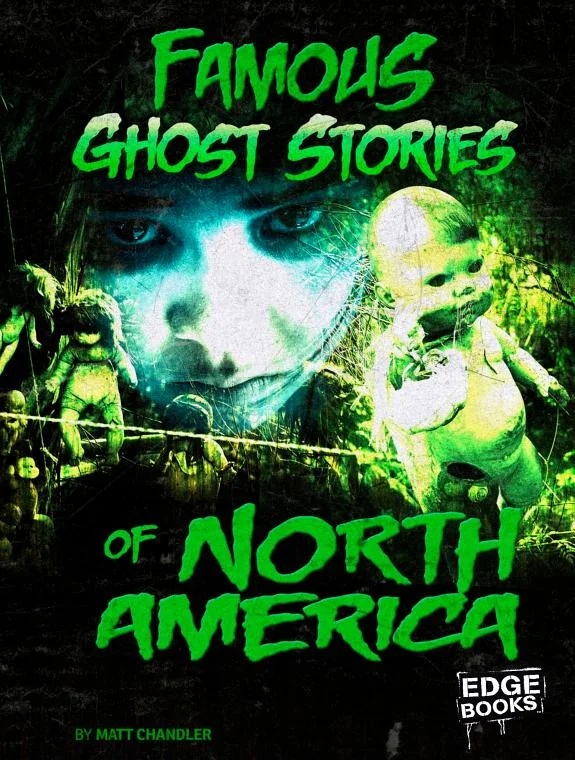
Famous Ghost Stories of North America
 73
73

Famous Ghost Stories of North America
Matt Chandler’s Famous Ghost Stories of North America offers a straightforward, if somewhat unadorned, collection of spectral tales. The strength lies in its breadth, covering a wide geographical spread of North American hauntings. However, the analysis sometimes feels superficial, like a brief nod to deeper cultural currents rather than a thorough examination. A particular passage detailing the alleged hauntings of the Eastern State Penitentiary in Philadelphia, while chilling, could have benefited from a more rigorous exploration of its historical context beyond the immediate spectral claims. The book is a competent overview, but lacks the incisive critical lens one might hope for in a work aiming for deeper esoteric insight. It serves as a competent primer for those new to the subject.
📝 Description
73
Matt Chandler's 2018 book collects spectral accounts from across North America.
Famous Ghost Stories of North America by Matt Chandler, published in 2018, compiles spectral accounts from across the continent. These narratives are treated not just as anecdotes but as cultural artifacts that reflect societal anxieties and beliefs. The book appeals to those interested in folklore, paranormal investigation, and American cultural history. It examines how societies confront the unknown through localized hauntings and apparitions.
Chandler situates these tales within the long tradition of ghost storytelling. He places them within the context of North American folklore, a field shaped by indigenous beliefs, colonial history, and immigration. The collection considers the continuing development of these stories in the modern era. A central idea is the 'haunting' as a manifestation of collective memory or trauma tied to specific places like old houses or battlefields. The work also touches on the psychology behind fear and belief in the supernatural.
This collection engages with the enduring human fascination with ghosts and the afterlife, a theme present in spiritualism and folklore traditions. It examines how spectral accounts function as a way for communities to process collective memory, trauma, and the unknown. By focusing on geographically specific hauntings, Chandler connects these stories to a broader exploration of place and memory, a concept found in traditions that imbue locations with spiritual or psychic significance. The book acknowledges the evolving nature of these beliefs in contemporary society.
💡 Why Read This Book?
• Gain an understanding of how specific North American locales, such as the aforementioned Eastern State Penitentiary, become focal points for spectral narratives, revealing local histories of distress or unresolved events. • Explore the cultural transmission of ghost stories from their indigenous roots and colonial origins through to modern interpretations, noting how societal fears evolve. • Discover specific types of apparitions and hauntings documented across the continent, providing concrete examples of paranormal folklore that can inform personal research or creative endeavors.
⭐ Reader Reviews
Honest opinions from readers who have explored this book.
❓ Frequently Asked Questions
What is the primary focus of Matt Chandler's Famous Ghost Stories of North America?
The book primarily focuses on recounting and exploring well-known ghost stories originating from various regions across North America, examining them as cultural phenomena.
Does the book offer new ghost stories or compile existing ones?
Chandler compiles and recounts existing, famous ghost stories, presenting them in a structured manner for readers interested in paranormal folklore and its cultural context.
What is the historical period covered by the ghost stories?
The stories span a wide range of periods, from colonial times and the 19th century to more contemporary accounts, reflecting the long history of spectral legends in North America.
Is this book suitable for academic study?
While not a strictly academic text, it provides a useful compendium of stories and touches on folklore and cultural history, making it a potential starting point for related research.
What kind of reader would most appreciate this book?
Readers interested in American folklore, paranormal accounts, local legends, and the cultural significance of ghost stories would find this compilation particularly engaging.
Does the book provide explanations for the reported phenomena?
The book generally presents the stories as they are told, exploring their cultural resonance rather than offering definitive scientific or supernatural explanations for the phenomena.
🔮 Key Themes & Symbolism
Localized Spectral Manifestations
The collection emphasizes how specific locations in North America become imprinted with spectral energy or memory. These are not abstract hauntings but are tied to places like the Eastern State Penitentiary or historical battlegrounds, suggesting that the geography itself retains traces of past events. Chandler explores how these sites act as focal points for supernatural narratives, often reflecting societal trauma, tragedy, or unresolved historical tensions.
Cultural Traces of the Past
Beyond mere tales of the uncanny, the book positions ghost stories as cultural artifacts that reflect the collective psyche of different eras and communities. The narratives serve as a lens through which to view historical anxieties, beliefs about death, and the process of memorialization. From colonial fears to post-industrial unease, the spectral figures represent persistent cultural narratives.
The Evolution of Folklore
Chandler traces how traditional ghost stories adapt and persist across generations and through different mediums. The book implicitly discusses the transition of these tales from oral tradition to print and now into digital forms, highlighting how the core elements of haunting often remain while the context shifts. This evolution shows the enduring human need to process the unknown.
Belief Systems and the Unexplained
The work looks at the varied belief systems that underpin North American ghost lore, acknowledging influences from indigenous spiritual practices, European folklore, and modern spiritualism. It examines how different cultures interpret and rationalize encounters with the spectral, showcasing the diverse ways people confront and integrate the unexplained into their worldview.
💬 Memorable Quotes
Direct passages from the work, attributed to the author.
“Hauntings often arise from places marked by significant human suffering or unresolved conflict.”
— This concept suggests that the spectral occurrences documented are not random but are intrinsically linked to historical events or emotional residues tied to specific geographical locations.
“The spectral figure can be seen as a lingering echo of a past tragedy.”
— This interpretation frames ghosts not as disembodied souls in the traditional sense, but as psychic imprints or energetic remnants of intense human experiences.
“Many North American ghost tales have roots in the folklore brought by early European settlers.”
— This points to the layered nature of North American supernatural lore, acknowledging the fusion of indigenous beliefs with the spectral traditions carried across the Atlantic.
“The landscape itself seems to hold memory, giving rise to persistent legends.”
— This highlights the idea that certain locations possess an inherent quality that makes them susceptible to paranormal phenomena, acting as a repository for historical events.
“Ghost stories function as a way for communities to process collective fears and historical traumas.”
— This interpretation views the recounting of spectral encounters as a form of communal catharsis, allowing societies to confront and integrate difficult aspects of their past.
🌙 Esoteric Significance
Tradition
This work fits within the broader tradition of folklore and comparative mythology, which often intersects with esoteric studies by examining shared archetypes and belief systems. While not explicitly Hermetic or Kabbalistic, it draws from the universal human fascination with the afterlife and the liminal spaces between worlds, a common thread in many esoteric lineages. It provides raw material for understanding how concepts of spirit, consciousness, and spiritual residue manifest in popular narratives.
Symbolism
Key symbols include the 'haunted house,' representing the psyche or the ancestral home burdened by past events; the 'phantom figure,' often an archetype of unresolved earthly ties or a karmic echo; and specific geographical locations, which act as symbolic anchors for collective memory or trauma. These elements function as archetypal representations of spiritual attachment, unfinished business, and the persistence of energy beyond physical death.
Modern Relevance
Contemporary practitioners of witchcraft, psychogeography, and even certain branches of parapsychology might find value in Chandler's work. The focus on place-based hauntings appeals to modern explorations of ley lines and earth energies, while the collection of narratives can serve as inspiration for ritual work or meditations aimed at understanding ancestral connections or localized spiritual dynamics.
👥 Who Should Read This Book
• Enthusiasts of North American folklore and local legends seeking a broad overview of documented spectral accounts. • Researchers interested in the cultural history of paranormal beliefs and how societal anxieties are reflected in ghost stories. • Individuals curious about the symbolic representations of death, memory, and the afterlife embedded within popular narratives.
📜 Historical Context
First published in 2018, Matt Chandler's compilation arrives in an era where paranormal investigation has become a mainstream media phenomenon, yet it engages with a tradition stretching back centuries. North American ghost stories have roots intertwined with indigenous spiritualism, the anxieties of colonial settlement, and the burgeoning spiritualist movements of the 19th century. Chandler’s work taps into this rich vein, presenting tales that reflect diverse cultural underpinnings. While the 2018 publication date places it long after the peak of Victorian spiritualism or the sensationalism of early 20th-century paranormal societies, it serves as a modern compendium. It indirectly engages with the legacy of folklorists like Vance Randolph, who meticulously documented Ozark superstitions, and the spectral accounts compiled by figures such as Charles Fort, who cataloged unexplained phenomena. The book’s reception, being a compilation, likely positioned it as accessible folklore rather than a text for rigorous academic debate.
📔 Journal Prompts
The spectral presence at Eastern State Penitentiary: what historical echoes might it embody?
Reflect on a geographical location that feels 'haunted' to you and why.
How do the ghost stories presented challenge or confirm your understanding of consciousness?
Consider the archetype of the 'phantom figure' in these narratives. What does it represent?
Analyze the cultural context of a specific ghost story and its relation to the era it emerged from.
🗂️ Glossary
Apparition
The visual manifestation of a ghost or spirit, typically perceived by observers as a distinct figure or form.
Haunting
The phenomenon of a place or object being persistently visited by a supernatural entity or exhibiting unexplained occurrences attributed to spectral presence.
Folklore
The traditional beliefs, customs, and stories of a community, passed through generations by word of mouth, encompassing legends, myths, and superstitions.
Spectral
Relating to or resembling a ghost or phantom; of or relating to specters.
Archetype
A recurring symbol, character, or pattern in literature and mythology that represents universal human experiences or concepts, often appearing in folklore.
Liminal Space
A transitional or in-between state or place, often associated with ambiguity, transition, and encounters with the supernatural or the unconscious.
Cultural Artifact
An object or product created by a society that provides insight into its beliefs, values, and practices, including stories and legends.
This book appears in 1 collection
🔮 Readers Also Liked
Browse all →








From the “Haunted Places” Collection
View all →





More Free Occult Philosophy Books
View all →