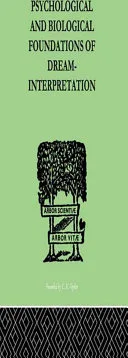
Psychological & Biological Foundations Of Dream-Interpretation
 78
78

Psychological & Biological Foundations Of Dream-Interpretation
Samuel Lowy’s "Psychological & Biological Foundations Of Dream-Interpretation" attempts a difficult feat: grounding the nebulous world of dreams in concrete biological and psychological processes. Published in 1942, the book is a product of its time, showcasing a neuropsychiatrist’s earnest effort to apply scientific rigor to dream analysis, moving away from purely symbolic readings. Lowy’s strength lies in his dedication to a psychobiological framework, suggesting dreams are not just random firings but are deeply connected to the dreamer's physical and mental state. He proposes that understanding the organism's total situation is key to unlocking dream meaning, a perspective that remains relevant. However, the book’s limitation is its inherent age; the neuropsychiatric understanding of 1942, while advanced for its era, has been significantly superseded by modern neuroscience. Certain interpretations may feel dated or incomplete to contemporary readers. A passage discussing the electrochemical processes influencing dream states, while ambitious for its time, highlights this gap between historical scientific understanding and current knowledge. Despite its age, the work offers a valuable historical perspective on the scientific study of dreams. Lowy's attempt to bridge psychology and biology provides a useful, albeit historical, lens for examining dream interpretation.
📝 Description
78
Samuel Lowy published Psychological & Biological Foundations Of Dream-Interpretation in 1942.
This 1942 volume by Samuel Lowy, a neuropsychiatrist, attempts a psychobiological approach to understanding dreams. Lowy sought to connect psychological theories with biological processes, moving beyond purely symbolic interpretations. He aimed to establish a systematic method for analyzing dream content based on observable neurological and psychological functions.
The book is aimed at readers with an interest in the scientific study of dreams, particularly those familiar with psychology and neuropsychiatry. It will appeal to scholars and students of psychology interested in early attempts at a psychobiological framework for dream analysis. Those curious about the evolution of dream theory, especially the shift from early psychoanalytic models to more empirically-oriented methods, will find value here. It is for readers who appreciate rigorous scientific inquiry into the human mind.
Published in 1942, Lowy's work emerged when dream interpretation was largely defined by psychoanalytic traditions like Freud's and Jung's. His psychobiological approach offered a counterpoint, emphasizing physiological and neurological underpinnings. Practicing in Czechoslovakia, Lowy engaged with the scientific currents of his time, seeking to integrate emerging biological understanding with psychological theory. This effort to ground dream states in observable science contrasts with more purely metaphysical or symbolic interpretations common in some esoteric circles.
💡 Why Read This Book?
• Gain insight into the historical psychobiological approach to dreams, specifically Lowy’s 1942 thesis, which connects dream content to the organism's total biological and psychological situation. • Understand the scientific milieu of mid-20th century Czechoslovakia, where Lowy, a neuropsychiatrist, sought to integrate dream analysis with emerging biological sciences. • Explore the evolution of dream interpretation by examining Lowy's critique of purely symbolic approaches and his emphasis on the physiological underpinnings of dream states.
⭐ Reader Reviews
Honest opinions from readers who have explored this book.
❓ Frequently Asked Questions
What is the primary focus of Samuel Lowy's "Psychological & Biological Foundations Of Dream-Interpretation"?
The book's primary focus is a psychobiological approach to understanding dreams and their interpretation. Lowy, a neuropsychiatrist, sought to connect dream content and purpose to the biological functioning of the brain and the psychological state of the dreamer.
When was "Psychological & Biological Foundations Of Dream-Interpretation" first published?
The book was first published in 1942 by the author himself, Samuel Lowy.
What scientific background did the author, Samuel Lowy, have?
Samuel Lowy was a neuropsychiatrist practicing in Czechoslovakia during the mid-20th century, which informed his scientific and biological approach to dream interpretation.
How does Lowy's approach to dreams differ from other schools of thought?
Lowy's approach emphasizes a psychobiological perspective, integrating neurological and psychological factors. This contrasts with purely symbolic or psychoanalytic interpretations that were prevalent during his time.
Is this book considered a primary source for modern dream research?
While not a primary source for modern research due to advances in neuroscience, it serves as a valuable historical document illustrating the development of scientific thought on dreams in the mid-20th century.
What does the 'Volume XX' designation signify?
The 'Volume XX of thirty-eight' designation indicates that this book is part of a larger series, specifically the General Psychology series, placing it within a broader academic context of psychological studies.
🔮 Key Themes & Symbolism
Psychobiological Dream Framework
Lowy's core contribution is the psychobiological framework for dream analysis. He argues against purely symbolic readings, instead proposing that dreams are deeply intertwined with the dreamer's biological state and psychological condition. This perspective seeks to understand dreams as a function of the organism's total situation, integrating neurological processes with conscious and unconscious psychological activity. The aim is to uncover the purpose and meaning of dreams by examining their roots in both the physical body and the mind's complex workings, reflecting a scientific inquiry into the nature of consciousness.
The Purpose of Dreams
The book probes the function and purpose of dreaming within the broader context of human experience. Lowy suggests that dreams are not arbitrary but serve a vital role in the organism's adaptation and integration. By analyzing dream content through a psychobiological lens, he aims to reveal how dreams contribute to maintaining equilibrium, processing experiences, and potentially preparing the individual for future challenges. This functional perspective moves beyond mere interpretation of symbols to understanding the underlying biological and psychological necessity of the dream state.
Scientific Dream Interpretation
Lowy advocates for a scientific methodology in dream interpretation, moving away from anecdotal or purely intuitive methods prevalent in his era. His background as a neuropsychiatrist in mid-20th century Czechoslovakia informs his commitment to empirical observation and biological correlates. He seeks to establish dream interpretation as a verifiable scientific discipline by linking subjective dream experiences to objective biological and psychological data. This approach represents an early attempt to bridge the gap between subjective mental life and the objective sciences.
Historical Context of Dream Study
This work offers a valuable glimpse into the field of dream study around 1942. It positions itself within the broader discourse of psychology and psychiatry, particularly in relation to the burgeoning understanding of the brain and nervous system. By presenting a psychobiological alternative, Lowy implicitly engages with dominant theories of the time, such as psychoanalysis, suggesting a need for more biologically grounded explanations. Its publication in Czechoslovakia also places it within a specific intellectual and geopolitical context of mid-20th century Europe.
💬 Memorable Quotes
Direct passages from the work, attributed to the author.
“The organism's total biological and psychological situation constitutes the basis for dream interpretation.”
— This statement expresses Lowy's central thesis, emphasizing that understanding a dream requires considering the dreamer's complete physical and mental state, not just isolated symbols or events.
“Dreams are not merely symbolic messages but phenomena rooted in the biological functioning of the brain.”
— Here, Lowy differentiates his approach from purely symbolic or psychoanalytic methods, highlighting his focus on the neurological and physiological basis of the dream experience.
“The science of dreams must integrate psychological theory with biological observation.”
— This reflects Lowy's ambition to bridge two distinct fields, advocating for a unified scientific approach to understanding the complex nature of dreaming.
“Dreams serve a purpose related to the organism's adaptation and integration.”
— This interpretation suggests that dreams are functional, playing a role in how individuals process experiences and maintain psychological and biological balance.
“Interpretation requires analyzing the connection between waking life, physiological states, and dream imagery.”
— Lowy directs the interpreter to look for concrete links between the dreamer's daily experiences, their physical condition, and the content that emerges during sleep.
🌙 Esoteric Significance
Tradition
While not explicitly aligned with a single esoteric lineage like Hermeticism or Kabbalah, Lowy's work touches upon the esoteric interest in the nature of consciousness and the subconscious. His psychobiological approach can be seen as an attempt to rationalize and scientifically validate aspects of the inner life that esoteric traditions have long explored through symbolic language and altered states of consciousness. It represents a mid-20th-century effort to bridge the empirical scientific world with the subjective experience of the psyche, a common endeavor in esoteric-adjacent intellectual movements.
Symbolism
Lowy's focus on the biological and psychological foundations shifts away from traditional dream symbolism. However, the 'organism' itself becomes a key motif – a complex interplay of biological drives and psychological states. The 'dream state' can be viewed as a symbolic representation of the psyche's internal dialogue. Lowy’s work implicitly suggests that the true 'symbolism' lies not in arbitrary images but in how the brain's biological processes manifest as subjective experience, reflecting the dreamer's lived reality and internal landscape.
Modern Relevance
Contemporary fields such as neuropsychoanalysis and consciousness studies, which seek to integrate neuroscientific findings with psychodynamic theories, echo Lowy's foundational psychobiological approach. Thinkers exploring the evolutionary and adaptive functions of dreams also draw on the functionalist perspective he championed. While modern neuroscience has advanced significantly beyond the concepts available in 1942, Lowy's work remains relevant for its historical perspective on the scientific study of dreams and its early attempt to bridge subjective experience with objective biological inquiry.
👥 Who Should Read This Book
• Students of psychology and neuropsychiatry interested in the historical development of dream theory and early scientific approaches to the subconscious. • Researchers in consciousness studies seeking to understand the intersection of biology, psychology, and subjective experience in the mid-20th century. • Individuals fascinated by the scientific study of dreams who appreciate rigorous, though historically situated, attempts to clarify the dream state.
📜 Historical Context
Published in 1942, "Psychological & Biological Foundations Of Dream-Interpretation" emerged from Samuel Lowy's work as a neuropsychiatrist in Czechoslovakia. This era was a crucible for psychological thought, heavily influenced by Freudian psychoanalysis and the burgeoning field of analytical psychology pioneered by Carl Jung. Lowy's psychobiological approach offered a distinct perspective, attempting to anchor dream interpretation in the observable realities of brain function and physiological states, a move that contrasted with the more symbolic and interpretative methods favored by psychoanalysts. The mid-20th century saw a general scientific trend towards understanding mental phenomena through biological mechanisms, influenced by figures like Ivan Pavlov. Lowy's work can be seen as part of this broader intellectual current, seeking to bring the study of dreams into the area of empirical science, distinct from purely philosophical or speculative inquiries.
📔 Journal Prompts
The organism's total biological and psychological situation: Reflect on how your current physical health and emotional state might be influencing your dreams.
The purpose of dreams: Consider if your dreams seem to be processing recent events or preparing you for future challenges.
Connecting waking life and dream imagery: Identify a specific element from your waking life and explore its potential manifestation in a recent dream.
The scientific study of dreams: How does Lowy's psychobiological approach differ from other dream interpretation methods you are familiar with?
Lowy's neuropsychiatric perspective: Analyze how a specific dream might be explained by considering neurological functions and psychological states simultaneously.
🗂️ Glossary
Psychobiological Approach
A method of studying psychological phenomena, such as dreams, by integrating insights from both psychology (mind, behavior, emotions) and biology (brain structure, nervous system, physiological processes).
Dream Interpretation
The process of analyzing the content and meaning of dreams, moving beyond subjective symbolism to consider underlying biological and psychological factors.
Organism's Total Situation
The comprehensive state of an individual, encompassing all aspects of their biological functioning and psychological condition at a given time.
Neuropyschiatry
A medical specialty that combines neurology (study of the nervous system) and psychiatry (study of mental disorders), focusing on conditions with both neurological and psychological components.
Adaptation and Integration
Processes by which an organism adjusts to its environment and maintains internal balance, including psychological and physiological homeostasis.
Biological Functioning
The operations and processes carried out by the body's biological systems, particularly the brain and nervous system, relevant to mental states and experiences.
General Psychology Series
An academic publication series that includes various volumes addressing different topics within the broad field of psychology, indicating this book's place within a structured academic context.