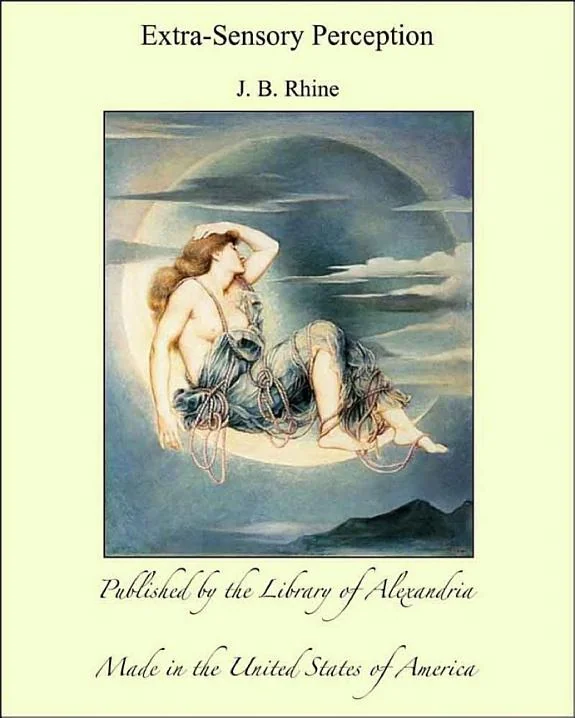
Extra-sensory Perception
 83
83

Extra-sensory Perception
Rhine's "Extra-sensory Perception" remains a pivotal work, not for its definitive proof, but for its earnest attempt to systematize the study of psi. The meticulous detail in describing experiments, particularly the card-guessing trials with Zener cards, showcases a dedication to scientific rigor that was, and often still is, rare in this field. A particular strength lies in the detailed statistical breakdowns and the examination of outlier results, which, while potentially open to interpretation, demonstrate a commitment to empirical data. However, the book's limitation is its inherent challenge: the elusive nature of psi phenomena and the ongoing debate regarding the interpretation of statistical significance versus absolute proof. Rhine's discussion of Hubert Pearce's performance, while compelling, is also emblematic of the difficulties in definitively isolating psi from other factors. It is a foundational text, not a final word, but essential for understanding the trajectory of parapsychological research. This book stands as a monument to the scientific pursuit of the anomalous.
📝 Description
83
Joseph Banks Rhine published "Extra-sensory Perception" in 1964, detailing his Duke University experiments.
Published in 1964, Joseph Banks Rhine's "Extra-sensory Perception" catalogs experimental investigations into psychic phenomena. The book presents extensive research conducted at Duke University, focusing on empirical evidence for telepathy, clairvoyance, and precognition. Rhine meticulously outlines experimental designs, statistical analyses, and the results from numerous participants, including notable individuals like Hubert Pearce.
This volume is directed towards students of parapsychology, psychology, and the philosophy of mind. It will appeal to researchers and academics interested in the historical development of empirical psi research. Individuals curious about the scientific study of consciousness, anomalous experiences, and the potential limits of conventional understanding will find Rhine's methodology and findings particularly relevant. It also addresses skeptics who wish to engage with the evidence from one of its primary early investigators.
The book emerged from Rhine's work at Duke University, which began in the early 1930s. This era saw other figures exploring precognition and psychical research. Rhine's approach, however, distinguished itself through its emphasis on laboratory controls and statistical validation. He sought to move psi research from anecdotal accounts to quantifiable data, setting a precedent for future parapsychological study.
Rhine's work on "Extra-sensory Perception" emerged from a spiritualist and psychical research tradition that gained momentum in the late 19th and early 20th centuries. This period saw a concerted effort to apply scientific methods to investigate phenomena previously relegated to folklore or religious belief. Authors like J.W. Dunne and organizations like the Society for Psychical Research were examining precognition and other psychic abilities. Rhine’s contribution was to systematically institutionalize this research within a university setting, emphasizing rigorous experimental design and statistical proof, aiming to legitimize the study of psi under the umbrella of parapsychology.
💡 Why Read This Book?
• Learn about the foundational Zener card experiments, a specific methodology developed by Rhine in the 1930s for testing extrasensory perception, offering a concrete historical example of psi research. • Understand the concept of "displaced awareness," a term Rhine uses to describe perceptions of events distant in space or time, providing a specific framework for anomalous perception. • Gain insight into the statistical challenges of parapsychology by examining Rhine's detailed analysis of card-guessing results, showcasing the empirical approach taken in the early 20th century.
⭐ Reader Reviews
Honest opinions from readers who have explored this book.
❓ Frequently Asked Questions
What were the primary types of psychic abilities Rhine investigated in "Extra-sensory Perception"?
Rhine primarily investigated telepathy (mind-to-mind communication), clairvoyance (perception of distant objects or events), and precognition (knowledge of future events). His work aimed to provide empirical evidence for these phenomena through controlled experiments.
What is the significance of Zener cards in Rhine's research?
Zener cards, featuring five simple symbols (star, circle, square, cross, waves), were a key tool in Rhine's experiments. They provided a standardized method for testing clairvoyance and telepathy by allowing for objective scoring and statistical analysis of guessing accuracy.
When was Joseph Banks Rhine's "Extra-sensory Perception" first published?
The book "Extra-sensory Perception" by Joseph Banks Rhine was first published in 1964. However, it consolidated research that had been ongoing for many years prior, particularly at Duke University.
What is "psi-gamma" as defined by Rhine?
"Psi-gamma" is a term coined by J.B. Rhine to encompass extrasensory perception, including telepathy, clairvoyance, and precognition. It represents the broad category of psychic abilities related to perception beyond the known senses.
Did Rhine's work face any criticism or controversy?
Yes, Rhine's work, including "Extra-sensory Perception," faced significant criticism from the scientific establishment. Critics questioned his experimental controls, statistical interpretations, and the potential for fraud or sensory leakage.
What role did Duke University play in Rhine's research?
Duke University was central to Rhine's research on extrasensory perception. He established the Parapsychology Laboratory there in the early 1930s, conducting extensive experiments and publishing his findings, including those detailed in this book.
🔮 Key Themes & Symbolism
Empirical Psi Research
This work is a core part of empirical parapsychology, attempting to validate psychic phenomena through rigorous scientific methodology. Rhine details numerous experiments, statistical analyses, and controls designed to isolate extrasensory perception (ESP) from chance and fraud. The focus is on quantifiable results from studies conducted primarily at Duke University, moving the discussion of telepathy, clairvoyance, and precognition from anecdote to laboratory observation. It represents a critical attempt to bridge the gap between the subjective experience of psi and objective scientific inquiry.
Methodology and Statistics
Central to "Extra-sensory Perception" is Rhine's meticulous approach to experimental design and statistical evaluation. He introduced standardized tests, most famously using Zener cards, to measure the probability of success purely by chance. The book elaborates on calculating deviation-from-chance, assessing individual subject performance, and accounting for potential confounding factors. This emphasis on statistical proof was intended to lend scientific credibility to the study of psi and remains a key aspect of parapsychological research methodology.
Individual Psi Capacity
Rhine's research highlighted the variability in psychic abilities among individuals. The book documents the performances of various participants, identifying certain individuals who consistently achieved results significantly above chance levels. Concepts like "displaced awareness" and the careful observation of subject states (e.g., concentration, fatigue) underscore the idea that psi may be an innate but not always accessible human capacity. This focus on individual differences and the conditions influencing psi became a significant area of study.
The Nature of Consciousness
By investigating phenomena that appear to transcend known physical laws, Rhine's work implicitly challenges conventional understandings of consciousness and its relationship to the physical world. The possibility of direct perception without sensory input or knowledge of future events suggests that consciousness might possess properties not fully explained by current neurobiological models. The book opens avenues for exploring consciousness as a fundamental aspect of reality, capable of interacting with the environment in non-local ways.
💬 Memorable Quotes
Direct passages from the work, attributed to the author.
“The results of the present series of experiments do not, in my opinion, leave room for doubt that the subjects were able to know the cards in the packs.”
— This statement reflects Rhine's strong conviction based on his experimental findings. It suggests that the statistical deviations observed were so significant that they could not be attributed to chance or ordinary sensory perception, leading him to conclude that extrasensory perception was at play.
“Displaced awareness is the perception of an object or event that is not present to the senses.”
— This definition highlights a core concept in Rhine's work. It describes the experience of knowing something without any physical sensory contact, encompassing both spatial separation (clairvoyance) and temporal separation (precognition), pointing to a perception that bypasses conventional means.
“The experimenter effect is a potential influence on results by the experimenter.”
— This interpretation points to a crucial consideration in psi research. Rhine acknowledged that the experimenter's expectations, unconscious biases, or even their presence could inadvertently affect the outcome of experiments, a factor that requires careful management in study design.
💡 Key Ideas
Editorial paraphrase of the work's core concepts — not direct quotes.
The statistical evidence for the existence of ESP is, I believe, overwhelming.
This paraphrased concept captures Rhine's persistent belief in the empirical basis for ESP. He felt that the cumulative data from his numerous experiments, analyzed statistically, provided a robust case for the reality of psychic abilities, even in the face of skepticism.
The work explores precognition, the foreknowledge of future events.
This statement summarizes a key area of Rhine's investigation. It indicates that the book examines experiments and theories concerning the human capacity to perceive or know future occurrences before they happen, a phenomenon that challenges linear causality.
🌙 Esoteric Significance
Tradition
While Rhine approached his subject from a strictly scientific, empirical standpoint, his work touches upon themes explored in various esoteric traditions, particularly those concerning consciousness and non-local awareness. It can be seen as an attempt to scientifically validate phenomena that mystics, seers, and occultists have long described. The work does not align with a specific lineage like Hermeticism or Kabbalah but rather seeks to provide an objective framework for experiences that these traditions often interpret through symbolic or spiritual lenses.
Symbolism
The primary "symbol" in Rhine's work is the Zener card itself, with its simple geometric shapes (star, circle, square, cross, waves). These were chosen for their distinctiveness and ease of identification, serving as standardized targets for extrasensory perception. Beyond the cards, the concept of "displaced awareness" acts as a symbolic representation of consciousness transcending physical limitations of space and time, a motif resonant with mystical experiences of unity or timelessness.
Modern Relevance
Rhine's empirical approach continues to influence contemporary parapsychology and consciousness studies. Researchers today build upon his methodologies, refining experimental designs and statistical analyses. Thinkers exploring extended mind theories, quantum consciousness, and the nature of intuition often reference Rhine's foundational work. His legacy is evident in ongoing investigations into telepathy, precognition, and the potential for consciousness to influence physical reality, keeping alive the question of psi's place in a scientific worldview.
👥 Who Should Read This Book
• Students of parapsychology seeking to understand the historical development of empirical psi research and its foundational methodologies. • Skeptics and open-minded inquirers interested in examining the scientific evidence presented for extrasensory perception and psychical phenomena. • Researchers in psychology and cognitive science looking to explore alternative models of consciousness and perception beyond conventional sensory input.
📜 Historical Context
Joseph Banks Rhine's "Extra-sensory Perception," first published in 1964, emerged from decades of dedicated research initiated in the early 1930s at Duke University. This period was marked by a growing interest in the scientific study of the paranormal, influenced by organizations like the Society for Psychical Research and thinkers such as J.W. Dunne, who explored precognition. Rhine's distinct contribution was his rigorous application of laboratory controls and statistical analysis, aiming to elevate parapsychology to a respected scientific discipline. His methods, particularly the use of Zener cards for ESP testing, set a precedent for empirical psi research. While Rhine sought validation, his work faced considerable skepticism from mainstream science, with critics often focusing on methodological flaws or alternative explanations, a debate that continued through the mid-20th century.
📔 Journal Prompts
The concept of displaced awareness and its implications for understanding perception.
Rhine's statistical methods for evaluating card-guessing experiments.
Personal experiences that might align with telepathy or precognition.
The challenges of establishing controls in parapsychological research.
The potential impact of the experimenter effect on subjective experiences.
🗂️ Glossary
Extrasensory Perception (ESP)
The purported ability to acquire information directly through means other than the recognized sensory channels, such as telepathy, clairvoyance, or precognition.
Psi-gamma
A classification term used by J.B. Rhine to denote extrasensory perception, encompassing telepathy, clairvoyance, and precognition.
Precognition
The ability to perceive or know future events before they occur, a form of ESP that challenges linear concepts of time.
Clairvoyance
The alleged ability to perceive objects or events that are not accessible to the senses, typically due to spatial separation.
Telepathy
The direct transmission of thoughts or feelings from one person to another without the use of known sensory channels.
Zener Cards
A deck of 25 cards, each featuring one of five simple symbols, used by J.B. Rhine and others in experiments to test for ESP due to their statistical predictability.
Displaced Awareness
A concept describing the perception of an object or event that is not directly present to the observer's physical senses, often due to distance in space or time.
This book appears in 1 collection
🔮 Readers Also Liked
Browse all →









From the “Extrasensory Perception” Collection
View all →








More Free Occult Philosophy Books
View all →