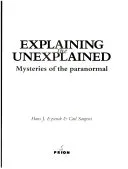
Explaining the Unexplained
 77
77

Explaining the Unexplained
Hans Jurgen Eysenck and Carl Sargent’s 'Explaining the Unexplained' tackles the persistent human fascination with phenomena that elude standard scientific frameworks. The book's strength lies in its methodical approach, dissecting claims of psychic abilities with the tools of empirical psychology and statistical reasoning. Rather than dismissing the paranormal outright, the authors meticulously examine the evidence, particularly in chapters discussing ESP and psychokinesis, revealing how experimental design flaws and psychological predispositions can create the illusion of the extraordinary. A notable limitation, however, is the reliance on research that, by today's standards, might be considered dated, potentially overlooking more recent methodological advancements or theoretical shifts in parapsychology. The discussion around the Ganzfeld experiments, for instance, highlights the challenges of replicability that continue to plague the field. Ultimately, the work serves as a valuable, if somewhat historical, primer on applying critical analysis to the unexplained, urging readers to look for concrete evidence before accepting extraordinary claims.
📝 Description
77
Hans Jurgen Eysenck and Carl Sargent's 1993 work examines paranormal phenomena with psychological and statistical tools.
Published in 1993, 'Explaining the Unexplained' scrutinizes alleged paranormal phenomena, including ESP, psychokinesis, and precognition. Eysenck and Sargent approach these subjects through a lens of empirical investigation and critical analysis. They draw upon existing research to propose frameworks for understanding claims that often fall outside mainstream scientific acceptance.
The book is for readers interested in the connections between psychology, parapsychology, and critical thought. It appeals to those who are skeptical yet open-minded, seeking rational explanations for experiences that defy simple categorization. Students of psychology, researchers of fringe sciences, and anyone curious about belief and perception will find this work relevant.
This study appeared when parapsychology was more openly discussed in academic circles, though often on the fringes. The late 20th century saw ongoing research into anomalous experiences, influenced by figures like J.B. Rhine. Eysenck and Sargent's contribution engaged with this discourse, contrasting empirical findings with prevailing scientific skepticism.
This book engages with the tradition of investigating anomalous phenomena through scientific methods, a path taken by figures like J.B. Rhine. It sits within a lineage that seeks to understand purported psychic abilities and supernatural experiences not through faith or mysticism alone, but through observation and statistical analysis. While acknowledging the challenges and skepticism surrounding parapsychology, Eysenck and Sargent contribute to a discourse that attempts to bridge the gap between the unexplained and conventional understanding, analyzing belief systems and experimental rigor.
💡 Why Read This Book?
• You will learn how statistical artifacts and cognitive biases, as detailed in the book's analysis of ESP research, can create the illusion of paranormal activity, offering a critical lens for evaluating anecdotal evidence. • You will gain an understanding of the experimental challenges in parapsychology, particularly concerning the rigorous controls needed to avoid confounding variables, as discussed in relation to psychokinesis studies. • You will encounter a systematic, research-based approach to phenomena often dismissed or sensationalized, providing a framework for critical inquiry into topics like precognition that transcends mere belief or disbelief.
⭐ Reader Reviews
Honest opinions from readers who have explored this book.
❓ Frequently Asked Questions
What is the primary goal of 'Explaining the Unexplained' by Eysenck and Sargent?
The book aims to critically examine paranormal phenomena using psychological and statistical methodologies. It seeks to explain reported supernatural experiences through empirical research and analysis, rather than outright dismissal, investigating claims of ESP and psychokinesis.
When was 'Explaining the Unexplained' first published, and who are the authors?
'Explaining the Unexplained' was first published in 1993. The authors are Hans Jurgen Eysenck, a prominent psychologist known for his work on personality and intelligence, and Carl Sargent.
Does the book argue that paranormal phenomena are definitively false?
No, the book does not definitively dismiss paranormal phenomena. Instead, it employs critical analysis and empirical investigation to explore potential explanations, including psychological factors and statistical anomalies, while acknowledging the difficulties in proving or disproving such claims.
What kind of evidence does the book rely on for its arguments?
The work draws upon existing psychological research, statistical data, and experimental studies related to parapsychology. It scrutinizes methodologies and findings from research into ESP, precognition, and psychokinesis.
Is 'Explaining the Unexplained' suitable for someone with no background in psychology?
While it delves into psychological and statistical concepts, the book is written to be accessible to a general audience interested in the topic. Readers seeking rational explanations for the unexplained will find its approach informative.
What are some of the key paranormal subjects discussed in the book?
The book addresses phenomena such as extrasensory perception (ESP), psychokinesis (PK), and precognition. It examines the scientific and psychological frameworks used to study these alleged abilities.
🔮 Key Themes & Symbolism
Psychology of Belief
The work meticulously dissects the psychological mechanisms that contribute to belief in the paranormal. It explores how cognitive biases, such as confirmation bias and the tendency to perceive patterns where none exist, can lead individuals to interpret everyday occurrences as evidence of supernatural forces. The authors examine the role of expectation and suggestion in shaping perceptions of anomalous events, offering a grounded perspective on why certain phenomena gain traction despite a lack of empirical support. This theme underpins the book's broader objective: to understand the human element in the discourse of the unexplained.
Statistical Anomalies in Research
A significant focus is placed on the statistical interpretation of parapsychological data. Eysenck and Sargent scrutinize experimental results, highlighting instances where findings that appear to support paranormal claims can be attributed to statistical artifacts, methodological flaws, or chance variation. The book emphasizes the importance of rigorous statistical analysis and the potential for misinterpretation when data is not handled with appropriate scientific caution. This theme underscores the authors' commitment to empirical rigor in evaluating evidence for phenomena like ESP.
Methodological Challenges in Parapsychology
The book addresses the inherent difficulties in conducting scientific research on subjective and often elusive phenomena. It details the challenges of controlling variables, ensuring replicability, and avoiding experimenter effects when investigating claims of ESP or psychokinesis. The authors discuss specific experimental paradigms, such as those used in Ganzfeld experiments, and critically evaluate their strengths and weaknesses. This exploration provides insight into why parapsychology has struggled to gain widespread acceptance within mainstream science.
Empirical Investigation of Psychic Claims
Fundamentally, , 'Explaining the Unexplained' advocates for an empirical approach to understanding supposed psychic abilities. Rather than relying on anecdotal evidence or theoretical speculation, the authors study the existing body of research on topics like precognition and telepathy. They apply principles of psychology and statistics to assess the validity of experimental findings, seeking naturalistic explanations before resorting to supernatural ones. This theme champions a scientific mindset when confronting the extraordinary.
💬 Memorable Quotes
Direct passages from the work, attributed to the author.
“The belief in ghosts, witches, and other supernatural phenomena is widespread, yet the evidence for them is often anecdotal and unconvincing.”
— This statement reflects the authors' critical stance, acknowledging the prevalence of supernatural beliefs while immediately questioning the quality of supporting evidence. It sets the stage for their empirical approach to explaining such phenomena.
“Many reported instances of telepathy or clairvoyance can be explained by coincidence, suggestion, or faulty memory.”
— This interpretation highlights the book's focus on naturalistic explanations for paranormal experiences. It suggests that psychological factors and statistical probabilities are often overlooked in favor of supernatural attributions.
“Experimental parapsychology faces significant hurdles in demonstrating replicable effects under controlled conditions.”
— This interpretation points to the core methodological difficulties discussed in the book. It emphasizes the scientific challenges in validating psychic phenomena due to issues like reproducibility and control.
“Statistical analysis is crucial for distinguishing genuine effects from chance variations in paranormal research.”
— This interpretation underscores the importance of quantitative methods in the book. It signifies the authors' belief that rigorous statistical evaluation is essential for making valid claims in parapsychology.
💡 Key Ideas
Editorial paraphrase of the work's core concepts — not direct quotes.
The human mind is prone to seeing patterns and meaning, even in random occurrences.
This paraphrase captures the authors' exploration of cognitive biases. It suggests that our innate tendency to find order can lead us to perceive paranormal activity where only chance or natural processes are at play.
🌙 Esoteric Significance
Tradition
While not strictly adhering to a single esoteric lineage, the work engages with phenomena often explored in occult and mystical traditions, such as telepathy and precognition. It approaches these subjects from a psychological and scientific perspective, seeking to clarify them rather than embed them within established magical or spiritual frameworks. It departs from traditional esotericism by prioritizing empirical evidence and statistical analysis over subjective experience or revealed knowledge, acting as a bridge between the unexplained and rational inquiry.
Symbolism
The book itself doesn't heavily rely on traditional esoteric symbolism. However, the phenomena it discusses—ESP, psychokinesis, precognition—can be seen as symbolic representations of consciousness transcending physical limitations. If interpreted esoterically, these concepts might symbolize deeper connections within a universal consciousness or latent human potentials often explored in Hermeticism's focus on the microcosm reflecting the macrocosm. The statistical charts and experimental data presented can be viewed as a modern, secular form of 'reading the signs' or 'interpreting omens' from the universe.
Modern Relevance
Contemporary thinkers and researchers in areas like cognitive science, consciousness studies, and even certain branches of critical psychology continue to engage with the questions raised by Eysenck and Sargent. The book's emphasis on critical thinking, statistical rigor, and understanding cognitive biases remains highly relevant for evaluating claims of extraordinary experiences, whether they originate from purported psychic phenomena, altered states of consciousness, or even sophisticated deceptions in the digital age. It informs discussions on pseudoscience and evidence-based reasoning.
👥 Who Should Read This Book
• Skeptical inquirers interested in the scientific study of paranormal claims, who seek to understand the psychological and statistical factors that might explain phenomena like ESP and precognition. • Students of psychology and parapsychology looking for a critical analysis of experimental methodologies and the challenges of researching anomalous experiences. • Readers curious about the history of scientific engagement with the unexplained, particularly concerning research conducted in the late 20th century and its intellectual context.
📜 Historical Context
Published in 1993, 'Explaining the Unexplained' emerged during a period of continued, albeit often fringe, academic interest in parapsychology. The late 20th century saw researchers like J.B. Rhine and later figures attempting to legitimize the study of psychic phenomena through empirical methods. This era was marked by debate, with skeptics often citing methodological flaws and lack of replicability, while proponents pointed to statistical anomalies in experiments. Eysenck and Sargent's work engaged directly with this tension, situating itself within a broader context of scientific psychology grappling with phenomena that defied easy categorization. Key contemporaries included figures like James Randi, a prominent skeptic known for debunking paranormal claims, and researchers within parapsychological associations who continued to publish findings in journals like the Journal of Parapsychology. The book's reception reflected the ongoing polarization: appreciated by those seeking rational explanations, yet viewed with caution by both mainstream scientists and staunch believers in the paranormal.
📔 Journal Prompts
The psychological tendency to perceive patterns in random data: how might this influence personal beliefs about unexplained events?
Experimental design flaws in parapsychology: identify a potential bias in a personal belief and how it could be tested objectively.
The concept of statistical significance in relation to psychic phenomena: reflect on a time when chance might have been mistaken for something more.
Critical evaluation of anecdotal evidence: consider a personal experience that seemed extraordinary and analyze it through the lens of cognitive biases.
The demarcation problem between science and pseudoscience: how does the book's approach to ESP inform your understanding of this boundary?
🗂️ Glossary
ESP (Extrasensory Perception)
A hypothetical ability to perceive information not gained through the recognized physical senses. This includes telepathy (mind-to-mind communication), clairvoyance (perceiving distant objects or events), and precognition (knowing future events).
Psychokinesis (PK)
The purported ability to influence physical objects or systems with the mind alone, without direct physical contact. Also known as telekinesis.
Precognition
The claimed ability to perceive or predict future events. This is considered a form of extrasensory perception (ESP) that operates outside the normal flow of time.
Ganzfeld Experiments
A series of experiments designed to test for telepathic ability, often involving a 'sender' concentrating on an image or object and a 'receiver' in a state of sensory deprivation, attempting to perceive the target.
Confirmation Bias
The tendency to search for, interpret, favor, and recall information in a way that confirms one's pre-existing beliefs or hypotheses, while giving disproportionately less consideration to alternative possibilities.
Statistical Artifact
An apparent effect or pattern in data that is not due to the phenomenon being studied, but rather to errors in the experimental design, data collection, or analysis.
Replicability
The ability of an experiment or study to be reproduced by independent researchers, yielding similar results. It is a core part of scientific validation.