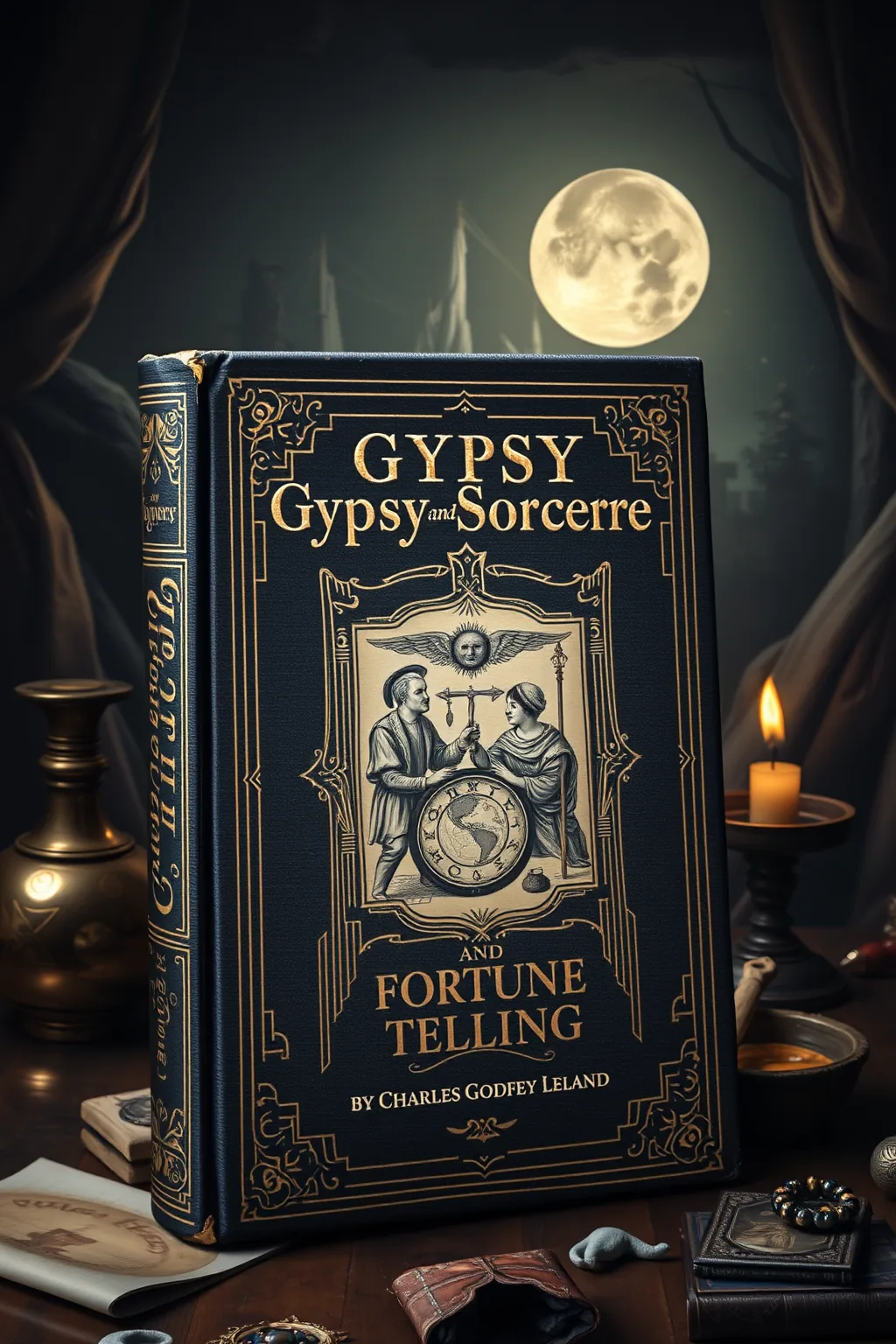
Gypsy Sorcery and Fortune Telling
 82
82

Gypsy Sorcery and Fortune Telling
Charles Godfrey Leland's 'Gypsy Sorcery and Fortune Telling' is a fascinating, if somewhat dated, compendium of Romani folk magic. Leland's dedication to documenting these practices in the late 19th century is commendable, providing a window into a world rarely captured with such detail. The strength of the book lies in its ethnographic approach; it presents spells, charms, and divination methods with a directness that feels remarkably authentic. However, the work is not without its limitations. Leland's perspective is undeniably that of an outsider, and his interpretations can sometimes reflect the biases of his time and culture. For instance, his discussion of certain practices, while informative, lacks the nuanced understanding of cultural context that modern anthropology would demand. A notable passage details the use of specific herbs in protective charms, illustrating the tangible, material basis of much Romani sorcery. Despite its historical distance, the book offers a valuable, unvarnished glimpse into a rich magical tradition, though it should be read with an awareness of its historical positioning. It remains a significant, albeit imperfect, resource for understanding historical folk magic.
📝 Description
82
Charles Godfrey Leland published 'Gypsy Sorcery and Fortune Telling' in 1891, documenting Romani folk magic.
First released in 1891, Charles Godfrey Leland's 'Gypsy Sorcery and Fortune Telling' details Romani folk magic and divination. This book is not a theoretical study but a collection of observed rituals, spells, charms, and methods for foretelling the future, gathered directly from Romani people. Leland, an American folklorist, spent significant time with the Romani, aiming to record their traditions before they changed. The work provides a close look at the daily magical practices of a community often on the margins of society. It details specific practices like the use of dice, cards, and other divinatory tools. The book also touches on the creation of amulets and protective charms.
This volume is suited for those studying folklore, comparative religion, and historical occultism. It will appeal to readers interested in the practical aspects of magical beliefs and the anthropological study of hidden traditions. Individuals looking for direct accounts of folk practices, especially those linked to Romani culture, will find this a useful reference. Readers who value detailed ethnographic accounts and primary source material will appreciate its contents.
Published in 1891, 'Gypsy Sorcery and Fortune Telling' arrived during a time of widespread interest in folklore and the occult. Leland's work appeared alongside movements like Theosophy and the broader occult revival. While some contemporaries focused on ancient or Eastern philosophies, Leland's research was based on direct observation of a specific European minority. His approach differed from more speculative occult theories, offering empirical evidence of living magical traditions. The book's appearance reflected a wider fascination with the 'exotic' and the practices of marginalized groups.
💡 Why Read This Book?
• Gain insight into Romani divination techniques like palmistry and crystal gazing, as detailed in the book's sections on fortune-telling, offering practical methods for understanding prognostication beyond common Western interpretations. • Discover specific Romani charms and protective spells, such as those for warding off the evil eye, providing concrete examples of folk magic rooted in cultural belief and practice from the late 19th century. • Understand the role of specific objects and natural elements, like herbs and stones mentioned in various rituals, which reveals how the Romani people integrated their environment into their magical worldview, offering a tangible connection to historical esoteric practices.
⭐ Reader Reviews
Honest opinions from readers who have explored this book.
❓ Frequently Asked Questions
When was Charles Godfrey Leland's 'Gypsy Sorcery and Fortune Telling' first published?
Charles Godfrey Leland's 'Gypsy Sorcery and Fortune Telling' was first published in 1891. This edition is a reproduction of that original work, offering historical insight into Romani folk magic.
What kind of fortune-telling methods are described in the book?
The book describes various Romani fortune-telling methods, including chiromancy (palmistry), crystal gazing, the interpretation of dreams and omens, and the use of cards. Leland details how these practices were integrated into daily life.
Does the book explain Romani spells and charms?
Yes, 'Gypsy Sorcery and Fortune Telling' extensively details Romani spells and charms for purposes such as protection, healing, and influencing events. It provides specific examples of incantations and the use of symbolic objects.
Is this book a primary source for Romani culture?
While not strictly a primary source created by Romani individuals, Leland's book is a significant secondary source that meticulously documented Romani folk magic and divination practices from his direct observations in the late 19th century.
What is the historical significance of this book?
Published in 1891, the book captures a snapshot of Romani folk traditions during a period of increased interest in folklore and occultism, offering valuable ethnographic data before significant cultural shifts occurred.
Are there any imperfections in this reproduction?
As a reproduction of a pre-1923 artifact, this edition may contain imperfections like occasional blurred pages or errant marks inherent to the original document or introduced during the scanning process.
🔮 Key Themes & Symbolism
Romani Divination Practices
The work meticulously details various methods of fortune-telling employed by the Romani people in the late 19th century. This includes extensive sections on chiromancy (palmistry), interpreting dreams and omens, and the use of scrying tools like crystals. Leland presents these practices not as abstract concepts but as lived traditions, offering specific techniques and interpretations that were current among the Romani communities he studied, highlighting a deep cultural reliance on prognostication for guidance and understanding.
Folk Magic and Charms
Beyond divination, the book studies the practical application of folk magic. It catalogues a wide array of spells, charms, and incantations used for protection against malevolent forces, for healing ailments, and for influencing personal fortunes. Leland's documentation includes the specific materials, gestures, and words believed to imbue these charms with power, offering a granular view of everyday magical workings within Romani culture. The emphasis is on accessible, community-based magical practices.
Cultural Observation and Preservation
A central theme is Leland's role as a folklorist attempting to document and preserve the traditions of the Romani people. He expresses a concern that these practices might be lost due to assimilation and modernization. The book serves as an ethnographic record, striving for accuracy in capturing rituals, beliefs, and social customs. This drive for preservation underscores the book's value as a historical document, reflecting both the Romani culture and the academic interests of the late Victorian era.
The Romani Worldview
Implicit throughout the text is an exploration of the Romani worldview, where magic is not separate from daily life but an integral part of it. The book illustrates how spiritual beliefs, symbolic actions, and the natural world are interwoven. Concepts like 'pachiv' (honor) and the understanding of spiritual forces influencing human affairs are subtly conveyed through the descriptions of rituals and social interactions, painting a picture of a holistic, tradition-bound existence.
💬 Memorable Quotes
Direct passages from the work, attributed to the author.
“The Romani are essentially fatalistic.”
— This observation points to a core element of the Romani worldview documented by Leland, suggesting that a belief in destiny or preordained outcomes heavily influenced their approach to life and magic.
“There are many charms for the preservation of health.”
— This highlights the practical, often utilitarian, nature of folk magic as described in the book, where spells and rituals were actively employed to maintain physical well-being within the community.
“The art of fortune-telling is held in high esteem.”
— This emphasizes the significant social and cultural value placed upon divination within Romani society, indicating its role as a vital tool for guidance, decision-making, and understanding the unknown.
“Amulets are worn for protection against evil.”
— This succinctly captures the function of talismans and amulets as described by Leland, serving as tangible magical defenses against perceived negative spiritual influences.
“Dreams are often interpreted as omens.”
— This points to the integration of the subconscious and the mundane within Romani belief systems, where nocturnal visions were considered significant messages or indicators of future events.
🌙 Esoteric Significance
Tradition
This work engages with the broad currents of Western folk magic and esoteric traditions, particularly those focusing on divination and practical spellcraft. It doesn't align strictly with Hermeticism or Kabbalah but rather documents a distinct stream of European folk belief systems. Its significance lies in preserving a specific cultural expression of magic, viewed through the lens of late 19th-century folklore studies, which often sought to categorize and understand 'primitive' or marginalized spiritual practices.
Symbolism
Key symbols include the hand in chiromancy, where lines and mounts are interpreted as indicators of fate and character. Crystal gazing ('scrying') represents a portal to the unseen, using a reflective surface to access divinatory visions. Amulets and charms, often incorporating specific natural objects or symbols, function as tangible conduits of protective or beneficial spiritual energy against malevolent forces.
Modern Relevance
Contemporary practitioners of folk magic, historical reenactors, and scholars of Romani culture and esoteric history draw upon Leland's work. It remains a reference point for understanding pre-modern divination techniques and spellcraft. Modern witchcraft and pagan traditions that incorporate diverse folk magical elements may find inspiration in the documented practices, viewing them as part of a wider set of global magical expression.
👥 Who Should Read This Book
• Students of folklore and ethnography interested in the practical application of magic in historical communities, particularly the Romani people, will find detailed accounts of divination and spellcraft. • Practitioners of historical or folk magic seeking to understand pre-modern techniques and beliefs will gain specific examples of charms, amulets, and prognostication methods. • Researchers of esoteric history and comparative religion can utilize this volume as a source for understanding late 19th-century documentation of non-Western European spiritual practices.
📜 Historical Context
Charles Godfrey Leland's 'Gypsy Sorcery and Fortune Telling,' published in 1891, emerged from a fertile ground of late Victorian occultism and ethnographic interest. The era saw a surge in the study of folklore, with scholars like Andrew Lang collecting fairy tales, and movements like Theosophy, founded by Helena Blavatsky in 1875, popularizing ancient esoteric traditions. Leland's work distinguished itself by focusing on the living, practical magic of a specific marginalized group – the Romani people – rather than purely theoretical or ancient systems. His approach was more akin to fieldwork, attempting to record firsthand accounts of divination, charms, and spells. This period also witnessed a growing academic and popular fascination with non-Western and 'primitive' cultures, often viewed through a lens of exoticism. While figures like Aleister Crowley were beginning their ascent, exploring ceremonial magic and Eastern philosophies, Leland provided a different kind of occult text: one grounded in empirical observation of folk practices, offering a counterpoint to more esoteric, ritualistic systems.
📔 Journal Prompts
The Romani methods of palmistry described by Leland.
Specific protective charms detailed in the text.
Interpreting omens as presented in the book.
The concept of 'pachiv' and its relation to magic.
Crystal gazing techniques documented by Leland.
🗂️ Glossary
Chiromancy
The practice of divination by interpreting the lines and features of the hand, commonly known as palmistry. Leland details specific Romani interpretations.
Scrying
A method of divination involving gazing into a reflective surface, such as a crystal ball or water, to receive visions or information. The book describes Romani practices.
Amulet
An object believed to possess magical properties, typically worn to ward off evil, bring good luck, or provide protection. The text lists various types used by Romani people.
Charm
A spoken spell or an object inscribed with magical symbols, used to influence events or provide protection. The book provides numerous examples of Romani charms.
Omen
An event or observation believed to be a sign or warning of future occurrences. Leland documents how Romani people interpreted various natural and unnatural signs.
Pachiv
A Romani term referring to honor, respect, or a pledge. While not explicitly detailed as a magical concept, it underlies social interactions crucial to the context of the magic described.
Prognostication
The action of foretelling or prophesying future events. This encompasses the various fortune-telling methods detailed throughout the book.