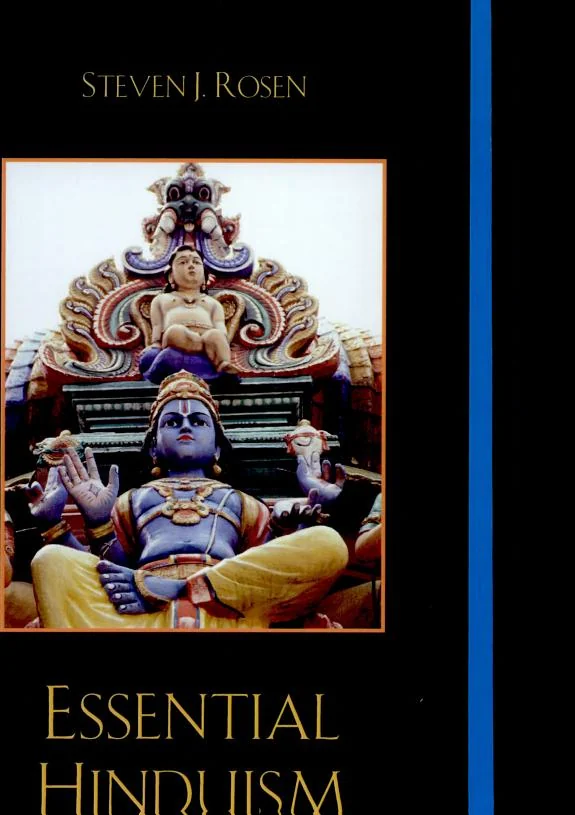
Essential Hinduism
 83
83

Essential Hinduism
Steven Rosen's Essential Hinduism presents a clear, if somewhat generalized, introduction to a vast spiritual landscape. The author’s focus on Vaishnavism provides a welcome anchor, preventing the book from becoming lost in the sheer breadth of Hindu traditions. Rosen effectively distills core tenets, making complex ideas accessible. For instance, his explanation of the concept of *guru* and its role in spiritual transmission is particularly lucid. However, the work occasionally feels more like a textbook summary than an exploration driven by deep personal engagement, lacking the nuanced philosophical debates that characterize some other scholarly works on the subject. While it covers the essentials admirably, it sometimes sacrifices depth for breadth. The book serves as a competent primer, but readers seeking esoteric interpretations or the subtle devotional nuances may need to look further.
📝 Description
83
Steven Rosen's Essential Hinduism, published in 2008, examines the Hindu traditions with a focus on Vaishnavism.
This 2008 volume presents a broad view of Hindu traditions, covering their diverse teachings, beliefs, practices, and history. The author places particular emphasis on Vaishnavism, a major branch of Hinduism, using it as a focal point to explain its core philosophies and devotional aspects. The book is designed for students of comparative religion, those interested in South Asian spirituality and philosophy, and individuals seeking to grasp the basics of a long-standing world religion. It suits readers who prefer a clear, organized method for learning about complex spiritual systems. Rosen traces the historical growth of Hindu thought and practice through the centuries, from its ancient Vedic origins to its modern forms. He points out significant eras and developments that have defined Hinduism's character and its influence worldwide. The text covers fundamental ideas like dharma, karma, samsara, and moksha. It also discusses the Hindu deities, important texts such as the Bhagavad Gita, and the function of gurus and spiritual lineages in passing down knowledge.
Essential Hinduism delves into the devotional and philosophical currents within Hinduism, particularly within the Vaishnava tradition. This focus aligns with esoteric studies that examine the inner workings of religious systems, their mystical interpretations, and the paths to spiritual realization. The book touches upon concepts like liberation (moksha) and the transmission of spiritual knowledge through lineages, which are common threads in esoteric traditions seeking direct experience or gnosis beyond exoteric dogma. By examining the structured theology and practice of a major Hindu sect, Rosen offers a gateway to understanding the deeper layers of spiritual pursuit within a major world religion.
💡 Why Read This Book?
• Gain a foundational understanding of Vaishnavism, the dominant Hindu tradition, by examining its core deities like Vishnu and Krishna, and its specific devotional practices as detailed in sections focusing on puja and mantra recitation. • Grasp the interconnected concepts of dharma, karma, and samsara, understanding how these principles shape the Hindu worldview and ethical framework, as presented through Rosen's clear explanations. • Appreciate the historical development of Hindu thought, tracing its lineage from ancient origins to the 2008 publication date, providing context for its enduring global influence.
⭐ Reader Reviews
Honest opinions from readers who have explored this book.
❓ Frequently Asked Questions
What is Vaishnavism and why does Essential Hinduism focus on it?
Vaishnavism is the largest sect of Hinduism, primarily worshipping Vishnu and his avatars, such as Krishna and Rama. Steven Rosen focuses on it due to its widespread practice and significant theological contributions, offering a manageable entry point into Hinduism's complexity.
What are the key philosophical concepts covered in Essential Hinduism?
The book details fundamental Hindu philosophical concepts including dharma (righteous conduct), karma (action and reaction), samsara (the cycle of birth and death), and moksha (spiritual liberation from this cycle).
When was Essential Hinduism first published and by whom?
Essential Hinduism was first published on May 16, 2008. The author, Steven Rosen, is known for his work in comparative religion and esoteric studies.
Does the book discuss Hindu deities and their significance?
Yes, Essential Hinduism explores the Hindu pantheon, with a particular emphasis on the deities central to Vaishnavism, such as Vishnu, Lakshmi, Krishna, and Rama, and their roles in worship and mythology.
What historical periods does the book touch upon regarding Hindu traditions?
The work broadly covers the historical trajectory of Hindu traditions, acknowledging their ancient Vedic roots and tracing their evolution through various eras up to the early 21st century, providing a sense of continuity.
Is Essential Hinduism suitable for complete beginners to Hinduism?
Yes, the book is structured to serve as an introduction, making its explanations of beliefs, practices, and history accessible to readers who have no prior knowledge of Hinduism.
🔮 Key Themes & Symbolism
Vaishnavism's Centrality
The work dedicates significant attention to Vaishnavism, the tradition centered on the worship of Vishnu and his avatars, most notably Krishna and Rama. This focus highlights the theological and devotional aspects that make it the most widespread form of Hinduism. Rosen examines the relationship between the devotee and the divine, exploring concepts like *bhakti* (devotional love) and the significance of divine grace. The emphasis on Vishnu as the supreme deity and the role of his consorts, like Lakshmi, are presented as central pillars of this particular path.
The Cycle of Existence
A core theme is the Hindu understanding of the cosmos and individual existence, particularly the concepts of *samsara* and *karma*. Samsara, the continuous cycle of birth, death, and rebirth, is presented as the fundamental condition of unenlightmented beings. Karma, the law of cause and effect governing actions and their consequences across lifetimes, dictates the nature of one's rebirth. The ultimate goal, *moksha*, the liberation from this cycle, is explored as the supreme spiritual attainment, achievable through various paths.
Dharma and Righteous Living
The concept of *dharma* is explored as a core part of Hindu ethics and social order. It encompasses one's duty, righteousness, moral law, and the inherent nature of things. Rosen explains how dharma is not a static set of rules but is often context-dependent, varying based on one's social role, stage of life, and individual disposition. Adhering to one's dharma is presented as crucial for maintaining cosmic balance and progressing spiritually, contributing to positive karma and a better rebirth.
Spiritual Authority and Practice
The importance of spiritual guidance is a recurring motif, with emphasis on the role of the *guru*. The book outlines how gurus serve as preceptors, transmitting esoteric knowledge and guiding disciples on their spiritual path. Practices such as *puja* (worship), chanting of mantras, and meditation are described as essential tools for spiritual development and connecting with the divine. The structured nature of these practices underscores the methodical approach within Hindu traditions.
💬 Memorable Quotes
Direct passages from the work, attributed to the author.
“Dharma encompasses duty, righteousness, and the inherent nature of things.”
— This concise statement captures the complex nature of dharma, a central concept in Hinduism. It signifies not just moral conduct but also one's societal role and the underlying order of the universe.
“The cycle of samsara continues until moksha is achieved.”
— This highlights the ultimate spiritual objective in Hinduism: liberation from the endless cycle of birth, death, and rebirth (samsara). It underscores the urgency and significance of the spiritual quest.
“Vaishnavism focuses on devotion to Vishnu and his avatars.”
— This accurately identifies the primary deity and devotional orientation of Vaishnavism, explaining its distinction within the broader Hindu landscape and its emphasis on a personal, loving relationship with God.
“Karma dictates the consequences of actions across lifetimes.”
— This interpretation clarifies the law of karma, explaining its transmigratory nature. It emphasizes that present circumstances are linked to past deeds, and future outcomes are shaped by current actions.
“The guru plays a vital role in spiritual guidance.”
— This points to the tradition of spiritual mentorship in Hinduism, where a qualified teacher (guru) is essential for navigating complex spiritual teachings and practices effectively.
🌙 Esoteric Significance
Tradition
While *Essential Hinduism* primarily serves as an introductory text to mainstream Hindu traditions, its exploration of concepts like mantra, guru lineage, and the pursuit of moksha touches upon aspects that resonate within esoteric lineages. Hinduism, particularly its Tantric and yogic branches, has profoundly influenced Western esoteric movements like Theosophy and various New Age philosophies. Rosen’s work, by detailing the source traditions, provides a foundational understanding for those tracing these influences back to their origins, offering a glimpse into practices that have been adapted and reinterpreted in Western occultism.
Symbolism
Key symbols like the Om (Aum), the lotus flower, and the conch shell are implicitly present in discussions of Hindu practice and iconography. Om represents the primal sound of creation and the ultimate reality, Brahman. The lotus, growing untainted from mud, symbolizes purity, spiritual enlightenment, and detachment. The conch shell, often blown in temples, signifies the call to spiritual awareness and the victory of good over evil, embodying the sacred sound that pervades the universe.
Modern Relevance
Contemporary spiritual seekers and practitioners of yoga and meditation often engage with Hindu concepts without a deep understanding of their origins. Rosen's work provides essential context for these modern engagements, clarifying the philosophical underpinnings of practices frequently adopted in the West. Thinkers and communities interested in comparative spirituality, or those seeking to decolonize their understanding of Eastern traditions from purely New Age interpretations, find value in such grounded introductions to the source material.
👥 Who Should Read This Book
• Students of comparative religion seeking a clear, structured overview of Hindu beliefs, practices, and history, particularly focusing on the Vaishnava tradition. • Individuals interested in understanding the cultural and philosophical foundations of South Asia, looking for an accessible entry point beyond popular superficial treatments. • Spiritual explorers curious about the origins of practices like yoga and meditation, wishing to connect with the deeper theological and philosophical context from which they emerged.
📜 Historical Context
Published in 2008, Steven Rosen's *Essential Hinduism* arrived at a time when global interest in Eastern religions was well-established, yet accessible, scholarly introductions remained valuable. The intellectual currents of the late 20th and early 21st centuries saw a continued academic engagement with Vedic traditions, alongside a popular fascination with yoga and meditation, often divorced from their religious roots. Rosen’s work aimed to bridge this gap by offering a structured overview. While the book doesn't engage directly with major contemporary debates or figures like Wendy Doniger or Diana Eck, its focus on Vaishnavism acknowledges the dominance of this tradition, which has historically been a significant force, contrasted with the philosophical schools of Advaita Vedanta, for example. The reception of such introductory texts typically involves their utility for students and general readers rather than critical academic discourse.
📔 Journal Prompts
Reflect on the concept of *dharma* as presented in the text and its personal application.
Consider the role of *bhakti* in Vaishnavism and how devotion is expressed.
Analyze the relationship between *karma* and *samsara* as described.
What is the significance of the *guru* in the transmission of Hindu teachings?
Explore the ultimate goal of *moksha* and its implications for life's pursuits.
🗂️ Glossary
Vaishnavism
A major tradition within Hinduism that worships Vishnu as the supreme God. It encompasses diverse philosophies and practices centered on devotion to Vishnu and his avatars, such as Krishna and Rama.
Dharma
A foundational concept in Hinduism, encompassing righteousness, duty, moral law, ethics, and the inherent nature of reality. It guides individual conduct and societal order.
Karma
The spiritual principle of cause and effect, where actions (karma) influence the destiny of the individual across lifetimes. Good deeds lead to positive consequences, and negative deeds lead to suffering.
Samsara
The continuous cycle of birth, death, and rebirth, driven by karma and ignorance. It is considered the fundamental state of existence from which liberation is sought.
Moksha
Liberation or release from the cycle of samsara. It is the ultimate spiritual goal in Hinduism, representing spiritual freedom and union with the divine.
Guru
A spiritual teacher or master who guides disciples on the path to enlightenment. The guru is highly revered for their wisdom and direct experience of spiritual truths.
Puja
A ritualistic worship performed by Hindus to honor deities. It typically involves offerings, prayers, chanting, and symbolic gestures, often conducted in homes or temples.
This book appears in 1 collection
🔮 Readers Also Liked
Browse all →








From the “Hinduism” Collection
View all →





More Free Occult Philosophy Books
View all →