Testimony of light
 81
81

Testimony of light
Helen Greaves's Testimony of Light presents an extraordinary, if challenging, account of the afterlife. The sheer detail with which Greaves describes the spiritual planes, the organization of spirit societies, and the process of 're-orientation' after death is remarkable. One particularly striking aspect is the systematic explanation of how spiritual progress is achieved, moving beyond simple notions of heaven and hell to a more nuanced understanding of soul evolution. However, the book’s strength—its detailed exposition—can also be a limitation; the sheer volume of information and the consistent tone can feel overwhelming to a reader not already predisposed to its worldview. The passage discussing the 'Workings' in the spirit world, where individuals contribute to the collective spiritual advancement, offers a compelling vision of continued purpose. While presented as direct experience, the text requires an open mind to accept its premises. It offers a structured vision of what lies beyond, for those willing to look.
📝 Description
81
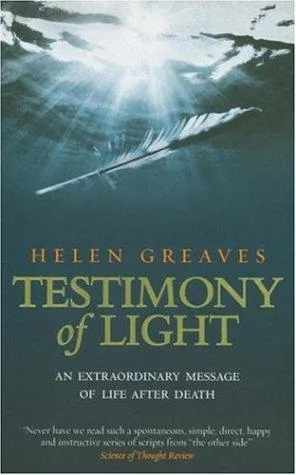
Helen Greaves's 1993 book Testimony of Light details her experiences in the afterlife.
Testimony of Light is a spiritual autobiography that describes the author's observations after death. First published in 1993, it lays out the spiritual realms, their inhabitants, and the development that occurs after Earthly life. Greaves presents a structured account of existence beyond the physical body, emphasizing that consciousness and purpose continue. The book is aimed at those who want a clear, detailed spiritual view of life after death. It will interest people curious about mediumship, spiritualism, and consciousness outside the body. Readers dealing with grief, seeking reassurance about continued existence, or investigating claims of spirit communication will find it particularly valuable.
The text discusses spiritual progress through different planes of existence, the function of spiritual guides, and the nature of spiritual bodies. It also considers the purpose of life on Earth as preparation for what follows. Greaves addresses how spiritual communication works, the growth of psychic abilities, and the ethical rules for interactions between the physical and spiritual worlds. The book suggests a universe where life is governed by specific principles.
Emerging in the early 1990s, this work builds on the traditions of 19th and early 20th-century Spiritualism and Theosophy. While not a direct academic argument, it contributes to discussions about consciousness surviving death and potential communication with non-physical beings. Greaves's detailed descriptions echo earlier accounts from figures like Allan Kardec, yet she maintains her own narrative style and focus on personal experience.
💡 Why Read This Book?
• Gain a structured understanding of the afterlife and spiritual progression, as detailed in Greaves's account of the spirit realms post-1993 publication, offering a coherent framework for existence beyond physical death. • Explore the concept of spiritual guides and the mechanics of inter-dimensional communication, providing specific insights into how these interactions are described within the spiritualist tradition. • Examine the purpose of earthly life as preparation for the next stage, learning about the ethical laws and continuous development central to the spiritual journey presented in the book.
⭐ Reader Reviews
Honest opinions from readers who have explored this book.
❓ Frequently Asked Questions
What is the primary focus of Helen Greaves's Testimony of Light?
The book's primary focus is a detailed, first-hand account of the afterlife and the spiritual realms experienced by the author after physical death, first published in 1993.
Who is Helen Greaves and what is her background?
Helen Greaves was an individual who claimed direct experience and communication with the spirit world, authoring 'Testimony of Light' to share her extensive observations of post-mortem existence.
When was Testimony of Light first published?
Testimony of Light was first published in 1993, offering a comprehensive spiritual perspective during a period of continued interest in parapsychology.
What kind of spiritual concepts are explored in the book?
The book explores spiritual progression, the nature of spiritual bodies, the function of spiritual guides, and the ethical laws governing existence in the non-physical realms.
Does the book discuss reincarnation?
While the book emphasizes continuous spiritual development and progression through different planes, its primary focus is on the immediate post-death experience and subsequent spiritual evolution rather than explicit cycles of reincarnation.
Is this book suitable for beginners in esoteric studies?
Yes, the book provides a comprehensive and structured overview of spiritual concepts related to the afterlife, making it accessible to those new to esoteric literature seeking detailed explanations.
🔮 Key Themes & Symbolism
Structure of the Spirit World
Testimony of Light offers an intricate map of the non-physical existence. Greaves details numerous planes of consciousness, each with its own environment, inhabitants, and purpose. These realms are not static but are structured environments where souls undergo spiritual progression. The book describes how individuals are guided to appropriate environments based on their spiritual development and needs, illustrating a universe governed by order and developmental laws rather than arbitrary judgment.
Spiritual Guides and Helpers
A central theme is the presence and function of spiritual guides. Greaves portrays these entities as highly evolved beings dedicated to assisting souls in their transition and ongoing development. The book explains how communication with these guides occurs and the crucial role they play in education, healing, and integration into the spiritual community. This concept underscores the idea that no soul is left to read through the afterlife unaided.
Continuity of Consciousness and Purpose
The work strongly asserts that consciousness persists after physical death, and with it, a sense of purpose. Greaves describes how individuals retain their identity, memories, and capacity for growth. The afterlife is presented not as an end, but as a continuation of an evolutionary journey, where earthly experiences are understood and integrated, and new opportunities for learning and service become available. This reinforces a view of life as an unbroken spiritual process.
Spiritual Development and Work
Greaves emphasizes that spiritual growth is an active, ongoing process in the afterlife. She details the 'Workings' undertaken by spirits, which involve contributing to the well-being of the spiritual realms and assisting others. This aspect highlights a philosophy of service and co-creation, where individual development is intrinsically linked to collective progress. The book presents a dynamic spiritual existence focused on learning, contribution, and mutual support.
💬 Memorable Quotes
Direct passages from the work, attributed to the author.
“The essential fact is that we are never alone.”
— This statement expresses the book's core message of constant spiritual support and connection. It suggests that even after physical death, individuals are surrounded by benevolent presences and guided throughout their journey.
“The spirit world is governed by laws as definite as those of the physical world.”
— This highlights the ordered nature of the afterlife as described by Greaves, countering notions of chaos or arbitrary divine intervention. It implies that understanding these spiritual laws is key to navigating and progressing in the non-physical realms.
“Earth life is a school, and the spirit world is the next stage of education.”
— This interpretation frames earthly existence as a preparatory phase for a broader, continuing education in the spiritual planes. It emphasizes the ongoing learning and growth that characterize the soul's journey.
“Our thoughts and feelings create our environment.”
— This points to the principle of manifestation and the power of internal states in shaping one's experience, even in the non-physical realms. It underscores personal responsibility for one's spiritual reality.
💡 Key Ideas
Editorial paraphrase of the work's core concepts — not direct quotes.
There is no death, only transition.
This paraphrased concept directly addresses the fear of death by reframing it as a natural passage. It emphasizes the continuity of life and consciousness beyond the physical form.
🌙 Esoteric Significance
Tradition
Testimony of Light aligns most closely with the Spiritualist tradition, particularly its emphasis on communication with the deceased and the existence of ordered spirit realms. It shares thematic elements with Theosophy regarding spiritual evolution and hierarchical planes but presents a more direct, autobiographical account rather than abstract philosophy. Unlike Kabbalistic or Gnostic traditions, its focus is less on divine emanations or cosmic redemption and more on the practicalities and progression of the individual soul post-mortem.
Symbolism
The book frequently employs the symbolism of light, representing spiritual illumination, knowledge, and the presence of higher consciousness. Another significant motif is the 'spiritual body,' often described as a more refined, luminous form of the physical body, symbolizing the soul's continued existence and evolving nature. The concept of 'planes' itself acts as a symbolic structure, representing stages of development and different vibrational frequencies within the cosmos.
Modern Relevance
Contemporary spiritual seekers, mediumship practitioners, and those exploring consciousness studies often reference Testimony of Light. Its detailed framework for the afterlife continues to inform discussions on spiritualism and personal spiritual development. Thinkers and communities focused on the continuity of consciousness and the potential for inter-dimensional communication find its systematic approach valuable, particularly in contrast to more fragmented or less detailed accounts.
👥 Who Should Read This Book
• Individuals grappling with grief or the loss of loved ones, seeking reassurance and a structured understanding of continued existence beyond physical death. • Students of Spiritualism and parapsychology interested in detailed accounts of mediumship, spirit communication, and the organization of the non-physical realms. • Seekers of esoteric knowledge who desire a comprehensive cosmology of the afterlife, offering insights into spiritual progression and the purpose of life from a non-material perspective.
📜 Historical Context
Published in 1993, Helen Greaves's Testimony of Light emerged during a period when esoteric and spiritualist literature continued to find an audience, albeit outside mainstream academic circles. The late 20th century saw a sustained interest in phenomena related to consciousness, near-death experiences, and mediumship, building upon the foundations established by movements like Theosophy and the Spiritualist churches in the 19th and early 20th centuries. While competing schools of thought such as reincarnationism gained prominence, Greaves's work offered a more structured, linear progression through specific spiritual planes, echoing some earlier Spiritualist narratives but with a unique level of detail. The book's reception was primarily within spiritualist and New Age communities, where its detailed descriptions of the afterlife were seen as authoritative. It contributed to the ongoing dialogue concerning the nature of existence beyond physical death, offering a specific cosmology that resonated with many seeking answers to existential questions.
📔 Journal Prompts
The concept of spiritual guides and their role in post-mortem existence.
Reflect on the described 'Workings' in the spirit world and their implications for service.
The structured nature of the spirit world as depicted in Testimony of Light.
Personal interpretation of 'light' as a symbol of spiritual evolution.
The transition from earthly life to the spiritual realms.
🗂️ Glossary
Spirit Planes
Distinct levels or areas of existence in the non-physical world, each characterized by specific vibrational frequencies, inhabitants, and purposes related to spiritual development.
Spiritual Guides
Highly evolved spiritual beings who assist souls in their transition, learning, and progression through the spirit realms, offering guidance and support.
Spiritual Body
The non-physical energetic form that houses consciousness after the death of the physical body, often described as luminous and capable of existing on various spirit planes.
Re-orientation
The process undertaken by a newly disembodied soul to adjust to its new state of existence, understand its surroundings, and integrate its earthly experiences.
Workings
Activities and services performed by spirits in the non-physical realms, contributing to the collective spiritual advancement and the well-being of the realms.
Spiritual Progression
The continuous process of learning, growth, and evolution that a soul undergoes throughout its existence, both in physical life and in the spirit realms.
Vibrational Frequency
The rate of oscillation of energy, believed to determine the level or plane of existence a spirit occupies and its interaction with other spiritual entities.
🔮 Readers Also Liked
Browse all →









More by Helen Greaves
All books →
More Free Occult Philosophy Books
View all →