Unser Christus

 75
75

Unser Christus
Constantin Brunner's "Unser Christus" is a bold, often jarring, re-examination of the figure of Christ, presented in 1921. Brunner eschews hagiography for a rigorous philosophical dissection, proposing Christ not as a singular historical savior but as an archetype of universal spiritual realization. His argument that the "Christ-principle" is an inherent divine potential within all humanity is compelling, especially when he contrasts it with the ossified religious structures that arose centuries later. The work is particularly effective in its critique of institutionalized religion, which Brunner argues obscures the direct, experiential path to spiritual truth. However, the text can be dense, requiring significant philosophical engagement. While Brunner's conceptual framework offers a powerful lens for understanding the symbolic dimensions of Christianity, his abstract approach sometimes leaves the reader yearning for more grounded, relatable examples of this "Christ-principle" in lived experience beyond the symbolic. The strength lies in its intellectual audacity and its challenge to conventional piety; its limitation resides in its demanding philosophical density. The passage discussing the ego's dissolution as a symbolic "crucifixion" is particularly striking for its psychological depth. Ultimately, "Unser Christus" serves as a profound philosophical treatise for those willing to undertake its rigorous intellectual demands.
📝 Description
75
Constantin Brunner's Unser Christus, published in 1921, reinterprets Christ not as a person, but as a universal archetype.
Published in 1921, Constantin Brunner's "Unser Christus" (Our Christ) offers a philosophical and symbolic reevaluation of the figure of Christ and his message. Brunner does not present a historical account or a devotional text. Instead, he posits "Christ" as an archetype, a universal symbol representing spiritual awakening and the innate divine potential within all people. The book scrutinizes the religious and social systems that have historically shaped and, in Brunner's view, often obscured the core of Christ's teachings.
This work is suited for readers interested in comparative religion, esoteric philosophy, and radical theology. It challenges conventional dogma and traditional interpretations of Christianity, focusing instead on the psychological and symbolic dimensions of the Christ mythos. Those seeking to integrate spiritual traditions with critical philosophical inquiry will find Brunner's perspective valuable. The text requires a degree of intellectual engagement and a willingness to consider unconventional viewpoints on fundamental spiritual narratives.
Emerging in the fertile intellectual climate of post-World War I Europe, "Unser Christus" aligns with a broader European trend of questioning established metaphysical frameworks. Brunner's work participated in a milieu influenced by thinkers who sought new symbolic languages for understanding existence, a spirit also seen in early psychological explorations of archetypes, such as those by Carl Jung. The book contributes to a period where comparative mythology and psychology were gaining prominence, offering a unique perspective on spiritual narratives distinct from orthodox religious dogma.
💡 Why Read This Book?
• Gain a philosophical framework for understanding "Christ" not as a historical figure, but as an archetypal principle of divine potential within human consciousness, challenging traditional religious interpretations. • Explore Brunner's critique of institutionalized religion, learning how established doctrines may obscure direct spiritual experience, a concept he elaborates on in his analysis of "Christ's" teachings. • Engage with the concept of ego-dissolution as a symbolic path to spiritual realization, mirroring the "crucifixion and resurrection" narrative as presented in "Unser Christus".
⭐ Reader Reviews
Honest opinions from readers who have explored this book.
❓ Frequently Asked Questions
What is the central thesis of Constantin Brunner's "Unser Christus"?
The central thesis is that "Christ" represents an archetype of divine potential within humanity, a principle of spiritual realization accessible to all, rather than solely a historical person. Brunner argues that institutionalized religion often obscures this immanent truth.
When was "Unser Christus" first published and what was the intellectual climate?
"Unser Christus" was first published in 1921. It emerged during a period of significant intellectual and spiritual ferment in Europe, following WWI, with growing interest in psychology, comparative religion, and alternative philosophical systems.
Does "Unser Christus" deny the historical existence of Jesus?
Brunner's focus is not on historical debate but on symbolic and philosophical interpretation. He reinterprets the Christ figure as an archetype, shifting emphasis from historical fact to the universal spiritual message and potential he symbolizes.
What does Brunner mean by the "Christ-principle"?
The "Christ-principle" refers to the inherent divine consciousness or spiritual potential within every individual. It represents the capacity for spiritual awakening, self-realization, and union with the divine, as embodied by the symbolic figure of Christ.
Is "Unser Christus" a religious text or a philosophical one?
It is primarily a philosophical and esoteric text that engages deeply with religious themes. Brunner uses the figure of Christ as a vehicle for exploring profound philosophical concepts about consciousness, spirituality, and the nature of reality.
What are the main criticisms Brunner levels against traditional Christianity?
Brunner criticizes traditional Christianity for its dogmatism, its emphasis on external authority, and its institutionalization, which he believes distracts from the direct, inner spiritual experience that the "Christ-principle" fundamentally represents.
🔮 Key Themes & Symbolism
Christ as Archetype
Brunner reframes "Christ" not merely as a historical figure but as a universal archetype – the "Christ-principle." This principle embodies the highest potential of human consciousness, the divine spark within. The work posits that this archetype represents an attainable state of spiritual perfection and realization, accessible through inner transformation rather than solely through faith in an external savior. This perspective aligns with broader esoteric traditions that view religious figures as symbolic representations of psychological and spiritual truths.
Critique of Institutional Religion
A central theme in "Unser Christus" is Brunner's sharp critique of organized religion, particularly the institutionalized forms of Christianity that emerged centuries after the figure of Christ. He argues that these structures, with their dogmas, rituals, and hierarchies, have often served to obscure and dilute the radical, liberating message of the original "Christ." Brunner contends that this institutionalization leads to a passive faith, hindering the direct, experiential connection to the divine that he advocates for.
Ego-Dissolution and Spiritual Realization
Brunner links the process of spiritual awakening to the dissolution of the ego. This concept is symbolically represented by the crucifixion and resurrection narratives associated with Christ. He proposes that shedding the limitations of the self-centered ego is essential for realizing the immanent "Christ-principle." This inner transformation, a form of "death" to the old self and "rebirth" into higher consciousness, is presented as the core of true spiritual practice, rather than external acts of worship.
Immanence of the Divine
The work strongly emphasizes the immanence of the divine within all beings. Brunner rejects dualistic views that separate the sacred from the mundane or the human from the divine. Instead, he asserts that the divine is present and accessible within each individual. The "Christ-principle" is the manifestation of this indwelling divinity, and spiritual growth is the process of recognizing and actualizing this inherent sacredness, leading to a unified experience of existence.
💬 Memorable Quotes
Direct passages from the work, attributed to the author.
“Christ is not a person, but a principle.”
— This statement captures Brunner's core argument: that the significance of "Christ" lies not in his historical biography but in his representation of a universal spiritual truth and potential inherent in all humanity.
“Dogma is the graveyard of living truth.”
— Brunner suggests that rigid, fixed doctrines (dogmas) stifle genuine spiritual understanding and experience. He implies that established religious systems often prioritize adherence to prescribed beliefs over the dynamic, evolving nature of spiritual insight.
“True salvation comes from self-realization, not external absolution.”
— This interpretation highlights Brunner's focus on internal transformation. He argues that liberation and spiritual fulfillment are achieved through understanding and actualizing one's own divine potential, rather than relying on external forgiveness or grace.
“The ego must be crucified to be resurrected.”
— This reflects Brunner's symbolic interpretation of Christian narrative. He equates the dissolution of the self-centered ego with the symbolic death of Christ, leading to a higher, spiritual consciousness represented by the resurrection.
💡 Key Ideas
Editorial paraphrase of the work's core concepts — not direct quotes.
The kingdom of heaven is within you.
This paraphrased concept reflects Brunner's emphasis on the immanence of the divine. He interprets the "kingdom of heaven" not as an external place but as an inner state of consciousness achievable through spiritual development.
🌙 Esoteric Significance
Tradition
Brunner's work engages with Western Esotericism, particularly its philosophical and psychological currents, rather than fitting neatly into a specific lineage like Hermeticism or Kabbalah. It shares with Gnosticism a suspicion of dogmatic religion and an emphasis on inner knowledge, but Brunner's approach is more overtly philosophical and less reliant on specific mythic narratives or cosmology. His focus on the "Christ-principle" as an immanent archetype can be seen as a modern, philosophical interpretation of universal spiritual truths often explored in various esoteric traditions.
Symbolism
Key symbols in "Unser Christus" include the figure of Christ himself, reinterpreted as an archetype of perfected humanity and divine potential. The concepts of crucifixion and resurrection are central, symbolizing the necessary dissolution of the ego (crucifixion) and the subsequent attainment of higher consciousness or spiritual awakening (resurrection). The "kingdom of heaven" is also re-symbolized as an internal state of being rather than an external afterlife.
Modern Relevance
Brunner's ideas continue to resonate with contemporary thinkers interested in comparative religion, radical theology, and esoteric psychology. His reinterpretation of Christ as an archetype and his critique of religious institutionalization find echoes in modern spiritual but not religious (SBNR) movements and in psychological approaches that explore the symbolic dimensions of religious figures. Philosophers and theologians seeking to reconcile spirituality with critical thought often revisit Brunner's challenging perspectives.
👥 Who Should Read This Book
• Students of comparative religion and mythology seeking non-traditional interpretations of major religious figures and narratives. • Philosophical readers interested in critiques of dogma and explorations of consciousness, particularly those who engage with early 20th-century continental philosophy. • Esoteric practitioners and scholars looking to understand the symbolic and psychological dimensions of Christian symbolism beyond orthodox theology.
📜 Historical Context
Constantin Brunner's "Unser Christus" emerged in 1921, a period marked by profound societal upheaval following World War I and a flourishing of diverse intellectual and spiritual movements. The early 20th century witnessed significant challenges to traditional religious and philosophical frameworks. Thinkers like Friedrich Nietzsche had already critiqued Christianity's societal impact, and a burgeoning interest in comparative mythology and psychology, exemplified by Carl Jung's work on archetypes, sought deeper symbolic meanings. Brunner's work fits within this milieu, offering a radical, philosophical reinterpretation of Christ that moved beyond orthodox dogma. The era also saw the rise of various esoteric societies and spiritual philosophies, such as Theosophy, which provided alternative spiritual frameworks. Brunner's approach, while unique, shared this broader cultural impulse to deconstruct and re-evaluate foundational myths and figures through a more critical, often psychological, lens.
📔 Journal Prompts
The Christ-principle as an inner potential: How does this concept challenge your current understanding of spiritual attainment?
Analyze the critique of dogma presented by Brunner in "Unser Christus". What forms does this "graveyard of living truth" take today?
Reflect on the symbolic meaning of ego-dissolution as described in the text. How might this relate to personal growth or spiritual practice?
Consider Brunner's distinction between an external savior and an internal "Christ-principle." What are the implications for personal responsibility in spiritual development?
How does Brunner's reinterpretation of "Christ" align with or diverge from other archetypal figures you have encountered in mythology or psychology?
🗂️ Glossary
Christ-principle
Brunner's term for the universal archetype of divine potential and spiritual realization inherent within all human beings, distinct from the historical figure of Jesus.
Ego-dissolution
The process of transcending or overcoming the limitations of the self-centered ego, seen by Brunner as a crucial step towards spiritual awakening and realizing the Christ-principle.
Dogma
Fixed, established beliefs or doctrines, which Brunner critiques as potentially hindering genuine spiritual understanding and direct experience.
Immanence
The philosophical concept that the divine is present within the material world and human consciousness, as opposed to being transcendent or external.
Archetype
A universal, primordial image, symbol, or pattern of behavior in the collective unconscious, which Brunner applies to the figure of Christ.
Spiritual Realization
The state of achieving profound spiritual understanding, enlightenment, or union with the divine, often through inner transformation.
Institutional Religion
Organized religious systems with established hierarchies, rituals, and doctrines, which Brunner often criticizes for obscuring direct spiritual experience.
🔮 Readers Also Liked
Browse all →








More by Constantin Brunner
All books →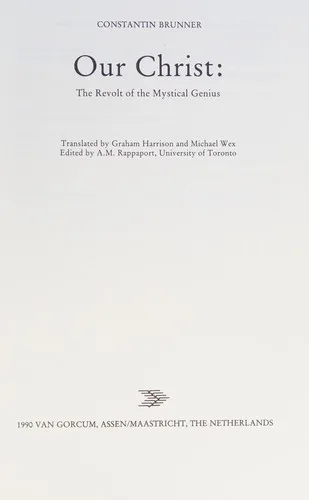
More Free Mysticism & Contemplation Books
View all →