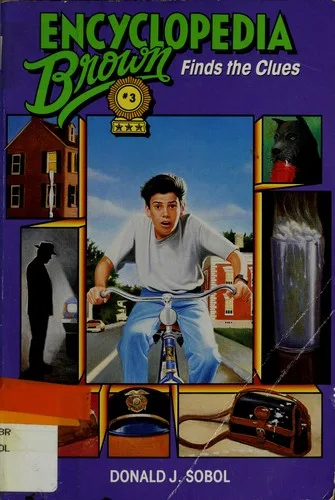
Encyclopedia Brown Finds the Clues
 72
72

Encyclopedia Brown Finds the Clues



By Aurelia Blackwood (Occult Philosophy Critic) — Donald J. Sobol's 'Encyclopedia Brown Finds the Clues' is a surprisingly potent text for those attuned to subtle energies. Beyond its juvenile facade lies a masterful exploration of deductive reasoning as a form of modern-day divination. Brown’s ability to perceive hidden connections and interpret omens in everyday occurrences mirrors the intuitive leaps of seasoned practitioners. The book elegantly demonstrates how meticulous observation and pattern recognition are key to unlocking veiled truths, a fundamental principle in many esoteric traditions. It’s an invaluable tool for young minds training to see beyond the veil.
📝 Description
72
Donald J. Sobol’s 1965 book, Encyclopedia Brown Finds the Clues, uses children’s mysteries to teach symbolic reasoning.
This collection of mysteries, first published in 1965, presents young readers with cases solved by Encyclopedia Brown. Beyond simple deduction, the book frames problem-solving as a method of uncovering hidden knowledge and symbolic connections. Each short story requires careful attention to detail to reveal underlying patterns in seemingly unrelated events. The narrative suggests that astute observation can unlock secrets, drawing parallels between the investigative process and the understanding of deeper universal principles. It encourages honing intuition and perceiving subtle connections, much like an alchemical transformation of raw data into meaningful insight. The stories function as a primer on deciphering coded information, showing how ordinary events can reveal extraordinary truths when viewed through a specific lens.
While ostensibly a children's mystery series, the book's approach to problem-solving can be seen as a simplified model of hermetic principles. The emphasis on uncovering hidden connections and the idea that observation reveals deeper truths echoes alchemical and divinatory traditions. The act of solving a mystery becomes an allegory for transforming base perception into higher understanding, mirroring the hermetic quest for hidden knowledge within the mundane world. It suggests that the universe operates on discoverable patterns, accessible through focused attention and intuitive leaps.
💡 Why Read This Book?
This collection offers a unique gateway into the principles of discernment and pattern recognition, crucial for any student of the mystical arts. It reframes detective work as a form of applied divination, encouraging readers to develop sharp observational skills and intuitive leaps. Ideal for young seekers and adults looking to rekindle their capacity for insightful deduction.
⭐ Reader Reviews
Honest opinions from readers who have explored this book.
❓ Frequently Asked Questions
What esoteric principles are subtly embedded in Encyclopedia Brown's methods?
Brown's success lies in his acute observation of mundane details, mirroring the esoteric practice of finding profound meaning in everyday occurrences. His ability to connect disparate clues reflects the hermetic principle of 'As Above, So Below,' where universal patterns manifest in microcosm.
How does this book relate to the concept of divination?
Each case is a puzzle waiting to be solved through careful analysis, akin to interpreting omens or casting runes. Brown 'divines' the truth by meticulously examining the 'signs' left behind by perpetrators, demonstrating that truth is often revealed through patient investigation.
Is this book suitable for adults interested in esotericism?
Absolutely. While presented for young readers, the underlying principles of logical deduction, pattern recognition, and the pursuit of hidden knowledge are universally applicable and can be a charming introduction to analytical thinking within an esoteric framework.
What kind of symbolic language is used in the mysteries?
The 'language' is in the details: the placement of an object, a casual remark, a seemingly insignificant action. These become symbols that, when pieced together, reveal the underlying narrative and the hidden truth, much like deciphering symbolic texts in occult studies.
How can 'Encyclopedia Brown Finds the Clues' enhance one's intuitive abilities?
By encouraging readers to actively engage with the mysteries and make their own deductions, the book hones intuitive faculties. It teaches the importance of trusting one's insights when they are supported by logical evidence, a balance vital in esoteric practice.
🔮 Key Themes & Symbolism
The Art of Deductive Divination
This theme explores how Encyclopedia Brown's investigative techniques mirror ancient forms of divination. His meticulous observation of seemingly insignificant details—a misplaced object, a peculiar statement, a subtle inconsistency—becomes a form of reading the 'signs' of a situation. Each solved case is a evidence of the power of focused attention and logical inference, demonstrating that hidden truths are often revealed to those who know how to look beyond the surface. It's a primer on how perception itself can be a tool for uncovering the unseen, transforming the mundane into a source of useful insights, much like interpreting omens or consulting oracles.
Perception as Esoteric Insight
Fundamentally, the book champions the idea that true knowledge stems from keen perception. Encyclopedia Brown doesn't just see; he *perceives* the underlying patterns and connections that elude others. This mirrors the development of esoteric insight, where practitioners learn to discern subtle energies and hidden meanings invisible to the uninitiated. The stories encourage readers to cultivate a heightened awareness of their surroundings, understanding that the universe communicates through a collection of symbols and interdependencies. This theme highlights the transformative power of focused observation in unraveling life's enigmas.
The Unveiling of Hidden Truths
Each mystery presents a scenario where truth is obscured, much like secrets guarded by ancient wisdom traditions. Encyclopedia Brown acts as a guide, leading readers through the process of unveiling these hidden truths. The narratives emphasize that knowledge is not always readily apparent but requires active pursuit and the courage to question assumptions. This mirrors the alchemical journey of transformation, where raw, unrefined facts are meticulously processed and refined into pure understanding. The satisfaction derived from solving each case underscores the profound reward of seeking and discovering concealed wisdom.
💬 Memorable Quotes
Direct passages from the work, attributed to the author.
“"A good detective knows what to look for."”
— This highlights the importance of trained observation and knowing the 'language' of clues, akin to understanding symbolic language in esoteric studies.
“"The smallest detail can be the most important."”
— Emphasizes the esoteric principle of finding profound meaning in the seemingly insignificant, a central to many mystical traditions.
“"Everything fits together if you look hard enough."”
— Reflects the hermetic concept of interconnectedness and the belief that underlying order exists, waiting to be discovered through diligent investigation.
“"A puzzle is just a story waiting to be told."”
— Frames mystery-solving as a narrative unfolding, where perception and deduction reveal the hidden plot and ultimate truth.
“"The truth is always there, you just have to find it."”
— A fundamental tenet of seeker's journeys, suggesting that knowledge is accessible, requiring only the right method and dedication to uncover.
🌙 Esoteric Significance
Tradition
This work subtly aligns with the principles of Hermeticism and the Western Esoteric Tradition, particularly in its emphasis on 'As Above, So Below' and the power of observation to reveal hidden connections. The act of deduction mirrors the alchemical process of refinement, transforming raw data into pure truth. It promotes a mindset of seeking underlying order and symbolic meaning within the mundane, a hallmark of contemplative and divinatory practices.
Symbolism
The 'clues' themselves function as symbols, representing fragmented aspects of truth. The process of collecting and interpreting them mirrors the deciphering of ancient texts or astrological charts. The young detective, Encyclopedia Brown, embodies the archetype of the 'wise child' or the 'inner seer,' capable of piercing illusion. The seemingly ordinary settings become microcosms where universal laws of cause and effect are subtly illustrated.
Modern Relevance
In an age saturated with information, the ability to discern truth from falsehood, and to connect disparate pieces of data, is more critical than ever. 'Encyclopedia Brown Finds the Clues' offers a timeless lesson in critical thinking and mindful observation, skills that are essential for navigating complex modern life and for deepening one's understanding in any field, including esoteric studies. It encourages a proactive approach to seeking knowledge and truth.
👥 Who Should Read This Book
Young readers eager to develop their analytical skills will find this a delightful and empowering read. Aspiring detectives and puzzle enthusiasts will relish the challenge. Furthermore, individuals interested in the foundational principles of discernment, pattern recognition, and the subtle art of observation—key components in many esoteric disciplines—will appreciate its elegant simplicity. Scholars of children's literature and those exploring the intersection of logic and narrative will also find value.
📜 Historical Context
Published during the mid-20th century, a period marked by a burgeoning interest in deductive reasoning and analytical problem-solving, 'Encyclopedia Brown Finds the Clues' emerged in a literary landscape that valued intellectual agility. While ostensibly juvenile fiction, its enduring appeal lies in its elegant presentation of logic and observation, resonating with readers of all ages. The era saw a growing appreciation for the methodical approach to understanding the world, a sentiment that aligns with the nascent exploration of psychological and analytical frameworks that would later influence broader metaphysical thought. The simplicity of the presentation belies a deeper engagement with how we construct understanding from scattered fragments of information.
📔 Journal Prompts
Reflect on a time you noticed a small detail that revealed a larger truth. How did this feel?
If you were to approach your daily life as a mystery to solve, what 'clues' would you look for?
Consider a common object. What hidden meanings or symbolic interpretations can you uncover?
How can the skill of deduction be considered a form of modern-day divination?
What does it mean to 'see' beyond the obvious, and how can you cultivate this ability?
🗂️ Glossary
Deduction
The process of reasoning from one or more general statements to reach a logically certain conclusion. In this context, it's the central to solving mysteries.
Divination
The practice of seeking knowledge of the future or the unknown by supernatural means. Here, it's metaphorically applied to keen observation and logical inference.
Symbolism
The use of symbols to represent ideas or qualities. In the stories, everyday objects and actions often carry symbolic weight revealing hidden meanings.
Perception
The ability to see, hear, or become aware of something through the senses. It's about actively noticing and interpreting information, not just passively receiving it.
Enigma
A person or thing that is mysterious, puzzling, or difficult to understand. Each mystery presented is an enigma waiting to be unraveled.
This book appears in 3 collections
🔮 Readers Also Liked
Browse all →







From the “Tarot” Collection
View all →









More Free Divination & Tarot Books
View all →