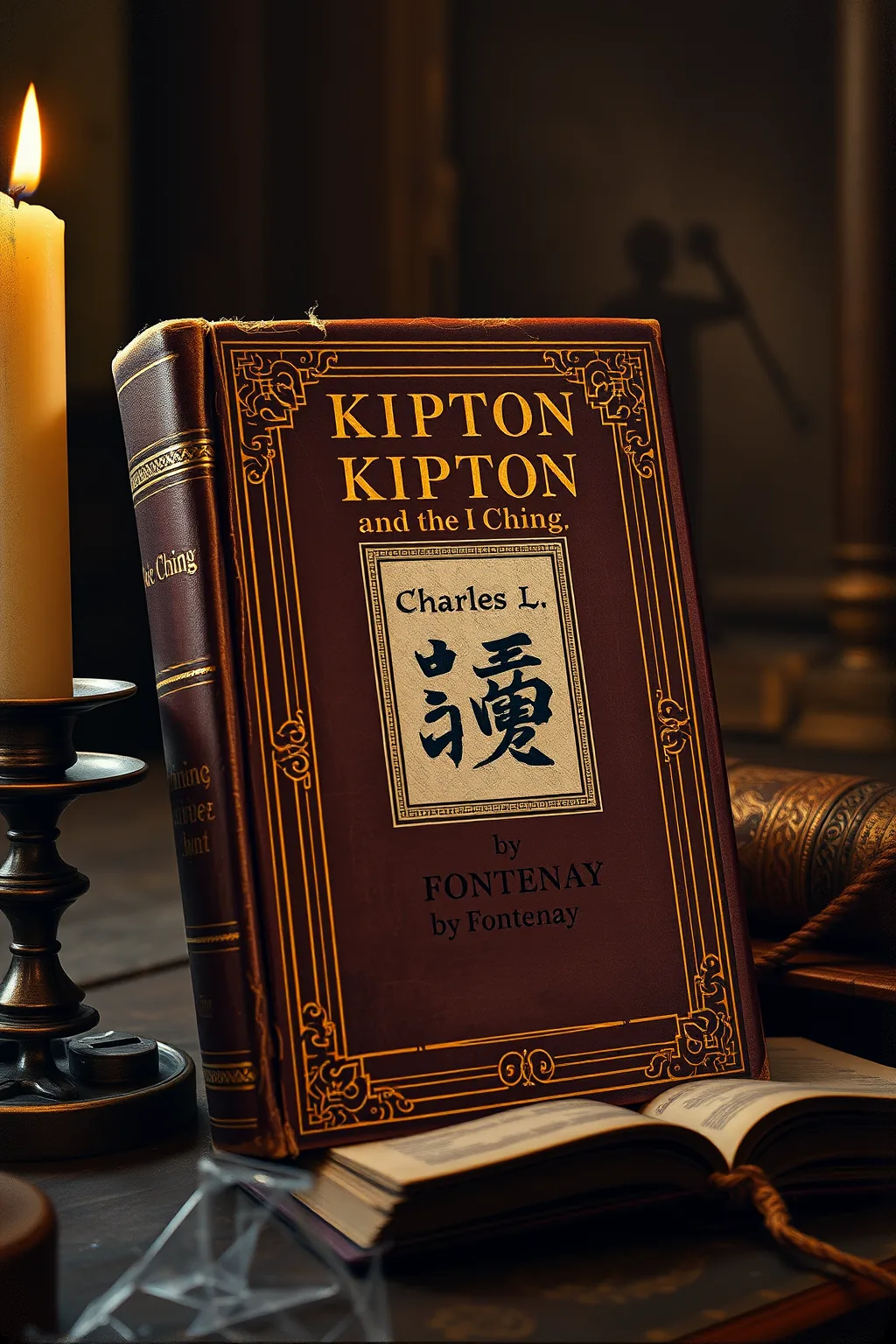
Kipton and the I Ching
 61
61

Kipton and the I Ching



Ophelia Vance, Mystical Literature Reviewer — 'Kipton and the I Ching' by Charles L. Fontenay is a remarkable fusion of speculative fiction and profound esoteric exploration. Fontenay's narrative skillfully integrates the wisdom of the I Ching into a gripping murder mystery, demonstrating the oracle's timeless relevance in understanding complex human motivations and cosmic order. The novel offers profound insights into pattern recognition, destiny, and the subtle interconnectedness of events, appealing to both seasoned practitioners of divination and curious minds drawn to philosophical depth. Its strength lies in its seamless blending of intellectual rigor and spiritual intuition, making it an essential read for those who seek to unravel the mysteries of existence through the lens of ancient wisdom.
📝 Description
61
Charles L. Fontenay's 1969 novel, 'Kipton and the I Ching,' integrates the ancient Chinese oracle into a science fiction narrative.
Set in 1969, Charles L. Fontenay's novel 'Kipton and the I Ching' places its protagonist, Kipton, in a world of scientific mystery and danger. Kipton finds himself entangled in a plot that involves potential assassination and complex scientific puzzles. The narrative uses the I Ching, the venerable Chinese oracle, not just for prediction but as a philosophical framework. It reveals connections between actions and their consequences, and the interconnectedness of events.
Fontenay combines elements of hard science fiction with esoteric concepts. The book creates a setting that engages the intellect while also touching on deeper questions of existence. It is written for readers interested in how ancient systems might influence our understanding of the universe and our place within it. The story prompts thought about destiny, personal choice, and the unseen forces that shape reality.
This novel engages with the I Ching, an ancient Chinese divination text and philosophical system. The I Ching, composed of 64 hexagrams, is traditionally used to understand cosmic patterns and guide decisions. Fontenay's work places this system within a speculative fiction context, suggesting its principles can offer insight into complex, future-oriented scenarios. It aligns with a tradition of esoteric literature that seeks to bridge ancient symbolic systems with contemporary or futuristic concerns, proposing that such frameworks hold enduring relevance for understanding human experience and universal order.
💡 Why Read This Book?
Embark on a journey where the ancient oracle of the I Ching becomes a key to unlocking a cosmic murder mystery. 'Kipton and the I Ching' offers a unique blend of science fiction intrigue and profound philosophical inquiry, perfect for seekers of hidden knowledge and practitioners of divination. Discover how timeless wisdom can illuminate modern enigmas and deepen your understanding of fate, causality, and the interconnectedness of the universe.
⭐ Reader Reviews
Honest opinions from readers who have explored this book.
❓ Frequently Asked Questions
What is the primary role of the I Ching in the story?
The I Ching functions as both a tool for Kipton's investigation and a philosophical framework, revealing patterns of causality and guiding his understanding of the complex events unfolding around him. It's integral to unraveling the mystery.
Is this book suitable for beginners interested in the I Ching?
While it is a work of fiction, the narrative provides an engaging and accessible introduction to the concepts and symbolic language of the I Ching, piquing curiosity for further study.
What makes this book unique compared to other science fiction novels?
Its uniqueness lies in the deep integration of a complex divination system with hard science fiction elements, creating a rich tapestry of intellectual and spiritual exploration.
Does the book offer practical advice on using the I Ching?
While not a practical guide, the novel demonstrates the interpretive power and symbolic depth of the I Ching, indirectly inspiring reflection on its application.
Who is Kipton?
Kipton is the protagonist, a character who must navigate a dangerous situation by consulting and interpreting the wisdom of the I Ching to solve a murder and uncover hidden truths.
🔮 Key Themes & Symbolism
The Oracle as a Cosmic Compass
This theme explores the I Ching's function beyond mere prediction, positioning it as a dynamic system of cosmic principles that mirrors the unfolding of universal patterns. The narrative examines how the hexagrams and their changing lines offer Kipton not just answers, but clear insights into the interconnectedness of actions, consequences, and underlying cosmic currents. It suggests that true wisdom lies not in foretelling the future, but in understanding the present moment's position within the grand set of existence, guiding one towards harmonious action.
Causality, Synchronicity, and Hidden Order
The novel masterfully ties themes of causality and synchronicity, proposing that events, even seemingly random ones, are part of a deeper, often unseen, order. Kipton's journey highlights how the I Ching can illuminate these connections, revealing the subtle threads that bind individuals and circumstances together. It challenges the reader to consider the universe not as chaotic, but as a complex, interconnected web where every element plays a role, and where apparent coincidences are manifestations of a profound, underlying intelligence.
The Intersection of Science and Esotericism
Fontenay brilliantly bridges the perceived divide between scientific inquiry and esoteric wisdom. The narrative posits that both disciplines, in their highest forms, seek to understand the fundamental nature of reality. The I Ching's ancient symbolic language is presented as a parallel system of knowledge that can complement, rather than contradict, scientific investigation, offering a holistic perspective on truth that encompasses both the tangible and the intangible aspects of existence.
💬 Memorable Quotes
Direct passages from the work, attributed to the author.
“Every change was a question, every answer a new path.”
— This reflects the dynamic nature of the I Ching and life itself, emphasizing that challenges and shifts are opportunities for growth and deeper inquiry, rather than static endpoints.
“In the pattern of the lines, he saw the shadow of the killer.”
— Illustrates the I Ching's predictive and analytical power, showing how its symbolic language can be applied to unravel complex mysteries and reveal hidden truths about human behavior.
“The universe breathed in riddles and exhaled destiny.”
— This evocative statement portrays the cosmos as a living entity, constantly posing questions and shaping the unfolding of fate through an intricate, perhaps unknowable, design.
💡 Key Ideas
Editorial paraphrase of the work's core concepts — not direct quotes.
The hexagrams whispered truths the stars had forgotten.
This quote poetically suggests that ancient oracular wisdom holds a deeper, more fundamental understanding of reality than even celestial observation, highlighting the profound and often overlooked power of esoteric systems.
Science sought 'how,' the Oracle sought 'why.'
This quote succinctly captures the complementary nature of scientific and esoteric approaches to understanding reality, suggesting that both are essential for a complete picture.
🌙 Esoteric Significance
Tradition
The novel is deeply rooted in the tradition of the I Ching (Book of Changes), an ancient Chinese divination system and philosophical text. It draws upon the I Ching's complex cosmology, its principles of Yin and Yang, and its understanding of the dynamic interplay of forces that govern the universe. This tradition emphasizes cyclical change, balance, and the interconnectedness of all phenomena, offering a profound framework for understanding life's mysteries.
Symbolism
Key symbols include the hexagrams, which represent archetypal situations and transformations; the lines (solid for Yang, broken for Yin), embodying fundamental cosmic energies; and the trigrams, combining to form the hexagrams, each associated with natural elements and familial roles. The novel uses these symbols to decode the narrative's mysteries, illustrating their power to represent complex concepts and guide interpretation, revealing hidden layers of meaning.
Modern Relevance
In a world often characterized by rapid change and perceived chaos, the I Ching's emphasis on pattern recognition, adaptability, and understanding underlying cosmic rhythms offers profound modern relevance. 'Kipton and the I Ching' showcases how these ancient principles can provide a framework for navigating personal and societal challenges, fostering a sense of order, and encouraging mindful decision-making. The novel highlights the enduring power of esoteric wisdom to offer insight and guidance in contemporary life.
👥 Who Should Read This Book
This novel is a compelling read for a diverse audience. **Seekers of esoteric knowledge** will find a rich exploration of the I Ching's philosophical depths woven into a captivating narrative. **Science fiction enthusiasts** will appreciate the intelligent blend of speculative concepts with ancient wisdom. **Practitioners of divination** will be intrigued by the novel's sophisticated portrayal of the I Ching's application. **Fans of mystery and detective stories** will enjoy the intellectual puzzle and suspense. **Scholars of comparative mythology and philosophy** will find it a thought-provoking piece that bridges disparate traditions.
📜 Historical Context
Published in an era where science fiction was increasingly exploring philosophical and societal themes beyond mere technological advancement, 'Kipton and the I Ching' emerged during a period of burgeoning interest in Eastern philosophies and esoteric traditions within Western culture. The late 20th century saw a growing curiosity about alternative ways of knowing and understanding the universe, spurred by counter-cultural movements and a desire for spiritual depth. Fontenay's work taps into this zeitgeist, demonstrating how ancient wisdom, like the I Ching, could be integrated into contemporary narratives, offering a unique perspective on mystery, destiny, and the human condition. The novel reflects a broader cultural fascination with systems of divination and their potential to provide meaning and guidance in an increasingly complex world.
📔 Journal Prompts
Reflect on a time when a seemingly random event led to a significant realization or turning point in your life. How did the concept of synchronicity play a role?
Consider a current challenge you are facing. If you were to consult the I Ching, what hexagram might represent your situation, and what advice could it offer?
Explore the idea of destiny versus free will. How does the I Ching's philosophy of change and interconnectedness inform your perspective on these concepts?
How does the interplay between the 'how' (science) and the 'why' (esotericism) contribute to a more complete understanding of the universe and our place within it?
Think about a complex situation where you had to decipher hidden meanings. What strategies did you employ, and how do they relate to the symbolic interpretation found in the I Ching?
🗂️ Glossary
I Ching
An ancient Chinese divination text and philosophical classic, also known as the Book of Changes. It comprises 64 hexagrams, each formed by combining two trigrams, used for divination and as a guide to understanding the dynamics of change.
Hexagram
A figure of six stacked horizontal lines used in the I Ching. Each hexagram represents a specific situation, process, or principle, formed by the combination of two trigrams.
Trigram
A figure of three stacked lines, each either solid (Yang) or broken (Yin). There are eight basic trigrams, representing fundamental elements and forces, which combine to form the 64 hexagrams.
Yang
In I Ching philosophy, Yang represents the active, masculine, light, and assertive principle of the universe, symbolized by a solid line (—).
Yin
In I Ching philosophy, Yin represents the passive, feminine, dark, and receptive principle of the universe, symbolized by a broken line (--).
This book appears in 3 collections
🔮 Readers Also Liked
Browse all →



From the “Tarot” Collection
View all →








More Free Divination & Tarot Books
View all →